Restaurant Franchise Financing

Restaurant Franchise Financing: Funding Options to Start & Grow Your Franchise

Home / Blog /
Restaurant Franchise Financing: Funding Options to Start & Grow Your Franchise

Read summarized version with

Restaurant franchise financing helps you cover the costs of opening or expanding a franchise, including franchise fees, equipment, renovations, inventory, and working capital.

It typically combines debt and equity, and the right mix balances speed of funding against long-term cost. The usual options are SBA loans, conventional bank loans, Rollovers for Business Startups (ROBS), equity investors, and your own cash.

The right choice depends on your startup costs, available capital, creditworthiness, and repayment capacity.

Before choosing a funding option, understand how much capital you need, what lenders expect, and how your repayments could affect day-to-day operations.

What You Will Learn

  • Restaurant franchise financing options for buyers
  • Factors that lenders look at when considering a restaurant franchise loan application and the lending process
  • Structure your financing so that it does not threaten your working capital
  • When to work with experts in the Industry versus dealing directly with banks

What Are the Main Options for Financing a Restaurant Franchise?

The main ways to finance a restaurant franchise are government-backed loans, private lending, and personal assets. 

Assessing funding readiness involves knowing your personal credit score, net worth, and available liquid assets. Franchise financing can range significantly, with some lenders providing options from $500,000 to $50 million, accommodating the growth of franchises over time. 

Know those three numbers before you approach anyone.

Funding options Examples What to know Best for
Government-backed loans SBA 7(a), SBA 504 loans 7(a) loans go up to $5 million, and 504 loans go up to $5.5 million. First-time and single-unit franchisees who want longer terms and a lower equity requirement.
Private lending Conventional bank loans, franchise lenders Cheaper cost of capital, with low origination costs. But banks typically require more money from the owner. Established operators with a proven financial track record who can put more of their own money in.
Equity investors Outside investors, family members No high upfront costs, but the investor takes a share of the business and its profit, which can make it the most expensive source of capital. Operators who want a valuable partner to support growth and lower upfront costs instead of more debt.
Personal assets Your own cash, Rollovers for Business Startups (ROBS) Cash keeps full control with no investors. A ROBS account rolls 401(k) funds into the business with no early withdrawal fees, penalties, or income taxes. Operators who want full control and no outside investors.

Small Business Loans and SBA Loans

For starters, small business loans, and specifically, SBA (Small Business Administration) loans, are some of the most popular means of financing that restaurant franchise owners seek out in America. 

The SBA doesn’t lend directly: it guarantees loans made by a private lender, and you always work with that lender, not the SBA. The two programs that matter most are 7(a) loans and 504 loan:

SBA 7(a) SBA 504
What is it? Financial assistance to small businesses Long-term, fixed-rate financing
Maximum loan $5 million $5.5 million
Use case Used for working capital needs, equipment, fixtures, real estate, and changes of ownership Used for major fixed assets such as land, buildings, and long-term equipment
Terms Up to 10 years for working capital, 25 years for real estate loans Fixed rate, with 10-, 20-, or 25-year maturities
How to apply? Through an SBA-approved local lender Exclusively through a Certified Development Company (CDC)

SBA 504 program suits large-scale asset purchases such as kitchen construction and real estate ownership. These loan programs require a strong personal credit rating, a detailed business plan, and proof that the franchising system has succeeded.

SBA Loans are partially guaranteed by the U.S. Small Business Administration, making them a top choice for startups due to lower interest rates and longer repayment terms. Long-term loans (like SBA or traditional) are suited for real estate or major build-outs, while lines of credit are useful for managing seasonal cash flow gaps. 

Because the SBA guarantees part of the loan, SBA loans are a top choice for startups. A lower equity requirement, typically 10%, and longer terms create lower monthly payments, which helps you preserve cash. Long-term loans (like SBA or traditional) are suited for real estate or major build-outs, while lines of credit are useful for managing seasonal cash flow gaps.

Hattan Bakor talks about the importance of having a strong foundation before franchising on the Restrocast podcast. According to him, one of the most important things in that foundation is your finances. He adds-

Hattan Bakor

INDUSTRY INSIGHT

The SBA 7(a) loan is the most versatile, covering franchise fees, working capital, and equipment up to $5 million. This loan program includes funds for working capital, equipment purchases, and real estate, and can be up to $5 million.

Equipment Financing and Franchisor Programs

Equipment financing is ideal for outfitting a commercial kitchen, where the equipment itself serves as collateral. Franchisor financing programs, meanwhile, may connect franchisees with preferred lenders or provide financing for specific startup expenses.

Equipment Financing

Equipment loans are designed to cover purchases such as commercial ovens, refrigerators, cooking ranges, and other kitchen equipment. The equipment often serves as collateral, which may make this financing useful for franchisees who want to spread setup costs over time.

Before applying, compare interest rates, down payment requirements, repayment periods, and fees. Also check whether the financing covers installation and delivery costs.

Quick service restaurants, especially, can benefit from equipment financing to reduce capital expenditures by $50,000 to $150,000. 

Franchisor Financing Programs

In some cases, franchisors may provide their own in-house financing arrangements or designated lenders to make the financing process smoother. The available support varies by brand and may cover specific expenses rather than the entire investment.

Ask the franchisor:

  • Which startup costs can the program cover?
  • Are there preferred lenders or negotiated terms?
  • What credit, financial, or franchise-specific requirements apply?
  • Can the financing be combined with an SBA loan or other funding?

Before choosing a franchisor financing program, review its terms in the Franchise Disclosure Document (FDD). The Federal Trade Commission requires Item 10 to disclose applicable direct and indirect financing arrangements, including what they cover, interest rates and fees, repayment periods, collateral, and potential liabilities upon default.

Restaurant Industry Financing Options: What Lenders Evaluate

Financing options

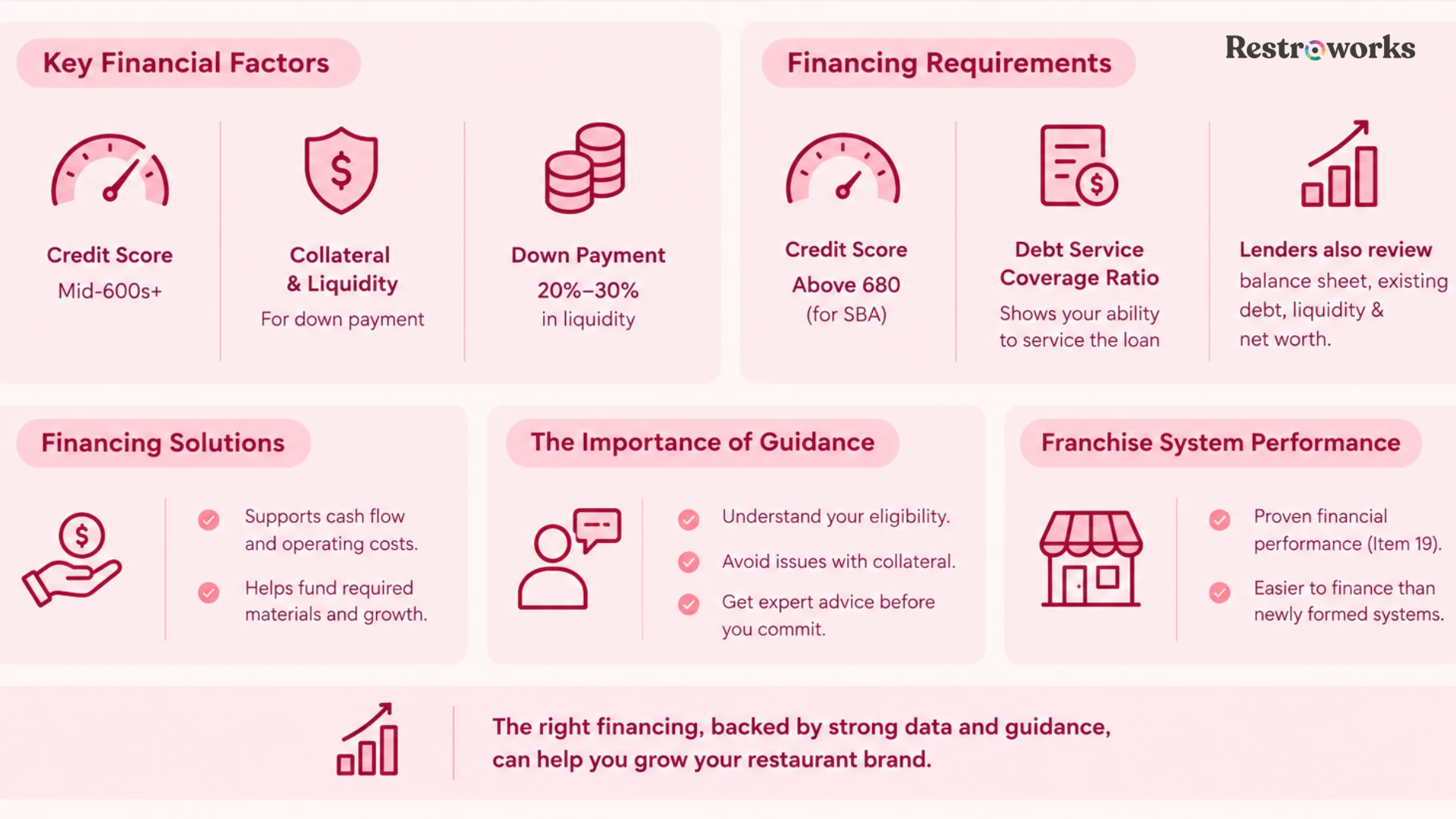
When evaluating a restaurant franchise financing application, lenders generally look for credit scores in the mid-600s, along with collateral and liquidity for the down payment. Financing companies offer several financing solutions designed for franchisees that can help with cash flow and costs.

Their requirements vary by lender, loan type, and the amount you want to borrow, so there is no single credit score or down-payment percentage that guarantees approval.

Key Factors Lenders Consider

Lenders review both your personal financial position and the restaurant’s ability to generate enough cash to repay the loan. Prepare the following information before applying:


Source: GovInfo
Evaluation factor What lenders look for What you should prepare
Credit history and score Your record of repaying personal and business debts, including any defaults or delinquencies Credit reports, details of existing loans, and an explanation of any past credit issues
Liquidity Cash available to fund the investment, cover the required equity contribution, and handle unexpected expenses Bank statements, proof of available funds, and a detailed startup budget
Existing debt Your current liabilities and assets Personal financial statements, balance sheets, and a schedule of business debts
Cash flow and debt repayment Projected cash flow and ability to cover operating expenses Revenue forecasts, expense estimates
Collateral Assets available to secure the loan Details of eligible business or personal assets
Restaurant or franchising experience Your management experience and understanding of restaurant operations A comprehensive, well-documented and researched business plan
Franchise performance The brand's operating history, financial disclosure Franchise Disclosure Document

Generally, most financing companies require 20%-30% of the total down payment amount in liquidity, a credit score above 680 to qualify for SBA financing, and a debt service coverage ratio that shows your ability to service the loan. 

Lenders also assess whether the restaurant can generate enough cash to cover its debt obligations. One measure is the debt service coverage ratio (DSCR), calculated by dividing the cash flow available for debt repayment by the required principal and interest payments.

For example, the SBA’s Standard Operating Procedures for its CAPLines program specify a minimum DSCR of 1.15 on a historical and/or projected cash-flow basis for that program. But this is a program-specific requirement, not a universal threshold for every SBA loan or commercial lender.

Franchise system performance is just as crucial. Financing companies that finance restaurant ventures know well which franchise systems are financially viable and which aren’t. Franchise systems with proven Item 19 financial performance are easier to finance than a newly formed one.

Before committing to a loan, consider asking a franchise financing specialist or accountant to review your projections, proposed debt, collateral exposure, and working capital needs. Professional advice can help you understand the risks, but only the lender can confirm its approval requirements and final terms.

Comprehensive Financing: Structuring Your Capital Stack

Franchise financing for restaurants typically involves multiple sources of funds, not just one loan. 

For example, a sound capital structure for a new quick-service restaurant franchise may include an SBA 7(a) loan for the franchise fee and build-out, financing for kitchen equipment and a POS system, and personal funds in the total investment required. This strategy will save working capital and minimize the personal funds needed.

Why Working Capital Should Be Part of Your Financing Plan

Working capital pays for the recurring expenses your restaurant incurs while sales build up, including payroll, rent, utilities, inventory, insurance, and marketing. Budgeting for these costs separately from construction and equipment helps prevent you from opening a restaurant that lacks the cash to operate.

Working capital is the financing area most entrepreneurs tend to ignore, but it can have the biggest impact on survival rates during the initial start-up phase.

The SBA recommends preparing detailed financial projections, including income statements, balance sheets, and cash-flow statements, to support funding requests. Its business planning guidance also recommends making the first year’s projections more detailed, using monthly or quarterly estimates.

Three to six months of operating costs can serve as an initial planning benchmark, but the amount you need will depend on your restaurant format, opening costs, expected sales ramp-up, and access to additional credit.

Use a monthly cash-flow forecast to identify when expenses may exceed incoming revenue, then arrange enough funding to cover that gap.

The goal is to finance the opening itself without using up the cash needed to run the restaurant afterward.

Franchise Team and Industry Experts: When to Get Professional Help

Involving experts in the field and the franchising industry, including a franchise lawyer, a CPA specializing in restaurant businesses, and a bank that provides franchise financing, can speed up the process and reduce the likelihood of structural errors that may negatively impact the business and the business model in the future.

Lenders specialized in franchise financing, who offer individual attention to franchise clients, understand how to analyze the franchise disclosure document, assess unit economics across markets, and have relationships with franchisors that can speed up approval.

In addition, these lenders understand the peculiarities of restaurant-industry capital markets.

KEY TAKEAWAYS

 

  • Restaurants are ideal candidates for structured financing, especially for franchises.
  • The bank will review your personal financial statement, the franchisee’s performance record, and the unit’s feasibility.
  • The biggest underfunded area is working capital; lack of funding for ramp-up operations is the main reason why a franchise fails during the first 18 months.
  • Industry professionals – specialized financiers, franchise lawyers, and experienced CPAs – minimize time and risk in financing for first-time franchise buyers.

Frequently Asked Questions

1. How hard is it to get a $1,000,000 business loan?

This depends on the borrower’s credit score, income, cash flow, collateral, and ability to repay the loan.

2. Can I get financing for a franchise?

Yes, franchisees can get financing from banks, SBA loans in the USA, franchisors, equipment leasing, or private lenders.

3. How much income do I need for a $500,000 business loan?

There is no fixed income requirement; banks evaluate the business’s cash flow, existing obligations, credit rating, collateral, and ability to repay the loan.

4. Why is it only $10,000 to open a Chick-fil-A?

The franchise fee for Chick-fil-A is $10,000 in the USA, and the company owns the restaurant’s real estate and equipment.


Newsletter subscription banner

Talk to a restaurant expert today and learn how Restroworks can help your business.

Request Demo >

Share

Discover More Insights to Power Your Journey

Rethinking Restaurant IT: Todd Kaufman on Technology as a Business Driver

Some of the most influential leaders in restaurant technology never set out to work in it, and Todd Kaufman, Chief…

POS
Best cloud-based restaurant POS
9 Best Cloud-Based Restaurant POS Systems in 2026

The best cloud-based restaurant POS system depends on how many locations you operate and how fast you plan to scale. Today,…

7 Best Cloud Kitchen Management Software in 2026

Whichever platform I (or anyone, for that matter) proclaim as the best cloud kitchen management software out there depends on…

Sharing the Love, One Taco at a Time: Eric Knott on Scaling TikiTaco the Right Way

Ask Eric Knott, CEO of TikiTaco, what business restaurants are really in, and you’ll get an answer that has evolved…

POS
Best Restaurant POS Software in Qatar
Best Restaurant POS Software in Qatar for Every Type of Restaurant

During a Friday dinner rush in Doha, the Talabat tablet at the pass is often where service breaks down: orders…

How to Start an Ice Cream Truck Business in the US

No other business out there can combine nostalgia with profit as well as an ice cream truck does. Like, it's…

Join. Learn. Grow.

Sign up to receive the latest hospitality insights and stories straight to your inbox

Streamline your operations with Restroworks