
The US quick-service restaurant industry is huge and highly competitive. Since restaurant owners operate under slim margins, there is very little room for mistakes. It only takes one mistake of any kind regarding demands, staffing, or stock inventory to eat up all profits.
This makes forecasting for quick-service restaurants crucial.
To put it simply, sales forecasting in the restaurant industry allows you to predict future income, number of patrons, and necessary resources. However, in the current world situation, forecasting goes beyond examining past sales figures and uses advanced technologies and analytics to support decision-making.
As noted by the National Restaurant Association, total US sales are expected to amount to $1.55 trillion. This makes forecasting vital since efficiency in business operations cannot be underestimated.
And if you are aiming for maximum profits, an enhanced customer experience, and business growth, then restaurant forecasting tool is a must-have nowadays.
What You’ll Learn
- How restaurant sales forecasting helps improve demand planning and daily operations
- Key data points and tools required to build an accurate forecast
- Practical ways to manage labor costs, inventory, and customer demand
- How modern technology and AI are transforming restaurant forecasting
What Drives Demand in the US QSR Market?

Understanding the factors that influence customer demand is the first step toward building an accurate forecast.
Key factors that impact restaurant sales
- Customer traffic patterns (breakfast rush, lunch peak, late-night dips)
- Seasonal trends like holidays and summer travel
- Local events such as sports games or concerts
- Weather conditions (rain can increase delivery orders)
- Promotions and limited-time offers
In reality, almost 78% of US customers visit a quick-service restaurant weekly. This is an enormous opportunity, yet also a problem, since there is always unpredictable demand that the restaurant owner must anticipate.
Why customer behavior matters
Modern customer behavior is shifting rapidly:
- More dependence on delivery apps
- Increase in takeout customers
- Increased demand for speed and convenience
If you don’t track these changes, it becomes harder to foresee sales or align your operations with actual demand.
What Makes Forecasting So Challenging for QSR Restaurant Owners?
Even seasoned restaurant owners and managers will struggle with forecasting, especially since quick-service restaurants operate at a fast pace with many things happening at once. While forecasting for other businesses may be straightforward, this is not the case for restaurants, given the industry’s high degree of complexity. Some of these challenges include:
- Over-reliance on historical data: While historical sales data is important, it often fails to reflect current market trends, changing customer trends, or sudden demand shifts.
- Fluctuating labor costs: Managing rising and unpredictable labor costs makes labor forecasting more complex, especially during peak and slow periods.
- Supply chain disruptions: Delays or shortages directly impact inventory needs, making inventory management and planning difficult.
- Promotions and discounts: Limited-time offers can distort sales volume, making it harder to predict sales accurately.
These variables contribute to making it difficult to match staffing requirements with demand. The lack of a formal process for forecasting may lead to an underestimation or overestimation of demand, resulting in unnecessary expenses and lower profits.
INDUSTRY INSIGHT
3. Inventory Forecasting
With accurate inventory forecasting, you can:
- Plan inventory needs
- Reduce waste
- Improve inventory management
4. Labor Forecasting
Labor is one of the biggest expenses in restaurants. Labor forecasting ensures:
- Optimal staffing levels
- Better control over labor budgets
- Reduced unnecessary labor costs
Traditional Forecasting vs. AI-Driven Forecasting: Which is better?
For years, restaurant owners relied on traditional methods for sales forecasting, but with changing customer trends and dynamic market conditions, these approaches are no longer sufficient. Today, modern tools are transforming restaurant forecasting by making it faster, more accurate, and data-driven.
Traditional Forecasting
The process is based mainly on previous results and requires manual analysis. Although it offers a foundation, it may not be flexible enough.
- Depends heavily on historical records and previous sales
- Utilizes spreadsheets and simple computations
- Cannot adapt quickly to abrupt fluctuations in consumer traffic
- Human error-prone and slow decision-making process
AI-Driven Forecasting
Sales forecasting in modern restaurants uses technologies that enable accurate predictions and real-time insights.
- Uses sales data in real time and external variables such as weather and events within the location
- Uses advanced forecasting methods in an attempt to enhance forecasting
- Assists in the prediction of sales with precision
- Allows better decision-making regarding staffing and inventory management
According to McKinsey, advanced analytics can improve demand forecasting accuracy by 20–50%. That’s a massive advantage in a low-margin industry.
What Data Do You Need for Accurate Forecasting?
An accurate forecast in restaurant forecasting depends entirely on the quality and variety of data you use. Relying on incomplete or outdated information can lead to poor decisions, while the right mix of data helps restaurant owners make informed decisions and improve overall restaurant operations.
Key data sources
To build strong restaurant sales forecasting, you need a combination of internal and external data:
- Historical sales and past sales trends: These provide a base to understand patterns and predict sales more effectively
- Daily and hourly sales data: Helps identify peak hours, slow periods, and fluctuations in sales
- Customer insights: Understanding footfall trends helps align staffing and inventory
- Promotions and discounts: These directly impact restaurant sales and should always be factored into forecasts
- External factors: Weather changes and market trends can significantly influence demand
Why external signals matter
Ignoring outside factors can lead to inaccurate planning:
- Unexpected demand can be caused by local happenings.
- Customers’ purchasing behavior is affected by seasonal changes.
- Market research aids in recognizing the changes and patterns.
By using accurate information, you will have realistic forecasts, enabling you to enhance your prediction skills and prepare for the unexpected demand.
How Does Forecasting Improve Sales and Profitability?
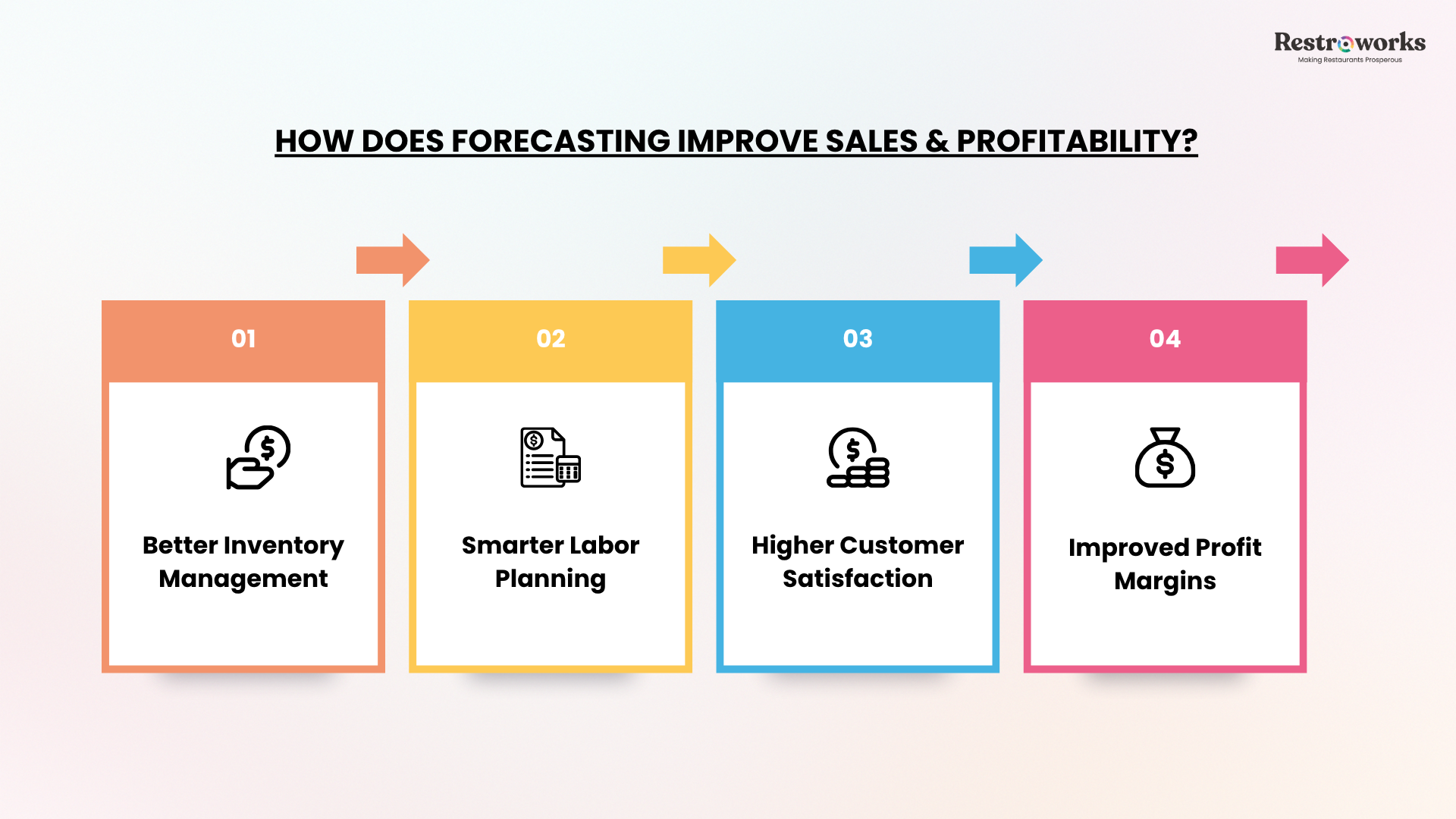
Good forecasting isn’t just about numbers; it directly impacts your profits.
1. Better inventory management
- Align stock with predicted demand
- Reduce waste
- Improve inventory projections
2. Smarter labor cost planning
- Optimize labor costs
- Avoid overstaffing during slow hours
- Improve staffing needs planning
3. Higher customer satisfaction
When customers expect fast service and menu availability, forecasting helps deliver that.
- Fewer stockouts
- Faster service
- Better service quality
4. Improved profit margins
Accurate restaurant forecasting helps:
- Control food costs and labor costs
- Reduce unnecessary expenses
- Protect profit margins
What Role Does Technology Play in Restaurant Forecasting?
Technology is rapidly reshaping how restaurant owners handle restaurant forecasting. Instead of relying only on manual methods, modern tools provide data-driven insights that help teams make faster and more informed decisions. This shift not only improves forecasting accuracy but also enhances overall restaurant operations and efficiency.
Key tools used today
Restaurants are highly relying on advanced systems to enhance their restaurant sales forecasting:
- Cloud-based POS systems:
POS systems capture real-time sales data, track actual sales, and provide visibility into customer trends. This helps build a more accurate forecast for daily operations. - AI-powered sales forecasting tools:
These tools use advanced forecasting models to analyze historical sales data, external factors, and customer trends. They deliver accurate forecasts for future sales, helping restaurants stay proactive. - Integrated inventory management systems:
These systems connect forecasting with inventory management, ensuring the right stock levels based on inventory needs and predicted demand, while also helping to reduce food waste.
By leveraging technology, restaurants can streamline their forecasting process, improve operational efficiency, and better align resources with real demand, ultimately driving stronger performance and profitability.
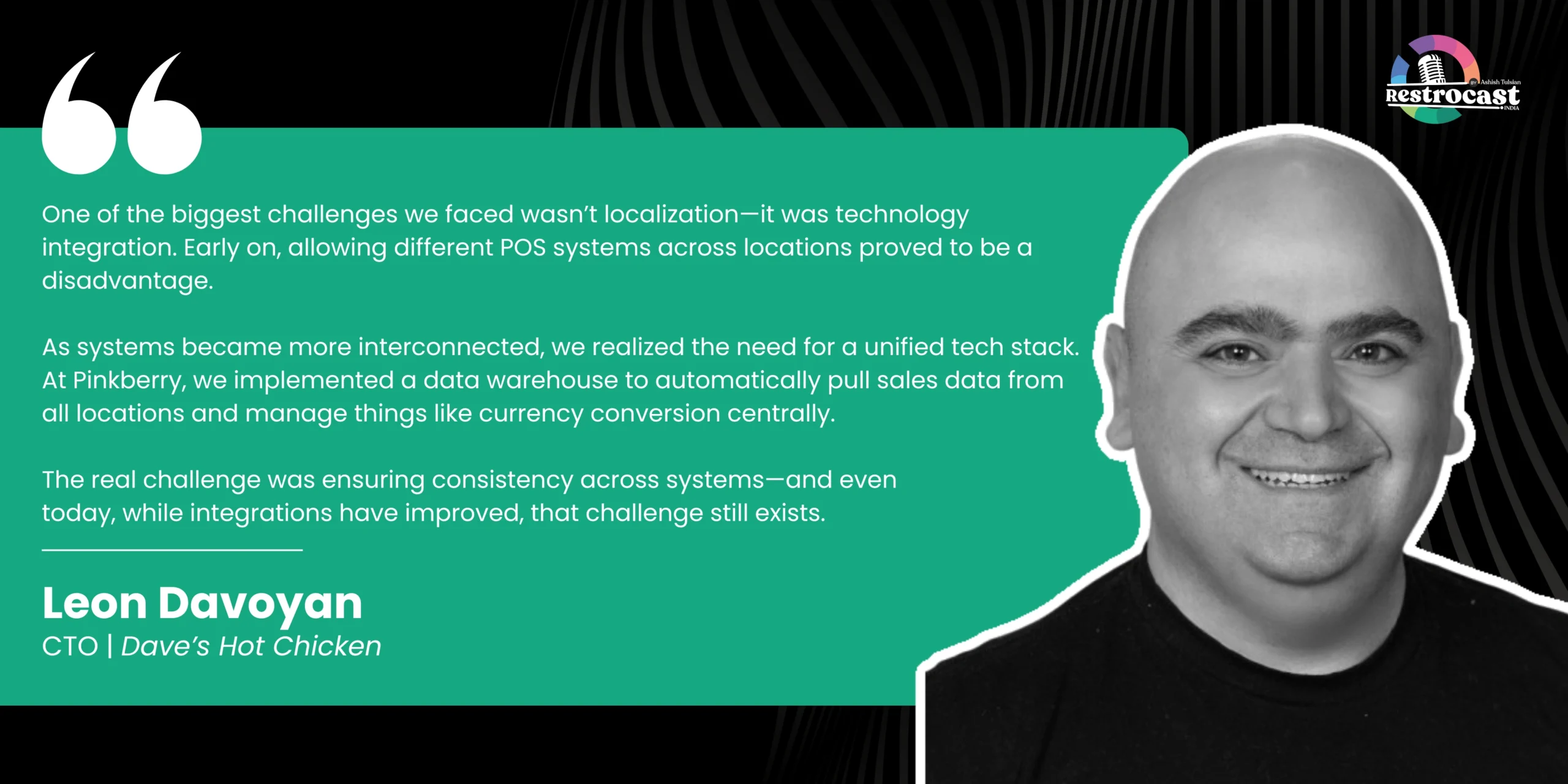
Recently, on Restrocast, Leon Davoyan, CTO at Dave’s Hot Chicken, shared his perspective on the growing importance of technology in the restaurant industry, especially when managing data, scaling efficiently, and making smarter decisions.
What Are the Best Practices for QSR Demand & Sales Planning?
Achieving accurate restaurant forecasting requires more than just tools; it depends on following the right approach. For restaurant owners, adopting proven best practices can significantly improve restaurant sales forecasting, reduce errors, and support better business growth.
Best practices to follow
- Combine past and real-time data:
While historical data and past sales provide a strong foundation, they don’t capture sudden changes. Blending them with real-time sales data and current trends helps create a more accurate forecast. - Forecast at a granular level:
Breaking down forecasts by hour, location, and menu item allows you to better predict sales, understand customer traffic, and plan inventory and staffing needs more precisely. - Update forecasts frequently:
Demand can shift quickly due to external factors. Regularly updating your forecast data ensures your planning stays aligned with actual demand. - Align forecasting with promotions:
Promotions and discounts can significantly impact sales volume and future sales, so they must be factored into your planning. - Use scenario planning:
Prepare for different situations, such as peak demand, slow hours, or unexpected spikes, to maintain flexibility and make more informed decisions.
Case Use Examples
Peak hour planning
During rush hours, accurate sales forecasting helps ensure the right staffing levels and sufficient inventory are met. This improves service speed, maintains customer satisfaction, and avoids missed sales opportunities.
Managing slow periods
Forecasting helps identify slow hours in advance, allowing restaurants to:
- Adjust staffing needs
- Reduce excess inventory orders
- Control rising labor costs
This ensures better cost management without affecting service quality.
Handling promotions
Promotions and limited-time offers can significantly impact future sales and sales volume. With proper planning, restaurants can align inventory and staffing with expected demand.
Delivery & takeout growth
With more takeout customers, forecasting must include:
- Delivery demand
- Packaging inventory
- Faster prep times
What Does the Future of Restaurant Forecasting Look Like?
The future of restaurant forecasting is moving towards being more predictive and instantaneous. With the evolution of technology, the owners are adopting techniques that can process information quickly and make accurate decisions by incorporating real-time factors into their forecasts. These technologies will assist businesses in achieving accurate forecasts and making informed decisions.
Emerging trends shaping the future
- AI-driven accurate predictions: Advanced tools use sales data and external inputs to deliver highly accurate predictions for future sales and customer demand.
- Real-time demand sensing: Instead of relying only on past trends, systems now adjust forecasts based on real-time data, helping align with actual demand instantly.
- Hyper-personalized offers: Forecasting is highly linked with customer preferences, enabling targeted promotions that boost restaurant sales.
- Automated inventory forecasting: Smart systems optimize inventory management, ensuring the right stock levels while helping to reduce food waste.
Restaurants that adopt proactive forecasting can identify trends early, respond quickly to changes in customer traffic, and consistently stay ahead of competitors, ultimately driving stronger growth and profitability.
How Can Forecasting Become Your Competitive Advantage?

At the end of the day, forecasting is about making better decisions.
When done right, restaurant sales forecasting helps:
- Predict how much revenue you’ll generate
- Plan staffing and inventory efficiently
- Improve overall financial management
It allows restaurant owners to:
- Make informed decisions
- Reduce costs
- Improve operational efficiency
- Drive business growth
The difference between struggling and thriving restaurants often comes down to one thing: how well they can forecast future sales and adapt to change.
In today’s QSR landscape, success is based on how well you can anticipate and respond to change. With that, sales forecasting for restaurants is important for helping restaurant owners remain flexible, control the cost of labor, and manage inventory more effectively.
It is possible to improve the sales forecast accuracy and ensure alignment with demand by analyzing historical data, gathering relevant information about the current sales, and using appropriate sales forecasting software. In addition to minimizing unnecessary expenditures and waste, this process also leads to increased customer satisfaction and higher standards of service delivery.
In a highly competitive environment, those restaurants that make use of data-driven sales forecasting will be in a better position in terms of making predictions and managing resources in a way that will bring profits in the long term.