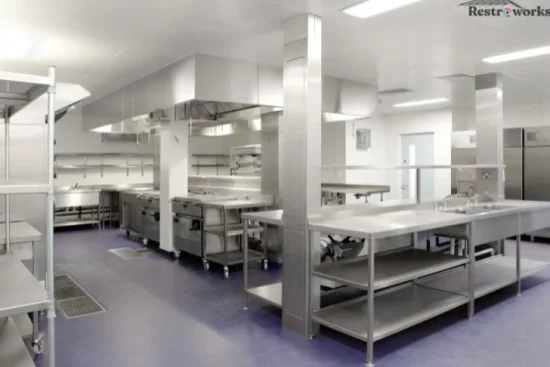


Just enter any restaurant during the weekday lunch hour, and you will find some empty seats. When you come back in the evening, you will find it filled with a long queue outside. It is such an unpredictable situation that is one of the biggest problems faced by the modern restaurant industry.
Even though the restaurant owners have decades of experience behind them, they often depend on the gut feel method or manually calculated data to schedule their day. However, in a highly competitive environment where even small mistakes can have serious consequences for the profit margin, wastage of raw material, and labor cost, an AI forecast is the way forward.
The application of artificial intelligence and data-based decision-making processes allows restaurants to predict customer turnout, reduce wastage, and optimize labor costs.
What You’ll Learn
- Advantages of AI-based forecasting vs. conventional forecasting
- Measures that eateries can adopt to minimize food waste and manage labor expenses
- Examples of how AI is being applied in QSRs, full-service dining establishments, and cloud kitchens
- Critical tools involved in forecasting and decision-making
What’s Wrong with Traditional Forecasting Methods?
For decades, restaurants have been relying on traditional forecasting methods, mainly based on historical sales data and manager intuition. While this approach worked in the past, it falls short in today’s dynamic environment.
Key limitations:
- Heavy dependence on historical data and past sales
- Inability to factor in external factors like the weather or local events
- Static models that don’t adapt to real-time changes
- Limited ability to predict future sales accurately
For example, a sudden rainstorm or a nearby concert can significantly impact customer demand. Traditional systems simply can’t process these external variables fast enough. As a result, restaurants often:
- Over-order inventory → leading to food waste
- Understaff shifts → hurting customer experience
- Miss revenue opportunities due to poor sales projections
What Is AI-Powered Forecasting in Restaurants?

At its core, AI-powered forecasting uses AI and predictive analytics to analyze data and generate more accurate demand forecasts. Modern restaurant forecasting tools bring these capabilities together in a single platform. Unlike traditional approaches, AI forecasting doesn’t just look at historical sales; it can analyze huge structured and unstructured data in real time. It combines:
- Historical sales data
- Weather forecasts and weather patterns
- Seasonal trends
- Local events
- Customer behavior and customer preferences
- Data from your pos system and existing systems
This allows restaurants to forecast demand more accurately and make data-driven decisions that align with actual demand.
How Does AI Improve Demand Forecasting Accuracy?
The real power of AI-powered forecasting lies in its ability to continuously learn and adapt.
1. Real-Time Data Processing
The AI model collects real-time data from different data sources, such as customer movement, climate, and events, and modifies the forecasts accordingly. If, for instance, it starts raining outside, causing fewer customers to visit, or there is a big event happening in the neighborhood, the AI changes the demand forecast immediately.
2. Pattern Recognition
AI excels at analyzing sales data to uncover patterns that are often missed by manual analysis. It can detect recurring behaviors, like weekend rush hours, holiday spikes, or slow midweek periods. By understanding these trends, restaurants can make more informed decisions around staffing, inventory, and promotions.
3. Continuous Learning
One of the most valuable aspects of AI forecasting is its ability to learn from every transaction. As new data flows in, the system refines its models, leading to continuous improvement in forecasting accuracy. Over time, this reduces errors and improves the reliability of predictions.
4. Predictive Capabilities
Whereas old methods concentrate on previous sales, AI technology assists restaurants in predicting their sales and needs in the future. The ability of AI to think ahead helps restaurants plan effectively.
What Benefits Can Restaurants Expect from AI Forecasting?
1. Can AI Help Reduce Food Waste and Food Costs?
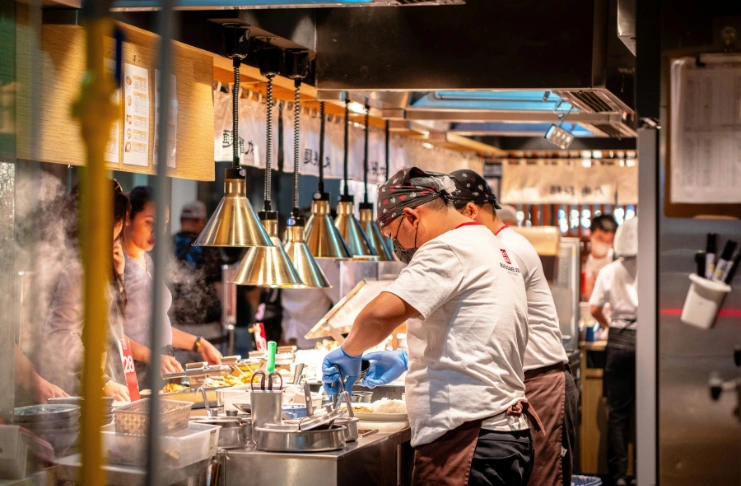
This is one of the biggest benefits of AI-powered forecasting. It helps in reducing food wastage. By aligning purchases with accurate predictions, restaurants can:
- Improve inventory management
- Avoid overstocking perishable items
- Minimize waste and control food costs
According to the U.S. Department of Agriculture, 30–40% of the U.S. food supply is wasted annually. Better forecasting directly helps tackle this issue.
2. How Does It Optimize Labor Scheduling and Costs?
In restaurant operations, labor is one of the highest expenses. With AI forecasting, restaurants can:
- Improve labor scheduling
- Align staffing with customer demand
- Enhance labor productivity
- Focus on managing labor costs
This leads to smarter resource allocation and avoids both overstaffing and understaffing.
INDUSTRY INSIGHT
What Tools Power AI Forecasting in Restaurants?
Modern restaurant forecasting software integrates multiple systems to provide accurate sales forecasts.
Common technologies include:
POS System Integrations
- Capture real-time transactions and historical sales data
- Help track customer demand and past sales trends
- Serve as the primary data source for AI forecasting
Inventory Management Platforms
- Support tracking inventory and stock levels
- Improve inventory management and reduce overstocking
- Align purchasing decisions with forecast demand
Cloud-Based Analytics Tools
- Allow restaurants to analyze large volumes of data within quick time frames.
- Integrate internal information along with external considerations such as weather trends and local occurrences
- Offer scalability options for expanding the restaurant business.
Machine Learning Algorithms (AI Technology)
- Power is the foundation for AI-based forecast solutions
- Learn from forecasts constantly and enhance forecasting capabilities
- Provide sales forecasts and assist with accurate sales forecasts
These tools work together to:
- Track and analyze huge amounts of forecast data
- Generate sales projections
- Support data-driven decision-making
What Challenges Should Restaurants Consider Before Implementing AI?
While AI adoption is changing the restaurant industry like never before, it also comes with a few practical challenges that restaurant operators must address before fully embracing it.
The main problem is the data quality. The accuracy of forecasts will depend on how correctly the sales were calculated historically. If the data are not comprehensive enough, this may cause problems in forecasting. Another problem is system integration. Usually, there are many different systems that are used in the restaurant; integrating them with the new AI system will require a lot of time and effort.
Another important aspect is costs. To start working with the AI system for forecasting, it is necessary to invest in tools, infrastructure, and, possibly, the forecast restaurant software. Staff training is another vital step. Without it, employees will not understand the system well enough to apply it in practice.
Implementing artificial intelligence for forecasting in the restaurant industry requires a business strategy and a phased implementation process.
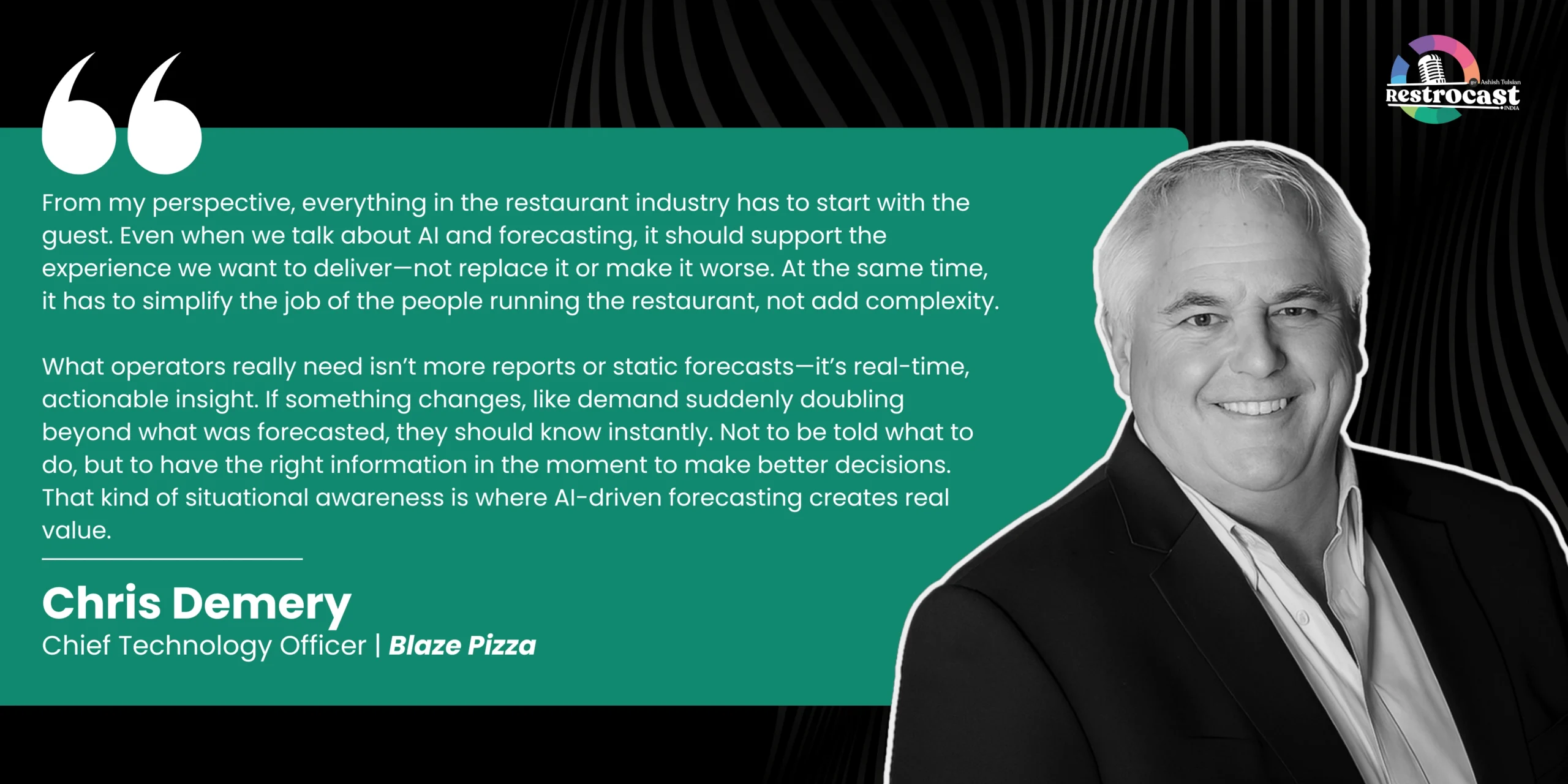
In a recent podcast, Chris Demery, CTO of Blaze Pizza, shared an interesting perspective on how AI and forecasting should actually work in restaurants.
What Does the Future Hold for AI Forecasting in Restaurants?
The future of AI-powered forecasting is exciting. We can expect:
- Hyper-personalized predictions based on customer preferences
- Integration with smart kitchens and IoT devices
- Even higher forecasting accuracy
- Greater automation in restaurant operations
As restaurants operate in increasingly complex environments, implementing AI will become less of an option and more of a necessity.
The transition from traditional methods to AI-powered forecasting is redefining how the restaurant industry approaches demand planning. By leveraging AI technology, restaurants can move beyond guesswork and embrace accurate forecasting to drive smarter outcomes. From making informed decisions to improving operational efficiency and enhancing the overall customer experience, the impact is both immediate and long-term.
In an increasingly data-focused landscape, adopting a data-driven approach is no longer optional; it’s essential for sustainable growth and stronger profit margins. Ultimately, success lies in the ability to not just estimate demand but confidently predict and respond to it.