

Franchise Restaurant Business Plan: A Complete Guide to Launch & Scale Successfully

Franchise Restaurant Business Plan: A Complete Guide to Launch & Scale Successfully

Home / Blog /
Franchise Restaurant Business Plan: A Complete Guide to Launch & Scale Successfully

Read summarized version with

In short: A franchise restaurant business plan is the document that proves to a lender and a franchisor that your location can operate profitably inside an established brand’s system. It covers an executive summary, business description, market analysis, operations plan, marketing plan, and at least three to five years of financial projections, plus startup costs and a break-even point built from the franchisor’s disclosure document (FDD). 

“A well-written business plan can help you raise money, manage your restaurant, and succeed,” says Gary Occhiogrosso, and can he be any more right? For franchises, a business plan is a document that makes them fundable, operable, and scalable because, at the end of the day, the restaurant industry only rewards those operators who plan carefully, and franchising adds a second layer of accountability on top of that.

There is even research backing him up. In a study of more than 1,000 would-be US entrepreneurs tracked from 2005 to 2011, Francis Greene and Christian Hopp found that founders who write formal plans are 16% more likely to reach viability than otherwise identical founders who don’t, and those seeking outside financing are 19% more likely to write one.

Buying into an established brand, of course, means you already have a proven menu, a recognizable name, and set standards for daily operations, but none of this guarantees that any bank will want to fund you or that you’ll get franchisor approval. That’s why it’s non-negotiable to create a franchise restaurant business plan, and this guide tells you how to do that.

Plus, since every franchise model depends on consistency, whether you’re running a full-service concept, a fast casual brand, or a food truck franchise, your business plan should show you understand that trade-off.

What You’ll Learn

  • How to create a winning franchise business plan.
  • What to include in every section of a franchise business plan, from market research to financial projections.

What is a Franchise Restaurant Business Plan and Why Does It Matter?

A restaurant franchise business plan is a structured document that explains how your franchise location will operate, compete, and generate profit in the long run. It matters because it is your proof to both the franchisor and your lender that you can really run a successful restaurant within the franchise system.

It’s a business description + financial plan + operations manual built around a business model that already “works” (it has proven so), and now you want it to be working as such (profitably) in your specific market as well.

The SBA recommends a traditional format if you plan to request financing from traditional sources, and that is the format most franchisees should use. Here is how its core sections translate to a franchise business plan for a restaurant franchise:

Business plan sections and what each section should cover.
Business plan section What it should cover
Executive summary The brand, your location, funding needed, and why you will succeed
Company description Your concept, service style, and fit with the franchisor's standards
Market analysis Trade-area demographics, competitors, and site justification
Organization and management Ownership, managers, and who runs each shift
Service or product line The approved menu and any local offerings the franchisor allows
Marketing and sales Local marketing on top of the brand's national ad fund
Funding request How much you need over the next five years and how you'll use it
Financial projections Revenue, costs, cash flow, and break-even
Appendix FDD excerpts, lease, permits, resumes, and credit history

As for the benefits of a strong business plan:

  • It helps you secure financing by giving lenders clear visibility into what you plan to do to make your business work.
  • It satisfies franchisor requirements, since many want to review a detailed business plan, or at least key sections of it, before granting final approval.
  • It serves as a reference point for any decision you may take regarding staffing, costs, and marketing in the future.
  • It shows your commitment to consistency in how you plan to manage the brand, understanding supplier agreements, and following operational protocols set by the franchisor.

A good business plan also builds confidence with everyone involved, from your franchisor to your lender to any partners you bring on.

Financing is, of course, a big reason. Under the SBA’s SOP 50 10 8, effective June 1, 2025, the agency reinstated its Franchise Directory, and a brand must be listed for its franchisees to be eligible for SBA financial assistance. The same update restored a 10% minimum cash injection for start-up loans, so your plan needs to show where that equity is coming from, such as your personal investment.

INDUSTRY INSIGHT

The restaurant franchise market continues to expand, making thoughtful business planning more important than ever. According to the National Restaurant Association, US restaurant industry sales are projected to reach $1.55 trillion in 2026, with real (inflation-adjusted) growth of just 1.3%. The International Franchise Association expects franchise output to grow to $921.4 billion and franchise establishments to rise from 832,521 to 845,000, or more than 12,000 new franchised businesses. As competition increases and more operators enter the market, a detailed plan becomes even more important for securing financing, winning franchisor approval, and launching with a clear strategy.

How Do You Define Your Restaurant Concept and Target Market?

To define your concept and target market, describe the guest experience you will deliver, show how it fits the franchisor’s brand, and then profile the specific local customers who will keep it busy. Every restaurant business plan needs this clear description of what you’re building and why it fits both the franchisor’s brand and the customer demand in your local market.

Since each franchise location has its own local demographic profile, even within the same brand, your business description must detail everything about your target audience.

First, start with the customer experience. What will people see or experience as they walk in or order for delivery?

  • What will be in your menu?
  • Your service style (quick service, fast casual, or full service)
  • The overall vibe of the dining room, etc.

Layer on top what makes your specific location distinct, like maybe there are a lot of opportunities for local partnerships, you have good connections with businesses that sponsor you, or you are sure that you position yourself well as a go-to lunch spot.

From there, define your target market. An effective franchise business plan requires a clear understanding of local demographics, including age, income, and lifestyle preferences, to align with the franchise’s ideal customer. Think through their dining habits too. Are you serving commuters who prefer to grab lunch on the go? Or families that go out every weekend for dinner? Or maybe even students who prefer late-night snacks? The clearer you’re on this subject right now, the easier it becomes to justify your location and your marketing plan later in the document.

Plus, your description should also show that you understand the franchisor’s brand standards, including approved suppliers, layout and signage requirements, and the operational protocols.

How Do You Conduct Market Research That Shapes Your Marketing Strategies?
How Do You Conduct Market Research That Shapes Your Marketing Strategies?

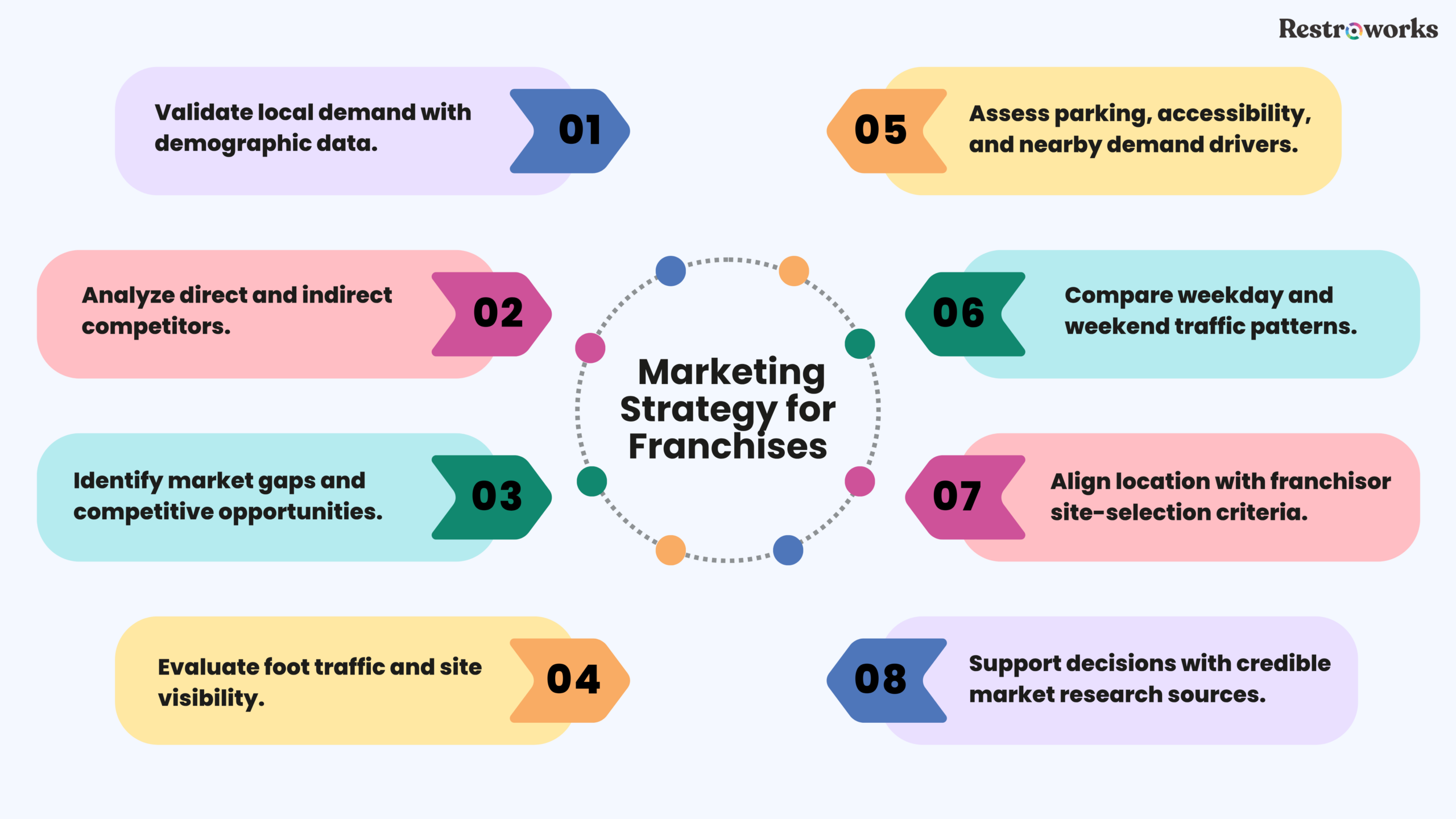
To conduct market research for a franchise, document your trade area’s demographics, daytime population, competitors, and site traffic, and show how each meets the franchisor’s site-selection criteria. Market research gives you insights into consumer trends, competition, and market conditions, which are essential for shaping marketing strategies and operational strategies in a franchise business plan.

This section proves your franchise can succeed in your specific market. How? Here you write in very, very detail why you chose a particular location and why it fits the franchisor’s site-selection criteria alongside your own foot-traffic research.

For this, first, pull your demographic data from credible sources such as census reports, chamber of commerce profiles, or franchisor market studies.

Key demographic data, such as population size, growth trends, and median income, should be outlined in the market analysis to demonstrate the potential demand for the restaurant franchise. You should also include daytime population and lifestyle indicators here, since they shape how many people will actually walk past your door throughout the week. The US Census Bureau publishes commuter-adjusted population estimates for exactly this: the number of people present in an area during normal business hours, including workers, as opposed to the people who live there. 

When you’re doing this research, make sure you include your potential direct and indirect competitors, analyze their strengths and weaknesses, and do a proper gap analysis where you may have a chance to make your name. That view of the competitive landscape is what turns a good address into a strategy.

Also, look into the real estate and foot traffic at your chosen location. Consider the shop’s visibility, parking, proximity to anchors like grocery stores or office parks, and weekday versus weekend traffic patterns, along with any site-selection requirements the franchisor may have already set for you.

How Do You Plan Daily Operations and Management Structure for Your Franchise?

To plan operations, map out how the restaurant will run every shift, from front-of-house and kitchen workflows to staffing, suppliers, and food safety, and name who is accountable for each. An operations plan outlines the day-to-day functioning of a franchise. It details its:

  • Logistics
  • Front-of-house and back-of-house operations
  • Staffing & scheduling
  • Inventory management
  • Supplier management
  • Food safety & quality control
  • Training & management protocols, etc.

Front-of-house protocols cover greeting and seating flow, order-taking and payment, guest recovery (in case they do complain about something), and your expectations around speed of service.

Back-of-house operations cover food prep workflows, station setup, receiving and storage standards, and food quality checks across every shift.

Establishing relationships with suppliers for food, beverages, and other materials is crucial for franchisees to maintain brand standards and control costs. Most franchisors do have an approved vendor list, but you most often need your own full ordering schedule and inventory management system to avoid waste and stockouts.

Staffing and scheduling are also a super important part of the plan, and they require you to carefully consider how many staff members you’ll need at any given time for any given position. Your staffing plan should map hiring timelines against the franchisor’s training schedule.

Plus, you should also outline your management structure clearly, so a lender can see who is accountable for what on a given shift. Proper training, both from the franchisor and through your own ongoing local coaching, is sure to keep service consistent.

How Do You Build a Sales and Marketing Plan & Local Advertising Strategy for Your Franchise?

To build a franchise marketing plan, start from what the brand’s national ad fund already covers, then budget the local tactics that will bring guests from your local market through the door in the first 90 days and beyond. If you invest in brand recognition, it will make people more curious about your restaurant, but your local marketing plan will get them through the door and keep them coming back, and that’s exactly what you have to outline in your business plan: how do you plan to market your outlet locally?

As for the plan itself, it should include:

  • Your sales targets and how marketing will drive them
  • Your exact plan to promote the brand locally
  • Customer acquisition plan for the first 90 days
  • How much do you expect to spend on marketing, etc.

On the local advertising side, you’ll have to account for everything you’d need for your grand opening, sponsorships, direct mail, and partnerships with local businesses.

You may also try your hand at digital marketing through social media platforms, Google Ads, and local SEO to increase online visibility for restaurant franchises. Plus, we highly recommend that you have an optimized Google Business Profile + active review management.

Planning special promotions, such as happy hour deals or discounts for large parties, can help attract customers and drive repeat visits. Local engagement through community events and promotions also keeps regulars coming back.

Keep in mind that most franchise systems do fund national marketing through a shared fee, and you should have a proper understanding of what it covers so your marketing plan is realistic enough. Marketing fees vary widely. In Franchise Update’s survey of franchisors, most said franchisees put 1% to 2% of revenue into the national marketing fund, while big restaurant brands often charge more: Subway’s advertising fee is 4.5% of gross sales, and McDonald’s is 4%. Item 11 of the FDD shows how the fund was spent last year.

How Do You Estimate Startup Costs and Conduct a Break-Even Analysis?
Franchise restaurant business plan: How Do You Estimate Startup Costs and Conduct a Break-Even Analysis?

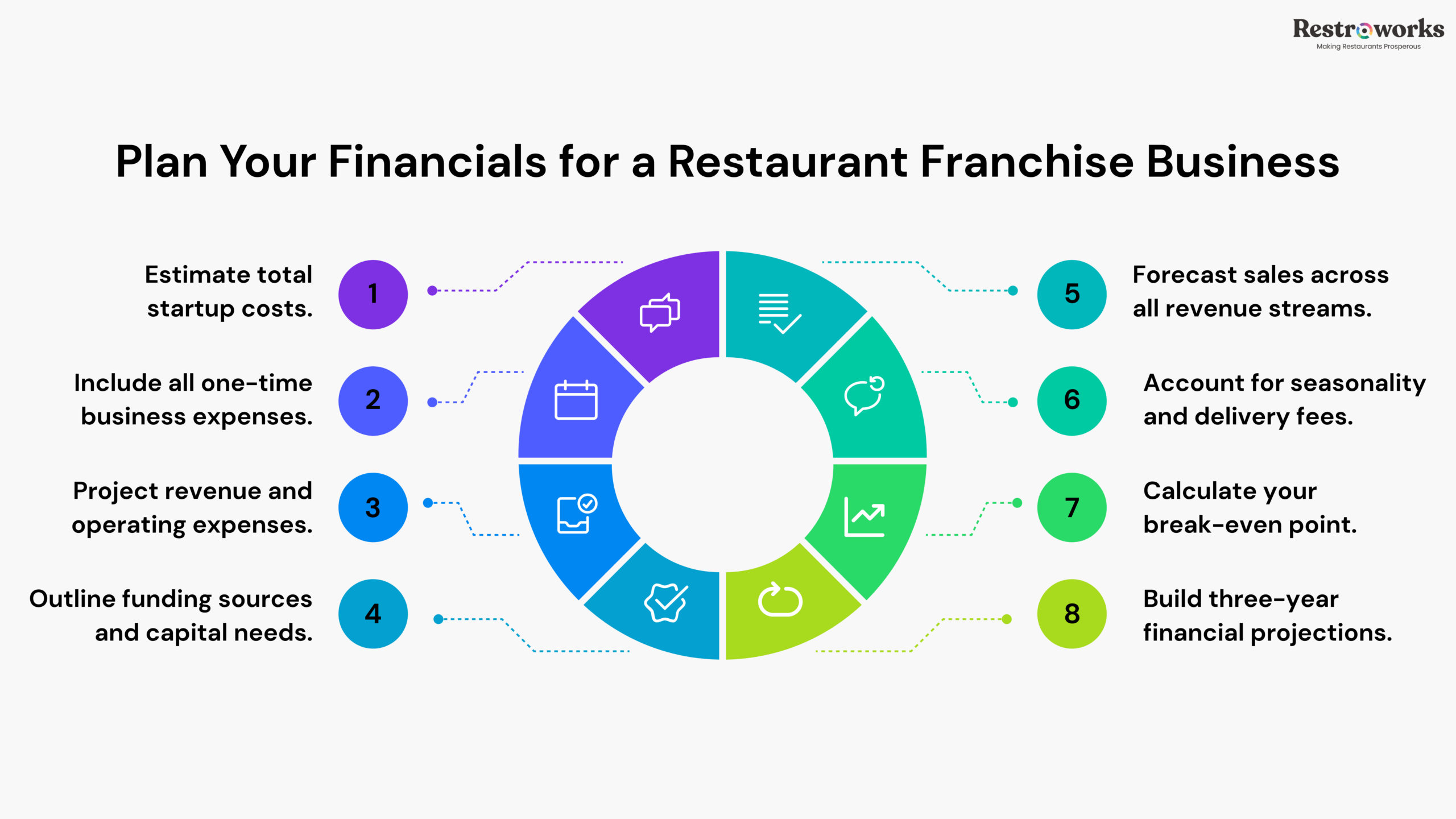
To estimate startup costs, start with Item 7 of the franchisor’s FDD, then replace its ranges with real quotes for your site; to find your break-even point, divide your fixed costs by your contribution margin. Financial projections for a franchise should cover at least three years and include expected revenue and expenses, and the SBA asks for a prospective outlook for the next five years if you are applying for financing.

Start-up costs for a franchise restaurant can include real estate, equipment, inventory, and other start-up expenses, which should be clearly outlined in your projections. Here, add:

  • Your franchise fee
  • Lease deposit
  • Buildout or tenant renovation plan
  • Permits
  • Licenses
  • Insurance
  • Working capital you’d need to sustain the first few months at the very least.

Your plan should also include how you plan to fund your business, whether you’ll bring in personal investments or any partner contributions.

What Do Real Opening Costs Look Like, From QSR to Food Truck?

Real opening costs vary more than tenfold depending on the concept. Here is what four well-known US brands disclose in their FDDs:

Franchise brands compared by format, initial franchise fee, and total estimated investment from Item 7.
Brand Format Initial franchise fee Total investment (Item 7)
McDonald's Quick service $45,000 $1,472,000-$2,807,000
Jersey Mike's Subs Fast casual subs $18,500 $203,583-$1,317,005
Subway Quick service $15,000 $263,000-$630,000
Kona Ice Food truck $15,000 $173,356-$222,141

On the revenue side, make sure you clearly write down your:

  • Average check size (or what you expect to bring in)
  • Customer count by daypart
  • Seating capacity and turnover
  • Seasonality (how it will impact sales, and how you will make do or cover for it)

List every revenue stream you expect to use, whether that’s dine-in, takeout, delivery, catering, or third-party platforms, and be honest about how each one affects your margins after fees and accounting for operating expenses.

If delivery services take up a meaningful share of sales, factor platform fees into those margins directly. DoorDash, for example, charges a 15%, 25%, or 30% commission on delivery orders depending on the plan, and 6% on pickup orders.

Your projections should include a monthly cash flow statement for at least the first year, because that is where a lender sees whether your working capital survives the ramp-up.

Then run the break-even analysis. The formula is: break-even sales = fixed costs ÷ contribution margin, where contribution margin is (price − variable cost) ÷ price. As a hypothetical example, a location with $40,000 in monthly fixed costs and a 40% contribution margin needs $100,000 in monthly sales just to cover costs. This shows when the business will become self-sustaining, which is exactly what a lender wants to see.

What Should You Know About the Franchise Disclosure Document?

You should know that the FDD is the legally required disclosure every franchisor must give you at least 14 calendar days before you sign or pay anything, and that its numbers are the backbone of your financial projections. The franchise disclosure document FDD summarizes fees, litigation history, and legal obligations important for potential franchisees in a standard 23-item format, and franchisors selling a restaurant franchise in the US generally must provide one under the FTC Franchise Rule.

These are the items that feed most directly into your plan:

Key Franchise Disclosure Document items, the information they provide, and how to use them in a business plan.
FDD item What it tells you Where it goes in your plan
Item 5: Initial Fees Franchise fee and other upfront payments Startup costs
Item 6: Other Fees Royalties, ad fund, technology and other ongoing fees Operating budget
Item 7: Estimated Initial Investment Total cost range to open Funding request
Item 11: Franchisor's Assistance, Advertising, Computer Systems, and Training Training, ad fund use, and required systems Operations and marketing plan
Item 19: Financial Performance Representations Sales or profit data, if the franchisor provides it Revenue projections
Item 20: Outlets and Franchisee Information Openings, closures, and contacts for current franchisees Competitor research and validation calls
Item 21: Financial Statements The franchisor's audited financials Risk assessment

*Item names from the FTC Franchise Rule (16 CFR 436.5)

Item 19 is optional. In Franchise Update’s latest Annual Franchise Development Report, 84% of franchisors said they provide FPRs, but plenty of big names don’t: Subway’s 2026 FDD has no Item 19. When there is no Item 19, build your revenue estimates from calls to current franchisees listed in Item 20.

By law, you must receive the FDD at least 14 days before you sign any contract or pay any money to the franchisor or its affiliates, and trust us, it’s super worth it to have this document reviewed with a franchise attorney before signing.

Now, here’s something very important because scams do happen. If the franchisor unilaterally gives you a final franchise agreement that’s materially different from the version you previously received with the FDD, the Federal Trade Commission mandates that you must be given at least seven calendar days to review the terms before signing anything or paying any fees. Before you sign, compare that franchise agreement side by side with the draft you already reviewed.

Watch the fee schedule closely, too. In July 2024, FTC staff issued guidance stating that franchisors charging fees not disclosed in the FDD may be violating the Franchise Rule and the FTC Act, a response to franchisee complaints about new fees for services and technology.

Legal and franchise considerations also require a review of necessary permits and licenses, including health department approvals, food handler or manager certifications, business registration, zoning clearances, and a liquor license if applicable.

How Long Should a Franchise Restaurant Business Plan Be?

A franchise plan for a bank or SBA loan typically runs 20 to 30 pages, and multi-unit or franchise expansion plans can run 30 to 50 pages with appendices, according to Upmetrics. It serves as a roadmap for operations and a critical tool to secure financing, so it needs room for detailed market research, brand compliance, and financial projections.

Shorter plans are also okay if you’re a single-unit location with a simple business model. Longer ones are for those franchisees who are planning to open multiple units or working with more complex financing.

But again, length is literally of very little priority. A reader should be able to skim your plan in about 15 minutes and still understand it. What’s important is that every point you want or your franchisor wants to highlight should be there in the plan no matter what.

You can use a business plan template (the SBA and SCORE both offer free ones), but still please, please customize it as per your own trade-area data, your franchisor’s specific requirements, and every other data/information of your business.

KEY TAKEAWAYS

  • A solid business plan connects strategy, finances, and execution, and founders who write formal plans are 16% more likely to reach viability.
  • Creating a franchise business plan requires focus on alignment with the franchisor’s brand, market research, and precise financial projections that include an operational plan and marketing strategy.
  • Strong market analysis, location strategy, and a clear view of the competitive landscape help with lasting competitive advantages.
  • Budget for the initial investment, franchise fee, and enough operating capital before opening, and expect lenders to want at least a 10% cash injection on SBA start-up loans.
  • The executive summary provides a concise overview of the entire business plan, highlighting the business objectives, franchise opportunity, and overall vision, making it crucial for attracting potential investors and lenders.
  • A franchise business plan should outline strategies for local marketing, while the franchisor manages national branding.
  • Every franchise owner should build efficient day-to-day operations supported by a reliable supply chain.
  • A focused sales and marketing plan helps attract and retain customers, whether you’re opening a restaurant or a food truck franchise.
  • A break-even analysis is essential in your financials, showing when the business will become self-sustaining by accounting for fixed and variable costs.
  • Prospective franchisees should carefully review the FDD at least 14 days before signing any agreement.
  • Effective sales and marketing and a resilient supply chain give restaurant owners a stronger foundation for long-term growth.

Frequently Asked Questions

1. What is the 30/30/30 rule for restaurants? 

The 30/30/30 rule is a budgeting guideline in which food costs, labor costs, and overhead each take about 30% of revenue, leaving roughly 10% as profit. But treat it as a starting point only, not a guarantee. The average operating profit for small independent US restaurants is just around 4% to 6%.

2. How profitable is owning a franchise restaurant? 

Profitability of a franchise restaurant varies by brand, location, and operating efficiency, and the best evidence is the franchisor’s Item 19. McDonald’s 2026 FDD, for example, reports that its US traditional franchised restaurants opened at least a year ago averaged $4,057,000 in 2025 sales, though that is revenue, not profit. Well-managed franchise restaurants generate profit through consistent operations, strong brand recognition, and effective cost control.

3. What are the 4 P’s of franchising? 

The four P’s are Product, Price, Place, and Promotion, the classic marketing mix applied to a franchise. In a franchise, the franchisor usually sets the product and much of the pricing, while the franchisee has the most influence over place (site selection) and local promotion.

Newsletter subscription banner

Talk to a restaurant expert today and learn how Restroworks can help your business.

Request Demo >

Share

Discover More Insights to Power Your Journey

How to Start an Ice Cream Truck Business in the US

No other business out there can combine nostalgia with profit as well as an ice cream truck does. Like, it's…

Franchise Restaurant Business Plan: A Complete Guide to Launch & Scale Successfully

In short: A franchise restaurant business plan is the document that proves to a lender and a franchisor that your…

Real-Time Analytics for Restaurant Franchises: Smarter Insights for Faster Decisions

Real-time analytics for restaurant franchises gives owners and franchisors live data on sales, labor, inventory, and guest activity across every…

Best Restaurant Software in Qatar for Smarter Restaurant Management   

The most efficient restaurant software in Qatar includes features not commonly found in general lists. In Qatar, more orders are…

POS
Integrating Accounting with Cafe POS: Streamline Finances & Daily Operations 

At the end of a busy day, the last thing a cafe owner (or anyone, for that matter) would want…

How to Start an Ice Cream Franchise: A Step-by-Step US Guide

Amy Simmons, who is the founder of Amy’s Ice Creams (Austin), said, “People don't just go to an ice cream…

Join. Learn. Grow.

Sign up to receive the latest hospitality insights and stories straight to your inbox

Streamline your operations with Restroworks