

How to Start an Ice Cream Truck Business in the US

How to Start an Ice Cream Truck Business in the US

Home / Blog /
How to Start an Ice Cream Truck Business in the US

Read summarized version with

No other business out there can combine nostalgia with profit as well as an ice cream truck does. Like, it’s quite difficult to forget how one ice cream truck uncle used to come to our street, ringing a bell, and we children used to be so happy urging our parents to buy us an ice cream – that’s one of the core memories we adults have, and maybe that’s why many of us dream of starting an ice cream business too. It brings us back to our childhood. Maybe the product is not as important as the feeling we came along with it. 

However, wanting to start an ice cream truck and actually making a profit out of it are two very different things. To sustain your business, you must understand the operations; you must secure necessary permits; you have to find a good location, a good truck (and keep it well-maintained), stock your inventory, and so much more. 

This guide walks you through everything you need to know about how to start an ice cream truck business in the US from the ground up. 

What You’ll Learn

  • How to set up your ice cream brand legally
  • What licenses, permits, and insurance does an ice cream truck actually need
  • How much does it really cost to start and run an ice cream truck business

Step 1: Build Your Business Plan and Choose a Legal Entity

Creating a comprehensive business plan is essential for starting an ice cream truck business, as it outlines your projected revenue, operational costs, and growth strategy. When planning your ice cream truck business, consider your target market, profit margins, and how you will make your business financially successful.

Also, before you go on to buy anything, decide on your legal entity. Most small operators choose an LLC to separate personal and business liability. From there, what you’ll have to do is:

  • Decide on your ice cream truck business name. Double-check if that name is available as a web domain as well as a username on social media.
  • Then, open a business bank account for your ice cream truck business. This is so every number related to your ice cream sales, inventory purchases, and truck expenses can be traced to one account without worrying about mixing it with your personal finances. This also makes your accounting system and tax filing far simpler down the road.
  • Also, talk to an insurance agent early on because, again, that’s an expense at the end of the day too, and you’d need to budget for it as per its coverage needs (truck, liability, product, etc.)

Owning your route and being your own boss is the appeal for most people getting into this business, but treating it like a real business, with a plan, a budget, and a legal entity, is what separates a hobby from a successful business.

Step 2: Licenses, Permits, and Local Regulations

A general business license, a health department permit, and a peddler’s license are commonly required for operating an ice cream truck. Some jurisdictions may require a peddler’s permit from the local police department to operate an ice cream truck.

To legally operate an ice cream truck, you typically need a business license, and in some areas, a special permit to sell food on the street. Before starting operations, ice cream truck owners must comply with local health department regulations, which may include passing health inspections.

Remember this one thing: Local regulations may vary dramatically from city to city. Like, some cities have a restriction on what type of food products you can sell from an ice cream truck. Plus, there might be some requirements around parking, idling, and whether you can or can not stop your ice cream truck near a school. That is why it is always a good idea to go back and double-check with your local area’s licensing office on these matters.

Step 3: Get Insured

Commercial vehicle insurance and general liability insurance are necessary for an ice cream truck business. Insurance costs for an ice cream truck business can range from $1,000 to $4,000 annually. Since you’re operating motor vehicles on public streets and serving food directly to the public, including at birthday parties and food truck events, an insurance agent familiar with mobile food businesses can help you avoid gaps in coverage that a standard commercial auto policy won’t cover.

Step 4: Budget for Startup and Ongoing Costs
Startup costs for an ice cream truck business

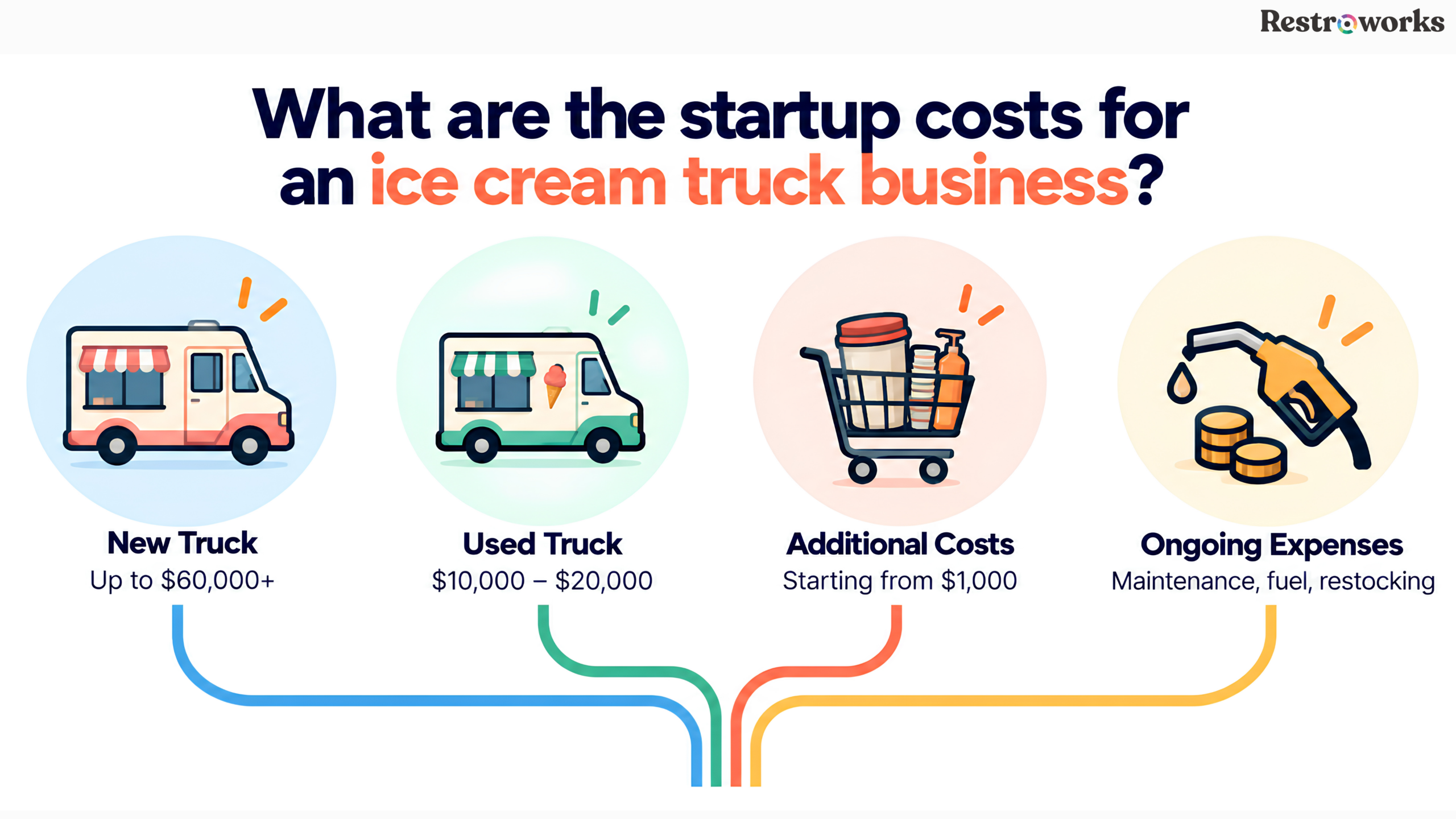
Startup costs for an ice cream truck can range between $25,000 and $100,000. More specifically, the average startup cost for an ice cream truck business ranges from $10,000 for a used vehicle to over $60,000 for a new, custom-fitted truck. The average cost for a used ice cream truck is between $10,000 and $20,000, depending on its condition and features.

In addition to the vehicle, initial costs include inventory, a point-of-sale (POS) system, and marketing materials, with a minimum of $300–$500 required for ice cream products. Initial inventory costs for an ice cream truck business can start at $1,000.

Plus, there will be some ongoing costs for your ice cream brand as well. This will include the cost of vehicle maintenance, refilling the tank with gasoline, and restocking ice cream ingredients depending on your sales volume. Note that gasoline prices increased 28.4 percent year-over-year in May 2026, while parking fees and tolls rose 2.9 percent – these costs keep going up and down frequently, so keep a check on them and make sure to factor them when calculating your operating costs.

Step 5: Choose Your Food Truck and Any Additional Equipment, If Needed

When choosing a vehicle for an ice cream truck business, it is important to consider comfort and cleanliness, as these factors can influence customer willingness to purchase. Whether you buy a new or used truck, the vehicle needs to be well-maintained, since breakdowns mid-route mean lost inventory and lost sales.

Most ice cream trucks are outfitted with specialized equipment: ice cream freezers, a music box, flashing lights, and often an amplification system to announce your arrival. Ice cream trucks typically require specialized equipment such as freezers, which should be bolted to the truck’s frame and floor to ensure safety and proper operation. Beyond the freezer, budget for inventory storage, a modern POS system, and any additional equipment specific to your menu, such as a soft-serve machine or shaved-ice unit.

Investing in a modern point-of-sale (POS) system can improve transaction speed and inventory management for ice cream truck businesses, making it easier to track sales and customer preferences. Over time, analyzing sales data from a POS system can help fine-tune your route by identifying which locations perform best at specific times of day.

Step 6: Decide on Your Menu & Inventory Storage 

When putting together a menu for your ice cream truck, you might want to consider a mix of ice cream novelties, soft serve ice cream, and hard ice cream to attract a broader customer base. Some operators even go so far as to add shaved ice or other cold treats to their offering, which most often than not works in their favor. We’re not asking you to do exactly that, but please give your menu serious thought.

Plus, no matter how many ideas you have, limit your menu to around 20 items at max (that too is a lot, actually). This way you’ll have enough variety for your customers, and it won’t even cause them choice fatigue that otherwise comes with long, long menus.

Do some research into the local preferences and what best-selling items your competitors have. This way, you can tailor your menu and your ice cream flavors to what customers are likely to buy in that area, which will in turn maximize your sales. You can also look for partnerships with wholesale food suppliers, so you keep getting a consistent and affordable supply of inventory.

Step 7: Plan Your Route

Mapping out areas with high foot traffic is crucial for planning an ice cream truck route. A strategic route plan helps maximize revenue per mile by identifying high-density areas such as parks, beaches, sports complexes, and residential subdivisions.

Your route should adapt to the seasons. Areas near schools may be less profitable when classes are not in session, and launching at the start of summer can help capture a larger audience, since demand for a cold treat peaks in the summer months. Academic research on Vehicle Routing Problem (VRP) approaches has even been applied specifically to optimizing delivery routes and truck capacity for ice cream distribution, underscoring how much a daily route affects profitability.

Step 8: Market Your Mobile Ice Cream Business

Using social media for promotion and advertising with eye-catching vehicle wraps can effectively attract customers to an ice cream truck. Being active on social media accounts across platforms like Facebook, Instagram, and TikTok is essential for promoting your ice cream truck business and engaging with customers coming to your regular stops.

Setting up a website is crucial for your ice cream truck business, as it provides contact information, details on where customers can find you, and interesting tidbits about your business. Claiming your Google Business Profile helps your ice cream truck show up in search results when potential customers look for ice cream trucks or ice cream in their area.

Traditional marketing still works, too. Passing out flyers can be an effective strategy to inform potential customers about your locations and hours, and offering a loyalty program can incentivize customers to return, helping build a loyal customer base over time. Booking birthday parties and food truck events directly is another reliable way to supplement daily route income.

INDUSTRY INSIGHT

The US ice cream truck market alone was valued at USD 1,942.2 million in 2025 and is projected to grow to USD 3,000.0 million by 2035. Zooming out further, the broader global ice cream market was valued at USD 121.4 billion in 2025 and is projected to reach USD 169.4 billion by 2033, a backdrop that shows real, sustained demand for cold treats even as costs shift year to year.

Operators who’ve built real ice cream brands know how the excitement gets you started, but the operational discipline is what makes an ice cream shop a successful business. 

As Mazen Kanaan, founder of House of Pops and a former Unilever manager, put it when reflecting on what it takes to begin: “You need to have, I think, a bit of foolishness in order to start this endeavor.” If you get too deep into supply chain and profit-margin analysis before you start, the excitement can get buried before it has a chance to carry you through.

KEY TAKEAWAYS

  • Startup costs for an ice cream truck business typically range from $25,000 to $100,000, with used vehicles starting around $10,000–$20,000.
  • You’ll generally need a business license, health department permits, and often a peddler’s permit, but local regulations vary significantly by city.
  • Commercial vehicle insurance and general liability insurance are non-negotiable, running $1,000–$4,000 annually.
  • A mixed menu of ice cream novelties, soft serve, and hard ice cream, kept to around 20 items, tends to perform best.
  • Route planning around parks, beaches, sports complexes, and residential subdivisions drives revenue per mile, and routes should shift with the seasons.
  • The US ice cream truck market is projected to grow from $1,942.2 million in 2025 to $3,000.0 million by 2035.
  • Ice cream truck operators average around $300 in daily revenue and $5,000+ monthly during peak season, per Southern Ice Cream TX.

Frequently Asked Questions

1. Can you start an ice cream truck with $10,000? 

It’s tight, but possible on the low end if you’re buying a used truck rather than a new, custom-fitted one. The average cost for a used ice cream truck runs $10,000 to $20,000 on its own. If you have only got $10,000, you’d likely be stretching to also cover licenses, insurance, and your first round of inventory (which itself starts around $1,000). That is why most new operators tend to keep a cash buffer or budget closer to $15,000-$25,000 in advance.

2. Is owning an ice cream truck profitable? 

Well, there is a lot of potential, especially if you look at the data: the average daily revenue of an ice cream truck is around $300 and $5,000+ in monthly earnings. Plus, this business requires very low overhead compared to a full-on brick-and-mortar shop, and so margins can be pretty strong. However, whether it will be profitable for you or not will depend on your route strategy, how you plan for seasonal dips, and how you control your everyday costs like those of gasoline and vehicle maintenance. Ideally, you should track your numbers daily and adjust your routes and strategies based on real sales data.

3. Is it hard to run an ice cream truck? 

It’s not really that hard to run an ice cream truck, provided you know what your responsibilities are, like you’ll have to maintain a commercial vehicle, oversee cold-chain equipment, be prepared for health inspections, market your offerings, and pick a daily route as per what the weather and seasons demand. You can learn almost all of this on the job if you are attentive enough.

Newsletter subscription banner

Talk to a restaurant expert today and learn how Restroworks can help your business.

Request Demo >

Share

Discover More Insights to Power Your Journey

How to Start an Ice Cream Truck Business in the US

No other business out there can combine nostalgia with profit as well as an ice cream truck does. Like, it's…

Franchise Restaurant Business Plan: A Complete Guide to Launch & Scale Successfully

In short: A franchise restaurant business plan is the document that proves to a lender and a franchisor that your…

Real-Time Analytics for Restaurant Franchises: Smarter Insights for Faster Decisions

Real-time analytics for restaurant franchises gives owners and franchisors live data on sales, labor, inventory, and guest activity across every…

Best Restaurant Software in Qatar for Smarter Restaurant Management   

The most efficient restaurant software in Qatar includes features not commonly found in general lists. In Qatar, more orders are…

POS
Integrating Accounting with Cafe POS: Streamline Finances & Daily Operations 

At the end of a busy day, the last thing a cafe owner (or anyone, for that matter) would want…

How to Start an Ice Cream Franchise: A Step-by-Step US Guide

Amy Simmons, who is the founder of Amy’s Ice Creams (Austin), said, “People don't just go to an ice cream…

Join. Learn. Grow.

Sign up to receive the latest hospitality insights and stories straight to your inbox

Streamline your operations with Restroworks