
In short: A specialized restaurant franchise email marketing agency builds and runs one email program for all locations in a franchise system: welcome, birthday, win-back, and loyalty automations from headquarters, plus local promotions each franchisee can send without breaking brand rules. It pays off because email is an owned, low-cost channel. It returns $36 for every $1 spent on average.
See, we can very well say that restaurants are fighting for every visit right now – competition has gone up by multiple folds. Moreover, the National Restaurant Association projects US restaurant and foodservice sales of $1.55 trillion in 2026, yet only 1.3% of that growth is real once inflation is stripped out. In fact, because of stressors like uneven traffic and rising costs, 42% of operators said their restaurants were not profitable in 2025. When new traffic is that expensive, the customers already on your email list are the cheapest growth lever you own.
That’s why for growing brands, a dedicated email partner has become one of the fastest ways to turn loyal customers into repeat visits and new franchisees into confident owners.
“As the number of franchise businesses in the U.S. continues to grow, this business model is an attractive one. Obvious advantages include growth and increased brand awareness,” says Durée Ross, President & CEO of Durée & Company, Inc.
What You’ll Learn
- Why email marketing is one of the highest-ROI channels for restaurants, and how you can structure an email program across your franchise system.
- How the top restaurant marketing agencies compare on services, email capability, and pricing, so you can choose the right partner for every franchise location.
Quick Comparison Table
| Agency | Best For | Core Expertise | Email Services Listed? | Est. Starting Price* |
|---|---|---|---|---|
| Gourmet Marketing | Restaurants & hotels | Branding, SEO, paid media, email | Yes | From $2,500/mo |
| The Digital Restaurant | Multi-location brands | SEO, Google Maps, local PPC | Yes | $1,200-$2,000/mo |
| CJ Digital (UK-based) | Bars, cafes & restaurants | SEO, PPC, social, web design | Yes (email automation) | From $1,500/mo |
| Embark Marketing | Restaurant chains | Social media, email, creative | Yes | From $2,500/mo |
| Hudson Creative | Fine dining & hospitality | Full-service digital marketing | Yes | From $3,000/mo |
| WebFX | Franchise & multi-location | SEO, PPC, web, content | Yes (email automation) | From $3,000/mo |
| Thrive Agency | Local & SMB restaurants | SEO, reputation, social | Yes | From $1,500/mo |
| LYFE Marketing | SMBs & local eateries | Social media, PPC | Yes | From $650/mo |
| Resto Experience | Independent restaurants | Demand gen, social, web design | NA | From $1,000/mo |
| Nice Branding Agency | Food & beverage brands | Branding, content, digital | NA | Custom pricing |
*Starting prices and service lists are third-party estimates from Marketing LTB's 2026 reviews of restaurant digital agencies. Confirm current pricing with each agency.
Why an Email Marketing Agency Matters for Growth
A specialist agency matters because email is the one high-return channel a franchise brand fully owns, and running it well across dozens of locations takes strategy and skills most franchise teams don’t have in-house. As per data, you may expect an average return of $36 for every $1 spent on email, and unlike social feeds or delivery apps, your list is a direct communication channel that is not affected by changes on third-party platforms.
An IFA-published study of more than 250 franchise marketing professionals found that just under half use email to reach their audiences, and only 37.4% rate their email efforts “very effective.” Customers, meanwhile, are waiting to hear from you. Don’t believe it? A HungerRush consumer survey found that 63% of consumers save restaurant marketing emails, and 55% of those who receive restaurant messages plan to dine at or order from that restaurant within the next month.
Franchise email programs also require a deliberate structural decision about who is managing email: headquarters, franchisees, or both. Each option has trade-offs depending on the franchise agreement and how sophisticated local operators are.
As Durée Ross puts it: “As for online presence, a public relations firm can lead a franchise business with targeted email marketing, optimized landing pages to gather leads, user-generated content (UGC) to increase engagement with audiences, and partnerships with the right influencers.“
How Email Marketing Powers Restaurant Marketing Results
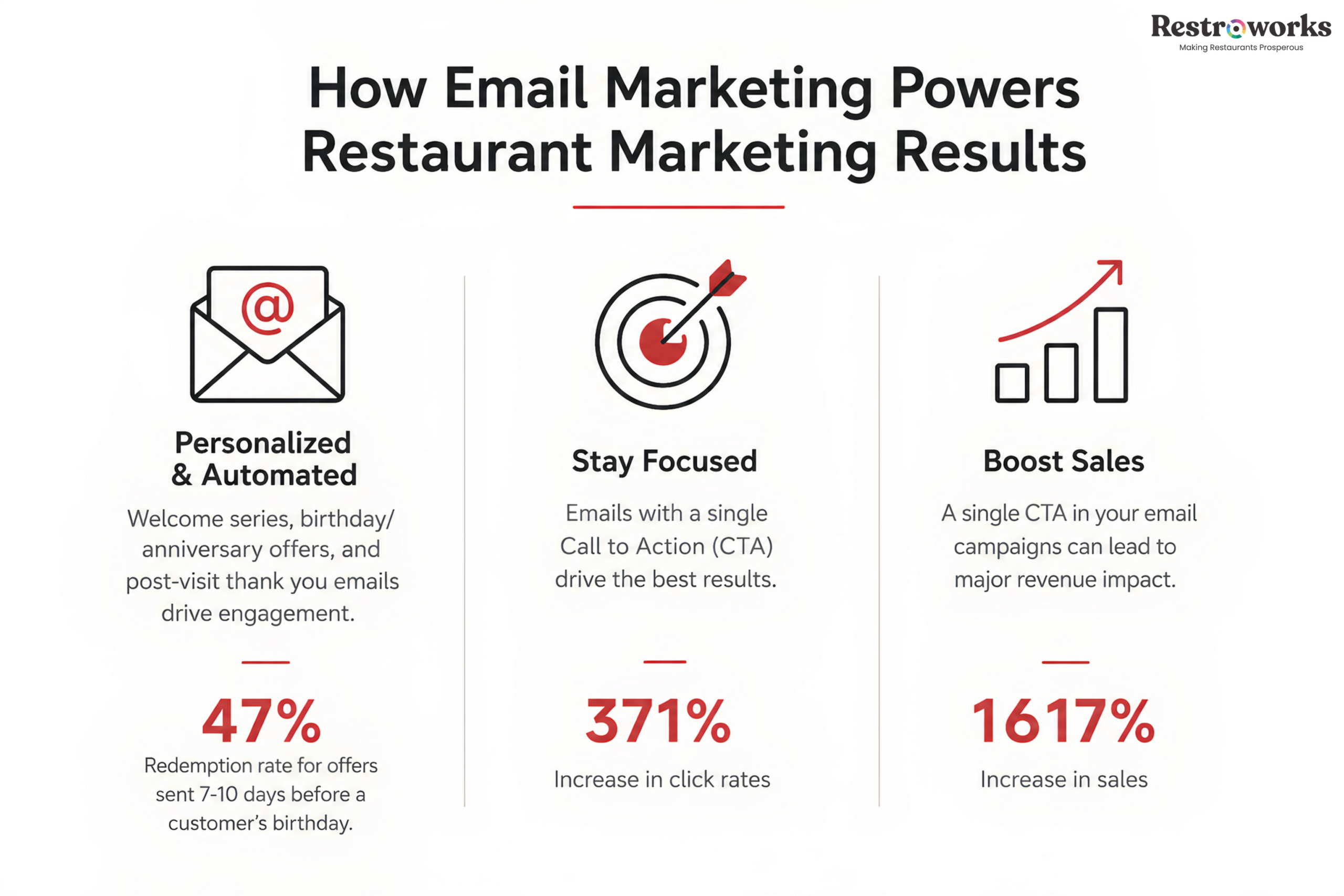
Email powers results through automation that reaches customers at the right moment with one clear offer. The strongest strategy combines personalization, local relevance, and triggered sequences such as welcome series, birthday offers, and post-visit thank-you emails.
While you might not believe it, a birthday trigger alone can carry a program. In a Paytronix case study, a regional quick-service chain emails loyalty members every Sunday if their birthday falls in the coming week, announcing a free-sandwich reward. The reward posts a 47% redemption rate and lifts targeted guest visits by 26% in the birthday month versus the prior month, with no added staff time.
Plus, according to Mailjet, emails with a single call to action increased clicks by 371% and sales by 1,617%, which is kind of a reminder that restaurant campaigns work best when they stay focused on one message.
CASE STUDY [Pizza Hut]
After moving its email program to Braze, Pizza Hut used dynamic logic to create emails with hundreds of variants and let its own machine-learning test review results every couple of days. Braze reports a 30% lift in transactions, a 21% lift in revenue, and a 10% lift in profit overall.
Marketing Team Structure and the Franchise Sales Process
Most brands should pair a small internal strategy owner with an agency’s shared team, because staffing a full marketing team capable of managing email campaigns, paid social, and loyalty journeys across dozens of locations is expensive. That shared-team model is now standard, usually with direct access for franchisees and a single line of communication for local requests.
The same team should also nurture franchise development leads, which is where many brands leak deals. In fact, an analysis of franchise sales data from more than 600 brands found that only about 1% of leads turned into sales, and only 25% of franchisors had established campaigns for new leads. Too few go beyond one or two automated drips to new leads.
That is costly, because lead generation itself isn’t cheap. According to data, an average franchisor recruiting budget is $225,240, with a median of $143,000. To help with that, Jeff Gooch of eMaximation recommends lead nurturing campaigns that reach candidates several times within the first seven days, and a mix of personal and automated outreach throughout the sales process.
Build a simple nurture plan around that, like: new leads get a welcome email within minutes, leads who download the franchise kit get a follow-up sequence, qualified leads get an invite to a discovery call, and stalled leads get a re-engagement email before sales gives up. You don’t want to pay for the same leads twice (nobody wants that!).
Google Ads vs Email Campaigns: Where Franchises Should Invest
Franchises should invest in both: Google Ads and paid search capture new customers actively searching nearby, while email campaigns nurture customers already in your database at a fraction of the cost per touch. Here is how the two channels benchmark for restaurants, before you split budget across locations:
| Channel | Benchmark | Figure |
|---|---|---|
| Search ads (restaurants & food) | Average cost per click | $2.05 |
| Search ads (restaurants & food) | Average click-through rate | 7.58% |
| Search ads (restaurants & food) | Average cost per lead | $30.27 |
| Email (all Mailchimp users) | Average open rate | 35.63% |
| Email (all Mailchimp users) | Average click rate | 2.62% |
| Email (all industries) | Average return | $36 per $1 spent |
Search ads buy the first visit; email earns the second, third, and tenth. With search ads you pay for every click, while each extra email costs little once the list exists. A blended budget, i.e., competitive pricing on paid search plus consistent email campaigns and some SMS marketing, typically outperforms leaning on either channel alone. Note that Mailchimp flags Apple’s Mail Privacy Protection as a factor that can inflate open rates, so judge email on clicks and orders, not opens alone.
AI is also changing how these campaigns get built. The IFA’s 2026 Franchising Economic Outlook cites AI investment as one of the factors expected to propel brand growth, and in email that mostly means using AI tools to create and test subject lines, personalizing send times, and automating audience segmentation.
INDUSTRY INSIGHT
Consumer spending is expected to push US restaurant industry sales to $1.55 trillion in 2026. Particularly, on the franchise side, the IFA projects US franchise establishments will grow from 832,521 to 845,000 units in 2026 (an increase of 1.5%), and for the first time since the pandemic, full-service restaurants are expected to outpace QSRs in output growth. More units and thinner real growth mean brands that professionalize their email program early hold a real edge over slower-moving competitors.
Structuring an Email Program Across Your Franchise System
To structure email across a franchise system, keep brand control at headquarters and give franchisees controlled access to send local promotions. In practice, that means one platform and one dashboard for all locations, standardized campaign approval, one communication calendar, and a shared template library franchisees use to create local sends.
Centralized control is, in fact, a legal safeguard. Under the FTC’s CAN-SPAM guidance, you can’t contract away compliance by hiring an agency, and both the company whose product is promoted and the company that sends the message can be held legally responsible. In a network of locations, one careless local message can expose the whole brand.
| CAN-SPAM rule | What it means for a franchise network |
|---|---|
| No false or misleading header information | All locations send from an approved, brand-verified domain |
| Subject lines must reflect the content | HQ reviews subject lines before local sends go out |
| Identify the message as an ad | Promotional templates carry the disclosure by default |
| Include a valid physical postal address | Addresses for all locations fill in automatically in the footer |
| Give a clear way to opt out | One unsubscribe link, honored across all locations |
| Honor opt-outs within 10 business days | Opt-outs sync centrally so a guest who leaves one list isn't emailed by other locations |
| Penalties apply per email | Each violating email can cost up to $53,088 |
*Source: FTC CAN-SPAM Act compliance guide
A “franchise-first” approach is what specialized agencies favor, with a strategy that works at both brand and local level. Professionally designed email templates with consistent branding keep every franchise location on message without making them time-consuming for local teams.
Local Customization for Every Franchise Location
Local customization means each location gets offers built on its own customers’ behavior while the brand look stays fixed. Advanced segmentation lets you target by location, frequency of visits, and menu preferences. That level of detail is hard when managing 50 locations by hand, which is where a good email platform earns its fee.
POS integration is what makes this possible: when the CRM pulls visit history from the register, a new menu item can be promoted with dynamic content to the right guests at the right franchise location instead of being blasted to the whole email list. Mailchimp’s own guidance warns against over-segmenting, though; keep segments broad enough that each one still reaches a meaningful share of your list.
Local customization also covers the small stuff: the store’s address, hours, manager’s name, and local community events. These are the details that make personalized emails feel local rather than corporate, and they engage regulars more than a generic blast.
Driving Online Ordering Through Targeted Campaigns
To drive online ordering, segment customers by behavior and put a link to your own ordering platform in every email. Two segments engage best: guests nearing loyalty milestones and those at risk of churning.
Starbucks shows how far loyalty plus digital ordering can go. Its Q4 FY2025 investor dashboard reports 34.2 million 90-day active Rewards members in the US, accounting for 58% of tender dollars in US company-operated stores, while mobile orders made up 31% of transactions.
Text messaging can supplement online ordering promotions for guests with low email engagement, giving multi-location brands a second channel to nurture customers and drive repeat visits. Get consent right first: as QSR Magazine notes, the TCPA requires express written consent before the first marketing text, even from loyalty program members, and multi-unit operators should make sure that consent covers every establishment that will text the guest.
What Independent Restaurants Can Learn From Franchise Email Strategy
Independent restaurants can borrow the same strategy by automating the same few triggers (welcome, birthday, win-back), designing for mobile first, and leading with food photography. You don’t need a franchise system behind you to do any of it, just consistent quality in every send. The fundamentals of email marketing don’t change with size.
Mobile optimization means single-column layouts with large, touch-friendly buttons. Visual-first design relies on high-quality food photography, which helps you engage guests before they read a word. Moreover, MIT neuroscientists found the human brain can identify images seen for as little as 13 milliseconds.
Keep subject lines tight to protect open rates, too. Mailchimp recommends no more than nine words and 60 characters, no more than three punctuation marks, and no more than one emoji in subject lines.
Onboarding New Franchisees to the Email Program
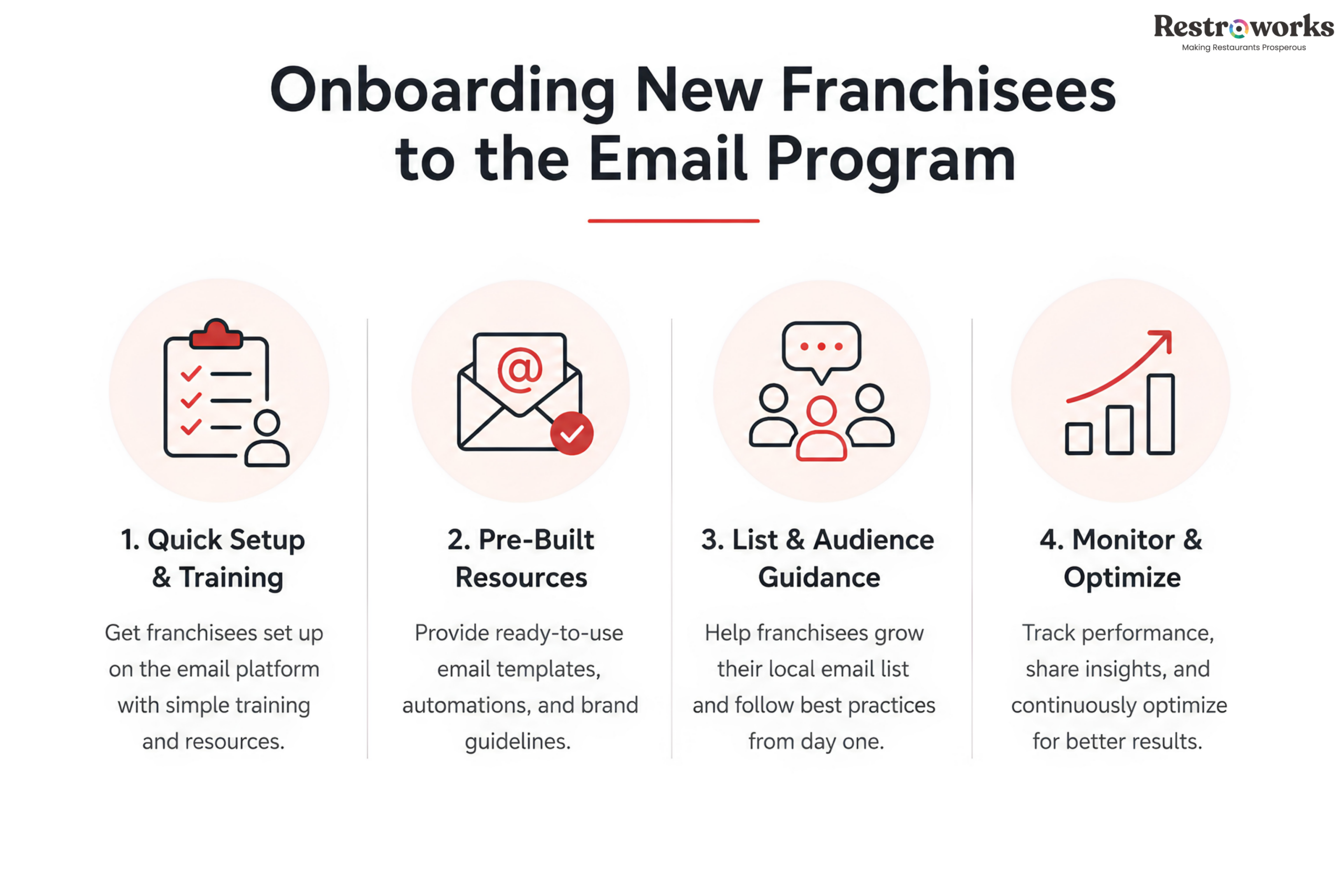
New franchisees should get access to the brand’s email program on day one: their location’s slice of the email list on the brand’s email platform, the template and content library, and the reporting dashboard, so they aren’t managing their list in spreadsheets. Waiting until after opening means new locations miss their first weeks of traffic.
The need is growing. The IFA projects more than 12,000 new franchised businesses in 2026, and each one needs a list-building plan before its first guest walks in. Give franchisees a 90-day email plan for their opening, help each new location create its first welcome series, and set a clear communication plan for who sends what.
Your onboarding kit should cover three things:
- The approved templates and send calendar
- List-capture tools at the counter and online
- A short compliance walkthrough covering CAN-SPAM and SMS consent
Top Restaurant Marketing Agencies for Franchise Growth
The best agency is one capable of managing both brand-level and location-level email, reporting results for individual locations, and handling compliance. This guide evaluates 10 agencies working with restaurant and franchise brands, using Marketing LTB’s 2026 agency reviews as the source for pricing and service details unless noted.
- Gourmet Marketing: Hospitality marketing agency covering branding, SEO, paid media, and a dedicated restaurant email service (welcome flows, birthday programs, win-back sequences). Its pricing is around $2,500/month, and clients often praise its campaign quality. Strong fit for hospitality groups needing full-funnel campaigns.
- The Digital Restaurant: Chicago-based, restaurant-only agency built around local SEO, Google Maps, and revenue-linked reporting across multiple locations. Its starting price is between $1,200 and $2,000/month, solid value for brands with many locations.
- CJ Digital: London-based, hospitality-only agency serving bars, cafes, and restaurants with SEO, pay-per-click (PPC), social, and email automation. From about $1,500/month; clients include UK brands Temper and Ole & Steen, so it suits brands with UK or international locations more than US-only systems.
- Embark Marketing: Creative-led agency combining social, email, and paid ads. Known for creative quality, its work for clients such as Rosario’s Mexican Restaurant produced 3,000+ new email subscribers and 40% Facebook follower growth.
- Hudson Creative: Has served 210+ restaurants across 1,500+ campaigns for fine dining and hospitality groups, with clients including Patina Restaurant Group and Wolfgang Puck Catering.
- WebFX: Harrisburg, Pennsylvania-based agency for franchises and multi-location chains, with a proprietary analytics platform. WebFX says it has driven over $10 billion in revenue for clients over the past five years.
- Thrive Agency: 200+ specialists focused on local SEO, Google Business Profile, and reputation management, with email marketing included and particular strength in managing reputation across locations. From about $1,500/month; Marketing LTB cites a 4.9/5 average across 300+ Clutch reviews from clients.
- LYFE Marketing: Atlanta-based Google Premier Partner serving small and independent restaurant clients with social media, Google Ads, and email. From about $650/month (email packages from about $750/month), this is one of the most accessible options on this list.
- Resto Experience: Demand-generation agency turning social audiences into foot traffic for independent and emerging brands.
- Nice Branding Agency: Franklin, Tennessee-based, branding-first agency for food and beverage concepts needing identity work alongside digital marketing.
How to Choose the Right Agency?
Choose by matching the agency’s “Best For” to your restaurant type and size first, then confirm it actually runs email strategy, not just SEO and social. Then focus on core expertise against what you need, like local SEO, a specialized email program, paid social, or full brand-building. Treat the retainer as an investment and use pricing as a floor, not a ceiling: expect to pay more as retainers scale with the number of locations, content creation volume, and market complexity.
Before signing, ask for live examples to judge the quality of their email work, then ask: Can franchisees send local campaigns inside brand-approved templates? Will reporting break out results for each of your locations? How will communication with franchisees work, and who will be managing day-to-day sends? Will they work in your existing email platform or force a migration? Can they also nurture franchise development leads? Who owns the email list and the CRM data if you part ways?
KEY TAKEAWAYS
- Email is one of the highest-ROI channels for restaurants, returning an average of $36 per $1 spent, and your list of customers is an owned asset no platform can take away.
- Top-performing franchises automate a few high-impact campaigns; a birthday reward can alone drive a 47% redemption rate (It did for one regional quick-service chain, as reported by Paytronix).
- Track open rates, click-through rates, conversion rates, and engagement over time, but weight clicks and orders more heavily because Apple’s privacy features can inflate open rates.
- CAN-SPAM applies to every commercial email to US recipients; both the brand and the sender can be liable, and each violation can cost up to $53,088 (FTC). Brands emailing EU residents also need GDPR compliance.
- Focus each email on one call to action; single-CTA emails lifted clicks by 371%, according to Mailjet.
- Automated, personalized emails help build trust with franchise development leads, yet only 25% of franchisors run nurture campaigns for new leads (FranConnect).
- Email marketing for restaurant franchises means balancing brand standards with local relevance across locations, and effective programs hinge on segmentation by location and behavior.
Frequently Asked Questions
1. How much does a franchise email marketing agency cost?
Agencies generally cost between $650 and $3,000 per month. The exact investment you’ll need to make depends on the number of locations, campaign volume, and whether branding or content creation is included. Brands with more locations typically pay toward the higher end for centralized reporting across every franchise location.
2. How do I choose the best email marketing agency for my restaurant franchise?
Choose an agency that has run email for multi-unit restaurants, can let franchisees send local promotions inside brand templates, and reports results across locations. Compare agencies on core expertise (email automation, segmentation, local customization), pricing against your location count, and case studies from similar restaurants. A “franchise-first” agency that understands centralized vs. local email management will typically outperform a generalist team.
3. What results can restaurant franchises expect in the first 90 days of email marketing?
In the first 90 days, expect early wins from automated welcome series, birthday offers, and re-engagement campaigns to lapsed customers. Email list growth, higher engagement, and measurable lifts in repeat visits and online ordering across locations typically build over two to three quarters as segmentation and dynamic content mature.