
Customer Review Strategy for Restaurant Franchises: Build Trust & Boost Local Reputation

Customer Review Strategy for Restaurant Franchises: Build Trust & Boost Local Reputation

Home / Blog /
Customer Review Strategy for Restaurant Franchises: Build Trust & Boost Local Reputation

Read summarized version with

A single bad shift can live online forever. A single great one can, too. That is the reality every restaurant franchise operates in now, and it is why, today, a deliberate, system-wide approach to reviews has become as important as the menu itself.

In one line: a franchise review strategy is a standardized system for asking every guest for a review, replying to every review within a day, flagging fake ones, and feeding recurring complaints back into operations at every location.

Online reviews shape which restaurants show up in search results, which locations earn repeat business, and which brands new customers trust enough to try. In fact, 97% of U.S. consumers now read reviews for local businesses, and 41% read them every single time they look for one.

For a franchise system, the challenge is greater than managing a single location’s reputation. Because the franchise business model puts many independent operators under one name, it calls for building a review strategy that works the same way everywhere, from flagship restaurants to the newest opening.

Here, in this article, we’ll discuss the best customer review strategy for restaurant franchises that you may put into action ASAP.

What You’ll Learn

  • How to turn satisfied guests into a steady, compliant stream of fresh ratings across every unit
  • How to reply to a negative review, spot fake ones, and use loyalty programs to strengthen your restaurant’s reputation

Why Do Online Reviews Matter So Much for Restaurant Franchises Right Now?
Why Do Online Reviews Matter So Much for Restaurant Franchises Right Now?

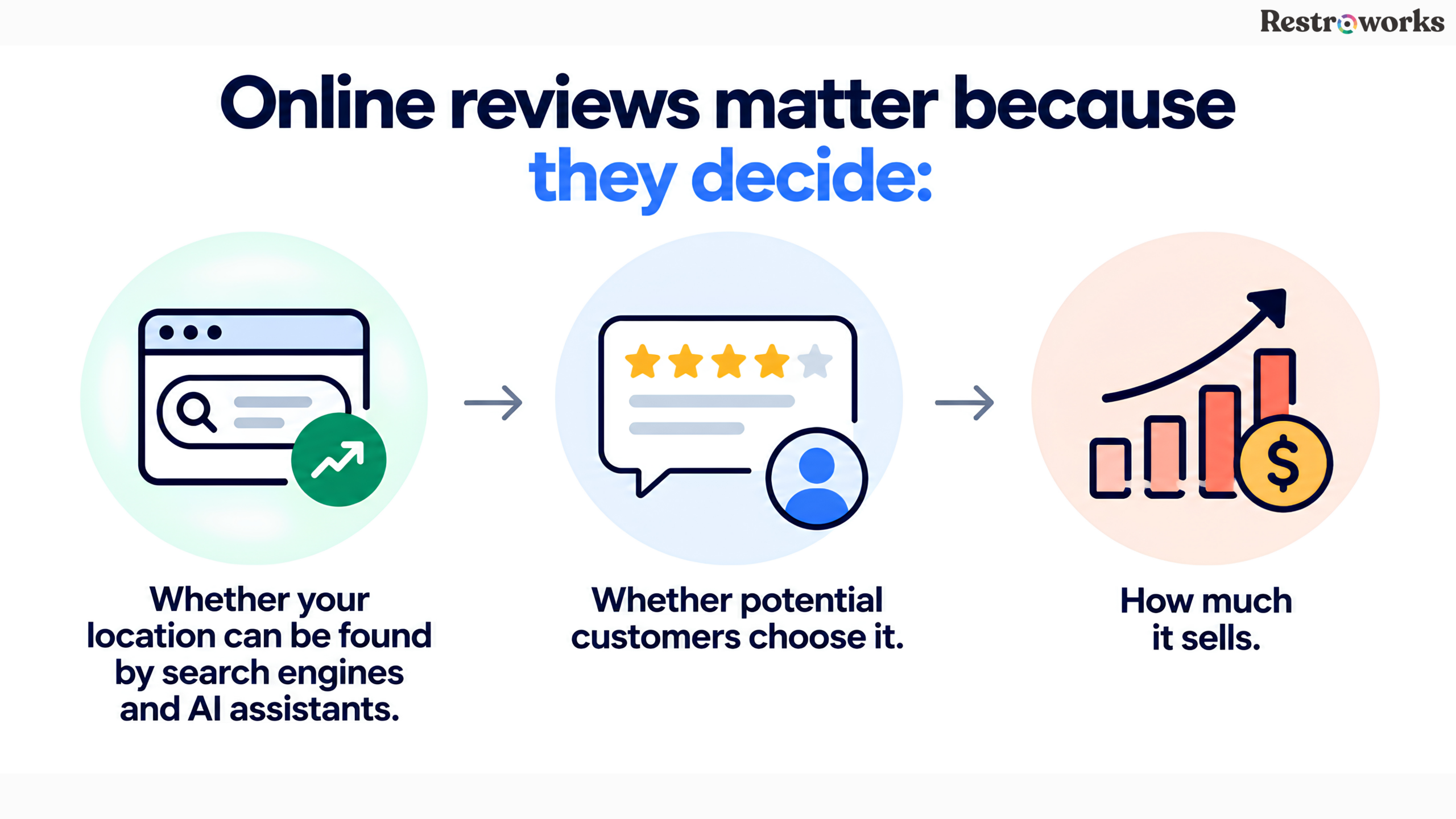
Online reviews matter because they decide whether your location can be found by search engines and AI assistants, whether potential customers choose it, and how much it sells. Restaurant reputation management used to be a nice extra. Today, it drives revenue directly.

It is especially important today, if you notice how The National Restaurant Association projects the U.S. restaurant industry will reach $1.55 trillion in sales in 2026, but only 1.3% real growth. Plus, about 40% of consumers say they are dining out less often than a year ago. Fewer visits mean every rating carries more weight for restaurants competing for the same diners.

Pricing, too, is adding pressure to the overall situation. This year, many operators planned for menu price increases…and what does that do? Even a 1% price increase results in a 3–5% drop in a restaurant’s average rating.

What reviews influence What the data shows
Discovery 97% of consumers read local reviews. 45% now use ChatGPT or other AI tools for local recommendations, up from 6% a year earlier.
The shortlist 47% won’t use a business with fewer than 20 reviews. 31% won’t use one below 4.5 stars (up from 17% in 2025).
The final decision 85% are more likely to use a business after reading positive reviews. 77% are put off by negative ones.
Revenue A one-star Yelp increase led to a 5–9% revenue increase (Seattle restaurants, 2003–2009).
Same-store sales At Blaze Pizza, stores rated 4.4 stars and higher grew same-store sales 15%, while stores below 4.0 saw negative same-store sales.

Sources: BrightLocal, Harvard Magazine, Birdeye case study

Basically, what’s happening is that customers are now starting to treat restaurant reviews as a substitute for brand familiarity. A recognizable logo no longer protects poorly rated restaurants, and every unit’s rating is now public evidence for or against the entire brand.

Why Is Review Volume the Key Ingredient for AI Search Visibility?

Volume is the key ingredient because AI assistants treat a large, recent pool of customer reviews as proof that restaurants are worth recommending. For search engines as well, as Google’s own guidance says, review count and positive ratings can help a business’s local ranking. To be exact, Rev Ciancio explains, “Reviews are the single most important trust signal for AI. To dominate, you need a three-part strategy: volume, response, and analysis.” 

A 2026 MyPlace study looked at how ChatGPT, Gemini, and Perplexity recommend restaurants. AI-recommended restaurants averaged 3,424 Google ratings, versus 955 for comparable restaurants that were not recommended. Star ratings above 4.4 had minimal additional impact.

Volume alone is not a guarantee, though. Local Falcon’s study of 10,000 U.S. restaurants found 74.9% never appeared in Google’s AI recommendations. Even places with more than 1,000 Google ratings were left out 70.9% of the time.

Uberall’s research points to why this happens. For restaurants, Yelp was the strongest AI signal, with 1,000+ Yelp ratings reaching a 93.3% AI mention rate. The lesson here is that it is very important to build volume on more than one platform, and not just Google.

What Do Customers Look for in Customer Reviews Before Choosing a Restaurant?
What Do Customers Look for in Customer Reviews Before Choosing a Restaurant?

Customers always look for a consistent pattern in reviews. The top trust factor is that a review is backed up by others saying similar things (56%). Next come a positive experience (46%), recency within the last month (44%), a high star rating (42%), and a visible owner reply (37%).

Customers rarely read reviews for entertainment. They are checking whether a location will meet customer expectations. Positive reviews reassure them. A negative review, especially one left unanswered, tells a very different story.

Reviews also start a journey rather than end it. After reading positive reviews, 54% of consumers visit the brand’s website, and 24% check its social media channels.

What potential diners check Benchmark
How many reviews a location has 47% need to see at least 20
Recency 74% only care about ratings written in the last three months. 32% look for the last two weeks
Star rating 68% will only use a business rated 4+ stars. Only 10% demand a perfect 5.0
Owner replies 89% expect an owner reply

Source: BrightLocal

Which Themes Drive Customer Satisfaction Across Franchise Locations?

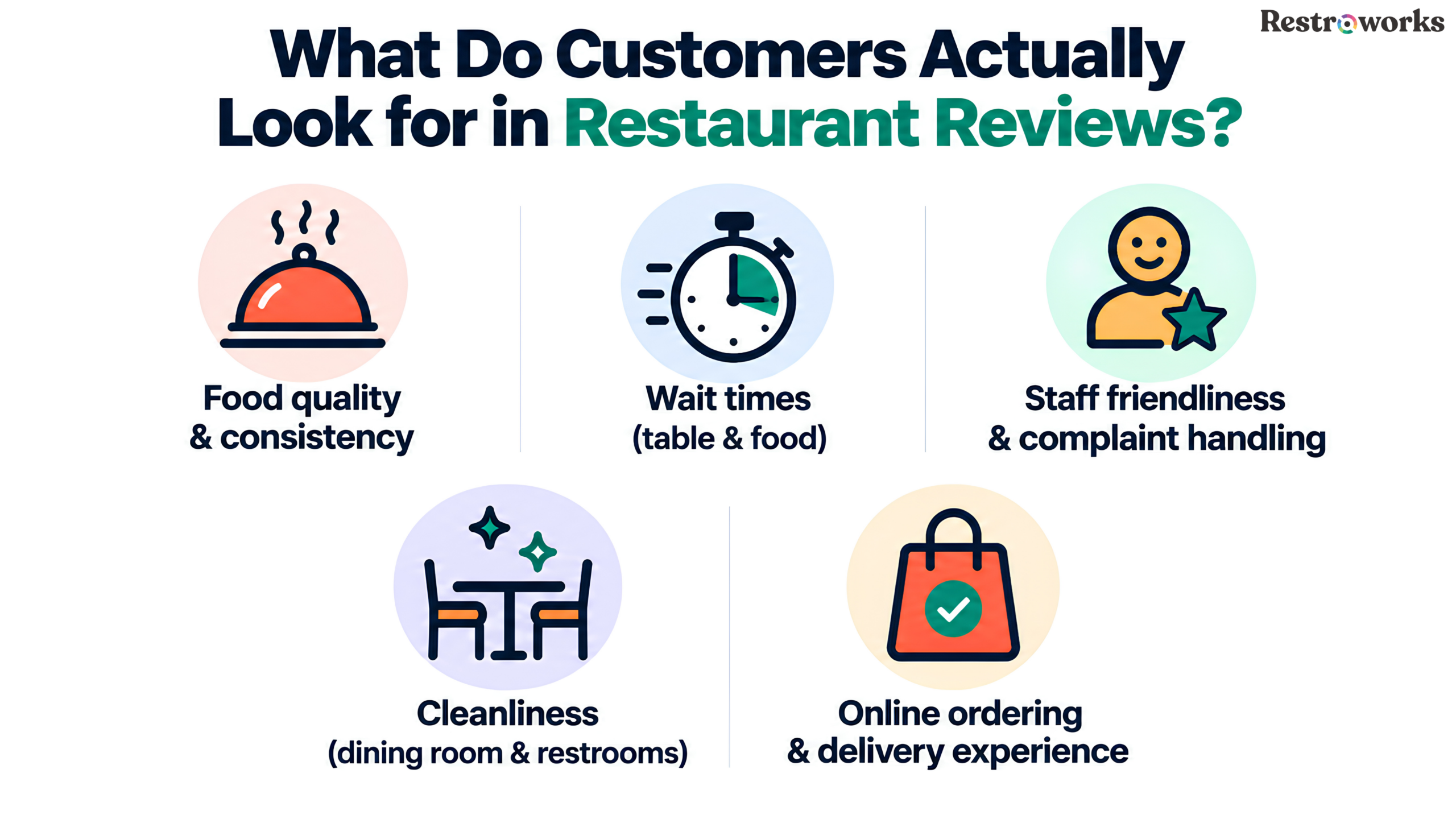
Five themes drive most ratings: food quality and consistency, speed, staff friendliness, cleanliness, and the off-premise experience.

Black Box Intelligence’s Q3 2024 data shows what the leaders get praised for. The top-rated limited-service restaurants, such as In-N-Out and Torchy’s Tacos, were praised most often in restaurant reviews for speed of service, unique menu offerings, and consistent quality. The industry average star rating was 3.9 for limited-service restaurants and 4.3 for full-service ones. What matters most also shifts by dining occasion and restaurant segment.

Theme What guests are checking What to standardize system-wide
Food quality Are menu items the same as at other locations? Recipes, holding times, portion checks
Wait times Table wait and ticket time Staffing by daypart, kitchen display targets
Staff and complaint handling Friendliness, how problems were fixed Recovery scripts, manager escalation
Cleanliness Dining room and restrooms Shift checklists
Online ordering and delivery Accuracy, temperature, packaging Order-accuracy checks, sealed packaging

The thing is – you should be able to track these themes across all the restaurants in your system, rather than reacting to one reviewer at a time. That’s what you call perfect damage control. 

How Do You Encourage Satisfied Customers to Leave Reviews?

To get more customer reviews, ask all customers while the experience is fresh, through a one-tap channel. Keep the request neutral: no incentive, no quota, and no script. Most happy customers will not post on their own, but they will when asked. 78% of consumers were asked for a review in the past year, and 83% of those asked went on to write one.

The goal is to encourage customers without pressuring anyone, since a pushy ask mostly tends to produce either a generic review or none at all. A few tactics consistently work well:

  • Place QR codes on receipts, table tents, and near the register so guests can post in seconds
  • Train staff to ask right after a guest compliments the meal or service, since that is the most natural moment
  • Send an automated SMS or email a few hours after the visit, while the experience is still fresh
  • Keep the ask short and neutral, simply inviting honest feedback, rather than suggesting what to write

Positive feedback is also the norm, not the exception. Consumers are about twice as likely to write about a positive experience (60%) as a negative one (29%).

Note that timing here matters as much as the method itself. Because 74% of consumers only trust ratings from the last three months, asking continuously beats running an occasional push.

So, what should you do? Here are some rules for you:

Do Don’t Why
Ask all customers, happy or not Send only happy guests to Google (review gating) Google lists gating as rating manipulation [Launchcodex summary of Google policy, 2026]
Use a neutral “tell us how we did” Ask guests to name a dish or a staff member Google’s April 17, 2026 update bans directing staff to request specific content, including staff names.
Track ratings at the location level Set staff quotas or contests (“get five this month”) Staff review quotas are now an explicit violation.
Thank customers for any honest rating Offer a discount for a positive review The FTC rule bans incentives conditioned on sentiment.

Irony is that while it is illegal, data shows that 11% of customers say a business offered them an incentive specifically for a positive review in the past year.

What’s the alternative, though? Restaurants that build the ask into the visit itself see results. Häagen-Dazs, for example, gave its franchisees a shared review tool with instant alerts for low ratings, and the number of ratings it collected rose 40%. New York restaurant group Hole in the Wall reports that 82% of its positive Google ratings now come through the review prompt in its QR pay-at-table flow.

Which Review Platforms Matter Most Beyond Google Reviews?

Google comes first among review platforms, but it is no longer the only one that matters. Google’s share of review reading fell from 83% to 71% in a year, and potential customers now check six different sites on average.

Platform % of consumers who wrote a review there in the past year
Google 45%
Facebook 34%
Yelp 24%
Apple Maps 17%
Tripadvisor 16%

Source: BrightLocal

As for social media platforms, 37% of U.S. consumers use Instagram and 29% use TikTok to find local business reviews. Relying on one platform thus leaves restaurants exposed if that site’s algorithm or policy changes.

How Should a Franchise Reply to Reviews?

Respond to all positive reviews and every negative review, ideally within 24 hours, in a personal voice. 80% of customers are likely to use a business that answers all of its reviews. 42% are unlikely to use one that ignores them, and 50% are put off by generic, templated replies.

Replying to online reviews shows customers their opinions matter, and the effect is measurable. When hotels began responding to reviews on TripAdvisor, they received 12% more reviews and their ratings rose by 0.12 stars on average. About one-third lifted their rounded rating by half a star or more within six months.

Reply speed Share of consumers who expect it
Same day 19% (up from 6% in 2025)
By the next day 32% (up from 18% in 2025)
Within a week 81%

Reputation management software and AI tools can draft responses to keep pace across dozens of units, but a manager should personalize each one before it goes live.

How Should You Reply to Positive Reviews?

Thank the guest by name and mention the specific thing they praised. Even short positive comments deserve a reply. Acknowledging positive reviews personally, rather than with a generic thank you, reinforces loyalty. If the guest called out a dish or a staff member on their own, echo it back.

This small effort turns happy customers into repeat ones and signals authenticity to prospective customers reading the thread. It also gives you a chance to restate your restaurant’s strengths in your own words.

How Should You Handle a Negative Review?

Respond fast, in an empathetic manner, and move the fix offline so customer concerns get resolved privately. A useful structure many franchise groups use is Acknowledge, Apologize, Act:

Step What to do Example
Acknowledge Name the specific issue “We’re sorry your order arrived cold on Friday.”
Apologize No excuses, no blame “That’s not the standard we hold ourselves to.”
Act Offer a concrete next step “Our GM, Dana, would like to make it right: [email protected].”

Handled well, a complaint builds trust. 83% of customers say they are more loyal to brands that respond to and resolve their complaints.

You’d better treat negative feedback as constructive criticism. Researchers found that once managers started replying, negative feedback became less frequent but longer and more detailed. That makes it more useful for fixing the root cause.

“What we discovered is that when managers read and respond to reviews, unsatisfied consumers become more hesitant to leave unsubstantiated complaints, hence directly leading to higher ratings,” Georgios Zervas of the Questrom School of Business explains. “It is almost like someone is looking behind your shoulder when you are writing a negative review.” Though there’s “an interesting trade-off for managers: fewer negative ratings at the cost of more detailed negative feedback,” says Davide Proserpio of the Marshall School of Business. “While this may hurt in the short run, it is a valuable source of feedback that businesses can act upon to fix problems and avoid future negative reviews.” 

One line you cannot cross at any cost (and read this again because this is important): threatening, intimidating, or suing a guest to get a bad review removed is review suppression under the FTC’s 2024 rule.

How Do You Turn Customer Feedback Into Franchise-Wide Fixes?

To fix customer complaints, group every rating by theme across all units, fix the root cause once at the system level, and tell teams what changed. This is where restaurant reputation management becomes an operating system. 

INDUSTRY INSIGHT

A single restaurant can manage reviews with a notebook and good intentions. A franchise cannot. Review volume across dozens of locations multiplies fast, and without shared review management standards, tone and reply time vary wildly from one franchise owner to the next.

The strongest franchise systems treat reviews as a form of training. Reviews should be treated as micro training modules for the entire franchise network, since a complaint about slow service at one restaurant often points to a workflow issue worth fixing everywhere. A cold-food complaint, for example, may trace back to holding times or inventory management rather than one bad cook.

Blaze Pizza used this approach, comparing locations by performance category. It grew to 175% more reviews while holding a 4.3 average as it doubled its footprint. Categorizing feedback into themes like wait times, food temperature, or cleanliness lets corporate teams prioritize fixes across all restaurants rather than chasing individual complaints.

Franchises must also close the loop. They should communicate back to teams, and sometimes guests, about what changed as a result of their feedback, so the process feels like continuous improvement rather than a one-time reaction.

How Do You Handle Fake Reviews Without Damaging Your Brand’s Image?

To handle fake reviews, first, flag suspicious ratings through your Google Business Profile, document why they look fake, and never argue with them publicly. 

Fake reviews are a growing headache, since a competitor or bad actor can target any single franchise location. Warning signs typically include vague language, no reviewer history, and multiple reviews posted in a short window.

Review platforms are acting at scale. Google blocked or removed more than 292 million policy-violating ratings in 2025, up from 240 million in 2024. It also removed over 13 million fake business profiles. Google now pauses new ratings on a profile during a sudden spam spike and blocks extortion scams that demand payment to remove fake one-star ratings.

Warning sign What to do
Vague text with no details about the visit Check it against POS records for that date
Reviewer has no history or one-off accounts Flag it in the Google Business Profile dashboard
A cluster of one-star ratings in a short window Document dates and patterns, then report it
Someone demands payment to remove ratings Do not pay; report it to the platform

Flagging works when it is systematic. Go Fish Digital ran a six-month flagging program for a national restaurant chain with 700+ locations. More than half of flagged ratings were removed by Yelp, 256 negative reviews came down, and 69 locations saw their star rating improve.

The rule cuts both ways. The FTC’s Consumer Review Rule took effect on October 21, 2024. Buying or creating fake ratings can now bring civil penalties of up to $53,088 per violation. In January 2026, trade press reported the FTC had sent warning letters to companies it believed were violating the rule.

And 97% of customers think businesses caught using fake ratings should face consequences. Getting drawn into a public argument over a fake post almost always does more harm to a restaurant’s reputation than the post itself.

What Role Do Loyalty Programs Play in a Franchise Review Strategy?

Loyalty programs create repeat customers, and they are your most reliable reviewers. A program that rewards repeat customers gives restaurants a natural moment to ask for a rating, right when a guest redeems a reward. Just never tie the reward itself to leaving one; offering incentives for reviews violates Google’s and Yelp’s guidelines.

The scale of loyalty is hard to ignore. Starbucks Rewards had 35.6 million 90-day active U.S. members in Q2 fiscal 2026. Members accounted for 59% of tender at U.S. company-operated stores.

Loyalty also predicts sales better than satisfaction does. Cornell research found that guests’ plans to return are a better predictor of restaurant sales than guest satisfaction scores.

A loyal customer base built through consistent service and thoughtful loyalty programs also tends to produce more positive customer reviews over time. Loyal patrons already trust the brand enough to vouch for it publicly.

How Can Each Location Turn Its Local Community Into Advocates?

Show up locally, then make it easy for customers to talk about it. Reviews are digital word of mouth. Academic research links the number and rating of restaurant reviews to measurable financial effects that vary with brand equity.

Sponsoring a school team, hosting a fundraiser night, or featuring guest photos (user-generated content) on social media gives customers a reason to post and tag the store. 49% of customers trust online reviews as much as personal recommendations, so local buzz that turns into ratings travels further than a flyer.

How Do You Measure Whether Your Strategy Is Improving the Customer Experience?

To measure whether your strategy is improving the customer experience, track five numbers per location every month: rating count, recency, average star rating, reply rate, and reply time, plus the top three complaint themes. Together, they give the clearest read on a restaurant’s reputation, and the benchmarks come straight from what customers say they expect. Most review management and reputation management platforms track them automatically.

KPI (per location) Target Why
Total ratings 20+ minimum, growing monthly 47% skip any with fewer than 20
Recency New ratings every week 74% only trust the last three months
Average rating 4.5+ 31% won’t consider anything lower; BrightLocal expects the 4.5–5 star range to see more foot traffic
Reply rate 100% 80% favor those that answer everyone
Time to respond Under 24 hours 32% expect a reply by the next day

Source: BrightLocal

Measure these at the location level, not as individual staff targets, since Google now treats staff quotas as manipulation. The right balance is simple: hold restaurants accountable for outcomes, and let honest guests decide what they write.

KEY TAKEAWAYS

  • AI-recommended restaurants average 3,424 Google ratings versus 955 for those not recommended.
  • A one-star Yelp increase can lead to a 5–9% increase in revenue.
  • 97% of consumers read reviews for local businesses.
  • 80% of consumers are likely to use a business that answers all of its reviews; 42% avoid one that ignores them.
  • 83% of consumers are more loyal to brands that resolve their complaints.
  • Staff review quotas and review gating break Google policy, and buying or incentivizing positive ratings violates the FTC rule, with penalties up to $53,088 per violation.

Frequently Asked Questions

1. How many 5-star reviews does it take to cancel out a 1-star review?

It depends on your current average, and the math is simple. To get back to your previous average after one 1-star rating, you need (current average − 1) ÷ (5 − current average) new 5-star ratings. A location averaging 4.5 needs 7; one averaging 4.0 needs 3. Replying to the bad review quickly matters too, since 89% of customers expect a reply.

2. How do you systematically generate more 5-star reviews across franchise locations?

Standardize a neutral ask everywhere: QR codes on receipts and table tents, automated SMS or email shortly after the visit, and staff trained to ask right after a compliment. Ask every guest rather than only happy ones, and skip incentives and quotas. Consistency across locations matters more than any single tactic.

3. Who should respond to reviews in a franchise system, corporate, or franchisees?

Many franchise systems split the work. Franchisees reply to ratings about their store’s food and service, while corporate maintains brand voice guidelines, reply-time standards, and escalation paths for serious complaints. What matters most is that someone is clearly accountable at each unit, so reviews never sit unanswered.

Newsletter subscription banner

Talk to a restaurant expert today and learn how Restroworks can help your business.

Request Demo >

Share

Discover More Insights to Power Your Journey

How to Start an Ice Cream Truck Business in the US

No other business out there can combine nostalgia with profit as well as an ice cream truck does. Like, it's…

Customer Review Strategy for Restaurant Franchises: Build Trust & Boost Local Reputation

A single bad shift can live online forever. A single great one can, too. That is the reality every restaurant…

Franchise Restaurant Business Plan: A Complete Guide to Launch & Scale Successfully

In short: A franchise restaurant business plan is the document that proves to a lender and a franchisor that your…

Real-Time Analytics for Restaurant Franchises: Smarter Insights for Faster Decisions

Real-time analytics for restaurant franchises gives owners and franchisors live data on sales, labor, inventory, and guest activity across every…

Restaurant Franchise Email Marketing Agency for US Growth

In short: A specialized restaurant franchise email marketing agency builds and runs one email program for all locations in a…

Best Restaurant Software in Qatar for Smarter Restaurant Management   

The most efficient restaurant software in Qatar includes features not commonly found in general lists. In Qatar, more orders are…

Join. Learn. Grow.

Sign up to receive the latest hospitality insights and stories straight to your inbox

Streamline your operations with Restroworks