

Choosing the right equipment to start an ice cream shop is one of the most important decisions you will make for your business. Properly chosen equipment will help your ice cream shop operate efficiently during peak hours and avoid crashes caused by an inability to meet customers’ needs.
The typical cost to launch an ice cream shop ranges from $20,000 to $200,000, depending on the state, and equipment accounts for the largest share of total costs, according to How Much to Start.
As Sean Kearney, content author at The Restaurant Warehouse, says, “A properly equipped shop is the key to meeting demand and keeping up with competition. Initial expenditure on equipment greatly affects efficiency, quality of products, and profitability in peak hours.”
What You Will Learn
- Which key pieces of ice cream equipment do you absolutely need regardless of the kind of store?
- How do batch freezers, soft serve machines, dip cabinets, and blast freezers vary, and when would you use each?
- What types of ice cream shop equipment, toppings, and point-of-sale systems aid in running your business?
- How do health codes, space planning, and cost of equipment impact your purchases prior to opening?
Ice Cream Makers and Ice Cream Equipment
An ice cream shop will need industrial production equipment along with special refrigerators. The equipment needed for a commercial ice cream maker depends on whether you intend to make ice cream from scratch in the store or simply sell ready-made ice cream, because the equipment used will differ widely in each case.
The methods and machines used to make ice cream vary greatly depending on the scale of production, whether at home, in a shop, or commercially.
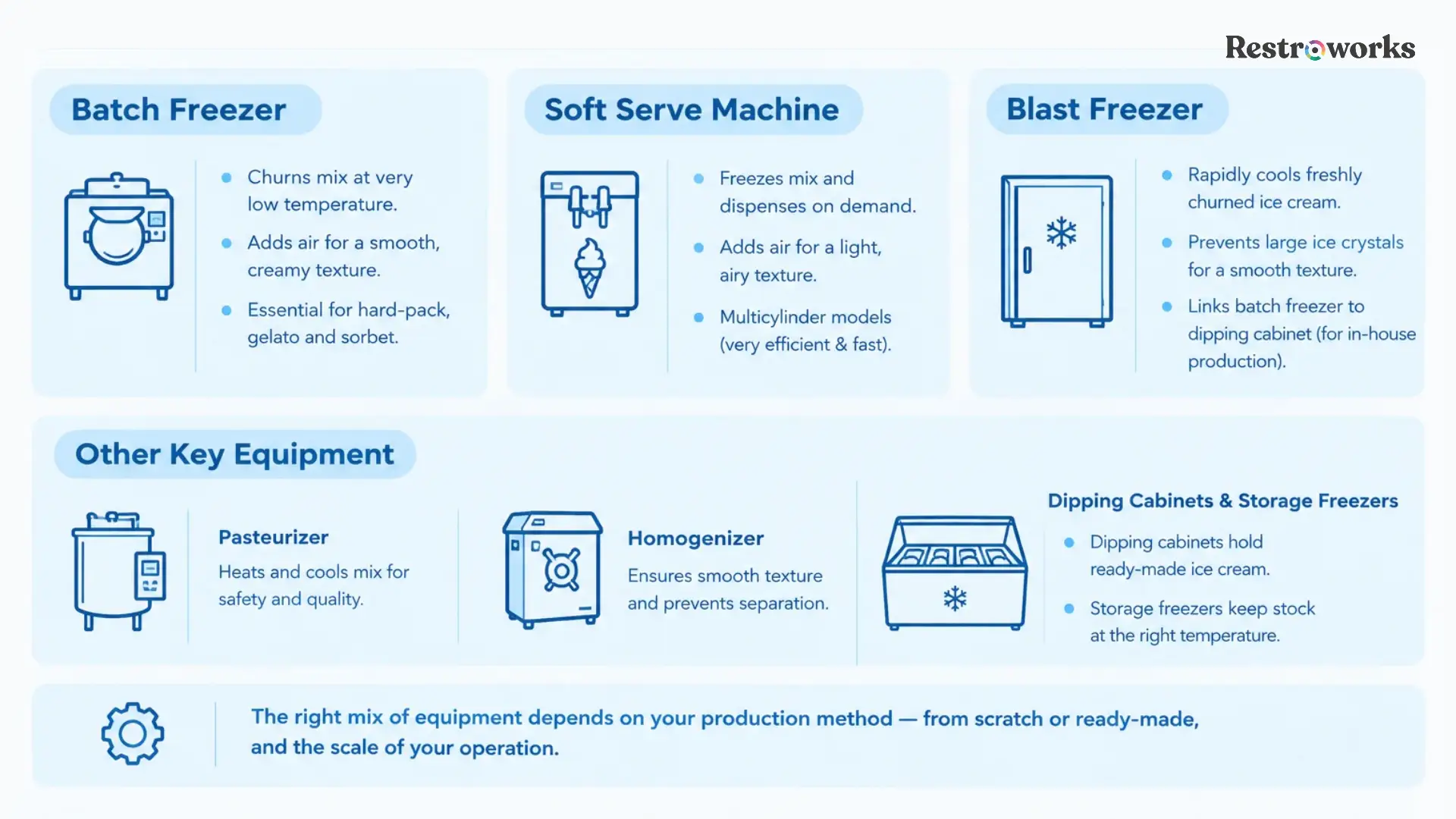
A shop producing ice cream will need equipment such as a pasteurizer, homogenizer, and batch freezer, while an ice cream store selling ready-made ice cream will need dipping cabinets and storage freezers.
1. Batch Freezer
A batch freezer is important for making classic hard-pack ice cream, gelato, or sorbet because it churns a liquid ice cream mix at a very low temperature.
It freezes the mix by adding air to prevent large ice crystals, which would result in dense, coarse ice cream rather than soft, creamy ice cream.
The batch freezer is key production equipment in all ice cream shops because it is essential for producing ice cream. Batch freezers used in this feasibility study cost about $25,000 each.
The gelato machine operates similarly to the batch freezer, but it is adjusted to incorporate less air and produce denser gelato than regular ice cream. Gelato shops that sell gelato as well as other flavors need different machines, since the batch freezer cannot produce gelato.
2. Soft Serve Machine
Soft serve machines freeze the ice cream mix and dispense it on demand, incorporating more air into the product, which gives soft serve its light and airy texture.
A soft serve machine freezes ice cream mix and dispenses it on demand, adding air to make soft serve light and airy.
INDUSTRY INSIGHT
This is because the multicylinder soft serve ice cream machine is efficient, demand-generating, and can serve customers quickly with less labor.
There are two types of multicylinder ice cream machines: gravity–fed, where mix is fed using an overhead hopper, and pump-fed, where mix is pumped into the freezing cylinder.
Good-quality multicylinder ice cream machines for commercial use cost between 8,000-15,000, and installation and setup add an extra 2,000-5,000. Buying below these prices means you’ll get residential-quality products that may not even comply with health codes.
3. Blast Freezer
A blast freezer is crucial for rapidly cooling freshly churned ice cream to prevent large ice crystals from forming, ensuring a smooth texture and longer shelf life for the final product.
The blast freezer helps quickly freeze churned ice cream to avoid large ice crystals that can affect texture. For shops that make ice cream in-house, the blast freezer links the batch freezer to the dipping cabinet. Without a blast freezer, the ice cream won’t freeze to the right temperature.
Stores without this equipment put their products at risk. This is because fresh ice cream loses texture quality when left unattended between production and storage in the dipping cabinet.
4. Storage and Refrigeration Equipment
Storage freezers are crucial for storing large quantities of ingredients and pre-made tubs at low temperatures. Specialized freezing equipment is required for production and storage in an ice cream shop.
A batch freezer is essential for crafting traditional, hard-pack ice cream, gelato, or sorbet, as it churns a liquid ice cream base at cold temperatures to create a smooth texture.
On the other hand, a blast freezer is important for rapidly cooling freshly churned ice cream to prevent large ice crystals from forming, ensuring a smooth texture and longer shelf life.
A display case is crucial for showcasing ice cream flavors, serving as both a sales platform and a visual marketing tool to attract customers.
A batch freezer is essential for crafting traditional, hard-pack ice cream, gelato, or sorbet, as it churns a liquid ice cream base at very low temperatures, freezing the mix while incorporating air to prevent large ice crystals from forming.
5. Dipping Cabinets
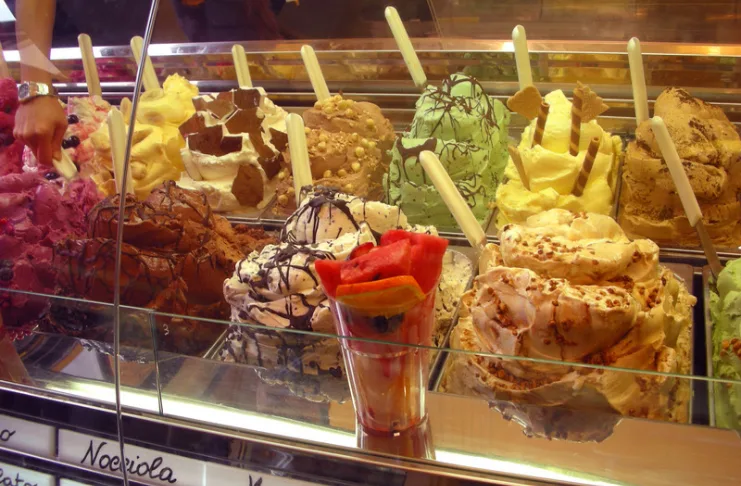
Dipping cabinets are glass-topped cases that hold ice cream flavors and keep them at an ideal, perfect scooping temperature.
A display case is important for showcasing ice cream flavors, as it serves as both a sales and marketing tool to attract customers. Dipping cabinets with glass tops help clients choose between flavors before ordering, which supports upselling and faster decisions during rush hours.
A scoop shop configuration includes several dipping cabinets that display all flavors. Major ice cream shop purchases include commercial batch freezers and dipping cabinets with glass tops.
Small ice cream shops need reach-in refrigerators, while larger venues need walk-in refrigerators and freezers to provide enough cooling capacity, says Katom Restaurant Supply.
Temperature control matters because Baskin-Robbins uses an automated alert system that notifies managers if walk-in freezer temperatures fall outside the optimal range of -10 to -20 degrees.
6. Storage Freezers
Storage freezers play an important role when stores need to keep large quantities of raw ingredients and premade tubs at cold temperatures.
If a store sells ice cream in bulk but does not manufacture it itself, it needs proper freezer capacity to store stock without running out during a busy summer weekend.
Maintaining a constant storage temperature is imperative, as even slight changes can cause heat shock, leading to ice crystal formation and ultimately product spoilage.
Ice Cream Shop Supplies: Service and Topping Equipment
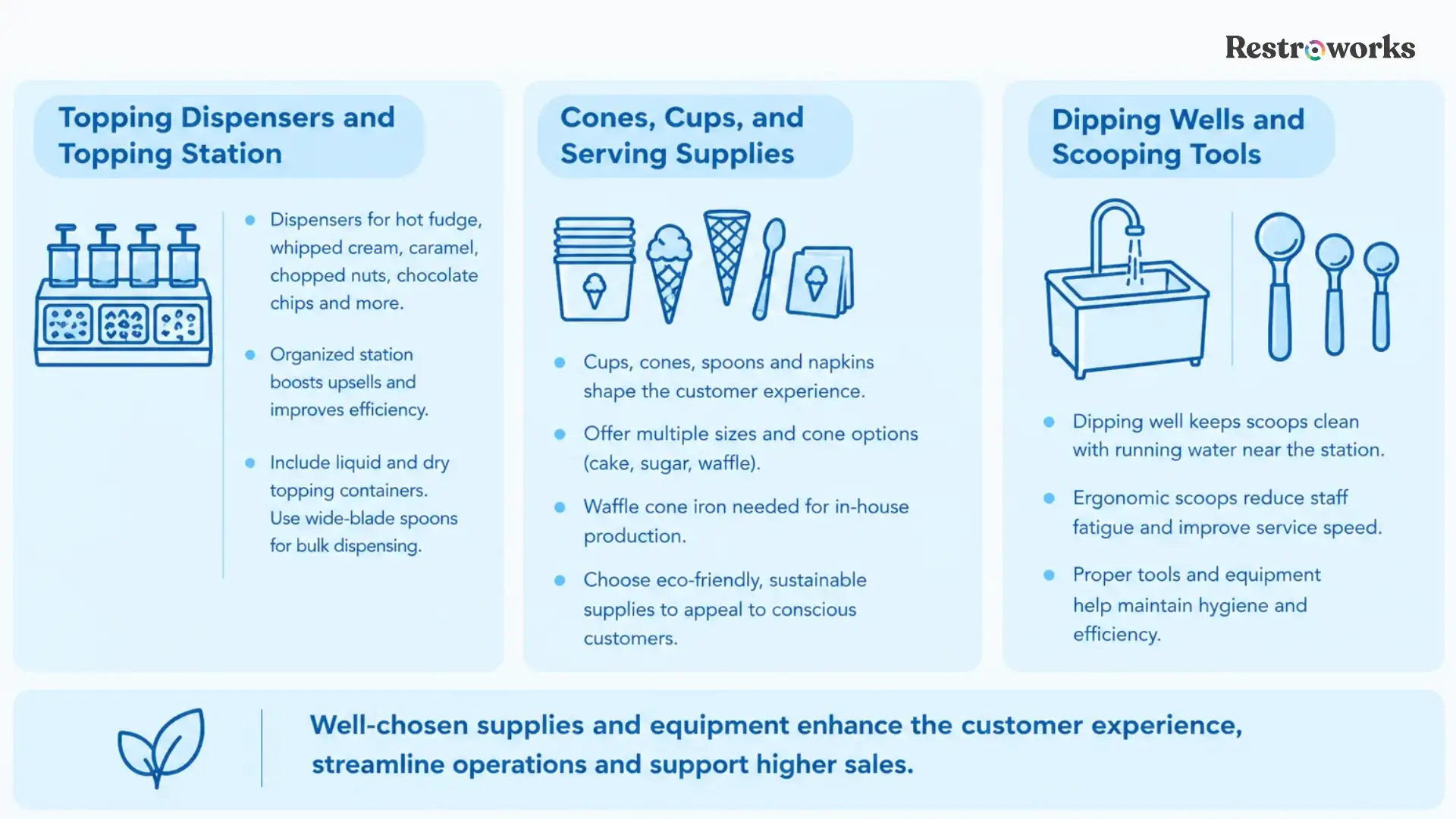
A successful ice cream shop focuses heavily on its supplies. Commercial blenders or spindle mixers are used for creating milkshakes and blending toppings.
A well-organized topping station can enhance customer experience and increase sales by encouraging upsells with a variety of toppings.
1. Topping Dispensers and Topping Station
An effective topping station improves the customer experience and increases sales by encouraging upsells with different ice cream toppings. Topping dispensers store and serve hot fudge, whipped cream, caramel, chopped nuts, chocolate chips, and other additions for cones and cups.
An effectively organized topping station makes the process more efficient and reduces loss from excess topping.
A topping station should include dispensers for liquid toppings such as hot fudge and whipped cream, as well as containers for dry toppings such as chopped nuts and chocolate chips. Wide-blade spoons work well for bulk-dispensing toppings.
A poorly organized topping station will slow the process, even with efficient production machinery.
2. Cones, Cups, and Serving Supplies
Products used in daily activities, like cups, cones, spoons, and napkins, are extremely important for ice cream parlor operations because they define the customer experience.
Cups in various sizes, cake cones, sugar cones, and waffle cones are basic supplies customers encounter during each visit.
In-house waffle cone production will require an additional machine, the waffle cone iron, a small equipment purchase that adds another level of presentation: a freshly baked cone unmatched by packaged counterparts.
Use of environmentally friendly disposable supplies like cups and spoons could appeal to environmentally conscious customers. Sustainable serving supplies are no longer optional but a must among young customers in most US urban markets.
3. Dipping Wells and Scooping Tools
A dipping well allows scoops to be properly cleaned under running water near the dipping station, which is among the hygienic practices health inspectors expect to find in every scoop shop.
Ergonomically designed ice cream scoops help staff members, who serve hundreds of clients every day, especially during the summer, avoid fatigue. Using proper utensils and equipment also shortens service times for each client.
POS Systems and Business Management
The POS system is essential for sales, inventory control, and customer loyalty programs in an ice cream parlor. McConnell’s Fine Ice Creams achieved 55x ROI by implementing the Klaviyo platform, various systems, and unifying first-party customer data across all touchpoints—in-store, deliveries, and e-commerce. It shows how powerful POS integration is and the benefits it delivers.
An ice cream parlor POS system needs to integrate with the inventory system, analyze which unique flavors sell fastest, and allow customers to enroll in the loyalty program.
La Estacion Ice Cream Parlor uses interactive customer satisfaction kiosk tablets in 15 or more stores to collect instant feedback from customers using touchscreen technology and satisfaction scoring. This is what keeps customers coming back.
Food Safety and Health Code Compliance Equipment
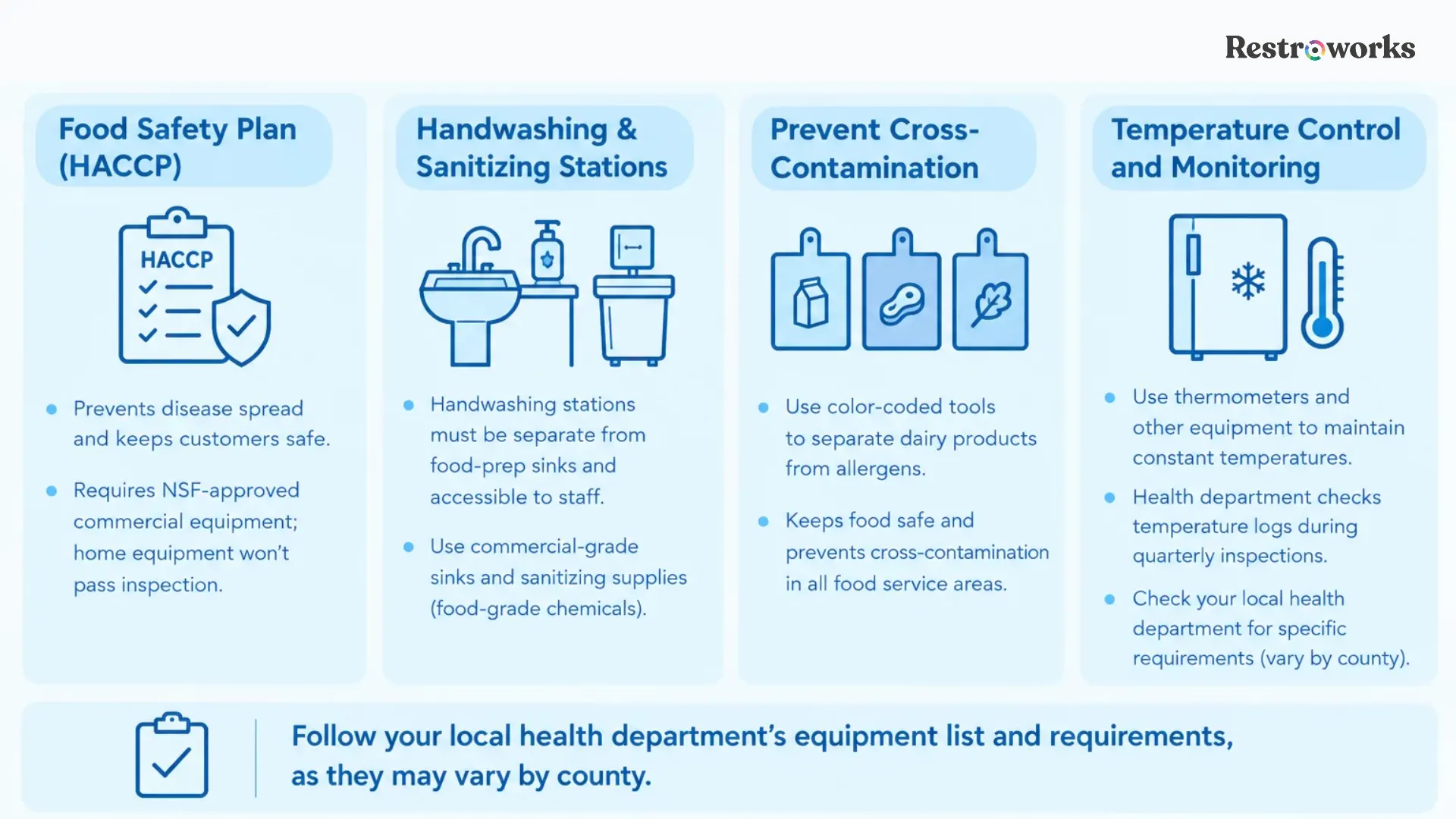
An effective food safety plan, such as HACCP, is critical to prevent disease spread through food and keep customers safe at ice cream shops.
This means that there must be a code that mandates NSF-approved commercial-grade equipment; home equipment would fail inspection.
Handwashing stations should be separate from food-preparation sinks, in places accessible to employees without entering the food-preparation zone.
Sinks and sanitizing stations should be commercial–grade; proper sanitizing supplies, like food-grade chemicals, are needed to ensure hygiene and prevent bacteria in ice cream shops.
Cross-contamination should be prevented in all food service businesses, including ice cream shops, using color-coded tools to separate dairy products from possible allergens.
Temperature controls with thermometers and other equipment are required to prove constant temperature control during storage and when providing the product.
The health department checks temperature logs during quarterly inspections; usually, it should remain at a consistent temperature. Consult your local health department for the equipment list, as requirements may vary greatly by county.
Ice Cream Shop Equipment Costs and Startup Budget Planning
The budget for essential equipment varies depending on the shop you want to open: a basic scoop shop that buys ready-made ice cream will need at least $8,000 for dipping cabinets and storage freezers.
A shop that produces its own ice cream needs a pasteurizer (around $5,000), a batch freezer (starting at $25,000), and a blast freezer ($50,000), excluding refrigeration and other equipment.
Used versus new equipment is a very important issue. Used equipment can be a good way to save money.
However, these pieces of equipment use highly complex refrigeration systems that break down easily; a used batch freezer sold for $15,000 may need $8,000 in repairs. If you cannot afford to launch your food business immediately, this plan is lethal.
Regional utility charges vary drastically for the energy needed to power freezer storage and production equipment; while the same setup consumes $400 worth of electricity per month in Ohio, it will consume $900 in California.
Make sure you factor in your exact regional utility expenses in your budgeting process and prior to choosing your equipment.
Your ideal ice cream shop equipment isn’t the most expensive or the cheapest; it’s the one that fits your production system and facility size from day one.
Purchase NSF-approved equipment, design the toppings counter layout and service process flow before building out, and include your utilities costs in your area.
KEY TAKEAWAYS