
The investment needed to start a franchise restaurant can range from $100,000 to $2 million. And some full-service brands cost even more. That total covers the initial franchise fee, real estate and build-out, equipment, and working capital, with royalties and marketing fees starting once you open.
This is a wide range, but understanding what drives it up or down distinguishes a savvy franchiser from one who runs out of money eight months later. The brand, restaurant format, location, and whether you build new or convert an existing space all play a role.
A franchise gives you a brand customers already know and a proven operating model. That shortens the time it takes to build a customer base and helps you avoid many of the mistakes that sink new restaurants.
The trade-off is a large upfront investment, ongoing fees that cut into early profits, and less freedom to adapt the menu or operations to local tastes.
In this article, we list all the costs involved in opening a restaurant franchise, plus post-opening fees and financial requirements.
What You Will Learn
- Every startup cost category in a restaurant franchise investment
- Ongoing franchise fees and royalties that affect profitability every month
- Financial requirements to qualify, including liquid assets and net worth thresholds
- How to evaluate a franchise disclosure document before committing capital
Average Startup Costs: What You Will Actually Pay
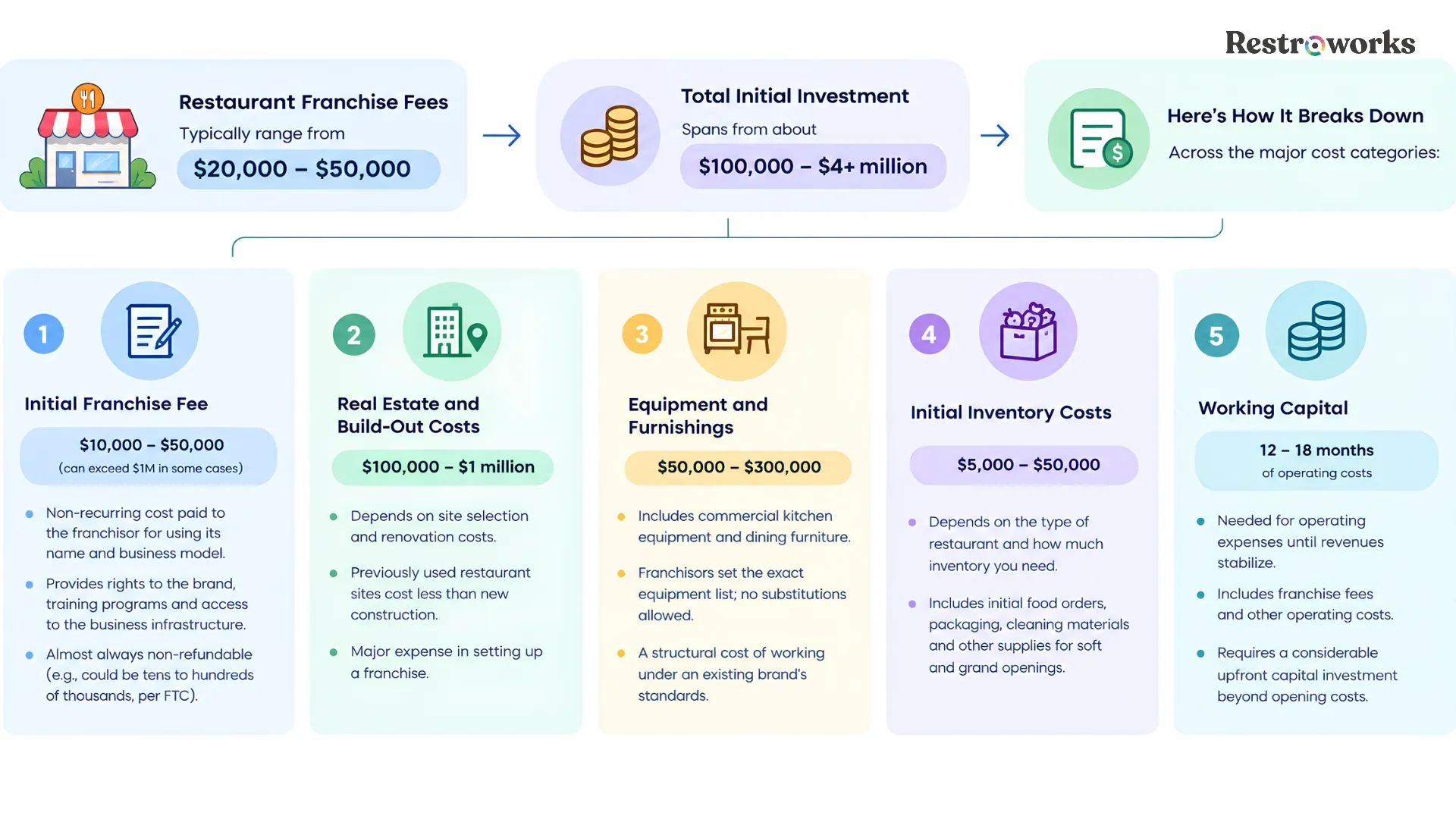
Most of what you’ll pay to open a franchise restaurant falls into five categories: the initial franchise fee, real estate and build-out, equipment and furnishings, initial inventory, and working capital.
Startup costs for opening a franchise can include real estate and construction costs, which depend on the location and size of the restaurant. Overall, the cost of opening a franchise can range from $100,000 to $2 million.
Here is how those numbers break down across the major cost categories:
| Cost category | Typical range | What it covers |
|---|---|---|
| Initial franchise fee | $10,000–$50,000 (higher for top brands) | Rights to the brand, training, and access to the franchisor’s systems |
| Real estate and build-out | $100,000–$1 million+ | Leasing or buying property, construction, and renovations to brand standards |
| Equipment and furnishings | $50,000–$300,000 | Commercial kitchen equipment, dining furniture, and POS systems |
| Initial inventory | $2,000–$15,000 | Opening food stock, packaging, and cleaning supplies |
| Working capital | $25,000–$150,000+ | Day-to-day operating costs until revenue stabilizes |
1. Initial Franchise Fee
The upfront franchise fee is a non-recurring cost paid to the franchisor for using its name and business model and ranges from $10,000 to $50,000; however, it may exceed $1 million in other franchises.
The franchise fee provides you with rights to use the franchisor’s brand and training programs and gives you access to the infrastructure of the business.
The fee is usually non-refundable, as noted by the Federal Trade Commission that initial franchise fees typically range from tens of thousands to several hundred thousand dollars and may be non-refundable.
2. Real Estate and Build-Out Costs
Real estate and build-out costs can range from $100,000 to over $1 million, depending on property selection and renovations required to meet brand standards.
The condition of the building plays a major role in determining renovation costs, as sites previously used for restaurants require less expenditure than those that must be built from scratch.
3. Equipment and Furnishings
Equipment and furnishings typically cost between $50,000 and $300,000 for commercial-grade kitchen equipment and dining furniture. This is one of the structural costs incurred in working under the standards of an existing brand and not your own.
Here’s what some of the main items cost:
| Equipment | Typical cost |
|---|---|
| Combi ovens | $15,000–$50,000+ |
| Deck ovens | $8,000–$30,000 |
| Walk-in coolers and freezers | $5,000–$25,000 |
| Commercial dishwashers | $3,000–$15,000 |
| Commercial Ranges & Grills | $2,000–$8,000 (ranges) $3,000–$15,000 (char-broilers) |
| POS systems | $2,000–$15,000 |
| Floor fryers | $3,000–$12,000 |
| Prep tables | $3,000–$12,000 |
4. Initial Inventory Costs
Initial inventory usually requires $2,000 to $15,000, depending on the type of restaurant and the needs for opening stock. These will include your initial food orders, packaging, cleaning materials, and all other materials you will require for the time of your soft and grand openings.
5. Working Capital
In addition to opening costs, you need enough working capital to fund day-to-day operations until revenues stabilize. Investing in a restaurant franchise usually requires capital because of startup and operating costs.
Costs Involved by Restaurant Type
The type of restaurant you choose is one of the biggest factors in your total investment. Quick-service restaurants (QSRs) are usually the cheapest to open, fast casual sits in the middle, and full-service restaurants (FSRs) cost the most, often exceeding $1 million.
| Restaurant Type | Typical Investment Range | Real Brand Example |
|---|---|---|
| Quick-Service (Small Format) | Low to mid six figures | Subway: $238,625–$536,745 |
| Quick-Service (Large Format) | $1 million+ | McDonald's: $1,008,000–$2,214,080 |
| Fast Casual | $300,000–$1.5 million | Jersey Mike's: $436,176–$1.162 million |
| Full-Service | $1 million+ | Perkins: $1,183,715–$3,290,465 |
Fast Food and Fast Food Franchise Costs
Fast food franchises typically fall in the lower to mid ranges for restaurant franchise investments. Quick-service franchises are usually cheaper because they are smaller and have simpler kitchen needs.
Well-established fast food restaurants often come with a premium attached. This cost also depends on the brand; well-established brands in the industry require higher investment amounts than new brands.
Fast Casual Franchise Costs
The fast casual franchises lie between quick service and full-service in terms of investment amount and difficulty. Food service franchises usually require an investment of $300,000 to $1.5 million.
Full-Service Restaurant Franchise Costs
This is the most expensive restaurant format because the total cost exceeds $1 million prior to working capital. Real estate, dining room specifications, bar facilities (if any), and front-of-house equipment drive high build-out costs compared to the quick service format.
Ongoing Franchise Fees After Opening
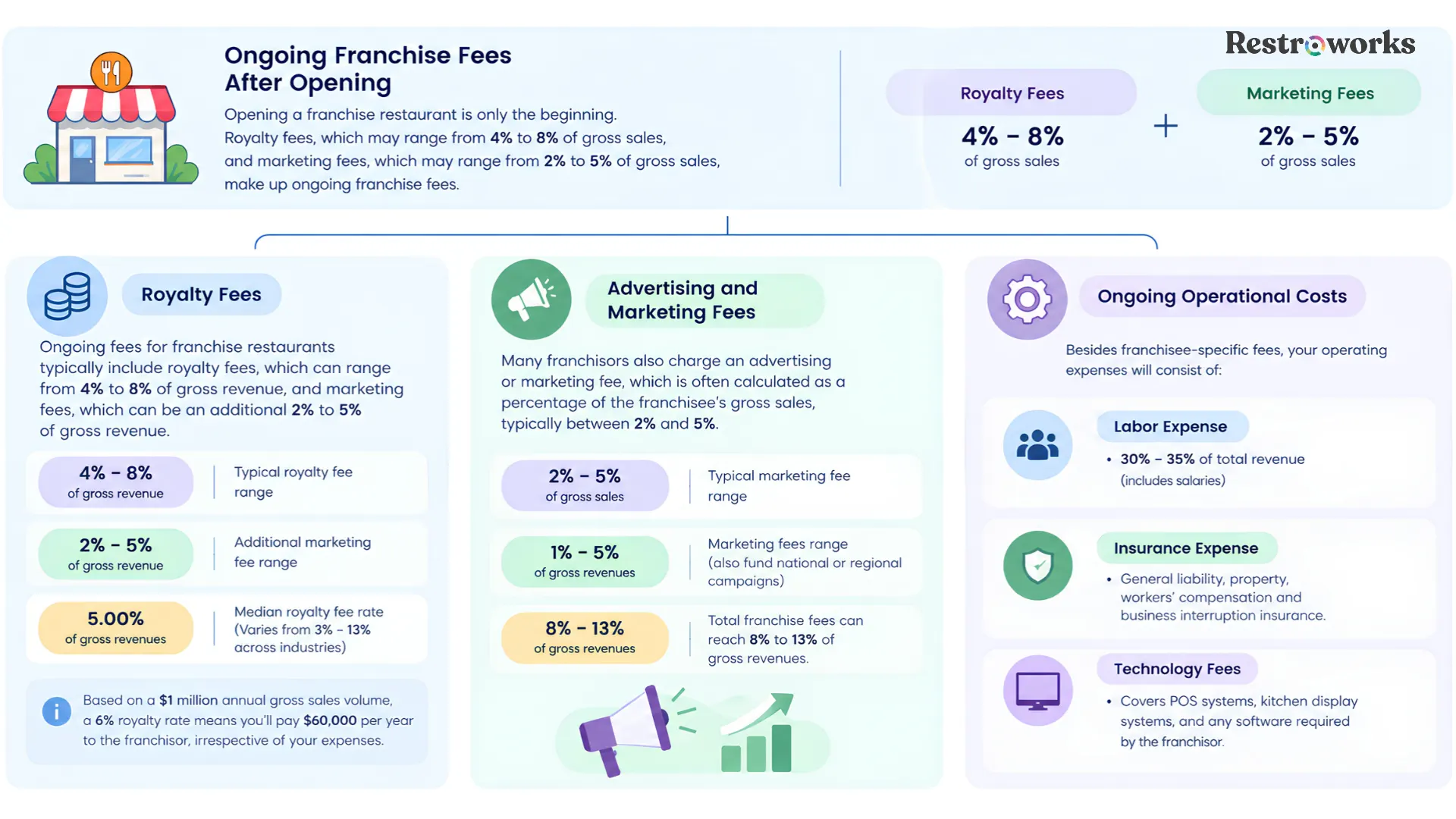
After opening, franchisees pay two main ongoing fees: a royalty fee and an advertising or marketing fee, both usually calculated as a percentage of gross sales. Royalties typically run 4% to 12% of gross sales, and marketing fees run 1% to 4%.
1. Royalty Fees
Royalty fees are recurring payments to the franchisor, usually charged as a percentage of gross sales, for the ongoing right to use the brand and its support systems. Across all industries, royalty fees range from 3% to 13%, with a median of 5.00%, according to FRANdata and BizBuySell. Perkins, for example, charges a royalty of 4% of net sales.
Royalties must be paid whether or not the business is profitable. If your restaurant does $1 million in annual gross sales and your royalty is 6%, you’ll pay the franchisor $60,000 a year, even in a year when you lose money.
2. Advertising and Marketing Fees
In addition to royalty fees, many franchisors will also charge a marketing or advertising fee, usually 1% to 4% of gross sales, to fund national or regional advertising campaigns.
According to a FranConnect study of more than 2,400 FDDs, 72% of franchise brands charge a national advertising fee, and most calculate it as a percentage of revenue.
Some large restaurant brands charge more. Domino’s U.S. franchisees, for example, generally contribute 6% of sales to fund national marketing and advertising.
Ongoing Operational Costs
Beyond franchise fees, you’ll also cover the everyday costs of running the restaurant, with labor usually being the largest. Your operating costs will include:
- Labor costs, which account for around 25% – 35% of sales
- Insurance costs, which comprise liability, property, workers’ comp, and business interruption insurance; and
- Technology costs, including POS, KDS systems, and software fees the franchisor requires.
INDUSTRY INSIGHT
Franchise production will increase from $907.3 billion to $921.4 billion in 2026. Franchising the restaurant will earn the company an additional 7 percent in revenue than if it were not franchised.
However, the extra income from the franchise structure comes from its structural benefits but does not ensure profitability for each unit. A considerable portion of the increase in franchise earnings will come from losing market share to competing national chains, not independent restaurants.
Fast Food Chains Cost Examples: Chick-fil-A, Burger King, and Others
Fast food franchise costs vary widely by brand. Chick-fil-A charges just a $10,000 franchise fee, while a new Burger King can cost $2 million or more to open. Understanding the costs of individual brands gives you more insight into the ranges above:
| Brand | Initial Franchise Fee | Estimated Total Investment |
|---|---|---|
| Chick-fil-A | $10,000 | $427,000 to $2.3 million |
| Subway | $15,000 | $199,135–$536,745 |
| McDonald's | $45,000 | $1,008,000–$2,214,080 |
| Burger King | $50,000 | $348,400–$3,320,600 |
Major fast food chains within the QSR segment differ significantly in cost structure; however, they share the ability to build brand recognition from the start. One advantage of restaurant franchises is immediate brand recognition.
Financial Requirements: Do You Actually Qualify?
To qualify for most major restaurant franchises, you’ll need to meet the franchisor’s minimum net worth and liquid asset requirements, which for big brands are often $1 million or more in net worth and $500,000 or more in liquid assets.
For instance, Burger King requires a minimum net worth of $1 million and liquid assets of $500,000.
The minimum net worth and liquid asset requirement stated in the franchise disclosure document is not a recommendation; it is rather the minimum below which the application will automatically be disqualified without entering the evaluation stage.
Beyond finances, the best franchise brands evaluate the level of experience of the operator in operations and management. Franchising is a business concept that works, and the franchisor protects it by ensuring it’s run by people who can deliver it.
Franchise Disclosure Document: What to Review Before You Commit
A Franchise Disclosure Document (FDD) is the legal document franchisors must give potential franchisees before they sign an agreement or pay any money. Under the FTC’s Franchise Rule, you must receive it at least 14 calendar days before signing.
The FDD has 23 sections, called “Items,” that cover the franchisor’s financial performance claims, franchisee lists, litigation history, and fee structure- everything you need for due diligence before opening a franchise restaurant.
Important items to look into:
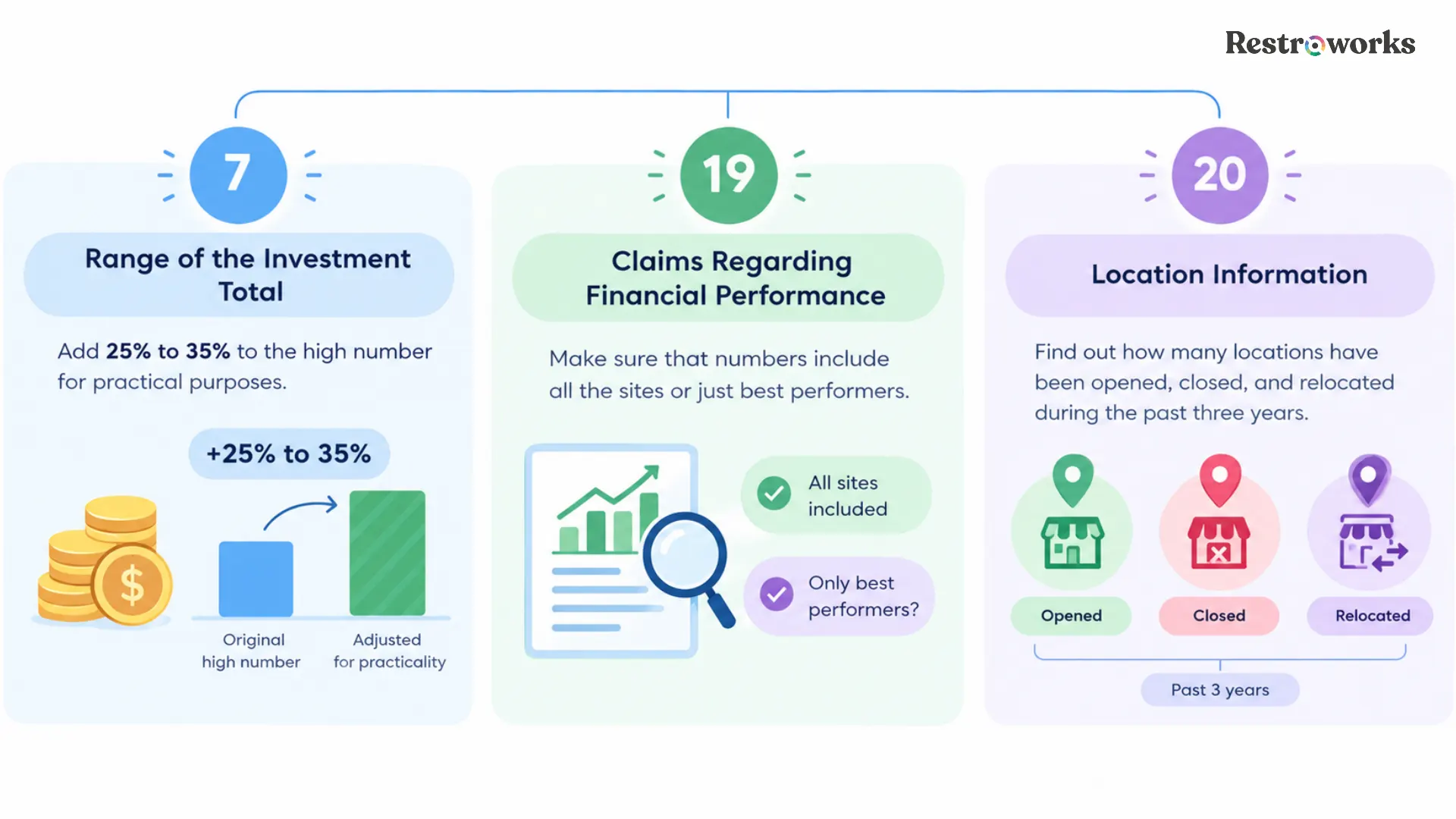
- Item 7: Range of the total investment: add 25-35% to the upper bound for real-world purposes
- Item 19: Statements about financial performance: ensure that the figures include all the outlets or only the best-performing ones
- Item 20: Information on location: ascertain the number of outlets that have been opened, closed, and moved in the last three years
Consult an attorney who specializes in franchise law when you get the contract. It won’t cost you a lot considering your future investments ($2,000 to $4,000).
KEY TAKEAWAYS
- Costs to set up the franchise restaurant could range from $100,000 to over $4 million, depending on the specific franchise restaurant, and initial–stage costs must be considered alongside the figures stated above.
- Ongoing costs include franchisee fees, comprising royalty fees (4 to 8 percent of total sales) and marketing fees (1 to 5 percent of total sales), which affect each dollar earned.
- Minimum standards related to financing include net worth and liquid assets required, these can differ drastically among various franchises, so make sure you have enough of both.
- Financial data on how well the particular franchise performs will be provided in the franchise disclosure document.
Frequently Asked Questions
1. What is the cheapest franchise restaurant to open?
The least expensive franchises generally range from $50,000 to $150,000 in total investment and usually represent smaller-format concepts such as sub-sandwich restaurants, smoothie cafes, or counter-service restaurants that don’t require elaborate construction.
These cheaper restaurants lack brand recognition but offer a cost advantage and usually require hands-on effort to keep operating costs down. Restaurants with low initial fees and simple kitchens are the fastest way for a capital-strapped entrepreneur to start their own restaurant.
2. Can you open a Chick-fil-A for $10,000?
The initial franchise fee for Chick-fil-A is very low, at $10,000, one of the lowest in the restaurant industry. However, despite the low fee, you cannot open your own Chick-fil-A restaurant with only $10,000 because the company owns the property and all equipment, which reduces start-up costs but means the franchisee owns no assets.
Chick-fil-A is a very selective company and rejects most financially capable individuals.
3. Is owning a franchise restaurant profitable?
Owning a franchise restaurant can be profitable; top-performing QSR franchise operators generate average unit volumes approaching $4 million with operating margins of 12 to 15%.
Franchises operate under predetermined rules and guidelines, which can limit the franchisee’s freedom to adapt to local market conditions.
Negative publicity or customer dissatisfaction at other franchise locations can reflect on an individual franchisee’s restaurant, potentially affecting customer perception and performance.
4. What franchise can I start with $10,000?
Owning a franchise restaurant can be profitable; top-performing QSR franchise operators generate average unit volumes approaching $4 million with operating margins of 12 to 15%. However, profitability is not guaranteed.
Franchises operate under predetermined rules and guidelines, which can limit the franchisee’s freedom to adapt to local market conditions. Negative publicity or customer dissatisfaction at other franchise locations can reflect on an individual franchisee’s restaurant.