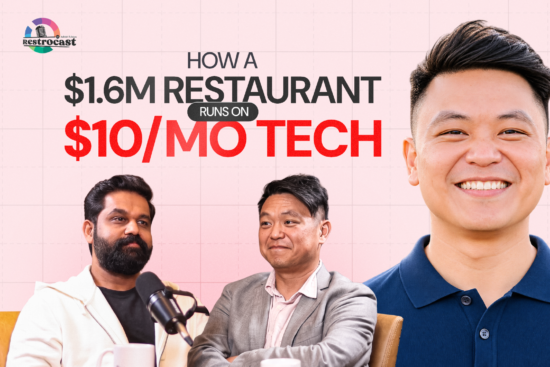
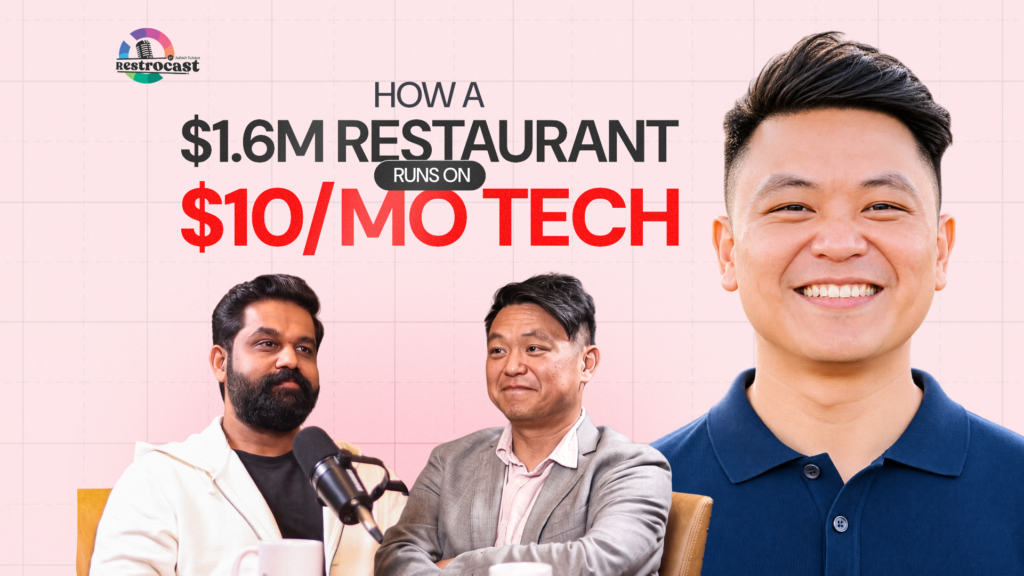

Most restaurant leaders buy their technology. Angell Tsang builds his. As Chief AI Officer and Co-Founder of Tso Chinese Takeout & Delivery, Angell brings a software developer’s mindset to a digital-first Chinese restaurant brand that now operates five locations in Austin, Texas. From its first order in 2017, Tso has run on in-house technology, and today much of the business is supported by AI agents that Angell and his team built themselves.
Angell joined Ashish Tulsian, Co-Founder and CEO of Restroworks, on Restrocast to talk about building a restaurant brand from the ground up with technology at its core. Here are the highlights of their conversation, from pioneering autonomous delivery and putting AI agents to work to his belief that the real purpose of all this technology is to bring people closer to what makes restaurants special.
How did you get into the restaurant industry?
Like many people in this industry, I didn’t plan it. My career has been in software development, working across a number of startups. In 2016, a close friend who was running a full-service Chinese restaurant shared an idea with me. He had previously run quick-service restaurants, and his favorite part of that business had always been takeout and delivery. He wanted to build a Chinese restaurant that was entirely takeout and delivery, with every order placed online. I assumed we could simply buy software to do it, but at the time there was no solution that met our needs. We wanted a fast, mobile-first ordering experience, and we wanted to run our own deliveries, batching two to four orders in one car heading in the same direction to maximize deliveries per hour. Building and running software teams was what I knew, so I decided we would build it ourselves. We wrote the ordering platform, the delivery logistics, and eventually the kitchen display system, all running in the browser.
What was it like to build a restaurant’s technology from scratch?
For three years, I worked a day job while building Tso. Early in the morning, I joined stand-ups with our engineers, and after work I did deliveries for the restaurant so I could test what we had built. My partner ran restaurant operations, and I handled the technology. I’m a strong believer in browser technology, and we built everything that way, right down to receipts printing automatically as orders came in. Our first location opened in 2017, and in its first year we did $1.6 million in sales, all online. That told us people were ready for digital ordering for takeout and delivery. When we opened our second location in 2019, we still had no point-of-sale system in the store. If guests wanted to order in person, we reminded them they already had one in their pocket. Then COVID changed everyone’s culture around online ordering, and we were already three years in. Even today, around 98% of our revenue comes from digital orders.
How has Tso’s approach to delivery evolved over the years?
For a long time, we ran all our own deliveries. At one point, we had 25 cars wrapped in bright colors with our logo and about 60 drivers on our team. It turned out to be an amazing idea, because every delivery doubled as advertising in the neighborhood, and our drivers brought real hospitality to the front door. By 2023, however, rising labor and insurance costs made that model unsustainable, so we moved to white-labeled delivery partners. This past summer, we became the first restaurant in the world to deliver with autonomous Teslas through a partner operating within Austin’s robotaxi network. Guests who choose autonomous delivery love it. The cost per trip is a fraction of a traditional delivery; there is no tip, and every order is fully trackable. We now have around 14 vehicles running, some carrying our branding, and when demand outstrips supply at peak dinner times, orders move to our delivery partners. It isn’t the same as the hospitality our own drivers once offered, but it solves many of today’s delivery challenges.
What led you to become Chief AI Officer, and where did your AI journey begin?
I’ve been fortunate to focus entirely on technology at Tso, and over the past several months I changed my title to Chief AI Officer as we became a fully AI-integrated company. It started with an old computer I was about to sell. I decided to experiment with an AI agent framework on it, and we built our first agent, Tsora. Every agent since has carried a “Tso” in its name, from our finance agent, Tsolomon, to our SEO agent, Tsolaris. I treated those early agents the way you would treat a new employee you don’t yet fully trust. They got their own credentials, limited permissions, and a sandbox to work in, away from production. The first real automation came in catering. Our catering team had to accept orders from delivery platforms within minutes, at any hour, which meant someone was always on call, even on weekends and holidays. Tsora wrote the code to automate that process, then worked through all 20 of our catering platforms, rewriting each standard operating procedure for both humans and AI. Today, that automation runs reliably at virtually no cost.
Beyond catering, how are AI agents transforming the way Tso operates?
I had a long wish list of things I wanted to do but didn’t have the time, money, or expertise for. One by one, we built them. Today we have our own CRM, a customer data platform, an SEO agent that researches and updates our website every day, and our own business intelligence tools, each costing around $10 a month to run. We also built a centralized digital advertising manager that runs campaigns across every major ad network, segmented by location, zip code, and whether we are acquiring, retargeting, or retaining customers. That level of complexity would be almost impossible for a team of people to manage. It also changed how we measure marketing. I used to optimize for return on ad spend, but revenue doesn’t tell the whole story. Our agents can see every transaction, food cost, and invoice, so we can calculate the profit on each order and measure profit on ad spend instead. And our tech team is the same size it was before. We are simply doing far more.
How do you address concerns around security, compliance, and code quality?
Skeptics often ask about security, compliance, and privacy. My answer is that we build those concerns into how our agents work. We have a dedicated legal and compliance agent that reviews every code change, and another for testing that writes unit, integration, end-to-end, negative, and load tests. Nothing gets merged until it is truly done: developed, tested, and covered by automated tests. A year ago, our test coverage was poor. Today it is close to 100%. Most of the worries people have about AI come from the same experiences we have all had of shipping untested code. If you ask one AI tool to do everything, including reviewing its own work, you will be disappointed, just as you would be if one person wrote, reviewed, and tested their own code. That’s why we use a diverse mix of AI models and ask them to act as hostile reviewers. No code moves forward until several agents have reviewed it and reached agreement.
Many software vendors fear a future where customers build their own technology. Where do you stand on that?
I may be a little unusual in the restaurant industry, but I don’t think I’m that different from anyone who is passionate about the tools available to them. When I have a question, I ask it, I learn, and I keep going until I understand what is possible. With the right guardrails in place, I am often just one prompt away from building what I need. That said, vendors with proprietary data or hard-to-access integrations remain valuable, because data is something I can’t create out of thin air. Data is the new hard currency, but for entrepreneurs, the real currency is desire, passion, and will. I also value relationships, and I weigh cost, current functionality, and whether a founder can innovate faster than I can imagine. Even when something is possible, there is still the question of focus and priorities. My view is that we have lived in a linear world, but technology is now moving on an exponential curve. People talk about skating to where the puck is going, but the puck no longer moves in a straight line. You have to skate on the curve. And I think there is a real opportunity for vendors here. Many operators would love to build like this but don’t think they can. A vendor who brings that same passion can be the partner they are looking for.
With so much technology in place, what is your ultimate goal for Tso?
Scaling the restaurants themselves is a different challenge, involving capital, real estate, and construction, and that is led by my co-founder and CEO. My goal is to help the company focus on what makes restaurants wonderful, which is the human component. Nobody gets into this business because they want to work on spreadsheets, insurance, taxes, or menu modifier settings. They get into it because they want the food to be great and their guests to be delighted. If our team can spend far less time on keyboards and far more time thinking about our guests, talking to them, and making the food better, then I have done my job. Ideally, as we grow, the corporate side won’t have to grow with us, because so much of it is handled by technology. You want to see a guest taste your food and watch their face change. That is why people get into restaurants.
How do you keep up with technology that is changing this quickly?
It takes daily effort. I keep track of the latest models, their benchmarks, and their costs, because the landscape changes every few weeks, and something that didn’t work a few months ago may work beautifully today. I compare options closely, so I always know what each model costs and where the best value lies. I also learn a great deal from the industry. I attend many restaurant technology conferences and speak on panels about practical uses of AI, and I have frank, open conversations with our vendors about their capabilities and costs. But I never lose sight of why I do it. Food and the social moments around it are something truly special. Everything I am doing with AI and code is meant to bring us closer to that core humanity of sharing a meal and delighting someone with food. AI will never replace that. If anything, it can give all of us more time for those moments, and I believe that, in the end, is what most of us are working for.
Conclusion
Angell Tsang’s story is a reminder that the most advanced technology in a restaurant can serve the simplest purpose. From coding before work and delivering orders after it, to running AI agents that handle much of the back office, he has built Tso Chinese Takeout & Delivery on a recipe of curiosity, discipline, and a deep respect for hospitality. Whether you are an operator wondering what AI can truly do or a technology partner rethinking your role, his perspective offers insights worth savoring. Wok, code, repeat, and never lose sight of the guest.