

How to Start an Ice Cream Franchise

How to Start an Ice Cream Franchise: A Step-by-Step US Guide

Home / Blog /
How to Start an Ice Cream Franchise: A Step-by-Step US Guide

Read summarized version with

Amy Simmons, who is the founder of Amy’s Ice Creams (Austin), said, “People don’t just go to an ice cream store because they’re hungry. They go because they’re happy, or because they want to celebrate, or because they’re going on a date. It can be a reward. There’s something about it that’s just bigger than food.”

In fact, the data shows that the global ice cream market size stood at $121.4 billion in 2025 and will amount to $169.4 billion by 2033. In the US alone, the ice cream stores industry has grown at an annualized rate of 5.8% over the five-year period up to 2025, which in a way confirms the fact that if you do it right, an ice cream shop can be one of the most profitable business formats you can get into in the entire hospitality industry.

But, again, as Mazen Kanaan, CEO of House Pops, says, “You need to have a bit of foolishness in order to start [an ice cream business],” because no matter how much passion you have for ice cream and everything around it, fantasizing about the sector will get you so far. It’s only when you pair your foolishness (desire to actually get started) with repeatable systems that you’re bound to find success – and the good news is that franchise models are built exactly for that – to give you a proven system, i.e., repeatable systems that you can rely on.

So, how do you start an ice cream franchise? This article discusses the same in depth.

What You’ll Learn

  • How can you evaluate whether a particular ice cream franchise opportunity is good for you or not? + How do you estimate startup costs and total investment, and build a proven business model?
  • Best strategies you can employ to manage seasonal sales (because an ice cream franchise is best in summer, of course), control operating costs, increase customer loyalty, and scale your business. 

Step 1: Understand the Common Business Model That Works in the Ice Cream Industry

The ice cream industry has a structural advantage that most others don’t have, i.e., multiple revenue channels feeding into a single operation. As Kanaan explains from his own experience building House of Pops:

“In our model, we operate around seven channels. We have our own shops, we service the hotels, restaurants, cafes, we do events, we do catering, we do online. We are present in the supermarkets; we do schools.”

Basically…multi-channel reach is central to the economics of any ice cream franchise.

That’s why, before you pick a franchise brand, you need to decide which business model fits your goals, your city, and your lifestyle.

Ice cream business formats compared by startup cost range and ideal use case.
Format Startup Cost Range Best For
Brick-and-Mortar Franchise Easily $300K–$700K for a conventional branded franchise.
For example, a Baskin-Robbins franchise requires an initial investment of $307,400–$626,700.
High-traffic areas
Higher brand visibility
Independent Ice Cream Parlors $75K–$250K Niche markets and owners who want greater creative control.
Mobile Dessert Businesses $10K–$100K, depending on whether you choose a cart or a truck. Events, parks, and neighborhoods where you can reach customers on the go.
Kiosk / Small Scoop Shop $25K–$100K+ High-foot-traffic malls, airports, and compact retail locations.

Each format varies widely depending on location, lease terms, and the franchisor’s requirements. Mobile dessert businesses and ice cream trucks tend to offer lower overhead costs, and so they are seen as businesses with more attractive entry points. Ice cream trucks, in particular, have made a solid comeback in recent years as operators are now starting to discover how impulse sales in high-traffic areas boost revenue by multiple folds, and that too without you having to pay fixed rent.

Step 2: Do the Market Research to Gauge Demand for Ice Cream and Frozen Yogurt

The biggest mistake, if I were asked to point to only one, you can make is not doing market research. Kanaan, on this, says, “We opened a shop [at an IFC business district]. It failed miserably. We closed it. Although the rent was very low.” Even though their core customers did work in that building, they didn’t actively buy ice cream…sales weren’t consistent at all. What the team learned from this was that as much as the target market matters, so does the moment of consumption within that market. No matter how many potential customers you have, if they remain potential only…like if they don’t buy for real…what’s the use?

That’s why experts advocate for good market research. How? It’s easy – wherever you plan to open your franchise, just go walk around that area at different times of the day. Observe foot traffic on both weekdays and weekends at 11 am, 3 pm, and 7 pm alike.

You can also try to talk to people in the community about whether they like to have ice cream or not, if they have teens or children at their home, and when they usually prefer to buy ice cream, if at all. 

Alexandre Bachir, owner of Bachir Ice Cream, says, “I started doing it two years after arriving in Dubai. I tried to understand the market first because I knew that Dubai is a very big market, very competitive.”

To sum, what you should do at this step is:

  • First of all, go and map all existing ice cream, frozen yogurt, Italian ice, and other frozen dessert businesses that are within a 2-mile radius of where you want to open your own store.
  • Next, identify seasonal demand patterns specific to your climate zone.
  • Survey 50 to 100 potential customers in the target location to validate pricing strategies.
  • Assess whether you’re entering a market that needs another unit of the same chain or something new.
  • Research which franchise opportunities are SBA-listed, as SBA-backed lenders favor brands on the directory. This will help you get the funding easily.

Once you’ve analyzed all those – 

Step 3: Choose the Best Franchise Opportunities and Understand their True Costs

The initial franchise fee for ice cream franchises is usually between $25,000 and $100,000, depending on the chain you want to franchise of – for this, franchisees need significant liquid capital and a healthy net worth.

For multi-unit franchises, your total investment may even reach $500,000 or more over time.

If you’re already clear with money stuff, here are some of the best franchises with the largest market share in the US:

  • Dairy Queen
  • Baskin-Robbins
  • Cold Stone Creamery
  • Ben & Jerry’s
  • Kona Ice
  • Jeremiah’s Italian Ice
  • Rita’s Italian Ice

Cold Stone Creamery, for reference, grew from a single franchise location in Tempe, Arizona, in 1995 to more than 900 store locations across the US and international markets today.
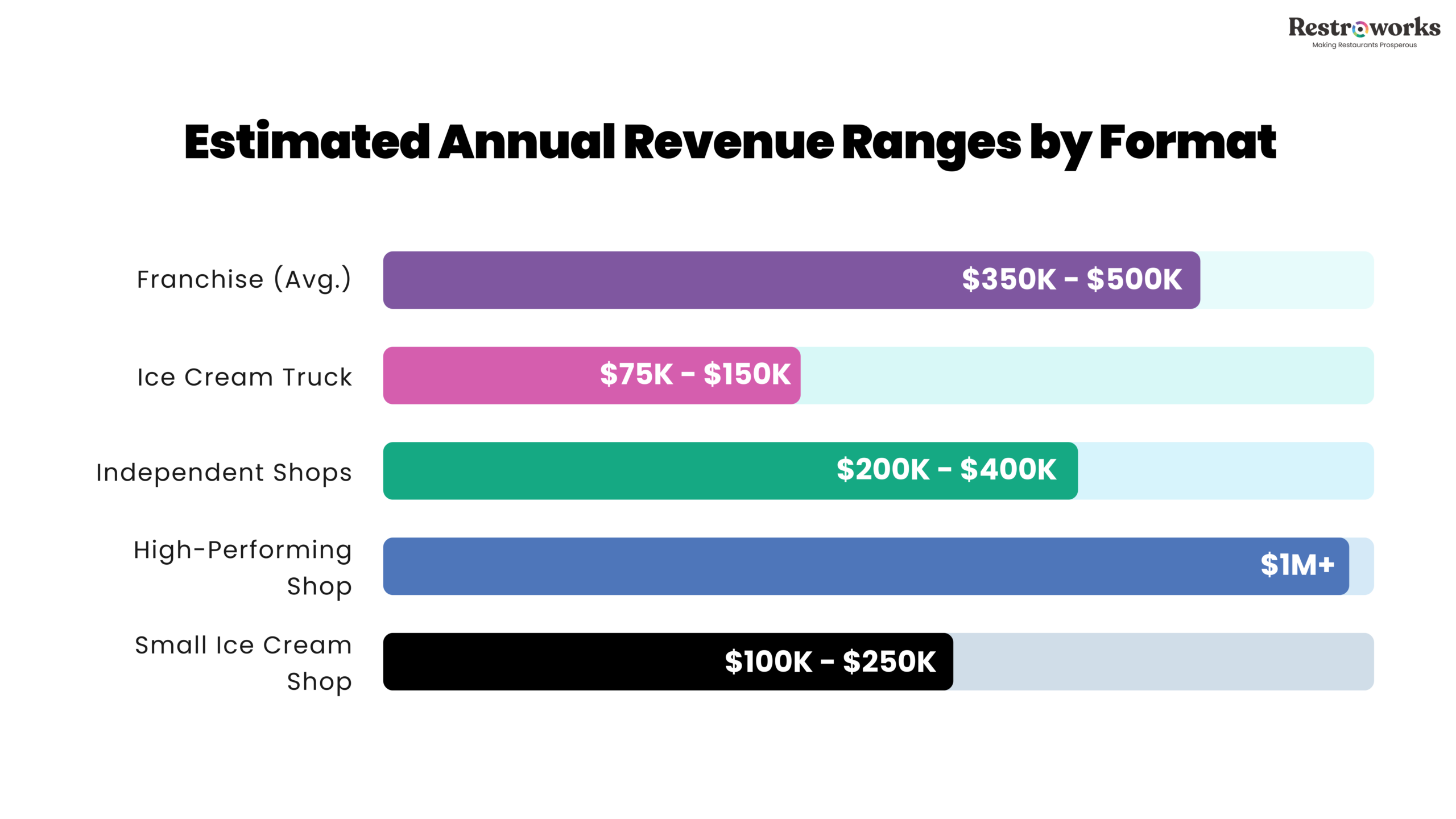
How to choose best franchise opportunity based on their estimated annual revenue

Profit margins for ice cream stores vary based on business model, with independent outlets averaging 15% to 25%, franchises 12% to 20%, and mobile operators 20% to 30%. When evaluating revenue ranges from any franchisor’s Franchise Disclosure Document (FDD), always ask for audited financials from three to five franchisees in markets similar to yours, and ask what marketing support the franchisor provides.

Step 4: Lock Down Your Location Strategy

Among all the key factors that determine the success of an ice cream store, location sits at the top. Ice cream stores that are strategically located near schools, amusement parks, or tourist spots tend to perform better due to increased foot traffic, while poor location choices are a leading cause of failure. Rent in busy areas can take up 9% to 15% of an ice cream store’s revenue, while suburban or neighborhood locations typically cost less, ideally aiming for rent to be around 5% to 8% of revenue.

Basically, your goal should be to be in the location where your target audience already is – in a good mood, already moving, and already spending.

Like, near a movie theater, a public park, near a stadium…people naturally spend more at these places, and so they will probably spend on a delicious ice cream too, especially because people rarely buy an ice cream to satisfy hunger. Amy Simmons says they do it “to celebrate, reward themselves, or simply feel something good.”

As for the type of outlets, gourmet and super premium ice cream stores and artisan parlors tend to outperform in dense urban ZIP codes with median household incomes above $65,000. But even in price-sensitive markets, premium positioning built on artisanal quality and high-quality ingredients (think fresh fruit, waffle cones made in-house, or gluten-free options) can support higher average order value and stronger customer loyalty.

Step 5: Build Your Financial Model Around Gross Sales and Control Your Costs

Many ice cream parlors serve 100 to 300 customers daily at an average ticket of $5, potentially generating $30,000 a month in gross sales with a 20% net profit margin, resulting in $6,000 in profit each month. The biggest problem here is that fixed and variable costs vary widely depending on the time of year, and summer can account for up to 70% of annual revenue for ice cream stores, meaning a poor winter plan can, in a way, erase every effort you put into a strong summer.

Recommended restaurant cost percentages as a share of revenue, with warning signs for cost control.
Cost Category Recommended % of Revenue Warning Sign
Labor Costs 30%–40% High risk above 42%
Rent / Occupancy 5%–15% Review above 15%
Cost of Goods Sold 25%–35% Danger above 38%
Marketing 3%–6% Invest here
Operational Costs (utilities, packaging) 8%–12% Monitor closely

As for labor costs, try to keep it between 30% and 40% of your ice cream store total revenue. How can you do this? There are some ways:

  1. By efficient scheduling – don’t over- or understaff at any location.
  2. Cross-train employees so they are capable enough to handle multiple roles, as the demand calls for.
  3. Employ part-time or seasonal workers during weekends and holidays.
  4. Account for payroll taxes when you’re accounting for your annual revenue projections. Payroll taxes may add 7-10% on top of base wages.

Plus, invest in proper inventory management. It will help you closely monitor stock levels, order the right quantity of fresh ingredients, and reduce waste/spoilage. 

Step 6: Build a Customer Experience System

If you listen through the entire Restrocast podcast featuring Mazen Kanaan, the biggest lesson there is that the product (the one you intend to sell – here, ice cream) is never the whole product (it’s not the only thing you sell – you sell experience as well).

That’s why Kanaan says, “The single factor that can drive high sales or lower sales is the promoter, so they are a great asset for us. So we only recruit people who are happy. Who can, you know, have a high-pitched voice. They can be singing.”

And the most important thing is that this experience should be replicable across each of your locations – everything “from the greeting to how you serve customers to what kind of best seller to suggest to up-trading, to closing, to asking them to take the loyalty card, to follow us on Instagram.”

To maximize your sales and encourage repeat business, what you can do is combine comprehensive training in customer service with structured incentive programs so as to keep your employees motivated enough to work on delivering great service, increasing upsells, and driving repeat visits.

Step 7: Plan for Seasonality

Seasonal demand significantly impacts ice cream store revenue, with summer months accounting for up to 60% of annual sales, while winter months can see a revenue drop of around 30%. Ice cream parlors that do not plan for seasonal fluctuations may face cash flow issues, as fixed expenses remain constant while customer traffic decreases during off-peak months.

So, the most important thing here is to understand how you can mitigate the impact of the off-peak season on your ice cream franchise in the first place. There are certain ways to do it:

  • You can have fun with your menu items as per the season. Soft ice cream, refreshing Italian ice, and shaved ice are obvious, but maybe, if you can, you can include some warm desserts and beverages like hot chocolate or oatmeal in your menu.
  • You can reach out to some local businesses in your community that you can potentially partner with to keep your sales on track.
  • If it works for you, you can try giving catering services, launching subscription boxes, and even selling branded merchandise – these will diversify your monthly source of income and keep your business afloat. 

INDUSTRY INSIGHT

Lately, the ice cream franchise industry (and the larger frozen dessert industry) has been undergoing a structural shift. There are four key trends that are taking over:

Health is the new indulgence

Consumers now demand natural, low-sugar (hello, frozen yogurt), and allergen-free options. In fact, that’s a baseline expectation in urban markets.

Distribution is the moat

The food delivery industry has doubled in the US and is worth more than $150 billion globally. If you’re still not online and doing doorstep delivery of your ice cream, you might be leaving some obvious cash on the table.

Data analytics closes the assortment gap

Franchisees are now actively using sales, customer, and inventory data to understand which flavors, formats, and products drive more demand and when. This helps them improve margins and ensure each location stocks what its customers actually want.

Flavor globalization is accelerating

According to Innova Market Insights (2020), 64% of US consumers are very much interested in discovering new flavors from other cultures around the world as well. Successful independent ice cream parlors and franchises are now starting to add South Asian, Latin, and East Asian flavor profiles to their menu as well.

Are Ice Cream Franchises Profitable? 

Yes, with the right systems, ice cream franchises are indeed profitable.

Ice cream stores in the U.S. typically generate between $200,000 and $500,000 in annual revenue, with high-performing outlets even crossing the $1 million mark. Independent parlors average 15% to 25% profit margins, and mobile ice cream carts can reach 30%.

But again, you can’t be asking “are ice cream franchises profitable?” without asking “under what conditions?” because trust me, they play a huge role.

The franchisees who build genuinely profitable businesses measure their daily sales, they track monthly sales by SKU, they train relentlessly, and they stay close to the customer and the community (like they literally understand what their customers want by the back of their hand) even as they grow.

And if you want to do this, the first thing you need to change right away is that you need to stop thinking just like an operator…everyone who owns a business does that…you need to start thinking like a strategist. Especially because ice cream franchisees tend to see very immediate visibility in the market, and their branding feels very familiar from day one (maybe because the menu, no matter what ice cream shop you go to, is something customers already know and love), the business can be very, very profitable, given you can select the right brand, right location, and the right team from the start.
Are Ice Cream Franchises Profitable?

Remember this very well – whether you want to run just a small ice cream parlor in a local neighborhood or want to take on a multi-unit brand, you must respect both – the joy that your product brings to you, your staff, your customers, and the discipline it needs to run the business around it. Build your systems, hire people for happiness and fun, and never (I say, never) underestimate the power of a loyal customer who returns not because they have to, but because, somehow, your store has become a part of their best days.

KEY TAKEAWAYS

  • Before you sign any document, I’d ask you to please read the FDD line by line, especially Item 7 for costs and Item 19 for earnings, and have a lawyer go through the franchise agreement.
  • Plus, of course, you need to budget very carefully for everything – the initial franchise fee is around $25,000, for example, and it can go well over $100,000. Plus, if you account for the actual size and brand you’re going with, the total investment may land between $150,000 and $500,000. Always ask what the franchise fee actually covers.
  • Each brand lists certain eligibility criteria, like minimum net worth and proof of liquid capital, so you can go through them and check if you can even apply to be one of their franchisees or not.
  • When doing market research, be very, very thorough. For example, if you go to North Dakota and Rhode Island, they are basically registration states, where applicable pre-sale registration has to be in place before a franchise can be sold. On the other hand, South Dakota asks franchisors for a filing, so you better check everything.
  • Mind that the staff turnover is very high in the ice cream industry, so you should invest in building comprehensive training and seasonal staffing into your plan from day one.
  • Make sure your parlor is accessible to people because, believe it or not, customer access, parking, and visibility are very important if you want your business to succeed.
  • Many franchises diversify their revenue from scoops to gourmet coffee and baked goods like breads, bagels, pretzels, and cakes, and it is important to do so because how else can they overcome seasonal slowdowns? Menu expansion and continuous innovation keep customers coming through the door year-round.
  • Always, always, always match your menu to local demand. If your customers want it, you may include premium, soft ice cream (also known as soft serve), vegan, or allergy-friendly options. Premium, dairy-free, and artisanal frozen desserts are trendy these days; plus, this way, you can play around with unique flavors and health-conscious offerings.
  • Whether it’s the very famous Cold Stone Creamery or another Italian ice franchise, ask current franchisees what a typical year really looks like for them in terms of sales and footfall, and if possible, speak with other business owners in your community too.
  • A good franchisor gives you ongoing operational support, marketing support, and branding support. And because ice cream franchises offer established brand recognition and operational support, they can reduce the risk of failure compared to going independent. 
  • For aspiring entrepreneurs, I’d suggest you research top franchise opportunities, apply to the brand, secure financing, and complete the training the franchisor provides.

Frequently Asked Questions

1. Are there any ice cream franchises available for under $10,000?

Most traditional ice cream franchises require a much larger investment. With a budget under $10,000, your options are limited to maybe mobile carts, small kiosk concepts, or independent ice cream parlors.

2. How long does it take for an ice cream franchise to become profitable?

Most ice cream franchises take 18 to 36 months to break even and maybe earn a profit, but that too usually depends on where the parlor is located, how much the initial franchise fee and startup costs were, what the daily and monthly expenses are, and what kind of customer traffic you see every day.

Newsletter subscription banner

Talk to a restaurant expert today and learn how Restroworks can help your business.

Request Demo >

Share

Discover More Insights to Power Your Journey

How to Start an Ice Cream Franchise: A Step-by-Step US Guide

Amy Simmons, who is the founder of Amy’s Ice Creams (Austin), said, “People don't just go to an ice cream…

Best Restaurant Management Software in Dubai for Smarter Operations

Dubai is a kind of different, if not difficult, market to operate in. Why do I say that? There are…

Ice Cream Shop Failure Rate: What the Data Says and Why It Matters

The very thought of opening an ice cream shop feels like scoops, sprinkles, pink-all-around, cloud…and a hundred other words that…

Cloud Kitchen UK License: Complete Guide to Requirements & Compliance

Launching a cloud kitchen is often considered faster and simpler than opening a traditional restaurant. That perception is partly true:…

How to Start Cloud Kitchen in Dubai: A Complete Guide [Updated 2026]

Dubai’s culinary landscape has evolved significantly in recent years, with digital transformation and shifting consumer preferences redefining food consumption, making…

Cloud Kitchen License Cost in Dubai: Fees, Requirements & Setup Guide for 2026

A cloud kitchen license cost in Dubai ranges from AED 17,000 to AED 27,500 for a mainland setup, covering the…

Join. Learn. Grow.

Sign up to receive the latest hospitality insights and stories straight to your inbox

Streamline your operations with Restroworks