

Ice Cream Shop Failure Rate: What the Data Says and Why It Matters

Ice Cream Shop Failure Rate: What the Data Says and Why It Matters

Home / Blog /
Ice Cream Shop Failure Rate: What the Data Says and Why It Matters

Read summarized version with

The very thought of opening an ice cream shop feels like scoops, sprinkles, pink-all-around, cloud…and a hundred other words that suggest “dreamlike,” but still you need to know what Nico, founder of a very famous brand, Nico’s Ice Cream, mentioned in one of his Instagram posts: “I remember reading this statistic that 20% of small businesses fail within the first year, and roughly 50% fail within the first three years.” 

Shocking, right? But why is that so – Why do so many ice cream shops fail? This guide digs into the reasoning behind such a high ice cream shop failure rate, and how, if you want to enter the business, you can make sure yours doesn’t. 

What You’ll Learn

  • Understand why ice cream shops fail.
  • Learn practical strategies to build a profitable, resilient ice cream business.

What Is the Ice Cream Shop Failure Rate Right Now?

If we go data-by-data, failure rates of ice cream businesses seem very similar to, or maybe even slightly better than, those of typical restaurants.

But there’s another angle to it as well, i.e., in this particular business, owners have to bear low overhead costs + there are smaller staffing needs, and so naturally they tend to enjoy net profit margins as high as 12-30%.

And that gap between risk and reward is exactly what makes entering the sector all very thrilling, and aspiring ice cream shop owners, like you, keep taking the leap every year.

Why Do So Many Ice Cream Shops Fail?
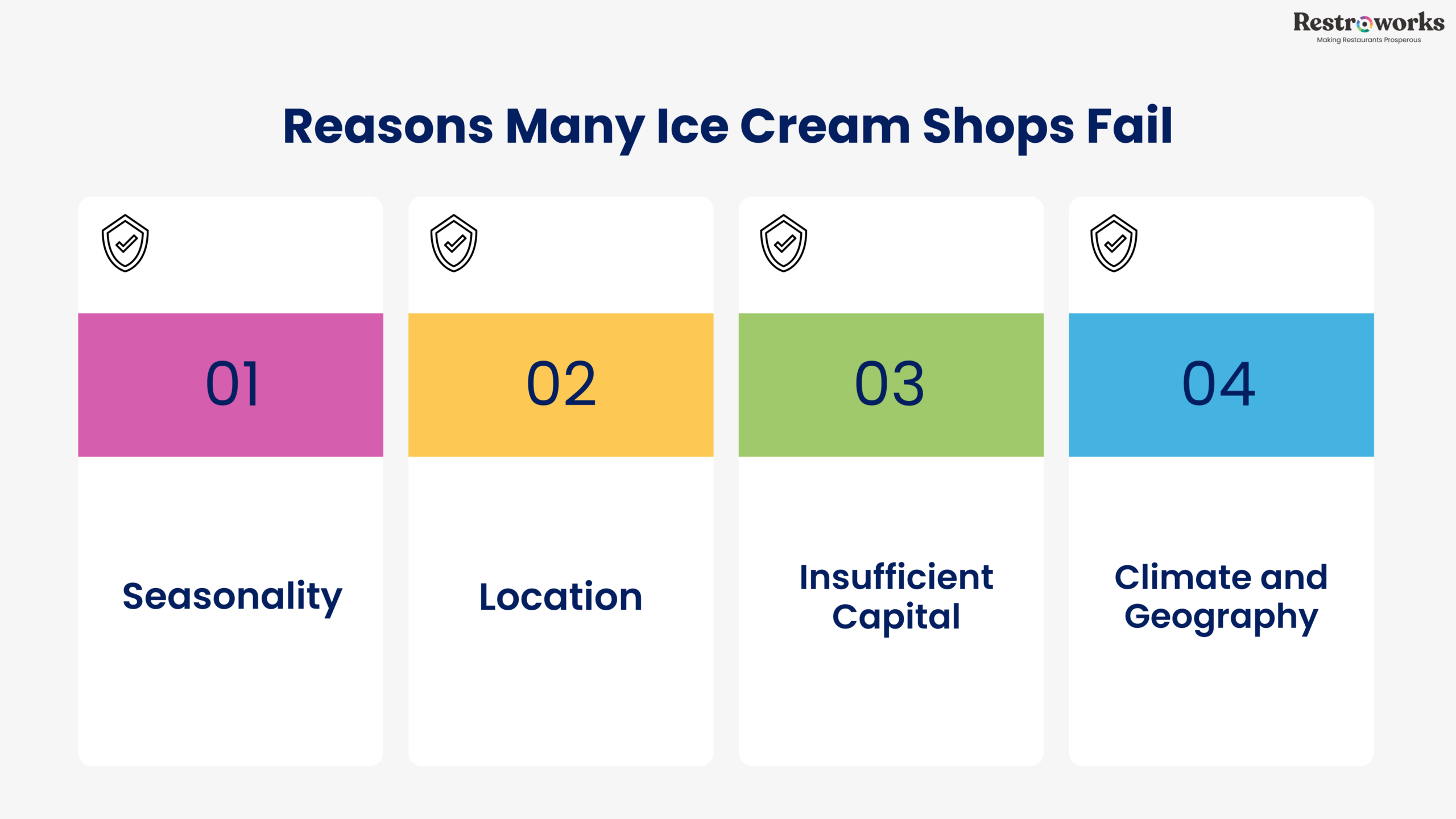
Ice cream shop failure rate - what are the reasons?

The key reasons ice cream shops fail are extreme seasonality, undercapitalization, poor location choices, and inexperienced management. Let’s take each one by one.

#1: Seasonality 

Ice cream sales typically peak during the summer months (so much so that summer brings up to 60% of the year’s total sales) and decline in colder seasons. 

Such seasonal fluctuations hit small, independent shops the hardest, and owners who run their own shop without a proper plan for handling them struggle to pay rent, staff salaries, and other bills during the off-peak season.

#2: Location

It is very, very important for you to choose the right location for your business because it is going to directly impact your customer traffic and sales. You should look for shops near schools, parks, beaches, tourist spots, etc., since they usually get more customers. 

And, in any case, you should know that 25% to 30% of ice cream shops close, especially because of poor site selection, so you should not be making the same mistake.

#3: Undercapitalization

Too often, ice cream shop owners underestimate just how much money they would need to cover startup and ongoing expenses when opening an ice cream shop. Like, you can’t call it a day just by purchasing machines and ingredients; where do you think the money to pay rent, electricity, employee salaries, marketing, repairs, and other monthly expenses will come from? You have to have a proper budgeting plan and capital to account for those expenses as well, and not only that, you will need a lot of buffer to cover any emergency or slow month in advance. 

#4: Climate and Geography

Regional differences, such as climate and local demographics, affect the profitability and viability of an ice cream shop – that’s too obvious.

INDUSTRY INSIGHT

The Ice Cream Stores industry in the US has grown 4.1% per year on average over the five years between 2020 and 2025, according to IBISWorld, reaching $7.4 billion in revenue. The broader ice cream industry contributes an $11.6 billion impact on the US economy, per the International Dairy Foods Association, and American producers churned out 1.23 billion gallons of ice cream in 2025. 

With these numbers at hand, if you say the growth of the sector is big, so is the churn beneath it. Every new shop opening has to compete with the same seasonal and competitive headwinds.

What Are the Common Pitfalls Behind a Struggling Ice Cream Business?

There are many, many factors that impact an otherwise profitable ice cream business in a bad way. For starters, it can be:

  • Inadequate staff management, including high employee turnover and poor training, which results in poor customer service and, in turn, loss of loyal customers. 
  • Poor inventory control
  • Rising cost of goods sold and operational expenses
  • Lack of loyalty programs, etc.

Plus, in this economy, owners can’t and shouldn’t rely solely on just foot traffic and word of mouth. They need to have backup revenue streams, must partner with local businesses, hop on social media trends to stay relevant in the market, and more, and this applies no matter how good of an ice cream you think you sell. 

How Do You Build a Solid Business Plan That Actually Works for an Ice Cream Parlor?

You can think of a business plan as a roadmap you can always fall back on when you don’t understand what’s next, or things get a little patchy with a new “good” competitor opening nearby, or weather takes a turn all of a sudden.

Effective marketing strategies and business planning are essential to the success of ice cream shops (or any business for that matter), and they should have these key details:

  1. Business idea – what kind of ice cream shop do you want to open? 
  2. Financial projections of your business – startup costs, expected sales, expenses, profit, break-even timeline, etc.
  3. Profile of your target audience
  4. Location plan
  5. Menu and pricing – What you’ll sell and how much you’ll charge for it?
  6. A detailed financial plan that accounts for slow months as well
  7. Competitor analysis
  8. Staffing plan
  9. Risk management – What could go wrong at any point in the business and how will you handle it?
  10. Growth plan

Once this groundwork is in place, you can strategize for marketing accordingly, like how people are supposed to find your shop (through social media, local events, partnerships, etc).

After that, focus on bettering your customer experience because people can find you once, but whether they will repeat or not depends entirely on their first-time experience. Were your staff friendly and well-trained? Was your shop clean? Did you complete the order-taking to checkout quickly enough?

Investing in staff training and fostering a positive work culture can significantly reduce employee turnover and improve customer service quality in ice cream shops, because, at the end of the day, happy employees lead to happy customers, and happy you. 

Owners who create loyalty programs, roll out seasonal flavors, and offer simple online ordering all add convenience that keeps customer engagement high even when foot traffic dips. Even small touches, like eco-friendly packaging for takeout pints or a genuinely dietary-friendly options menu, tell customers you have thought about more than just the scoop.

How is Fierce Competition Reshaping the Competitive Market for Scoop Shops?

Ice cream shops face intense competition, with 83% of consumers purchasing ice cream at grocery stores compared to just 30% at specialty shops. 

Winning in such a market means you must have a clear unique selling proposition and a strong brand identity. A unique selling proposition (USP) can set your ice cream shop apart from competitors and attract customers by highlighting distinctive flavors, exceptional customer service, or eco-friendly practices. Creating memorable branding, such as a cohesive brand story and themed experiences, is essential for differentiating your ice cream shop in a crowded market. Offering niche flavors or dietary-friendly options, such as vegan or gluten-free ice cream, can help ice cream shops stand out and attract a broader customer base. Shops that pull this off build established brand recognition around unique flavors people drive across town for.

Can a Food Truck Be a Smarter Way to Start an Ice Cream Business?

Yes, of course, you should consider a food truck or a mobile cart, especially because they have minimal equipment needs, lower overhead costs, and a much smaller initial investment than a full lease, which is why so many owners test their concept this way before renting or buying a storefront. Plus, with an ice cream truck, you can be right where there is high foot traffic, like at an event in the morning and a festival at night.

Moreover, independent shops achieve profit margins between 15% and 25%, while mobile businesses see margins of 20% to 30%. 

High-performing shops with efficient and smooth operations behind the counter and strong branding achieve high profit margins, even higher than 30%. 

Starting small on wheels also lets an owner learn labor costs, supply chains, and customer preferences before signing a long-term lease.

KEY TAKEAWAYS

  • Ice cream is a seasonal treat, with sales typically peaking during the summer months and declining in colder seasons, which can create significant cash flow challenges for ice cream shops. 
  • Summer months can account for up to 60% of an ice cream shop’s annual revenue, making it crucial for owners to plan for off-season sales to ensure steady cash flow. 
  • To manage seasonal fluctuations, ice cream shops can diversify their offerings by including warm desserts or beverages during the off-season to maintain revenue year-round. 
  • Insufficient capital and budgeting can lead to financial struggles for ice cream shops, as underestimating startup costs and ongoing expenses can result in cash flow issues. 
  • Ice cream shops located near schools, parks, or high-foot-traffic areas tend to perform better than those in less accessible locations. 
  • Rising costs of ingredients and operational expenses can significantly impact profitability for ice cream shops. 
  • Implementing a multi-channel marketing strategy, including social media engagement and local collaborations, is essential for attracting customers and building a loyal following. 
  • Diversifying income streams, such as offering catering, online ordering, and selling related products, can help successful ice cream shops maintain revenue during off-peak seasons.

Frequently Asked Questions

1. What is the success rate of ice cream shops?

While many ice cream shops do succeed, they also face high failure rates because of seasonality, competition, and cash flow challenges. Building a successful business depends on choosing high-foot-traffic areas, creating a strong unique selling point, delivering an excellent customer experience, and maintaining healthy profit margins through efficient operations that keep repeat customers coming back.

2. Do franchise ice cream shops have higher success rates than independent shops?

Generally, yes, because franchise stores benefit from established branding and proven systems, while independent boutique shops have more flexibility to experiment with sweet treats, premium ingredients, or seasonal flavors like pumpkin spice. Ultimately, a shop’s success depends more on execution than ownership model, and owners shouldn’t rely solely on brand recognition to attract customers.

3. How much does it cost to start an ice cream shop?

Startup costs vary based on location, size, and equipment, but opening an ice cream shop requires a significant financial commitment. Before investing, conduct thorough market research, prepare a detailed budget, account for overhead expenses, variable costs, labor such as minimum wage, and plan for low overhead costs wherever possible to protect your profit margins.

Newsletter subscription banner

Talk to a restaurant expert today and learn how Restroworks can help your business.

Request Demo >

Share

Discover More Insights to Power Your Journey

Ice Cream Shop Failure Rate: What the Data Says and Why It Matters

The very thought of opening an ice cream shop feels like scoops, sprinkles, pink-all-around, cloud…and a hundred other words that…

Cloud Kitchen UK License: Complete Guide to Requirements & Compliance

Launching a cloud kitchen is often considered faster and simpler than opening a traditional restaurant. That perception is partly true:…

How to Start Cloud Kitchen in Dubai: A Complete Guide [Updated 2026]

Dubai’s culinary landscape has evolved significantly in recent years, with digital transformation and shifting consumer preferences redefining food consumption, making…

Cloud Kitchen License Cost in Dubai: Fees, Requirements & Setup Guide for 2026

A cloud kitchen license cost in Dubai ranges from AED 17,000 to AED 27,500 for a mainland setup, covering the…

Cloud Kitchen: Complete Guide to Start and Run a Successful Delivery Business

Less than a decade ago, opening a restaurant meant investing in a high-rent retail space and hiring a full front-of-house…

Cloud Kitchen vs Restaurant: Key Differences, Costs & Which Is Better

Cloud kitchen vs restaurant - The core difference between the two is that a cloud kitchen prepares food exclusively for…

Join. Learn. Grow.

Sign up to receive the latest hospitality insights and stories straight to your inbox

Streamline your operations with Restroworks