
Restaurant Franchise Media Buying Agency

Restaurant Franchise Media Buying Agency: Drive Local Reach & Franchise Growth

Home / Blog /
Restaurant Franchise Media Buying Agency: Drive Local Reach & Franchise Growth

Read summarized version with

A restaurant franchise media buying agency plans, negotiates, and buys ad space for franchise brands across national and local channels, so every location gets consistent, cost-efficient reach.

These agencies act as intermediaries between restaurant franchises and media firms, helping with advertising purchases at both national and local levels. That role matters because advertising for a restaurant franchise is far more complex than advertising a single restaurant.

It means maintaining consistent branding across dozens or even hundreds of franchise sites, managing franchisees’ co-op fund contributions, driving customers into franchises, increasing lead generation, and boosting the franchise brand’s national equity. 

The stakes are high. U.S. restaurant and foodservice sales are projected to reach $1.55 trillion in 2026, with real growth of just 1.3%. Margins are tight too: in the same report, 42% of operators said their restaurant wasn’t profitable last year, and 60% reported softer customer traffic.

In such a competitive market, uncoordinated marketing campaigns across franchise sites waste money and undermine the consistency that makes franchise expansion strong.

What You Will Learn

  • What a restaurant franchise media buying agency does differently from a standard marketing agency
  • The core services that drive results for multi-location restaurant franchise brands
  • How to build a clear digital strategy and evaluate franchise marketing agency partners
  • What to expect from agency pricing and performance reporting

What Does a Restaurant Franchise Media Buying Agency Do?
Franchise marketing agency

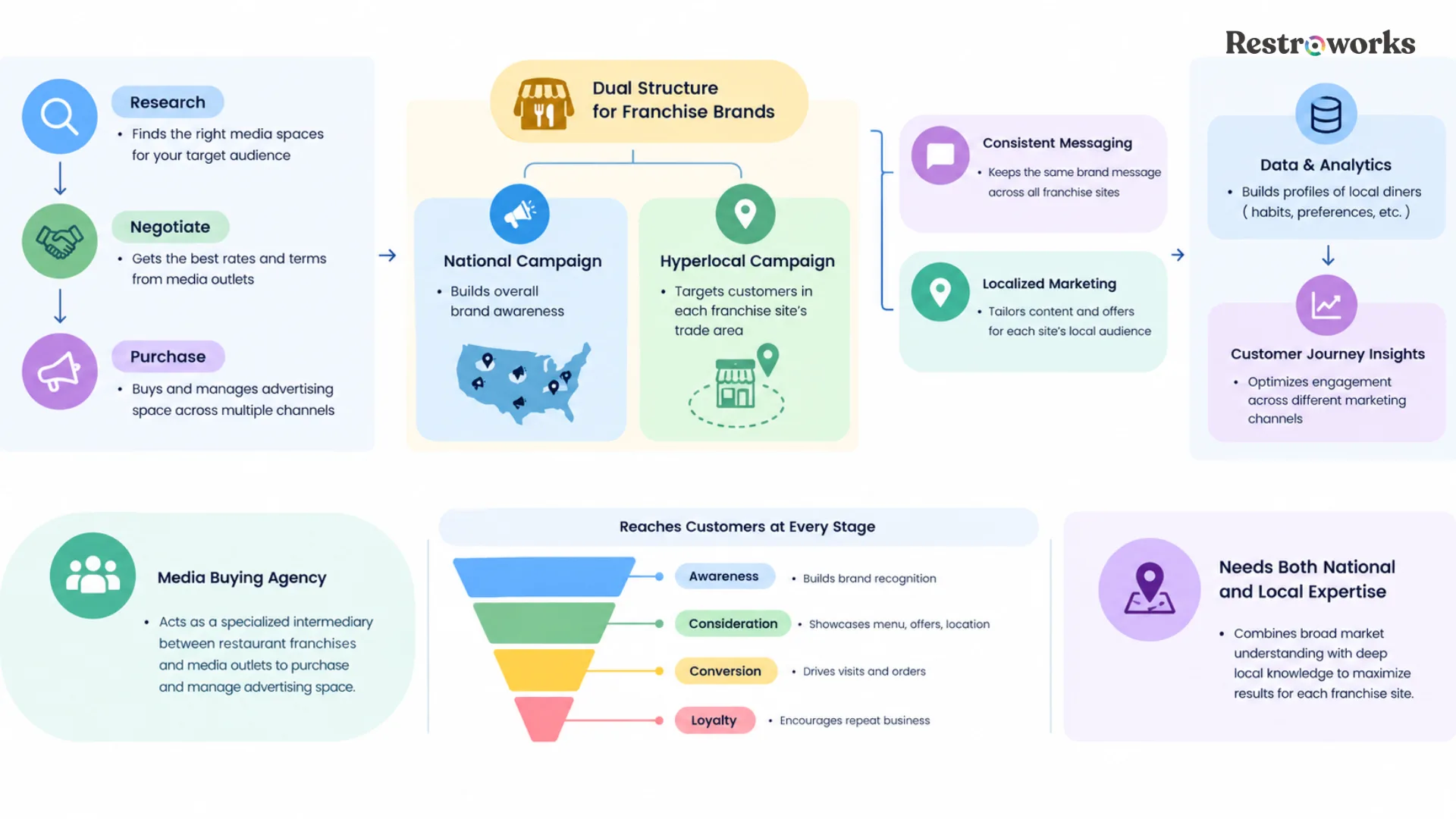
A restaurant franchise media buying agency researches, negotiates, and purchases advertising space for a franchise brand, then manages those placements so national and local campaigns work together.

For a franchise brand, this means running a dual structure: a national campaign that builds overall brand awareness, plus a hyperlocal level that targets customers in each franchise site’s trade area. 

Media buying involves consistent brand messaging across franchise sites and localized marketing for each site. Agencies use data analytics to build profiles of local diners, identifying habits and preferences.

Utilizing data and analytics to understand customer journeys is crucial for optimizing engagement across different marketing channels. 

Restaurant franchises typically use both types of marketing to reach customers at different stages of the sales funnel. Franchisees usually fund both levels by contributing a share of their sales.

For example, Domino’s U.S. franchisees generally contribute 6% of their sales to fund national marketing and advertising campaigns across 6,924 U.S. franchised stores. 

With budgets pooled from so many locations, every media dollar has to be planned carefully. 

Core Services for Franchise Brands

A restaurant franchise media buying agency offers four core services-

  • Media planning across traditional and digital channels
  • Paid digital media
  • Campaign management and local SEO across multiple locations
  • Co-op fund management with performance reporting. 

Together, these let a franchise brand run one coordinated media strategy instead of dozens of disconnected local campaigns.

Core services What the agency does What the franchise gets
Media planning and buying Chooses the best mix of traditional and digital channels, then negotiates and buys placements Wider reach at lower cost through bulk buying
Digital marketing and paid media Runs Google Ads, paid social, programmatic display, and OTT/CTV campaigns Targeted, measurable campaigns using enterprise-grade ad tech
Multi-location campaign management and local SEO Runs regional campaigns and optimizes each location for local search Every location shows up for nearby diners
Co-op fund management Plans co-op spending, enforces brand guidelines, and reports on results Accountable spending and consistent branding across sites

Agencies determine the best combination of traditional media and digital platforms to reach customers. Multichannel marketing strategies can significantly enhance customer engagement by reaching customers through various platforms, including social media, email, and direct mail. 

Effective customer engagement channels can lead to higher traffic and revenue. Direct mail is a good example: according to the ANA’s 2024 Response Rate Report, mail sent to house lists (existing customers) averages a 5% to 9% response rate. 

Digital Marketing and Paid Media via Google Ads

Agencies run a franchise’s paid digital media, including Google Ads, paid social, programmatic display, and OTT/CTV ads, and use their buying power to secure lower ad rates than individual locations could get on their own. 

An experienced franchise marketing team builds the strategy for each channel based on its role in the customer journey:

  • Google ads (search): For capturing high-intent diners searching for food or restaurants nearby
  • Paid social media: Building awareness and promoting local offers to targeted audiences
  • Programmatic display: Retargeting past visitors and reaching audiences at scale across websites
  • OTT/CTV: TV-style reach on streaming platforms, with digital-level targeting

Agencies can offer lower ad prices through bulk purchasing and negotiation while delivering maximum ROI for clients. 

Franchisees also get direct access to sophisticated programmatic media buying and analytics technology from media buying agencies that most in-house teams do not have access to on their own.

This lets brands engage consumers, market the brand, develop loyalty, and support growth, all through organic marketing.

Multiple Franchise Locations Campaign Management and Local SEO

Agencies manage campaigns for every franchise location from one place, combining targeted regional campaigns with local SEO so each site reaches nearby diners without wasting spend.

They can launch highly targeted regional campaigns to attract more customers by improving local digital advertising effectiveness across franchise locations.

Local SEO helps ensure each franchise location appears in Google search results for people nearby, supported by the right content creation strategy.

This matters because local search drives real decisions. According to BrightLocal’s 2026 research, 84% of consumers searched for a local business in the past three months, and 71% used Google Search at some point during their search. 

Most also shortlist quickly, with 72% looking at three or fewer businesses before deciding. AI is now part of local discovery too: 45% of consumers use ChatGPT or other generative AI tools for local business recommendations. 

Co-op Fund Management and Clear Strategy

Agencies manage co-op funds by planning how pooled franchisee contributions are spent, keeping every local ad within brand guidelines, and reporting results so franchisees can see what their money delivered. 

An integrated strategy covering brand messaging, media buying, local listing management, and content strategy is necessary to qualify for the co-op. Agencies should provide clear, regular reporting on these metrics for transparency

  • ROI/ROAS: Revenue generated for every dollar spent on media
  • Conversion rate: Share of people who ordered, booked, or visited after seeing an ad
  • Cost per acquisition: Average cost to win one new customer or order
  • Store visits/foot traffic: How well campaigns drive diners into specific locations
  • Reach & frequency: How many people saw the ads, and how often

Agencies ensure consistent brand messaging across multiple franchise locations while allowing localized tactics. Agencies ensure all local advertising adheres to corporate brand guidelines to maintain brand consistency. 

INDUSTRY INSIGHT

Studies show that advertising’s long-term effect on sales growth exists only in restaurant companies with a franchising business model. 35% of franchise restaurant companies rely on social media advertisements as the main marketing strategy.

Sustained, coordinated media investment builds compounding returns that fragmented campaigns don’t, making the right franchise marketing agency partner one of the highest-leverage decisions in your growth strategy. 

The U.S. food service market reached $1,610.1 billion in 2025 and is projected to reach $2,703.6 billion by 2034, growing at a CAGR of 5.93% during 2026-2034

How to Choose the Right Marketing Agency & Increase Sales
Choosing the right marketing agency

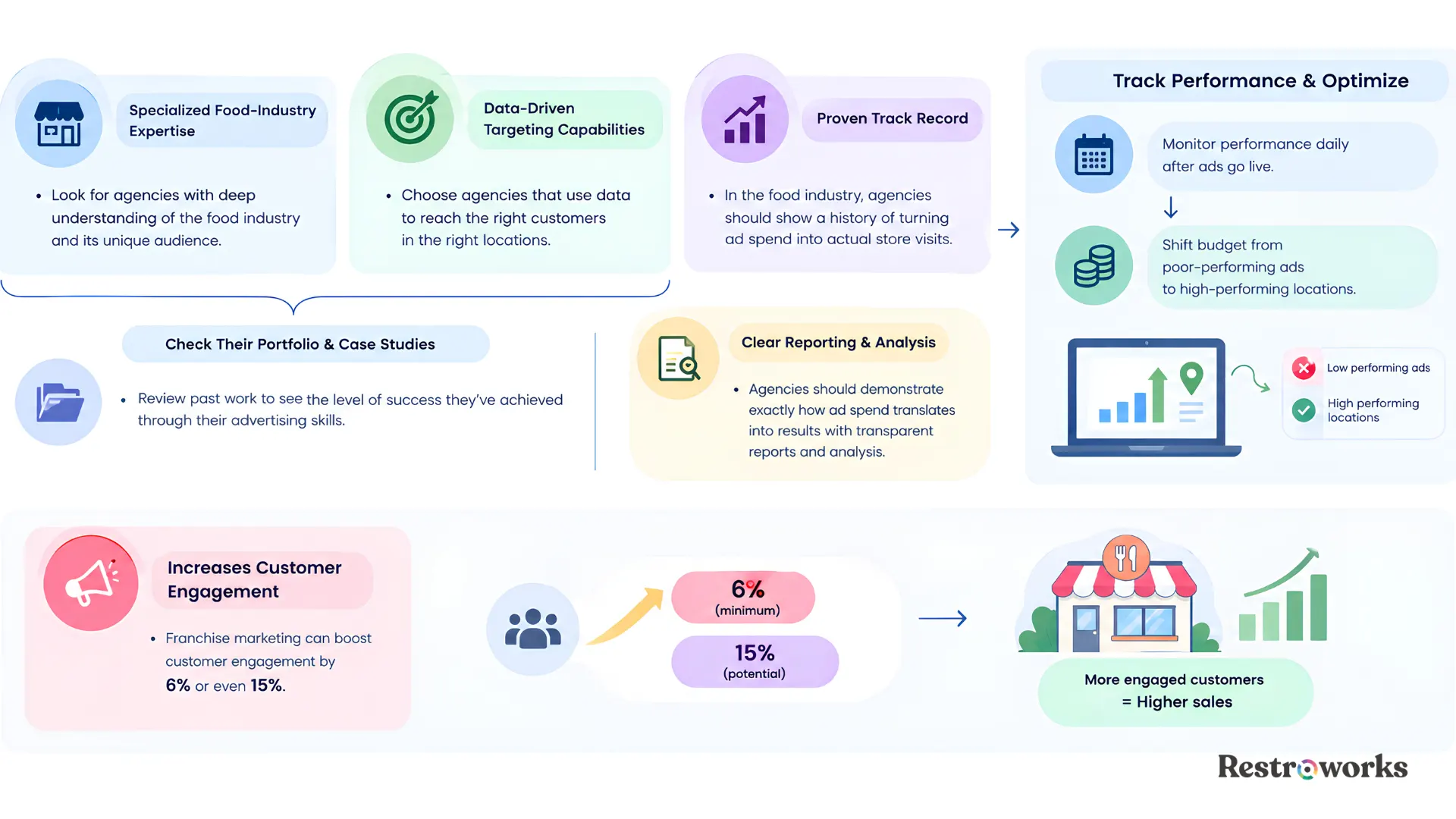
Restaurants should choose agencies with specialized food-industry expertise and data-driven targeting capabilities. Here’s what to look for-

  • Food-industry and franchise experience: The agency should have worked with restaurant brands, ideally multi-location franchises. This means it already understands co-op funds, brand guidelines, and how to balance national campaigns with local ones.


  • Proven results in portfolios and case studies: Portfolios and case studies can show the level of success an agency can achieve through its advertising skills. Look for results tied to business outcomes, such as store visits, orders, and sales lift.


  • A track record of turning ad spend into store visits: In the food industry, agencies should be able to connect online ads to offline visits. For example, Google Ads offers store visit conversions, which measure the additional conversions that happen offline and help calculate full ROI.


  • Data-driven local targeting: The agency should build campaigns around each location’s trade area, using local diner data rather than one-size-fits-all national targeting.


  • Transparent pricing and media costs: Ask for a clear breakdown of agency fees, platform fees, and actual media spend. Hidden costs add up quickly. The ANA’s Programmatic Media Supply Chain Transparency Study found that only 36 cents of every dollar entering a demand-side platform effectively reaches the consumer, with transaction fees taking 29% and low-quality media another 35%.


  • Clear, regular reporting: Agencies should clearly show how ad spending translates into success through their reports and analysis, with KPIs like ROI, conversion rate, and cost per acquisition reported at both brand and location level.


  • Account and data ownership: Make sure your brand owns its ad accounts and campaign data, so you keep your performance history if you ever switch agencies.

The right agency also keeps improving results after launch. Once ads go live, agencies track performance daily and shift budget away from poor-performing ads and locations toward high-performing ones, so every dollar works harder to increase sales. 

KEY TAKEAWAYS


  • Restaurant Franchise Media Buying Agency will manage media for the entire chain of franchise restaurants, blending a national brand approach with hyper-local execution in each market
  • Major service lines will include Google Ads, Paid Social, Programmatic Display, Local SEO, and Co-Op Fund Management, managed for multi-location businesses
  • Agencies can offer two-tiered reporting meeting the goals of the corporate brand as well as the ROI needs of franchise owners
  • Look for agencies with experience in your specific franchise industry, location-level attribution ability, and the capability to grow sales throughout the system

Frequently Asked Questions

1. How much does a restaurant franchise media buying agency cost?

Costs vary by scope, but agencies may charge $7,000-10,000+ per month, a percentage of ad spend, or project-based fees.

2. What should I look for when choosing a media buying agency for my restaurant franchise?

Look for franchise experience, multi-location campaign expertise, transparent pricing, clear reporting, and proven impactful results in restaurant marketing.

3. What ROI can restaurant franchises expect from professional media buying?

ROI varies by market, offer, and execution, so track return on ad spend (ROAS), customer acquisition cost, conversions, and incremental sales.

4. Should restaurant franchises handle media buying in-house or hire an agency?

In-house teams offer greater control, while agencies provide specialist expertise and scalability; the best choice depends on budget, resources, and campaign complexity.

5. What contract terms are standard for restaurant franchise media buying agencies?

Common terms include service scope, management fees, ad budgets, contract duration, performance reporting, account ownership, termination clauses, and data access.

6. What does a restaurant franchise media buying agency do?

It plans, purchases, manages, and optimizes paid advertising across platforms to increase brand awareness, visits, orders, and sales.

7. How do media buying agencies handle multi-location franchise campaigns?

They coordinate national brand campaigns with location-specific targeting, budgets, creative assets, and performance tracking for individual outlets.

8. How do restaurant franchise media buying agencies handle seasonal campaigns?

They align advertising with seasonal demand, holidays, local events, and promotional calendars, adjusting budgets and creative direction to maximize campaign performance.


Newsletter subscription banner

Talk to a restaurant expert today and learn how Restroworks can help your business.

Request Demo >

Share

Discover More Insights to Power Your Journey

POS
Best restaurant POS software in Dubai
Best Restaurant POS Software in Dubai for Faster, Smarter Operations

The best restaurant POS software in Dubai is the one that handles UAE VAT, Arabic and English, and every delivery…

The Other Side of the Table: Tyler Marpes on Technology, Trust, and Restaurant Growth

Few people in restaurant technology get to see the industry from both sides of the table. Tyler Marpes, Vice President…

Rethinking Restaurant IT: Todd Kaufman on Technology as a Business Driver

Some of the most influential leaders in restaurant technology never set out to work in it, and Todd Kaufman, Chief…

POS
Best cloud-based restaurant POS
9 Best Cloud-Based Restaurant POS Systems in 2026

The best cloud-based restaurant POS system depends on how many locations you operate and how fast you plan to scale. Today,…

7 Best Cloud Kitchen Management Software in 2026

Whichever platform I (or anyone, for that matter) proclaim as the best cloud kitchen management software out there depends on…

Sharing the Love, One Taco at a Time: Eric Knott on Scaling TikiTaco the Right Way

Ask Eric Knott, CEO of TikiTaco, what business restaurants are really in, and you’ll get an answer that has evolved…

Join. Learn. Grow.

Sign up to receive the latest hospitality insights and stories straight to your inbox

Streamline your operations with Restroworks