
Search “Starbucks” on Google.
Within seconds, Google shows nearby Starbucks locations, their opening hours, directions, phone number, and even how busy they are. You don’t have to hunt for the nearest outlet; just the brand name is enough.
Local SEO for restaurant franchises helps each outlet appear in relevant local search results by optimizing its business listings, location pages, reviews, and other local signals. According to BrightLocal, 80% of U.S. consumers search online for local businesses every week. And for many, that search is the first step in deciding where to eat.
Now, for your restaurant franchise, this changes the game. Your brand can get customers interested, but each location still needs to gain visibility in local search. That’s exactly what local SEO solves. Let’s see how local SEO for restaurant franchises works and the strategies that can help you grow.
What you will learn
- What’s local search engine optimization for restaurant franchises and what makes it different?
- How to build your local SEO presence with Google Business, content marketing, and link building?
- Technical SEO aspects to take care of
What Is Local SEO for Restaurant Franchises?
Local SEO for restaurant franchises is about improving each outlet’s visibility in local Google Search results and Google Maps. It involves optimizing individual Google Business Profiles, location pages, customer reviews, and business information so nearby customers can find the restaurant quickly.
So when you search for “Starbucks open now” or simply “Starbucks”, Google decides which nearby locations are the most relevant for your search based on relevance, distance, and prominence.
Similarly, for your restaurant franchise, Local SEO helps you improve those signals so your restaurant appears more in local search engine results and map listings. The result? Nearby local customers can find you easily and visit your business.
What Different Challenges Do Restaurant Franchises Face with Local Search?
Now, all this would be much simpler if you had just one restaurant location.
But restaurant franchises face the challenge of managing local search visibility across multiple outlets, each with its own Google Business Profile, reviews, local competitors, and search visibility, even though they all operate under the same brand.
Common challenges include-
- Keeping NAP (Name, Address, and Phone Number) information consistent across every restaurant location.
- Managing Google Business Profiles for multiple outlets without missing updates.
- Creating dedicated location pages to avoid confusing search engines with duplicate content.
- Maintaining brand consistency while allowing each location to stay locally relevant.
- Building and managing customer reviews for every individual restaurant, not just the franchise as a whole.
- Tracking local search performance across multiple locations and markets.
Google’s guidelines for businesses emphasize accurate business information and consistent names and categories across locations. Getting these basics right gives your franchise a stronger foundation for local search.
Why Local SEO Is Critical for Restaurant Franchise Success
For most customers, choosing a restaurant is a digital-first decision. In fact, about 62% of consumers use Google Search to find new restaurants, while 51% consider it the best way to gather and compare restaurant information.
For you, every one of those searches is an opportunity. A strong local SEO strategy helps each location appear at the right moment, making it easier for nearby diners to discover, trust, and visit your restaurant.
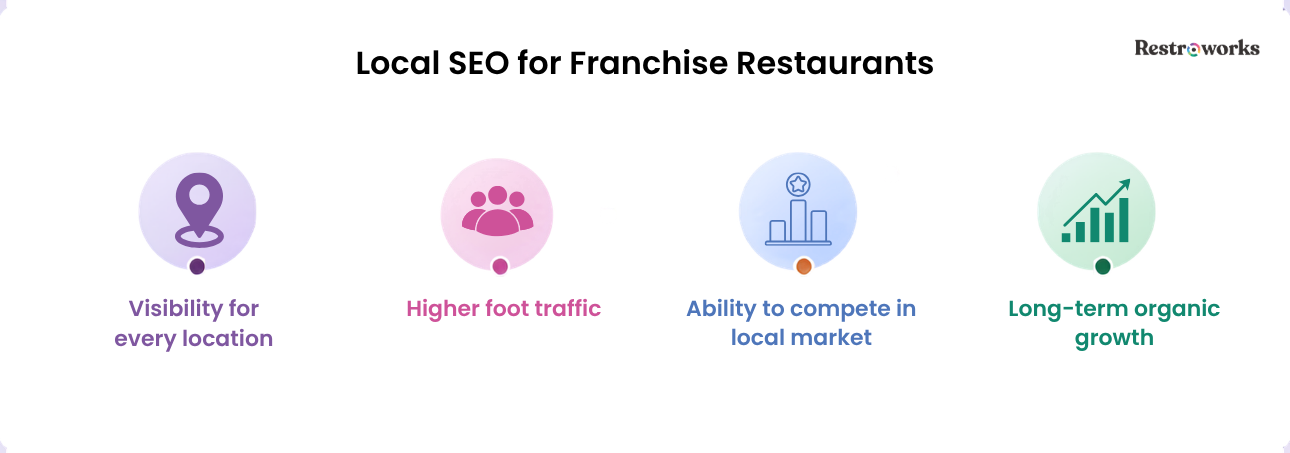
- Increase visibility for every location: Appear in local search results and map listings when the intent is high, so it’s more likely for nearby customers to discover and visit you.
- Drive more foot traffic: Makes it easier for potential customers to check opening hours, browse photos, read reviews, and get directions before visiting. 72% of consumers who search locally actually visit a store within 5 miles. So that’s a good way to gain search engines’ trust.
- Compete in every local market: Strong local SEO helps every outlet stand out against nearby restaurants, even when competing in crowded markets.
- Generate long-term organic growth: Creates a foundation for attracting relevant local traffic without relying exclusively on paid campaigns. Results depend on competition, ongoing optimization, and each location’s online presence.
BrightLocal’s 2024 Brand Beacon Report found that 94% of high-performing multi-location businesses had a dedicated local marketing strategy, compared with 60% of average-performing businesses. The finding reinforces the value of a structured approach to managing local visibility across outlets.
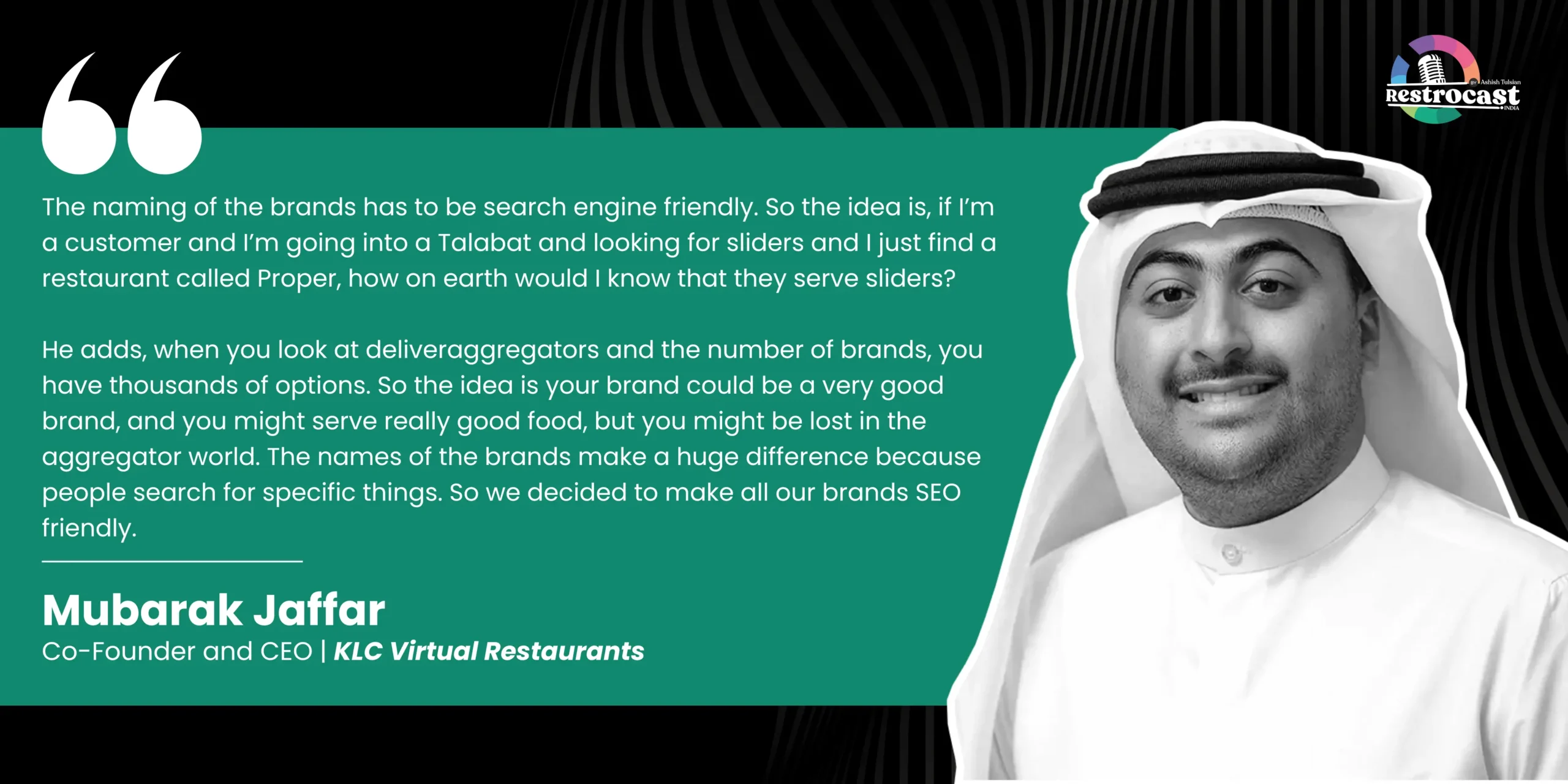
Talking about the importance of an SEO-friendly digital presence for franchise brands, Mubarak Jaffar, CEO of KLC Virtual Restaurants, says on Restrocast–
Local SEO for Restaurant Franchises: Key Components and Strategies
A strong local SEO strategy for restaurant franchises combines location-level optimization with consistent brand-wide management to improve search visibility across every outlet.
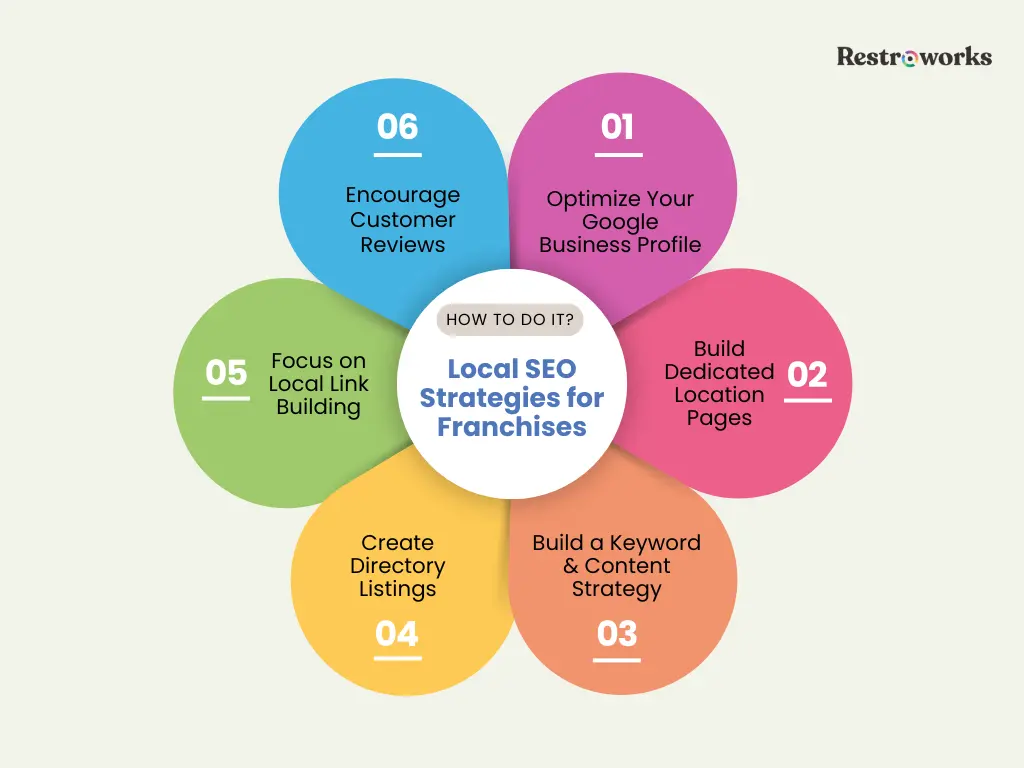
1. Optimize Your Google Business Profile
Your Google Business Profile (GBP) is the first thing a customer will see when they search for your restaurant. So, first impressions matter. Google uses this profile information to populate Map results, Knowledge Panels, and voice search answers.
This shows important information, including the outlet location, contact, directions, business hours, reviews, and even a link to your website content.
So if you haven’t already, claim your GMB for every franchise outlet first. And then-
- Add accurate Name, Address, and Phone Number (NAP)
- Select the right primary and secondary business categories
- Update business hours, holiday schedules, and contact details
- Upload high-quality photos of the restaurant, menu items, and interiors
- Respond to customer reviews and answer questions promptly
- Add links to your website, online ordering, reservations, or menu
Google’s guidelines for representing your business require accurate business information and prohibit unnecessary keywords in business names. For restaurants with 10 or more locations, Google also supports bulk photo uploads, which can make franchise-wide profile management easier.
2. Build Dedicated Location Pages
Along with your GMB profile, individual website pages for every franchise location are a good SEO practice. A single “Find a Store” page is useful for navigation, but it may not provide enough information to Google about every outlet.
Dedicated location pages give each restaurant a clear destination on your website and make it easier for potential customers to find its address, menu, hours, and directions. To make each page valuable, include-
- A unique description of the location instead of reusing the same copy across every page.
- Store-specific menus, services, or ordering options.
- Business hours, amenities, and contact details for the individual restaurant.
- An embedded map and clear directions to help Google associate the page with a physical location.
- Local content, such as nearby landmarks, neighborhood details, or local community events.
Unique local information can make these pages more useful than generic templates. A Wiideman study reported a 107% higher probability of outranking with hyperlocal content on dedicated location pages.
Avoid creating near-identical pages that only swap the city or neighborhood name. Google’s spam policies identify substantially similar pages created to rank for location-specific keywords without providing distinct value as a potential form of doorway abuse.
3. Build a Keyword and Content Strategy
Your customers don’t always search the same way. Some look for your brand, while others search for “family restaurant in Dallas” or “best burgers near Times Square.” A strong local keyword strategy helps your locations appear for both branded and non-branded local searches.
To achieve this, start by identifying the keywords that matter for each location for on-page SEO-
- Google Autocomplete, where you can search your brand, cuisine, or restaurant type and note the suggested searches.
- Keyword research tools like Google Keyword Planner, Semrush, or Ahrefs
- Try the “People Also Ask” section on Google to find question-based keywords
- Find which local keywords are bringing customer traffic for your competitors, using keyword research tools
Based on your research, look for a combination of long-tail and short-tail keywords, based on their monthly organic search volume, local keyword difficulty and local search intent.
Once you’ve finalized your target keywords, naturally incorporate them into location pages, page titles, meta descriptions, headings, image alt text, and blog content. Avoid repeating keywords unnaturally or creating pages solely to capture variations of the same search.
To further strengthen your content strategy,
- Publish location-specific content on your blog, such as neighborhood guides, local events, seasonal promotions, or local community partnerships.
- Refresh existing content regularly by updating menus, promotions, images, and business information to keep pages relevant.
- Avoid duplicate content by giving every location page its own unique copy, photos, and local details
- Answer common customer questions through FAQs about parking, reservations, delivery, catering, or operating hours
- Use internal links to connect location pages with relevant blogs, menus, and service pages, helping search engines discover and understand your content
4. Create Directory Listings
Google checks whether your restaurant’s information is consistent across trusted online directories and business listings when evaluating a local business.
That’s why, listing every franchise location on different platforms helps strengthen your local presence. These include-
As you manage directory listings, make sure to-
- Keep your business name, address, phone number, and website consistent across every platform.
- Update business hours, contact details, and location information whenever changes occur.
- Remove duplicate or outdated listings that can confuse search engines and customers.
- Regularly audit your listings to identify missing or incorrect information.
5. Focus on Local Link Building
Backlinks remain one of Google’s strongest ranking signals. Local link building helps restaurant franchises build online prominence by earning links from credible websites in the communities where their outlets operate.
But the thing is, you can’t just link your website to any third-party blog or directory. It’s important to focus on earning relevant, credible links to build your local authority.
- Partner with local businesses and organizations that can feature your restaurant on their website.
- Reach out to local news outlets and food bloggers for restaurant features, product launches, or community stories.
- List your restaurant on local tourism websites, city guides, and destination portals that recommend places to eat.
- Create locally relevant content that other businesses and publications naturally want to reference and link to.
Prioritize quality and relevance over the number of backlinks. Avoid buying links or using unrelated websites purely to manipulate local search rankings. Each link should make sense for the restaurant, its location, or its audience.
6. Encourage and Manage Customer Reviews
Who doesn’t love a positive customer review? Your business surely does; at least 68% of customers get encouraged to try out local businesses because of them, and Google uses them as a major trust signal.
It’s also how Google evaluates the relevance, credibility, and authority of your franchise business. But to actually rank your business, only a few positive reviews aren’t enough. Google looks at three things-
- Quality (how relevant, useful, and honest the review is)
- Quantity (how many reviews each franchise outlet has)
- Velocity (how often do you receive them)
Now, for a restaurant franchise, this means you need to focus on all three factors for each outlet to rank better. A few ways to encourage reviews are-
- Add links to your review pages in emails, across the website, on QR code menus, or even on packaging material.
- Ask your staff to encourage online reviews during payment or at the checkout counter.
- Put QR codes on tables with a link to your Google review page
- Have a follow-up page after online order delivery to request feedback
- Offer genuine incentives like a reward or promo code in exchange for a review
Don’t forget to respond to reviews, both positive and negative. It’s good for restaurant SEO, and thoughtful replies can actually turn a bad experience into a better one.
Technical SEO Considerations for Multi-Location Restaurant Websites

Strong content and optimized Google Business Profiles can only take you so far. Technical SEO helps restaurant franchises make site pages easy for search engines to crawl, understand, and index. A clear site structure, mobile-friendly design, fast loading times, and accurate structured data form the technical foundation for local visibility.
Site Structure and URL Architecture for Franchise Locations
Site structure is simply how your website organizes and connects its pages. A clear, logical structure makes it easier for search engines to discover, crawl, and index every restaurant location.
Keep your location pages organized under a consistent URL structure. For instance:
- yourrestaurant.com/locations/chicago/downtown
- yourrestaurant.com/locations/new-york/manhattan
In addition, think about these structural aspects as you build your website-
- Create an XML sitemap that includes all location pages.
- Link location pages from your main navigation and “Locations” hub.
- Add internal links between nearby locations and relevant content where appropriate.
- Avoid orphan pages that aren’t linked from anywhere else on the website.
With over 70% of search happening on mobile and Google using the mobile version of a website’s content for indexing, make sure your website is optimized for it. Its Core Web Vitals guidance also recommends a Largest Contentful Paint (LCP) of 2.5 seconds or less for a good loading experience.
Schema Markup
Schema markup (structured data) is code that helps search engines understand your website and business, like what it is, what it offers, or where it is located. Your visitors won’t see it but Google uses it to better interpret details about each restaurant location.
For every location page, add schema that includes-
- Restaurant name
- Address and contact details
- Business hours
- Geographic coordinates
- Menu URL
- Online ordering or reservation links
- Customer ratings and reviews (where applicable)
Use Google’s Local Business structured data guidelines to check supported properties and implementation requirements. Each outlet should have its own accurate location information rather than inheriting incorrect details from the franchise’s main profile.
Schema markup does not guarantee higher local search engine ranking or enhanced results. It helps Google interpret eligible information, but Google decides whether to display rich results. Validate your implementation with Google’s Rich Results Test and monitor indexing in Search Console.