


Should I franchise my restaurant? Yes, but only if your first location is consistently profitable and your systems can run without you. If they can’t, franchising will multiply your problems faster than your profits.
That’s why this question doesn’t have a simple yes-or-no answer. But it’s a fair one, especially when you see your first location doing well. Or your customers enjoying something you’ve built on your own. Or other restaurant brands growing through franchising.
The idea is exciting. More locations. A bigger brand. Faster growth.
But franchising also means giving other people the responsibility of running your business under your name. And that’s very different from running one successful restaurant. The biggest challenge of all? Understanding if your restaurant is truly ready. Can your systems work without you? Or would franchising create more problems than opportunities?
Let’s explore.
What you will learn
- A simple way to analyze if your restaurant is ready for franchise opportunities
- The cost of franchising your independent restaurant
- How you can prepare your restaurant business for franchising
- Alternative options you can consider
What Does Franchising Your Restaurant Really Mean?
Franchising your restaurant means licensing your restaurant’s brand, business model, recipes, operating procedures, and intellectual property to independent restaurant owners, who pay an upfront franchise fee and other ongoing payments to operate under the brand name.
It’s a model that already runs at serious scale. The IFA’s 2026 Franchising Economic Outlook, conducted by FRANdata, projects U.S. franchise establishments growing from 832,521 to 845,000 units, with franchise output rising to $921.4 billion.
At an operational level, you’re also responsible for creating the franchise framework. This includes documenting your operating procedures, training franchisees and their staff, maintaining brand standards, offering ongoing support, and making sure customers receive a consistent experience, regardless of which location they visit.
The stronger and more repeatable that system is, the easier it becomes to scale your brand without compromising what made it successful in the first place.
Is Your Restaurant Brand Franchise Ready?

Your independent restaurant brand is franchise-ready when it has a proven business model, a clear identity, documented systems, and the financial strength to support other restaurant owners.
So, it all comes down to how ready your brand is. Here are the factors to decide your franchise readiness:
1. You’ve Built a Proven and Profitable Business Model
A proven, profitable model is one that earns consistently without relying on you to make every decision.
Because franchisees may not be investing in your hard work or instincts, but in a replicable business model with proven profitability. So it’s important to first build your credibility through a proven track record of consistent sales, loyal customers, and healthy profits.
Prospects will also check that record in your Franchise Disclosure Document (FDD), under items 19 and 21, which disclose earnings claims and sales, and audited financial statements, respectively.
However, item 19 is voluntary, but a franchisor who skips it gives prospects no FTC-sanctioned basis for projecting revenue.
2. Your Brand Has a Clear and Strong Identity
A clear brand identity means customers can say, in one line, what your restaurant stands for.
Think like this. What do Dave’s Hot Chicken, Subway, and Domino’s all have in common? They are popular franchises, sure. But more importantly, what they are known for.
These brands aren’t trying to be everything to everyone. They’ve become known for something specific, whether it’s Nashville hot chicken, customizable submarine sandwiches, or reliable and fast pizza delivery.
That’s what a strong franchise brand gives customers: a clear reason to choose you and gives franchisees confidence that they’re investing in a strong concept. Your restaurant doesn’t need national brand recognition, but it should stand for something distinctive. It could be a signature menu, a unique dining experience, exceptional service, or a clear value proposition.
3. Your Systems Are Documented and Easy to Replicate
Your systems become franchise-ready when everything that makes your independent restaurant work is written down and easy for someone else to follow.
When you are running one restaurant, you can be involved in every decision. That’s not possible with a franchise unless you document your systems. An operations manual that covers everything below is the best way to franchise successfully:
The manual stays confidential until a franchisee signs the agreement, but your FDD should have its table of contents. So it needs to exist before you start selling and can cost about $10,000 – $40,000 to get professionally created.
Hattan Bakor, Former CEO of Dhahia Juice and Abu Zaid, also talks about building a strong foundation before franchising on Restrocast–

Ultimately, franchising isn’t about whether you can run the restaurant. It’s about whether someone else can. Can another owner recreate the same food, service, and customer experience?
If the answer is yes, you’re much closer to being franchise-ready.
4. Your Brand is Financially Ready to Support a Franchise Network
You should be able to cover the cost of setting up a franchise network without waiting on initial franchise fees. Franchisees do pay to open new locations, but the groundwork has to be built first, and that investment comes from your side.
You’ll need legal documentation, franchise disclosure documents, employee training programs, marketing materials, technology, and a team that can support franchisees after they launch. That’s why it’s important to make sure your business is financially stable enough to support the growth you’re planning.
Use this franchise-readiness framework to understand where your business stands. And if you think you are ready for it, the next question is: should you be franchising your restaurant?
Pros of Franchising Your Restaurant
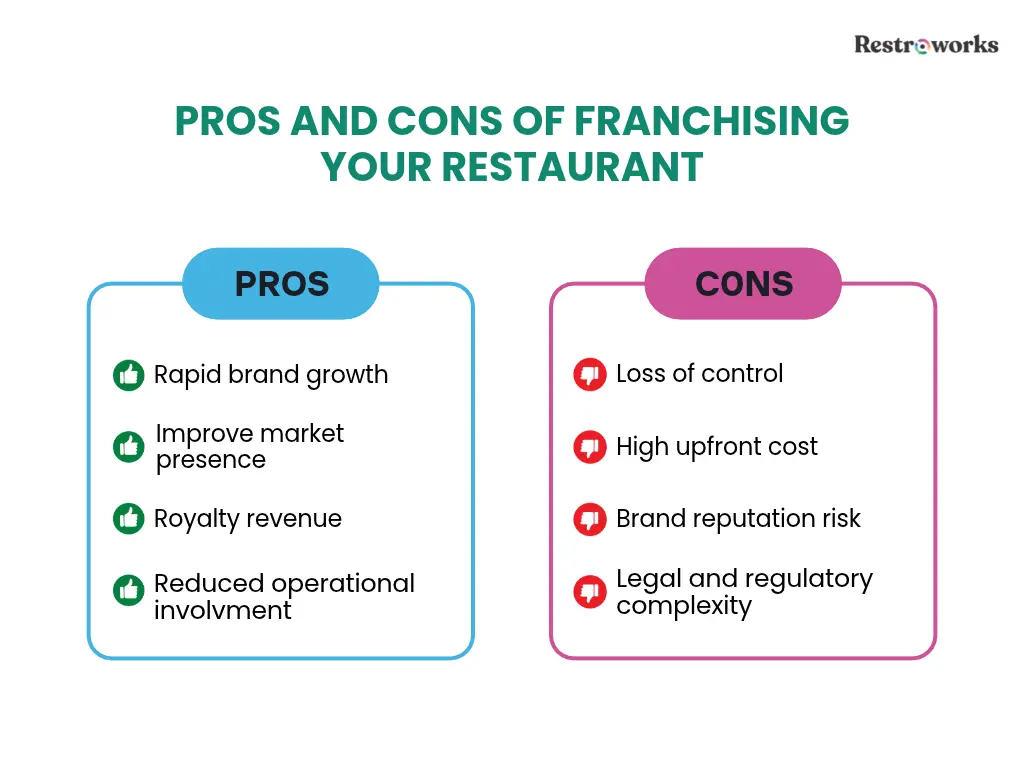
If your restaurant is franchise-ready, it can unlock growth opportunities that are difficult to achieve through company-owned expansion alone. Here are some of the biggest advantages-
- Rapid brand growth: Franchising is a much faster way to grow and open multiple locations than doing it all by yourself, with your own capital. Multiple entrepreneurs can invest in your franchises at the same time, and franchisees put in their own money and time, which reduces your risk. Dave’s Hot Chicken shows how fast this can move, with the brand opening its 500th outlet in less than a decade.
- Improve market presence: Franchise partners let you enter new neighborhoods, cities, or even countries. That wider footprint increases brand awareness and helps more customers discover your restaurant.
- Reduced operational involvement: Franchisees manage operations themselves, from hiring staff to controlling costs. This frees you to focus on growing the brand, supporting franchisees, and maintaining quality standards instead of overseeing every location.
- Royalty revenue: Franchisees pay an upfront franchise fee, averaging $10,000-$50,000 or higher for premium brands, followed by ongoing royalty fees, often at 4-8% on gross sales. As your network grows, those royalties become a predictable, recurring income stream.
Cons of Franchising Your Restaurant
While you may be looking at franchising from a growth lens, there are also operational and financial challenges that you must weigh in. Here are some key disadvantages worth looking into-
- Loss of control: You give up direct control over how every restaurant operates. Detailed SOPs and regular audits help, but franchisees have their own management styles, which may even conflict with yours. You’ll have to prepare for this loss of control.
- High upfront cost: Franchisees fund their own locations, but becoming a franchisor still means paying for franchise agreements, SOPs, marketing assets, and franchisee setup support.
- Legal and regulatory complexity: Food franchises run under strict laws, so you’ll spend time and money on agreements, disclosure documents, and compliance. In the U.S., the disclosure document has 23 items and must be shared with each prospect at least 14 calendar days before they sign or pay anything.
- Brand reputation risk: Your brand’s reputation depends on how each outlet runs. A franchisee who cuts corners on food quality, ignores your standards, or delivers a poor experience can damage what you’ve spent years building. That’s why training, operational support, and quality audits matter as the network grows.
How Much Does It Cost to Franchise Your Restaurant?
Franchising your restaurant typically costs $75,000 to $250,000, covering setup, legal fees, documentation, and franchisee support. Plus, another $50,000 to $150,000/year in ongoing costs for the first two to three years.
The exact amount depends on the complexity of your concept and the support infrastructure you build.
Here’s what the initial investment can include–
Should I Franchise My Restaurant: Steps to Prepare Your Business
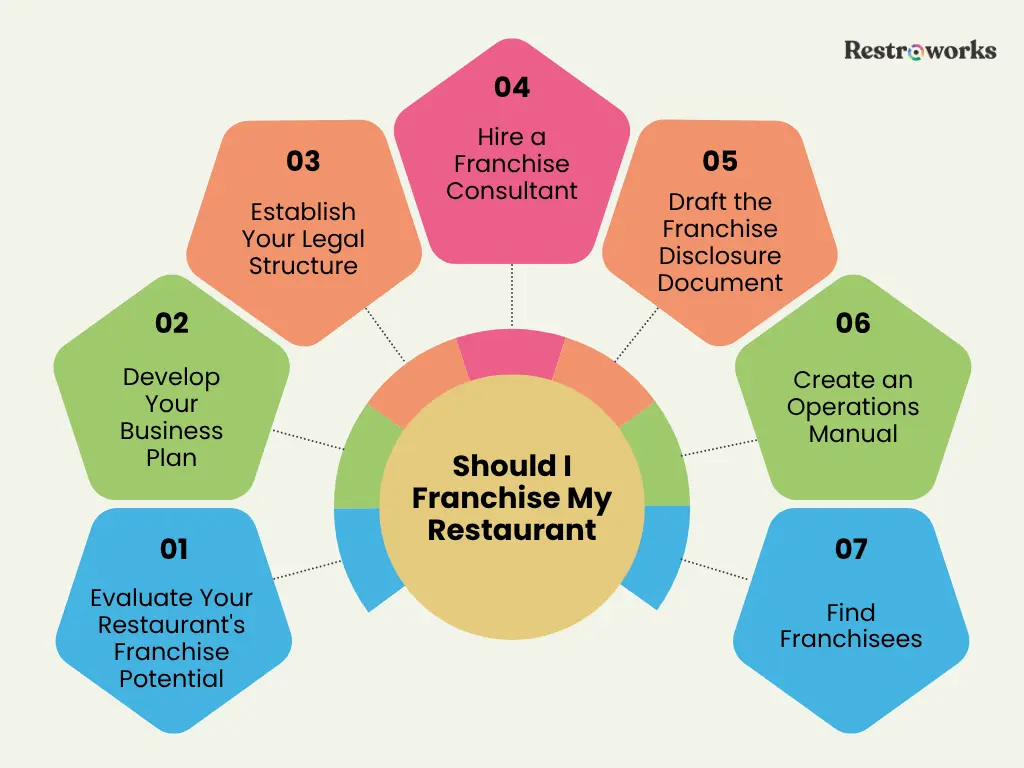
On average, it takes three to four months from starting the process to establishing your first franchise. If you are ready to build your own restaurant franchise, here’s what it all involves-
1. Evaluate Your Restaurant’s Franchise Potential
You’ve evaluated your business model, brand, franchise systems, and financial readiness. Now think about the concept. Can this restaurant concept succeed beyond its current location?
Evaluate your concept and menu in terms of-
- Market demand
- Location and target demographics
- Menu adaptability
- Competitive advantage
If you’re still unsure, get an outside perspective. Someone who already has the experience, like a franchise consultant or a successful restaurant owner, can help you identify gaps before you invest in developing it.
2. Develop Your Franchise Business Plan
A franchise business plan is the roadmap for your franchise model, finances, expansion, and the support you’ll give franchisees. It should cover:
- The franchise model
- Restaurant history, details, mission, and vision
- Business goals
- Current financial analysis
- Short-term and long-term financial forecasting
- Expansion strategy
- Ideal franchisee
- Your marketing and operations plan to support franchisees
This plan does two jobs. It guides your own operational and strategic decisions, and it shows potential franchisees what to expect from the partnership.
3. Establish Your Legal Structure
It is advisable to separate your franchise from your primary restaurant operations. A separate legal entity makes it easier to manage agreements, royalties, taxes, liabilities, and future growth.
A new franchise restaurant can operate as a private limited company or a limited liability partnership, with its own financial books. This helps limit your personal liability and protects you (the owner), and your original restaurant in case of any legal or financial trouble.
4. Hire a Franchise Attorney and Consultant
Because franchising involves extensive paperwork, legal requirements, and compliance obligations, it’s best to have a franchise consultant handle everything. An attorney with experience in restaurant franchising can help you build stronger systems. They can-
- Evaluate your concept and make recommendations
- Advise you on franchise fees and royalties
- Ensure adherence to state-specific laws for franchises
- Protect intellectual property
- Meet all legal and disclosure requirements
- Offer ongoing guidance on expansion
It also matters for the paperwork. The FTC’s disclosure document must identify the franchisor’s business organization and include its audited financial information, which is far easier with separate books.
5. Create Your Franchise Disclosure Document (FDD)
The Franchise Disclosure Document is a pre-sale information document for prospective franchisees to tell them exactly what they’re investing in, and in the U.S. you must give a compliant one to every prospect before a sale can happen.
It features 23 specific categories of information, including-
- How your franchise works
- The fees they’ll have to pay in terms of franchise fees, royalties, and other ongoing fees
- Level of support they’ll receive from you (For instance, if you’ll provide the location and technology)
- Their obligations
- The operational or financial risks franchisees should understand before signing the agreement
Additionally, it covers specifics such as-
- The history of your restaurant business
- The estimated initial investment to open a franchise location
- Responsibilities of both the franchisor and franchisee
- Territory rights and any restrictions on where franchisees can operate
- Details of any lawsuits or bankruptcies against the restaurant brand
- Conditions for renewing, transferring, or terminating the franchise agreement
- Financial performance of any existing franchise locations
In the U.S., the Federal Trade Commission requires franchisors to provide a compliant FDD to prospective franchisees before the sale can take place. Plus, you’ll have to manage other state-level registration and disclosure requirements.
6. Create an Operations Manual
If you are franchising, your operations and training should already be standardized. Here, you’ll put those together in an operations manual. This will cover-
- Service processes and standards, from greeting to serving and checkout
- Kitchen operations, recipes, ingredient specifications, portion sizes, cooking methods, plating guidelines, and food safety procedures.
- Daily operations such as day opening and closing processes, inventory management, supplier ordering, equipment maintenance, and cash handling.
- Brand standards for store layout, employee uniforms, signage, brand colors, packaging, marketing materials, and the overall customer experience.
Keep this manual as detailed as possible, but flexible enough to tailor it as the number of franchises grows.
7. Find Franchisees
The people you bring into your network will represent your brand every single day, so don’t rush the process just because someone has the money to invest.
A strong franchisee should believe in your concept, be willing to follow your systems, and have the commitment to run the business the way you meant it to be run.
Take the time to interview candidates, verify their financial capacity, and understand why they want to join your brand. Franchising is a long-term partnership, and choosing the right partners from the start will save you countless headaches as your network grows.
Alternatives to Franchising Your Restaurant

Franchising can help you grow faster, expand into new markets, and build a recurring revenue stream. But it’s not the only way to scale a successful franchise business.
If you’re not completely convinced about franchising yet, take a look at these alternatives before deciding-
A. Open Corporate-Owned Locations
Opening corporate-owned franchise locations is a good fit if you want to retain direct control over your restaurant’s operations, customer experience, and brand standards.
Every new outlet remains under your restaurant’s ownership, so you decide everything from the menu and pricing to hiring, marketing efforts, and daily operations. That’s one of the biggest reasons brands like In-N-Out Burger have chosen not to franchise. They’ve grown steadily while maintaining tight control over the customer experience and brand standards.
The downside is that growth depends on your own capital and operational capacity. Every new restaurant is your investment, your team, and your responsibility.
B. License Your Restaurant Concept
Licensing is worth considering if you want to capitalize on specific parts of your restaurant brand, such as its trademark, recipes, or packaged products, without necessarily franchising the entire business.
A licensing agreement allows another business to use specified elements of your brand under agreed terms. Depending on the arrangement, you will need to provide some level of training and support, without transferring the entire operating system.
The trade-off is that you have less direct control over how the other business uses and represents your brand.
C. Consider Strategic Partnerships or Joint Ventures
Strategic partnerships and joint ventures let you expand your restaurant business by working with another company that brings something you need, whether that’s capital, operational expertise, or local market knowledge.
Instead of funding and managing every new location yourself, you can agree to share the investment, responsibilities, decision-making, and profits with your partner. This approach is especially common when restaurant brands enter new countries, where local knowledge can make all the difference.
Should You Franchise Your Restaurant: A Quick Decision Framework
If you’re still on the fence, use this framework as a final gut check. You don’t need to answer “yes” to every question, but the more confidently you can, the stronger your foundation for franchising is.