

For the most part, most owners have received the message that restaurant forecasting is essential. Some have invested in the software that will assist them in their forecasting tasks. However, very few have actually made forecasting a habit at their restaurant.
The difference between having access to such software and using forecast information to drive operations in the restaurant is definitely not technological. It is definitely a cultural one, and you’re losing money by not addressing it. By having no forecasting capability in your restaurant, the management is forced to make fifty or more decisions per week without any basis other than intuition.
Will Fleming, President of Global Shared Services, put it plainly: “Companies that aren’t good at budgets aren’t good at predicting the future. If you’re not good at predicting the future, the business can sometimes be an accident.” Accurate forecasting helps you manage inventory by aligning stock levels with projected sales and inventory projections, reducing waste and preventing shortages.
This is not an explanation of what restaurant forecasting is or why it is important in theory. It is a complete, ultimate guide to forecasting restaurant sales.
What You Will Learn
- Why restaurants need restaurant forecasting
- How historical sales data helps businesses
- How you can build a forecasting culture in your business.
Why Restaurant Sales Forecasting Fails Without Culture?
The first thing restaurant owners need to know about this is that having forecasting solutions without a forecasting culture is just another way of paying for a tool that will collect dust on your spreadsheet.
Forecasting and scheduling solutions can cost restaurant owners between $200 and $600 monthly per store. If their predictions do not yield any tangible results, it is not the algorithm that should take the blame for failing at its job. Instead, the issue is that the team has not yet created a consistent practice of making decisions based on information coming from the forecast.
Herb Taylor, writing for EisnerAmper, described the transformation when culture actually shifts: “Managers move beyond reacting to immediate situations and begin to shape outcomes proactively. They become more than floor leaders; they become restaurant operators in their own right.”
This transition does not occur due to the purchase of a new software program. This occurs as a result of the development of a pattern where the team assesses forecasted sales against actual sales. This pattern is the true essence of developing a culture of forecasting in restaurants.
Mr. Kamran Khan said on Restrocast, a podcast with Ashish Tulsian,

Proving how important forecasting culture is and how advantageous this skill can be for your business.
The Reactive vs. Proactive Operator: Where Do You Stand?
Accurate forecasting is essential for preparing for seasonality, reducing surprises, and building a more resilient operation ready to grow.
Here is a fast self-assessment for you:
Reactive operators notice most of these trends: order based on quantities decided by whoever worked the previous weekend, scheduling based on memories rather than history, extreme increases in labor expenses caused by unexpected influx of customers because of the local activity, food cost surprises at the end of the month, even if cost trends were very predictable from the start of the month.
Proactive operators need no fancy technology. They simply make decisions for the coming week based on analysis of their sales history. Managers analyze their historical information before the coming week at the beginning of Monday, and by mid-week, they verify the actual versus planned sales. Labor and food costs are analyzed depending on their expected revenues.
All restaurateurs who are reading this piece of writing find themselves somewhere in between, being more reactive as they recognize they have their historic data but fail to use it effectively without knowing how to get into it.
The great news is that you may actually start this process way easier than you may think.
Step 1: Audit Your Data Before Buying Anything
The number one error in forecasting is spending money on specialized software without knowing if your sales data is sufficiently clean to make it valuable. All forecasts depend on sales data input into them.
- First, assess these five criteria:
- Do you have historical sales data for at least 12 months by day?
- Can you generate sales data for your restaurants by daypart?
- Do you have historical labor hour data alongside sales data?
- Is your inventory data collected in a consistent manner, or has it been sporadic due to periods where no count was done?
- Do you have data on local events, closures, or promotions impacting selected weeks?
If you can say “no” to any one of these, this is where you start. Forecasts made using incomplete historical sales will give you erroneous forecasts, and erroneous forecasts are worse than no forecasts since they erode managerial trust in their output.
Stephanie O’Rourk, CPA and Partner at CohnReznick, who leads their hospitality consulting divisions, framed this directly: “If you’re utilizing the prior year as a baseline without understanding what some of those outliers were, and not adding relevant information for this year, you’re not forecasting.”
Accurate forecasting helps restaurants manage inventory by aligning stock levels with projected sales. Prior to developing the forecasting process, note all the weeks that were corrupted. This could be due to the construction taking place near your business premises, the week that had an extremely strong promotion campaign, or the week during the holiday that was 40% higher than an average weekend.
Step 2: Design Your Weekly Forecasting Cadence
This is by far the most critical structural change for any restaurant. The weekly forecast cycle is where the culture lives or dies.
Most restaurants that have problems with sales forecasting will try to do it daily, despite never having established the weekly forecast cycle. This is completely backward. Restaurant managers will get frustrated easily with daily fluctuations, and their faith in sales forecasting will be shaken up with an inaccurate daily forecast, eventually leading them to give up. Start with the weekly, first.
Here is a proven three-meeting structure:
- Monday: Forecast Set (20 minutes). Compare the actual sales from the last week to your forecasted sales and emphasize the gap between them. Prepare your forecasted sales based on the historical sales of the last week of the previous year, taking into account all external factors like local activities, weather forecasts, and marketing initiatives.
- Wednesday: Mid-Week Pivot (15 minutes) Sales results from Monday to Wednesday are to be compared with the projected sales numbers. If you find yourself over-performing, do you have adequate stocks? Are you in a position to employ extra people on Thursdays and Fridays? If you underperform, how do you plan to reduce labor costs prior to the weekends? This is the type of conversation that will define your forecasting culture or forecasting exercise.
- Friday: Variance Review (20 minutes) How close was the accuracy of this week’s forecast? In which area did we fall short in forecasting customer demand? What role did outside events play in this difference between our expected and actual sales? It may give some lessons for the coming week.
It means that each week, 55 minutes are saved on average. It compensates for all the time wasted while dealing with issues on the fly because the manager is not prepared to manage customer flows that he should have forecasted.
Step 3: Set Realistic Targets Your Team Will Trust
One surefire way to ensure the destruction of any culture in which you may wish to create forecasters is by implementing this process along with challenging accuracy targets prior to your managers having experienced successful forecasting in restaurants.
These are realistic expectations at each step:
- Manual forecasting, first 30 days: Forecasted sales vs. actual sales can fluctuate by plus/minus 15 percent. Don’t worry about it; it’s normal. It’s your starting point.
- Consistent weekly cadence, 60 to 90 days in: Plus/minus 10 percent target. Your managers now know how to spot patterns in their data and consider seasonality and external events.
- Software-supported forecasting after 90 days: Plus/minus 5 percent target. Crunchtime says restaurant forecasting is accurate within a plus/minus 7 to 32 percent range. The 7 percent side is possible. The 32 percent side is where most restaurants begin.
Stephanie O’Rourk’s framework for restaurant forecasting accuracy: “Revenue forecasting is the basis for the major line items in your overall forecasting cash flow, cost of goods, labor needs, and operating supplies. Therefore, whenever you start to model and do financial planning, revenue is an appropriate starting point.”
Connecting forecasting with cash flow helps bring home the importance of forecasting. If your sales forecast misses by 10%, then the food and labor costs follow suit. If you have an excess of food expenses by 2% because of ordering too much due to incorrect forecasts of the inventory, you can quantify that. For a $1 million food budget per year, 4% loss equals $40,000.
Step 4: Build Accountability Without Burning Out Restaurant Managers
It will be sensible to dispel one misconception that should not persist: the main problem in adopting the forecasting culture does not come from managers who understand everything and therefore stick to old routines. Forecasting routines only increase managers’ workload without reducing their other activities.
You have already ensured your failure if you start implementing Monday forecasts and Wednesday pivots but do not remove anything from your manager’s routine schedule. Forecasting needs to fit into the manager’s routine by substituting for something else, not just by adding new activities.
The best trade-off in this case is removing the scheduling process that is performed manually and takes lots of time, but does not involve any data analysis. Managers changing their habit of manually performing schedule construction in favor of automatically generating the schedules through sales forecasting save two to four hours per week.
The cultural change happened due to the fact that there was a combination of a reduction in administrative work, along with visibility in key metrics through the use of technology. This is what constitutes the culture: less paperwork, better forecasting metrics, better and faster decision-making in terms of financials using these metrics.
Where there are independent units of operation, there comes into existence the concept of an incentive system. The idea is that the incentive scheme must be created in such a way that labor forecasting starts getting critical importance, since the one doing this forecasting will gain from their accuracy.
Step 5: Choose Tools That Match Your Stage & Help Your Restaurant Operations
The tool selection sequence should follow the cultural development, not precede it.
Stage 1: Spreadsheet-first (months 0 to 2). Before making any investment in software, get the sales history by day parts for each week using your POS system. Just create a four-week moving average in Excel or Google Sheets. Find out your sales forecast for next week using the average, and then manually fine-tune it depending on other parameters like seasonality. That is all you have to do!
Stage 2: Mid-tier tools ($100 to $400 per location per month). Once it is determined that your team has shown that they are able to effectively conduct their weekly sales forecast for 60 to 90 days, then software that can integrate your POS, inventory management system, and scheduling can be considered. Some of the software that works along these lines are 7shifts, Lineup.ai, and Crunchtime. These softwares integrate well with any of the popular POS systems.
Stage 3: Enterprise platforms ($400 to $600 per location per month) Multi-location reporting can be achieved using Restroworks, Restaurant365, and others. This is because some people who are running restaurants have many locations, at least ten. Multi-location reporting is important in ensuring that the whole organization has a forecasting culture as well. It is possible to see where the forecasted sales are not matching the actual sales.
Measuring Cultural Adoption Beyond Accuracy
Most operators measure forecasting success by comparing forecasted sales to actual sales. That is necessary but not sufficient to know whether the culture is actually changing.
Here are behavioral metrics worth tracking:
- Frequency of meeting: Are all three weekly meetings conducted regularly? Inconsistency shows that the habit has not been developed yet.
- Recording of the decision-making process: Do the managers record the reason behind their deviation from the expected sales forecast while creating the schedule? If so, it means that they are considering the forecast before making any decision.
- Quality of variance analysis: After 60 days, are your managers able to explain why the sales variance exceeded 5%? Quality variance analysis shows that they monitor the external market conditions.
- Improvement trend of variance analysis: Is the variance improving month by month? Even a slow improvement shows that everything is going well.
Restaurant forecasting helps restaurants anticipate customer demand and align business strategies and operating decisions accordingly, including for inventory needs, marketing campaigns, and staffing schedules.
By leveraging historical data, market analysis, and modern technology, restaurateurs can create accurate and detailed forecasts, informing decisions about lowering costs, enhancing customer satisfaction, and driving profitability. Automated forecasting tools can help restaurant operators make data-driven decisions about pricing and menu offerings. Many restaurant forecasting solutions utilize AI and machine learning to improve prediction accuracy over time.
What Good Looks Like at 90 Days of Restaurant Operations
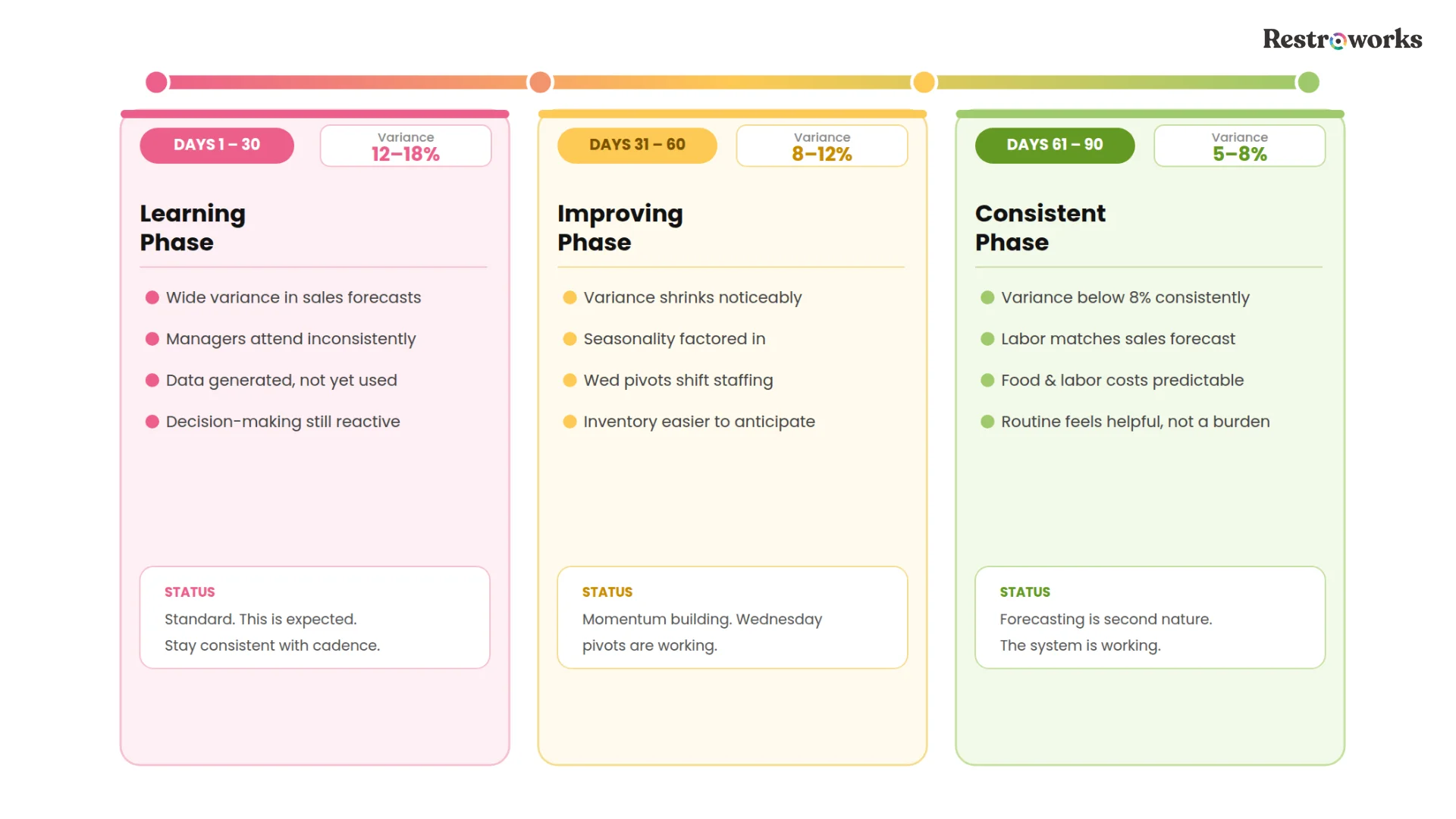
If you start the Monday-Wednesday-Friday cadence this week, here is what realistic progress looks like at 90 days after implementing restaurant forecasting software:
- Days 1–30: There’s a wide variance between expected and actual sales, typically 12%-18%, and managers have inconsistent attendance. While forecast data is getting generated, it isn’t necessarily informing decision-making. That’s standard.
- Days 31–60: The variance begins decreasing to the 8%-12% range as managers improve their use of outside influences and seasonality when predicting future business trends. The Wednesday pivot meetings begin yielding tangible shifts in staffing. It’s easier to anticipate inventory requirements.
- Days 61–90: Consistent teams achieve 5%-8% variance. Labor expenses come close to matching sales forecasts. Food and labor costs aren’t a surprise anymore. Managers characterize the week’s routine as helpful, not a burden.
After 90 days, a thriving forecasting process for restaurants involves managers referencing their forecast prior to executing any operations, rather than waiting until there are issues to address. Customer satisfaction remains steady since staffing aligns with customer needs. Menu planning is strategic due to more accurate inventory forecasting, which minimizes stockouts and excess inventory.
That is the practical definition of accurate restaurant forecasting working as a culture rather than a compliance exercise.
A forecasting culture within your restaurant is not about getting everything right. It’s about moving from being reactionary to being proactive at all organizational levels.
Begin by conducting a data audit. Establish the rhythm of weekly forecasting without investing in any sophisticated tools first. Set realistic accuracy standards for your forecasts that you’re able to achieve. Spend less time on paperwork and more on meeting time. And use your seasoned managers’ local insight as an information source for your forecasts, rather than a barrier to forecasting.
Forecasting helps you keep food and labor costs where they should be—well within industry standards. A successful restaurant forecasting process builds discipline and transparency, so teams spot issues early and take action before small problems become major setbacks. Accurate forecasting helps restaurants reduce waste, control labor costs, and improve customer satisfaction by aligning inventory, staffing, and menu planning with demand. By leveraging historical data, market analysis, and modern technology, restaurateurs can create accurate and detailed forecasts, informing decisions about lowering costs, enhancing customer satisfaction, and driving profitability.
The organizations that develop this ability today will safeguard their bottom lines through any challenges that lie ahead in the coming year.