

How confident are you that the allergen information your bakery provides is always accurate?
Think about it. A supplier updates an ingredient specification. Your bakers modify a recipe. Or the kitchen mishandles some ingredients. None of these changes seems big. But when it comes to managing allergen information and communication for customers? It is.
That’s the challenge with allergen control. The risk isn’t limited to the bakery floor. It extends to purchasing, recipe management, production, labeling, documentation, and employee training.
Which means, you need to understand where allergens enter your bakery operation and how information flows from suppliers to recipes, production, and eventually customers. The only goal? To keep allergen information accurate and your customers safe.
Here’s everything you need to know about managing bakery allergens and ingredients, ensuring compliance, and reducing risks across operations.
What you will learn
- FDA food safety regulations and allergens compliance requirements
- Managing bakery allergens and ingredients the right way
- Responding to allergen incidents
What are the Major Food Allergens in Bakery Products?
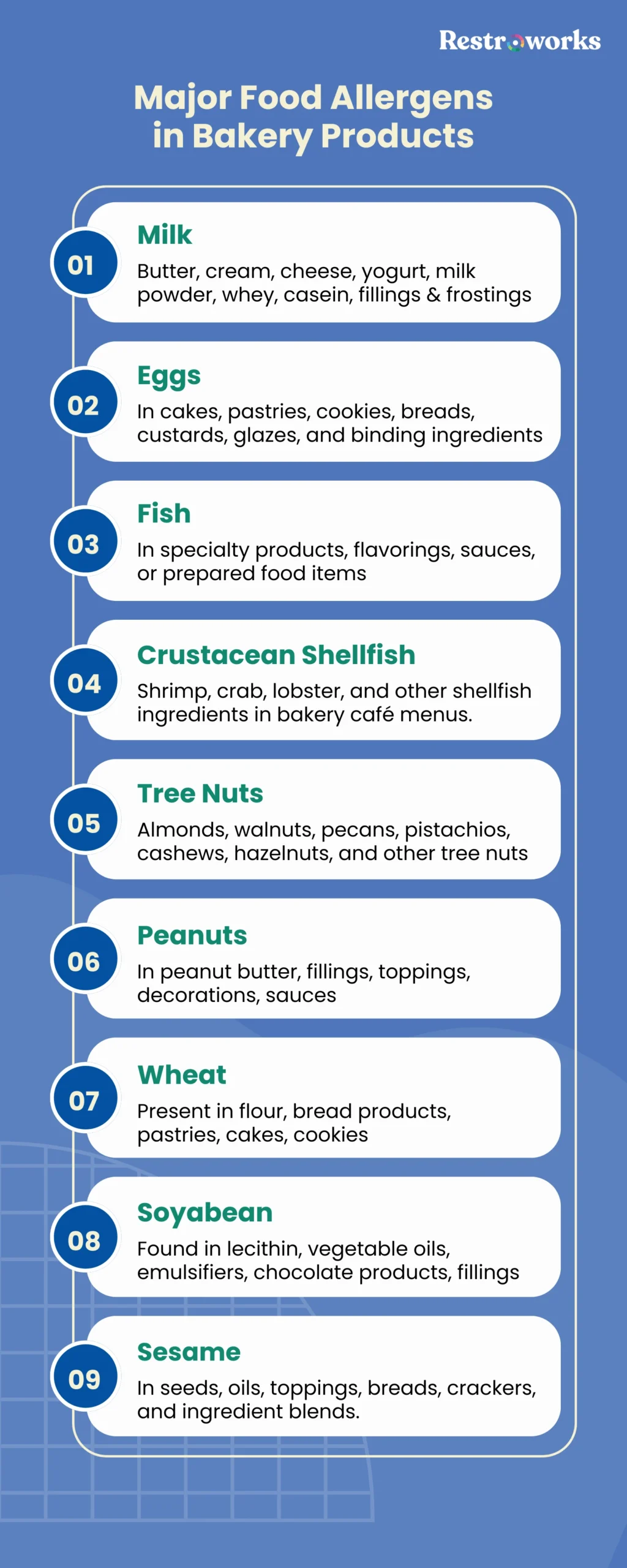
The first step to effective allergen management is knowing exactly which food ingredients require your closest attention.
While your bakery handles hundreds of ingredients in its recipes, the FDA recognizes nine major food allergens that account for most serious food allergy reactions in the U.S. These are-
- Milk
- Eggs
- Soyabeans
- Fish
- Tree Nuts (Almonds, walnuts, pecans, pistachios, cashews, hazelnuts, etc.)
- Crustacean Shellfish (Shellfish ingredients that may be used in bakery café menus)
- Peanuts
- Wheat
- Sesame
If any baked product includes any of these food ingredients, it’s your responsibility to label or communicate them clearly. A simple pineapple pastry, for example, will have wheat, milk, eggs, soy, and tree nuts.
That’s why allergen management requires detailed ingredient records, accurate recipes, up-to-date supplier information, and proper labeling practices across every product you sell.
FDA Food Safety Compliance and Legal Obligations
While you may know the FDA as the agency that oversees food safety in the United States, it also plays a central role in how businesses identify, declare, and manage allergens throughout the food supply chain.
With laws such as FALCPA and FSMA, the FDA sets requirements for labeling allergens, preventing incidents, implementing controls, managing ingredients, and meeting food safety regulations.
Some of these requirements are mandatory, while others are voluntary, and totally up to you in how you want to communicate any potential risks.
That said, here are the key FDA requirements for food allergy that you should know-
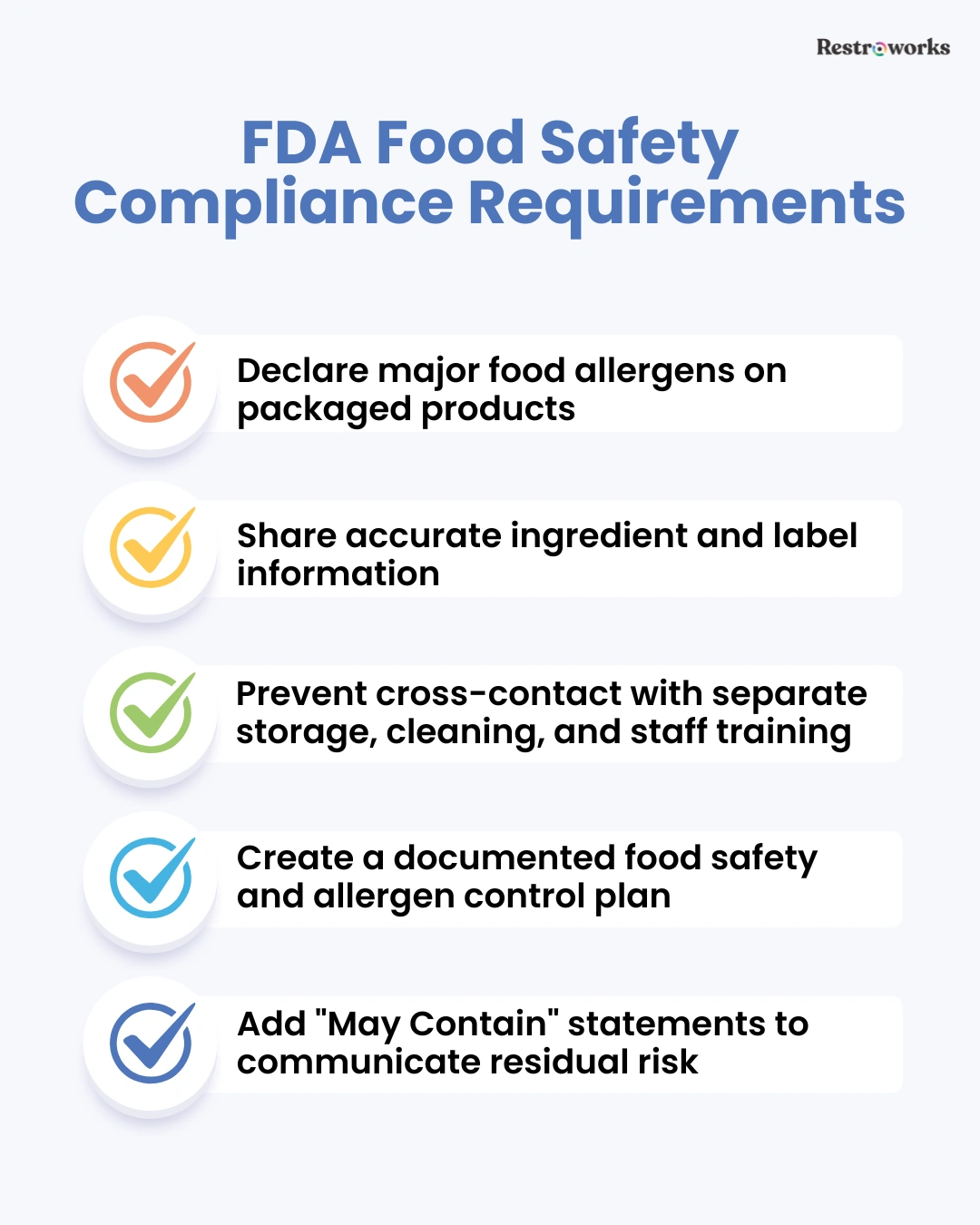
1. Properly Declare Major Food Allergens on Packaged Products
Under the Food Allergen Labeling and Consumer Protection Act (FALCPA), packaged food products regulated by the FDA must clearly identify any of the nine major food allergens.
For your bakery business, this means-
- Listing the allergen in the ingredient statement using its common name (for example, “whey (milk)”)
- Including a separate “Contains” statement, such as “Contains: Milk, Eggs, Gluten.”
The idea behind this naming guideline is that customers shouldn’t have to interpret any scientific ingredient names to know about the allergen risks.
2. Share Accurate Ingredient and Label Information
Your allergen declarations are only as accurate as the ingredient information behind them.
If a supplier changes a formulation, you use a substitute ingredient, or you update a recipe, make sure to review and change the product label immediately. Otherwise, you’ll be selling baked goods with undeclared allergens, which can lead to health issues for the customer and serious consequences for you.
3. Prevent Allergen Cross-Contact
The FDA’s Current Good Manufacturing Practices (CGMPs) require food businesses to implement controls to prevent contamination during manufacturing, processing, packing, and holding.
From a bakery operations point of view, this requires you to-
- Separate allergenic ingredients during storage
- Follow cleaning and sanitation procedures between food production runs
- Use designated utensils, containers, or work areas where necessary
- Train employees on allergen handling procedures
4. Follow Food Safety Plan Requirements
If your bakery falls under the FSMA requirements, you’ll need to account for allergen risks in your food safety plan to maintain food quality.
This includes doing allergen-related hazard analysis, documenting preventive controls, and defining what happens if those controls fail. You’ll also need to keep records of monitoring activities, corrective actions, and verification procedures where required.
A documented food safety and allergen control plan makes it easier for everyone to follow the same best practices.
5. Voluntary Requirements and “May Contain” Statements
You’ve likely seen labels such as “May Contain Peanuts” or “Produced in a Facility That Also Processes Tree Nuts.” These statements warn customers that the baked products may unintentionally have an allergen, even if it isn’t an ingredient in the product itself.
Unlike allergen declarations, which are mandatory requirements, these “may contain” declarations are voluntary precautionary statements.
These statements don’t replace allergen controls, accurate labeling, or good manufacturing practices. Instead, they serve as an added communication when there’s a genuine risk of cross-contact despite the preventive measures you’ve put in place.
In short, use “May Contain” statements to communicate residual risk, not to compensate for weak allergen management practices.
Creating an Effective Allergen Control Plan
When you’re running a bakery business, your ethical responsibility is high. According to the Asthma and Allergy Foundation, about 6 out of 100, or 22 million people in the U.S., have food allergies. So, food allergies affect millions, and for them, accurate allergen information and proper handling procedures are not just a matter of convenience but of safety.
An effective allergen control and management system will help you identify allergen risks, establish preventive measures, and standardize employee practices within the bakery. The 3 crucial aspects of this system are-
Conduct Allergen Risk Assessments
Before you start writing procedures or creating allergen controls, you need to know where the risks actually exist.
And no, the answer isn’t always obvious.
For instance, you obviously know which baked goods contain milk, soy, eggs, or nuts. But do you know how these ingredients are handled at the supplier level? Maybe not. To address this challenge, start with allergen risk assessments.
The goal is to identify every point where allergens can enter a product, be introduced through supplier ingredients, or transfer through cross-contact. This assessment will be the foundation for every control measure that you put next.
Develop Standard Operating Procedures (SOPs)
Identifying the allergen risks is one thing, but you also have to ensure your staff knows how to manage and control them. This is where you’ll need standard operating procedures.
SOPs will define the procedures, steps, and best practices your employees have to follow when storing, preparing, or handling baked goods.
This way, you reduce the risk of allergen contamination within the bakery, and of course, create more accountability within the team. For controlling allergens, your SOPs should cover-
- Ingredient receiving and verification
- Allergen storage
- Equipment cleaning and sanitation
- Preventing cross-contact
- Product labeling procedures
- Customer communication guidelines
- Incident reporting and response
The allergen-free food market is expected to expand from $51.6 billion in 2026 to $103.5 billion by 2036.
Digital Tracking and Documentation
Good allergen management depends on good recordkeeping.
If a customer asks whether a product contains a specific allergen, can you find the answer? If an auditor asks when you last updated an allergen declaration, do you have the records to show for it? If a supplier changes an ingredient, can you identify every product affected by that change?
Digital documentation and smart inventory management tools give you a centralized record of ingredients, allergen declarations, supplier specifications, recipe updates, and labeling changes. So you don’t need to waste your time searching through multiple files.
Plus, you can actually trace where a certain piece of information came from, when it changed, and who updated it. This level of traceability and visibility streamlines audits, improves compliance, and helps you respond faster when allergen-related questions or issues arise.
Managing Bakery Allergens and Ingredients: How to Do It Right?
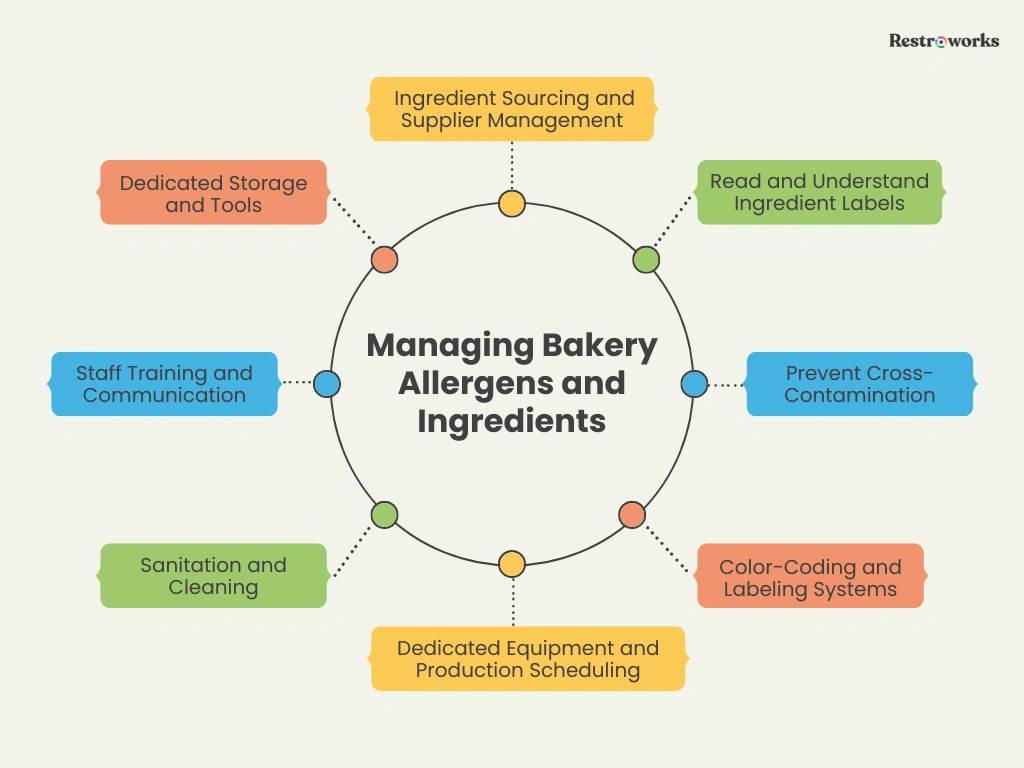
Not sure where to begin? Here are some practical ways for managing bakery allergens and ingredients in your food business.
1. Ingredient Sourcing and Supplier Management
Managing allergens starts with the ingredients you bring into your bakery.
That sounds simple, but sourcing non-allergen ingredients isn’t always easy. Your suppliers may change formulations, switch manufacturing facilities, update distributors, or update production processes. In such cases, even ingredients that have been safe to use for years can now have new risks if you fail to account for them.
Vet Suppliers for Allergen Controls
Before adding a supplier to your approved vendor list, take some time to verify how they manage allergens within their own facilities because you need to be confident that the supplier can consistently provide accurate allergen information and notify you when anything changes.
So before finalizing your inventory vendors, do a supplier review which covers-
- Their allergen control and cross-contact prevention practices
- Manufacturing and packaging processes
- Ingredient specifications and allergen declarations
- Procedures for communicating formulation or ingredient changes
- Food safety certifications and supporting documentation
Focus on building a strong supplier relationship, one rooted in trust and transparency, to ensure any incoming ingredients are safe and of the highest quality.
Read and Understand Ingredient Labels
It’s equally important to know how to read and interpret product labels. When sourcing your raw ingredients, pay attention to labels and review-
- Product specifications
- Major allergen declarations
- Precautionary statements such as “May Contain” warnings
- Shared manufacturing facility information
- Ingredient composition and sub-ingredients
- Recent formulation or packaging updates
Most importantly, continue reviewing ingredients even after you’ve approved them. Food manufacturers update formulations, substitute ingredients, and change food production processes more often than you may realize.
Regular reviews will allow you to identify those changes before they affect your bakery products.
2. Preventing Allergen Cross-Contamination
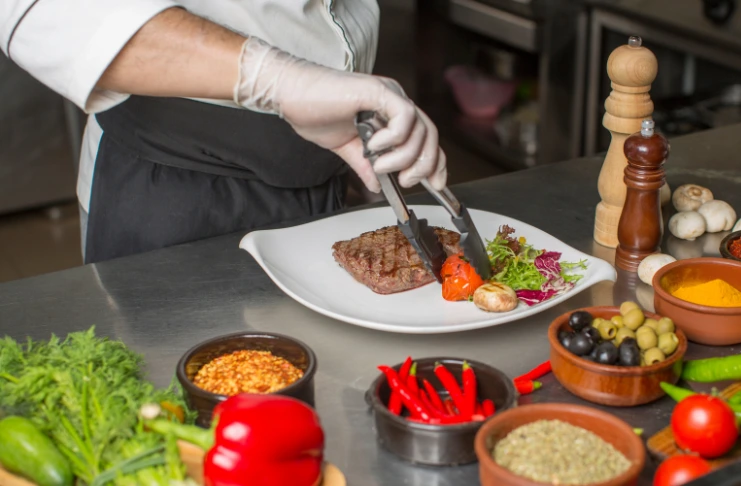
So your inventory sourcing practices are all good to go. But even then, allergens can spread through everyday bakery operations. Shared storage areas, airborne flour particles, spills, utensils, and production equipment can all contribute to cross-contact if proper controls aren’t in place.
The good news is that it’s entirely fixable. Here’s how-
- Create Dedicated Storage Spaces: Store allergen-containing products and ingredients separately from allergen-free ingredients whenever possible. A good way to do this is to use labeled shelves, containers, or storage zones to reduce the risk of accidental mix-ups and improve quality.
- Prevent Spills: Store your allergen raw materials in sealed containers and avoid storing them above allergen-free products to prevent accidental spills and leakage.
- Control Airborne Ingredient Transfer: Bakery ingredients like wheat flour and powdered mixes can get carried through the air during food production. To avoid this, consider production sequencing, dedicated preparation areas, or thorough cleaning procedures to prevent particles from reaching other products.
3. Production and Equipment Handling
Your kitchen uses the same mixers, preparation tables, trays, utensils, and workstations to bake dozens of products in a single day. Operationally, that’s how it should be.
But when it comes to managing bakery allergens, it also increases the risk of cross-contamination between ingredients and products.
So, after ingredient sourcing and storage practices, focus on your production line too. The way you organize equipment, facility layouts, and production schedules can play a major role in reducing allergen risks.
Follow Color-Coding and Labeling Systems
When things get busy in the kitchen, no one has time to stop and look through ingredients to identify which are allergen-free. The simplest way to solve this is with color-coding and labeling systems.
A simple color-coding and labeling system can help distinguish allergen-containing products from standard production materials and reduce handling errors. Employees can identify ingredients, tools, and containers at a glance.
Think About the Facility Design
When ingredients, employees, and products constantly cross paths, the risk of accidental cross-contact increases. Even a well-trained team can struggle to control allergens if your kitchen space itself creates unnecessary points of contact.
So, it’s best to design your kitchen space in a way that keeps things separate. So, apart from dedicated storage and baking zones for allergenic foods, organizing production flow to reduce cross-contact and limit unnecessary movement of ingredients between workstations is essential.
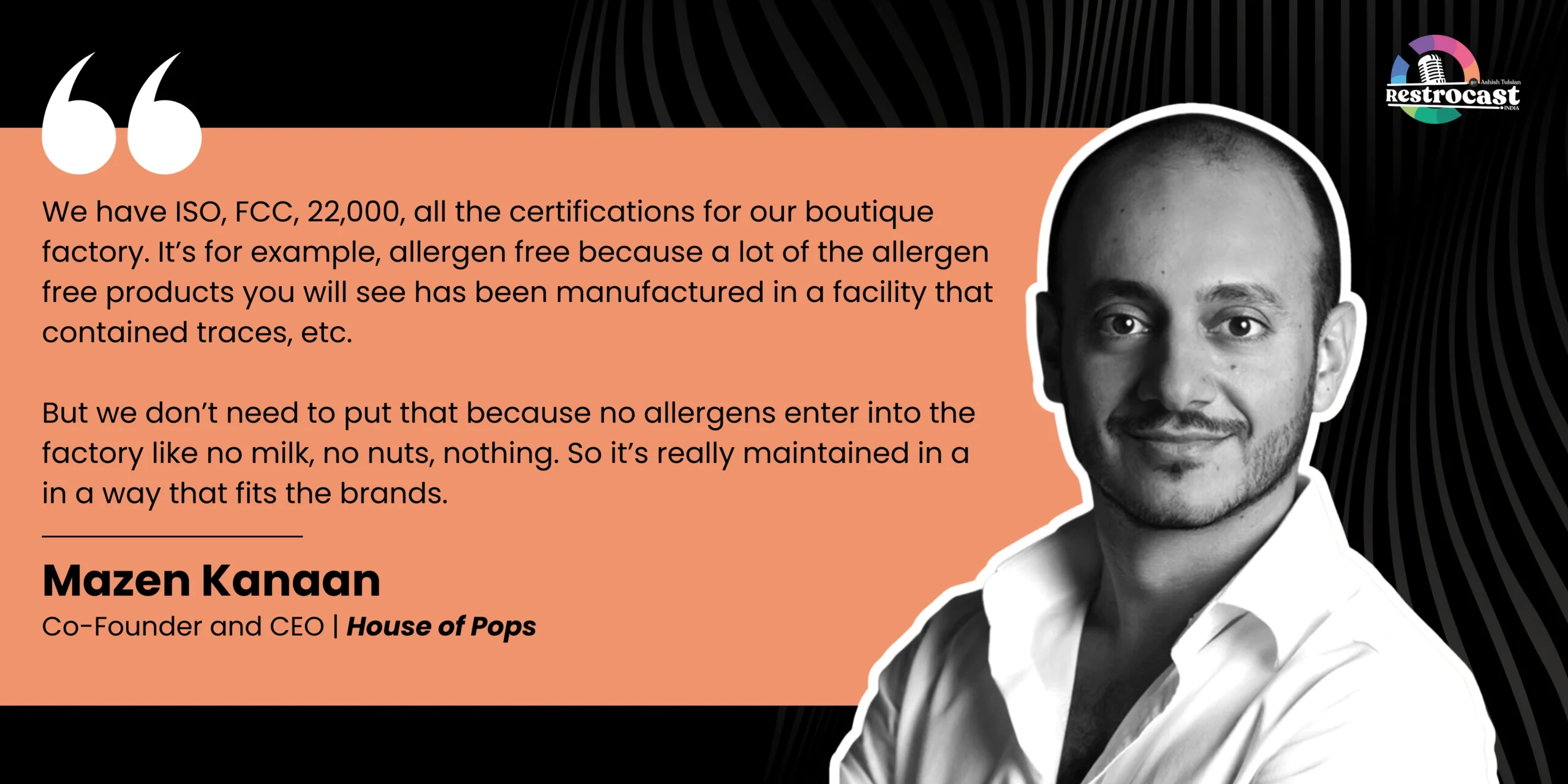
Some bakeries take facility controls even further by limiting which ingredients can enter the production environment. In a Restrocast episode, Mazen Kanaan, Co-Founder & CEO, House of Pops, talks about how they ensure no allergen enters their 7000 sq ft. production facility-
Dedicated Equipment and Scheduling for Allergenic Ingredients
Speaking of separate storage and prep zones, you’ll also need to use separate equipment for baked goods with common allergens.
This is because residual allergen-containing ingredients in mixing bowls, spatulas, or even ovens can increase the risk of contamination. Of course, buying every piece of equipment in two is both financially and operationally impractical, so you can have at least different ovens, mixers, and workstations for baking allergen-free products.
Production Scheduling
If separate equipment or workstations don’t look practical for your bakery operations, you can plan your production smartly to control allergens.
For instance, many bakers schedule allergen-free or lower-risk products earlier in the day before baking goods that contain major allergens. This helps reduce carryover risks and limits the amount of cleaning required between batches.
But this will also require you to have strong demand forecasting in place so that you can project sales and schedule batches more accurately. That said, when planning production schedules, consider-
- Baking allergen-free products, such as gluten-free breads, first
- Grouping similar allergenic foods together
- Adequate cleaning time between production runs
- Scheduling high-risk ingredients during dedicated production windows
- Avoiding unnecessary switching between allergen categories
A well-planned food production schedule reduces complexity for employees and makes allergen controls easier to maintain consistently.
4. Sanitation and Cleaning Procedures
Allergen residues can remain on equipment surfaces, utensils, containers, workstations, and other production areas long after a batch is finished. This makes a strict cleaning schedule extremely important.
Here, the goal is to prevent residues from carrying over into the next product. Let’s explore some cleaning and sanitation best practices for allergen management-
- Use dedicated cleaning tools where necessary: If you’re using the same brushes, cloths, scrapers, and cleaning equipment for multiple production zones, they also become a source of cross-contact. Use dedicated cleaning tools for allergen areas to reduce this risk.
- Clean from allergen-free areas toward allergen-containing areas: A smart practice is to follow a sequence while cleaning: clean from allergen-free surfaces to high-risk areas to prevent employees, tools, or cleaning materials from carrying allergens.
- Clean equipment between production runs: For all your shared equipment, clean and sanitize it thoroughly before switching to another allergen category. Pay special attention to mixers, utensils, trays, conveyors, and hard-to-reach areas where residue may accumulate.
- Maintain cleaning records: Document all your cleaning procedures, schedules, areas, and responsibilities. These records are useful for ensuring compliance and providing valuable documentation during internal and external audits.
5. Staff Training and Communication

After everything else, your allergen management procedures eventually come down to people. After all, your employees are the ones receiving ingredients, updating labels, answering customer questions, cleaning equipment, and baking treats.
Even the strongest allergen control plan will fail if employees don’t understand the role they play in maintaining it. So, offer comprehensive, regular staff training and make it practical.
- Train employees using real scenarios: Walk employees through situations they are likely to encounter. For example, how should they respond when a customer asks whether a product contains sesame? What should they do if a supplier delivers an ingredient with updated allergen information?
- Tailor training to employee responsibilities: Your front-of-house vs the kitchen staff will be dealing with allergens differently. Focus training on the risks and decisions employees are most likely to encounter in their specific roles.
- Offer easy access to allergen-related information: Employees shouldn’t have to rely on memory or repeatedly check product information when answering allergen questions. Maintain clear records, ingredient specifications, and allergen references that staff can quickly consult when needed.
- Provide refresher training throughout the year: New products, supplier changes, seasonal menu items, and employee turnover can all introduce new risks. Offer regular training sessions to keep refreshing their memory and knowledge.
How to Respond to Emergency Allergen Contamination?
If you discover a potential allergen contamination issue, take the following steps-
- Stop production and isolate affected products: Separate any products, ingredients, or batches that may have been contaminated so employees don’t accidentally use, package, or sell them.
- Notify relevant stakeholders: Share accurate information with managers, employees, distributors, retail partners, and regulatory authorities if required. If you delay communication due to the fear of compliance action, it can create bigger problems than the incident itself.
- Document the incident and corrective actions: Document the timeline, affected products, investigation findings, and corrective actions. You’ll need those records for regulatory compliance, internal audits, and future training.
- Update procedures and retrain employees if necessary: Once you’ve contained the issue, review the procedures that allowed it to happen. Update controls, revise documentation, and retrain employees where necessary
While allergen management can seem complex, building clear procedures and maintaining accurate information can make it much easier to control. The goal is not just to meet compliance requirements, but to create a safer operation, protect customer trust, and ensure your bakery can manage allergen risks consistently as it grows.