

Opening an ice cream shop feels like a dreamy, dreamy dream, doesn’t it? Maybe that’s why Jeni Britton Bauer, founder of Jeni’s Splendid Ice Creams, said, “I was working in art, ice cream, and pastry. It was all crossing over for me. Once I figured that out, I had to start a little ice cream shop.” She now runs around 33 scoop shops across 10 cities and makes over $30 million in annual revenue.
We genuinely believe that every person who ends up opening an ice cream business has a story like “I love this thing, why am I not doing it too?” But loving ice cream and actually knowing how to start an ice cream shop are two very different things, and this guide focuses on the latter.
The ice cream industry is projected to reach approximately $132.32 billion by 2032, demonstrating a compound annual growth rate (CAGR) of 6.65%, which means there’s room for you to start and eventually make profits off your business, too, but you have to come in prepared.
What You’ll Learn
- Should you or should you not open an ice cream shop? If yes, is it the right time?
- How to build a business plan, secure a location, funding, and licenses before you launch your shop?
- What to do on the launch day and beyond?
Is an Ice Cream Shop Actually Right for You?
Do you think every ice cream business makes it big? According to Limepack, 20% of ice cream shops fail within their first year, and 50% fail within their first five years. Like, look at this case study:
In 2010, Brian Smith and Jackie Cuscuna opened Ample Hills Creamery, and with $10 million in annual revenue, 16 stores, a Disney partnership, and a $40 million valuation, it was going super strong. Yet, by 2020, the company had filed for bankruptcy.
Harvard Business School professor Thomas Eisenmann commented on this, “They did a lot of things incredibly well. But they tried to grow too fast.” + They chose investors with limited food and beverage expertise and hired teams that weren’t equipped to manage rapid growth.
Founder Brian Smith later admitted: “You could draw a straight line from those dizzying heights of dealing with Disney to all the troubles that befell us years later… It came from chasing that star and flying too close to the sun.”
What does this tell us? Yes, ice cream shops are profitable, but they do come with their own set of challenges, and if you aren’t ready in advance to deal with them, failure is inevitable, especially because the seasonal nature of this business is brutal. Andrew Helfrich, former owner of Lansdowne Cone, puts it, “One of the biggest challenges in owning an ice cream shop is the fact that you only make money five or six months of the year, while paying rent the whole year round. That really does add up.”
So, if you’re the type of person who can:
- Manage seasonal cash flow & build multiple revenue streams, such as cakes, catering, delivery, or wholesale, to offset seasonality.
- Deliver the same quality and service every single day.
- Create new flavors, promotions, and experiences to keep customers coming back.
- Market your business throughout the year.
- Work long hours during weekends, holidays, and peak summer months.
And most importantly, accept that success depends as much on business management as it does on making great ice cream. Then, congratulations, you can go ahead and open an ice cream shop.
How Do You Choose Your Ice Cream Business Concept?
The first decision you’ll make, and honestly one of the most important ones, is what kind of cream shop you’re going to run because it will, in every sense, affect your equipment, your staffing, your costs, and who walks through your door.
So, should you go for a brick-and-mortar shop or an ice cream truck business?
The biggest benefit of a brick-and-mortar shop is that it gives you permanence. People know where you are, so you can build a regular clientele, decorate the place, and create an atmosphere however you want. The downside is that a brick-and-mortar shop also means lease negotiations, buildout costs, and rent even in months when nobody wants ice cream.
Ice cream trucks, on the other hand, give you mobility. You can follow the crowd. If there’s a concert nearby, you can be there. Or if there’s a Farmer’s market the very next morning, you can be there too. The trade-off is limited space, parking regulations, permits specific to mobile vendors, and the constant logistics of being on the move.
A mobile ice cream truck can also be a lower-cost entry point if you’re testing a concept before committing to a fixed location.
What are you going to actually sell?
This is where identifying a niche, such as dairy-free or alcohol-infused flavors, is important when choosing a concept for an ice cream shop. The ice cream parlor that tries to be everything to everyone usually ends up being memorable to no one. Alice Cherng, who co-founded Dear Bella Creamery in Los Angeles, went all-in on premium plant-based ice cream with Taiwanese-American flavors, and they launched nationwide shipping so that people outside of LA can also try their scoops. That specificity (flavor + delivery mode) is exactly what made the shop stand out.
She said, “People all over the country and even the world ask us all the time if we can open a shop near them, but opening an ice cream shop is very expensive and time-consuming. We felt that the only feasible way to get our products to people beyond LA is through shipping.”
Whether you choose to go with soft serve, hard scoop, rolled ice cream, frozen yogurt, Italian ice, or other frozen treats like sorbet and gelato, they’ll drive almost everything downstream, including what equipment you buy.
Next, do you want to operate seasonally or year-round?
If you’re in Florida, this is a different question than if you’re in Minnesota. But even in warm climates, the ice cream season peaks in the summer. Many ice cream shop owners choose to go seasonal because it’s cheaper and simpler. Others stay open year-round and “survive” the slow months with loyalty programs, catering gigs, and creative campaigns.
A Canadian ice cream shop, for example, once increased its Instagram engagement by 82% and profile visits by 118% during winter through a gamified advent calendar campaign, with daily posts and giveaway contests that gave customers a reason to keep coming back even when it was cold out.
How Do You Write a Business Plan That Gets You Funded?
A business plan is the document that tells lenders and investors you’ve actually thought this through. A well-structured business plan for an ice cream shop should include an executive summary, company description, products and menu, market analysis, financial projections, and an operations plan.
The executive summary comes last, even though it appears first. It’s a distillation of everything else. The market analysis section is where you show if you really understand your local competition, customer demand, and pricing opportunities. In the financial projections section, you outline your startup costs, projected revenue, operating expenses, cash flow, and the timeline to profitability.
A few things lenders specifically want to see in your ice cream business plan are how you’re addressing seasonality in your cash flow projections, what your food cost percentage looks like, and how you’re planning to reach break-even. Maintaining a 25-35% food cost percentage is a key success factor for an ice cream shop, and experienced lenders in the food and beverage space know this benchmark well.
What Does It Actually Cost to Open an Ice Cream Shop?
Startup costs for an ice cream shop typically range from $50,000 to $250,000 for brick-and-mortar locations. More specifically, starting an ice cream shop typically costs between $20,000 and $250,000, depending on the business model, location, and scale of operations. An ice cream truck business, of course, sits on the lower end of that range.
So, where will your money actually go?
#1: Equipment
Initial startup costs for an ice cream shop can include equipment costs ranging from $20,000 to $150,000. Soft serve machines alone run $10,000 to $30,000 each. Dipping cabinets cost $4,000 to $10,000. You’ll also need storage freezers, milkshake machines, blenders, and a POS system.
As for what ice cream-making equipment you MUST invest in, Tyler Malek, co-founder of Salt & Straw, advocates prioritizing size and speed. He says, “Try to find machines that can handle at least 1 quart of ice cream. The bigger the better, since it will equate to stronger freezing components.” He also recommends looking for machines that are intuitive and have minimal parts, all of which are useful.
Please don’t cheap out on ice cream shop equipment. Used machines can be fine, but factor in maintenance costs and the risk of downtime that comes along.
#2: Location and Buildout
Lease costs vary widely by market, but expect to budget $10,000 to $20,000 just to get in the door, including deposits and the first month’s rent. Then, buildout and renovations will need anywhere from $20,000 to $100,000 or more, depending on what you’re starting with.
Plus, you’ll need architectural drawings, plumbing, electrical, flooring, and all the structural stuff that will make your food service space legally functional.
#3: Inventory and Supplies
Initial inventory expenses of $5,000 to $20,000 cover your first stock of ice cream tubs, cones, cups, toppings, syrups, napkins, and everything else you’ll need in the first few weeks.
#4: Ongoing Expenses
Ongoing expenses for an ice cream shop include rent, utilities, labor, and ingredient costs, which should be factored into the overall business plan from the very beginning.
INDUSTRY INSIGHT
A 2026 baseline analysis found that average monthly fixed costs for an ice cream shop, including rent, utilities, and labor, come to around $44,700 per month. With such high overhead, every additional sale must contribute meaningfully to profit, making pricing, labor efficiency, and food cost control critical to long-term success. |
How to Secure Funding?
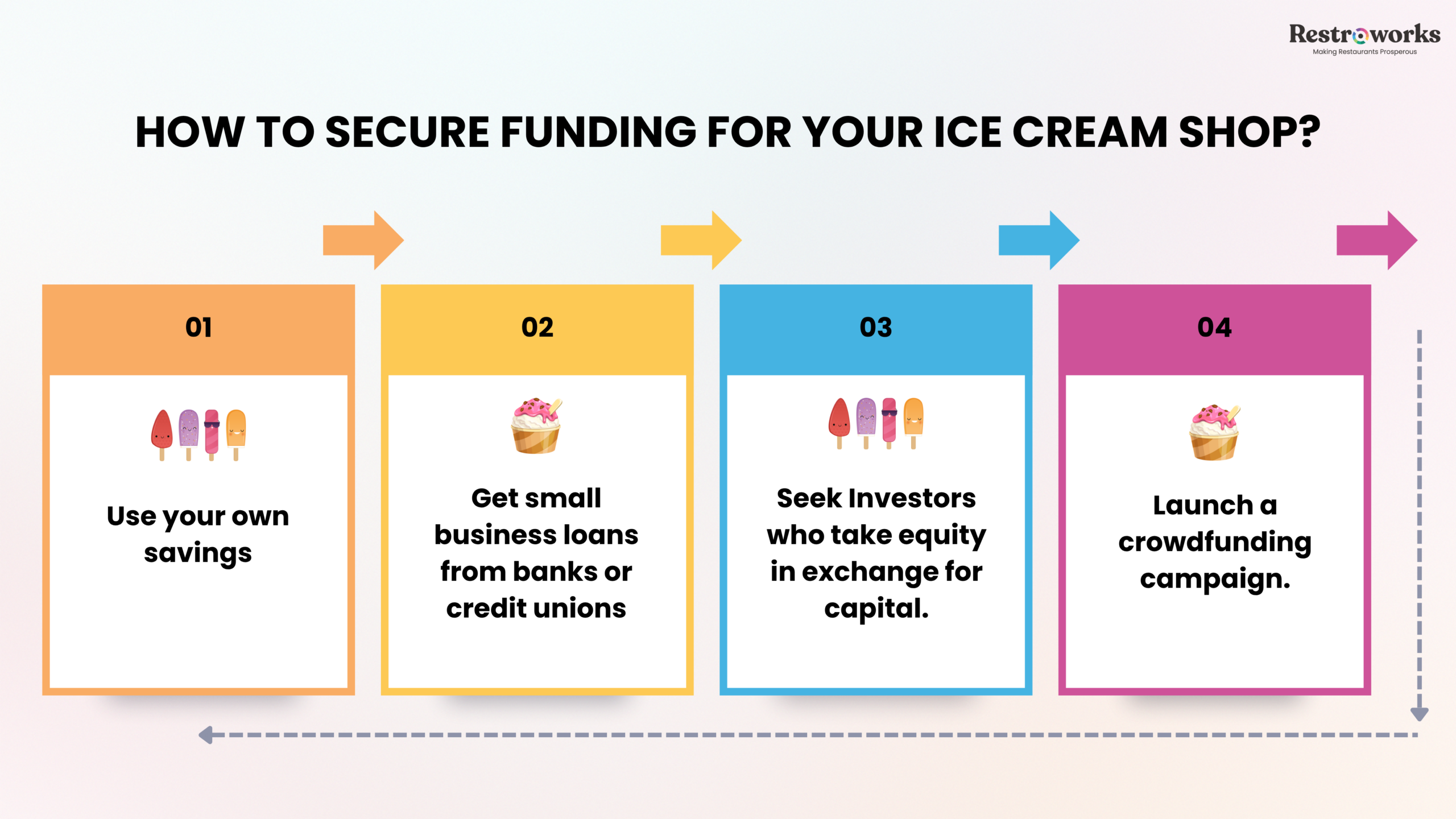
When it comes to funding your business, you may consider one or two of these options:
- Your own savings. This gives you the most control but puts you on the hook for everything if it doesn’t work.
- Small business loans from banks or credit unions. The Small Business Administration offers programs specifically designed for new businesses, and they’re worth looking into.
- Investors who take equity in exchange for capital.
- Crowdfunding, which, trust us, works surprisingly well for community-rooted businesses like ice cream shops.
Most successful ice cream shops use both personal funds and small business loans to get started. But whatever you choose, make sure you secure proper funding before you sign a lease.
How Do You Find a Good Location?
The ideal location for an ice cream shop is a high-traffic area such as beaches, parks, entertainment venues, and crowded streets, especially during warmer months. Conducting thorough market research is crucial for selecting a location, as it helps identify target demographics and assess foot traffic patterns.
One important thing is that when finding a location for your ice cream shop, don’t just look for where your customers are, but also when they’re there and what mood they’re in.
Mazen Kanaan, founder of House of Pops, shared during one of his interviews with Restrocast about how his team opened a location in a corporate district because their target customer worked there, but it failed because the same people who were their best customers on weekends, when relaxed and with their families, weren’t buying from them at lunch during the workweek. He says, “It’s not only about your target consumer, but it’s also about the moment of consumption.”
Watch the full interview:
Choosing a location that balances visibility, foot traffic, accessibility, and reasonable costs is essential for maximizing sales in an ice cream shop. And, yes, most important of all, whatever location you’re considering, double-check your zoning laws before getting started.
Business License, Permits, and All the Red Tape
To legally operate an ice cream shop, you typically need a business license, an Employer Identification Number (EIN), health and food safety permits, and a seller’s permit for collecting sales tax.
Other key operational permits for starting an ice cream shop include a health permit, a food handler’s certificate, and a business license. A business license is a baseline requirement for operating any business. What you need varies by city and state.
The process of obtaining licenses and permits for an ice cream shop can be time-consuming and often requires inspections by local health authorities before opening. Health departments have jurisdiction over your food storage, preparation surfaces, equipment temperatures, and sanitation protocols. They will show up and inspect you, probably more than once.
Employer Identification Number is your nine-digit federal tax ID. You can get your employer identification number through the IRS website.
A seller’s permit authorizes you to collect sales tax from customers. Most states require this, but you’d better double-check your state’s requirements, as sales tax rules vary significantly by state.
Next comes the food safety certifications. Starting an ice cream shop involves obtaining the health and safety certifications required for food establishments. Common permits required to open an ice cream shop include a mobile food vendor permit for trucks, a food handler’s permit for employees, and a building health permit for brick-and-mortar locations.
Start the permit process early. Much earlier than you think you need to, because the overall application process takes too long and may even get delayed.
How Should You Build Your Ice Cream Shop Menu?
The ice cream shop menu is where your personality as a business really shows up. You need to have classic ice cream flavors like vanilla, chocolate, strawberry, cookies and cream, and mint chocolate chip available almost every hour because customers expect them. Plus, you need to add to the diversity.
A diverse menu that includes things like soft serve, frozen yogurt, Italian ice, gelato, milkshakes, and floats gives you more reasons to attract customers and more price points to work with. Implementing seasonal flavors and treat calendars can encourage repeat visits to an ice cream shop, helping to maintain customer interest throughout the year. Fun flavors that rotate seasonally also give you a reason to post on social media, which basically works as free marketing.
Dietary accommodations are increasingly a competitive differentiator. Dairy products are off-limits for a significant portion of the population, either by preference or necessity. So, you must have solid non-dairy options too. It will help you attract loyal customers who often may feel underserved at traditional ice cream shops.
When setting prices on menu items, go back to that 25-35% food cost benchmark. Work backward from your ingredient costs to set prices that keep you in a healthy margin.
Remember: Ice cream sales tend to be high-volume and lower per-ticket, so have a good margin discipline.
How Do You Market Your Ice Cream Shop?
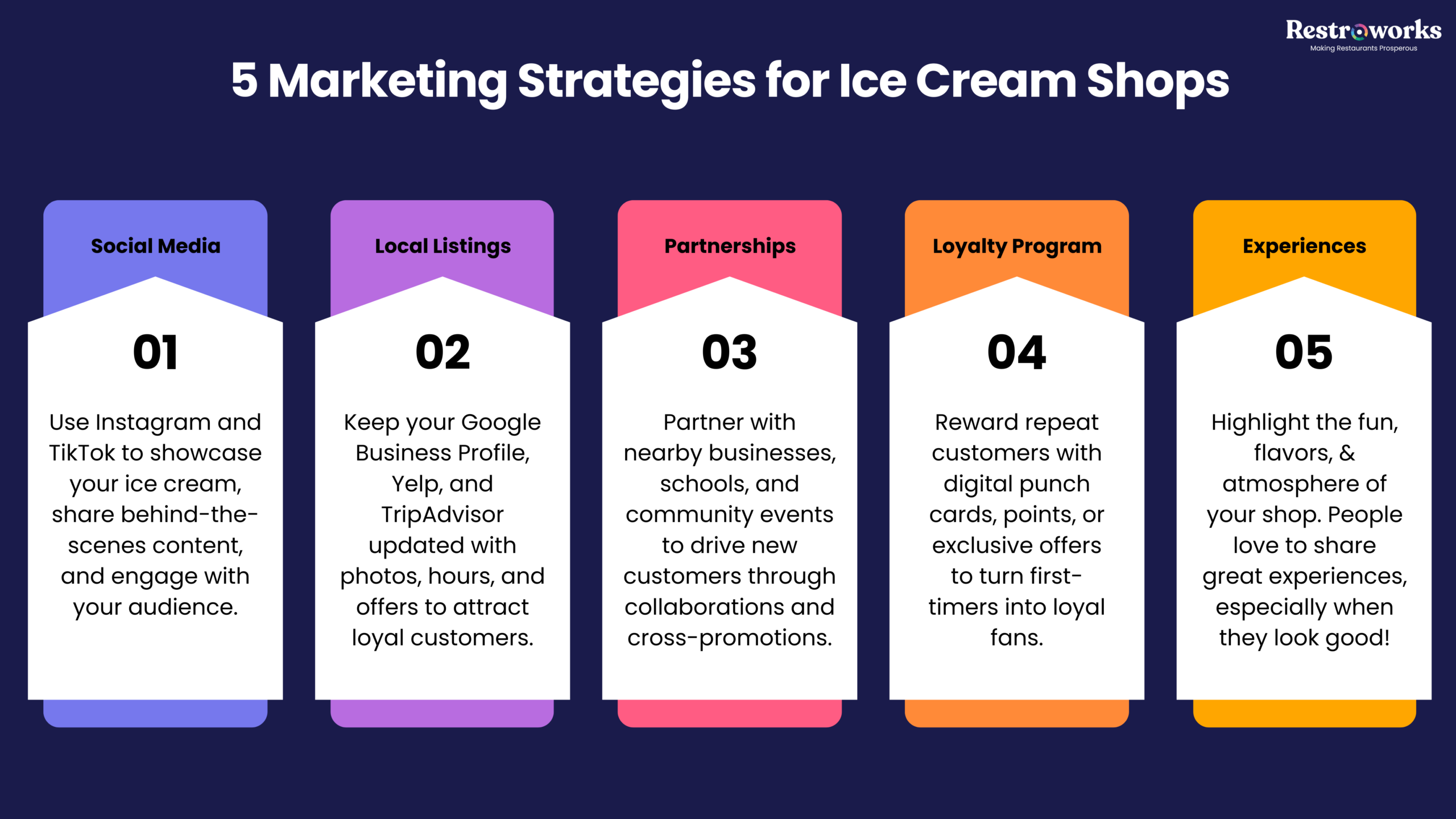
Marketing plays a significant role in the success of an ice cream shop, combining digital outreach with local efforts to build a loyal customer base. And for ice cream specifically, the visual nature of the product is a genuine advantage.
Effective marketing strategies for ice cream shops include using social media platforms like Instagram and TikTok to showcase visually appealing products and engage with customers.
Beyond social, make sure your ice cream parlor shows up everywhere local customers look, namely on Google Business Profile, Yelp, and TripAdvisor. Get on those platforms and keep them updated. Local partnerships with nearby businesses, schools, and community events can drive new customers to you without paid advertising. And loyalty programs, whether digital punch cards or a simple app, are one of the most proven ways to turn first-timers into repeat customers.
Opening Day: Soft Opening vs Grand Opening
Key steps in starting an ice cream shop include writing a business plan, securing funding, selecting a high-traffic location, and obtaining health and sales permits. But even after all of that, when the time finally comes to open, you will still have to decide whether to go for a soft opening or a grand opening.
A soft opening is a simulated opening with limited customers, often friends, family, and local community members, where you test your processes before going fully public.
A grand opening is the celebration that announces to your neighborhood that you’re here. Grand openings with special offers, exclusive menu items, and community events generate real buzz and can quickly build your early customer base.
“It was completely unplanned. We were totally unprepared and did everything DIY, but we somehow ended up opening our little ice cream shop just three months after getting the keys,” said Alice Cherng of Dear Bella Creamery. Sometimes, imperfect and done beats perfect and delayed. But a little planning around your ice cream shop opening will make that first week a lot more enjoyable.
How Do You Go Through The First Year?
Launching a successful ice cream shop requires focusing on high-traffic locations, a diverse menu catering to dietary trends, and strong visual marketing.
In your first year, cash flow will probably be your biggest pain point. You’ll need to manage your money through a slow winter with fixed expenses, then scale back up quickly when the doors open again in spring. Equipment may break at the worst possible moments. Then you’ll face staffing challenges and have weeks when you’ll question everything out there.
The shops that make it through year one are usually the ones that stayed close to their customers, adjusted quickly based on what was and wasn’t working, and kept their costs disciplined. Inventory management, especially managing waste for perishable inventory like ice cream tubs and dairy-related products, improves with experience but requires attention from day one.
KEY TAKEAWAYS
- A successful ice cream shop opening begins with market research, a solid business plan, realistic estimated costs, and the ability to secure funding before signing a lease.
- Whether you open a storefront or operate ice cream trucks, your concept should match your target market, budget, and local demand. Startup costs vary based on your business model.
- Choose a location with strong foot traffic and obtain all required permits, including a health permit and a sales tax registration, before your doors open.
- Build a menu that lets you serve ice cream alongside other frozen treats to attract more customers and increase average order value.
- Monitor gross sales, labor expenses, food costs, and sales tax costs closely. Strong financial discipline is what turns an ice cream shop into a profitable business.
- Independent shops continue to thrive in the competitive foodservice industry by offering unique products, delivering great customer experiences, and improving visibility in local search results.
- Conducting comprehensive market research is crucial for the success of new ice cream shops, as it helps identify target demographics and analyze competitors.
Frequently Asked Questions
1. How long does it take for an ice cream shop to break even?
Most ice cream shops reach break-even within 18 to 36 months, depending on their location, startup costs, and sales.
2. Can you make a living owning an ice cream shop?
Yes, of course, you can make a living owning an ice cream business. A well-managed ice cream shop with strong sales and controlled costs can be a great investment.
3. What experience do I need to open an ice cream shop?
Though you don’t need prior experience to open an ice cream shop, knowledge of food service, customer service, and business operations will give you an advantage.