

How to Write an Ice Cream Shop Business Plan in the US

How to Write an Ice Cream Shop Business Plan in the US

Home / Blog /  

How to Write an Ice Cream Shop Business Plan in the US

Read summarized version with

When Jeni Britton Bauer first started talking to people about her ice cream dream, someone gave her advice that changed the course of what would become one of America’s most celebrated ice cream brands. “She had shared her ice cream dream with her babysitting clients, Jay and Sue Wright, and they suggested that she write a business plan.” That nudge, from a babysitting client of all people, set Jeni on the path to building Jeni’s Splendid Ice Creams into a nationally recognized ice cream shop business with 33 locations and over $30 million in annual revenue.

The story isn’t really about luck. It’s about the gap between an idea and a functioning business, and how a written plan is the only thing that reliably closes it. Alexis Gallivan and her co-founder, Jennie Dundas, took a similarly practical route when starting Blue Marble Ice Cream in Brooklyn. “Before long, the two women had purchased a $99 business plan template online and were on their way to launching Blue Marble Ice Cream. One week shy of nine months later, they opened the doors to their first shop.” Nine months from template to open doors. That’s not a miracle. That’s what a business plan actually does when you use it.

A business plan for an ice cream shop should include an executive summary, company description, market analysis, marketing strategies, operational plan, management structure, and financial projections. This guide walks through each section, not as a bureaucratic exercise, but as the practical thinking you need to do anyway to build a profitable business, just organized in a way that funders, partners, and your future self can actually use.

What You’ll Learn

  • How to build an investor-ready ice cream shop business plan, from market research and financial projections to operations and marketing.
  • The practical decisions that determine whether your ice cream shop becomes profitable and sustainable over the long term.

Why Your Ice Cream Shop Needs a Business Plan Before Anything Else

A lot of people who want to open an ice cream shop skip the planning stage because the product feels obvious. Ice cream sells itself, right? What’s there to plan? Quite a lot, as it turns out. A well-structured business plan helps define the concept of the ice cream shop, outlines goals, and provides a roadmap for operations, which is essential for attracting investors and ensuring long-term success. Without one, you’re making very expensive guesses.

The business also has structural complexities that aren’t obvious from the outside. Seasonal demand, cold-chain logistics, high-turnover staff, and the perishable nature of the product all create financial pressure that a new owner without a detailed plan will feel long before they understand it. Alexis Gallivan described the deeper purpose of her ice cream business this way: “I realized that filling this gap in the ice cream market was my chance to both satisfy my sweet tooth AND push for more good in the world in an entirely new and innovative way.” That dual purpose, commercial and community, needs to live somewhere in writing before you can act on it. The business plan is where it lives.

Beyond personal clarity, the ice cream shop business plan is what you show a bank, an SBA lender, or a potential investor. The executive summary is a critical component of the business plan, providing a concise overview of the ice cream shop’s concept, mission, and key operational details to attract investors and secure funding. Without that document, you’re asking people to fund a feeling. With it, you’re presenting a case.
Why Your Ice Cream Shop Needs a Business Plan Before Anything Else

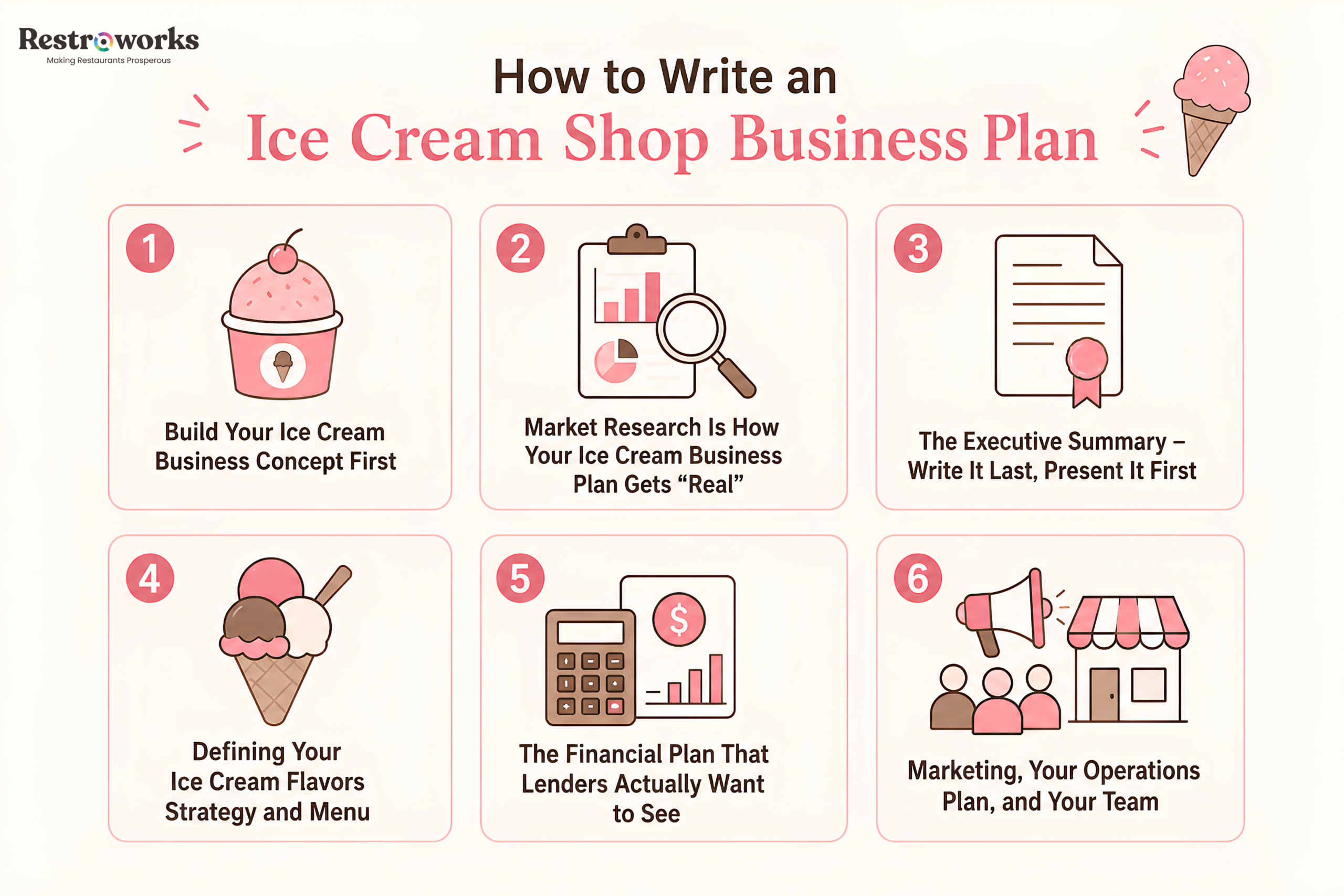
Step 1: Build Your Ice Cream Business Concept First

Before you fill in any template, you need to know what kind of ice cream shop you’re actually opening. The ice cream industry and the ice cream market contain multitudes: A boutique ice cream parlor making small-batch artisanal flavors in a neighborhood storefront is a completely different business from a franchise kiosk in a mall food court, even though both sell ice cream. Your business plan should describe exactly which type of shop you are.

Think about your unique selling point. What does your ice cream shop offer that the three other ice cream stores in your town don’t? Maybe it’s the unique flavors that no one else in the market is making. Maybe it’s an allergen-free kitchen. Maybe it’s a rotating menu of 60 seasonal specialties. Maybe your shop commits to unique flavors that use locally sourced fruit each month. Maybe it’s the only ice cream parlor in the area that also offers hot desserts and frozen yogurt on the same menu, giving you a year-round product story. Gallivan built an entire social enterprise model around the gap she saw in the market: “Instead, we were equipping them to run an ice cream business,” she said of the Blue Marble Dreams initiative in Rwanda and Haiti, describing how a replicable concept became a tool for community rebuilding. The point is that concept clarity precedes everything else.

Concept Questions to Answer First

  • What type of ice cream shop are you opening?
  • Who is your core customer?
  • What makes your shop different from existing options?
  • Will you make your own ice cream on-site or work with a supplier?

Take These Decisions Right Away

  • Brick-and-mortar, food truck, seasonal stand, or kiosk?
  • Year-round or seasonal operations?
  • Dine-in ice cream parlor or takeaway focus?
These choices affect every financial and operational section that follows.

Step 2: Market Research Is How Your Ice Cream Business Plan Gets “Real”

Effective market research is the foundation of a thriving ice cream shop, helping to understand the target market and analyze competitors to tailor offerings accordingly. This is where a lot of first-time owners shortchange themselves. They do a quick Google search, note that ice cream is popular, and move on. The operators who build successful ice cream shops do something different: they go out into the world.

Mazen Kanaan, who built House of Pops after years running the ice cream division at Unilever, described his research process this way: “We used to go to market visits, and then whenever you enter into any supermarket, you go around the shelves checking what’s new. And I kept seeing like new health and wellness snacks and bars popping up, popping up. And after I finish my tour, I come to the ice cream shop to check our products, and there is nothing there. So it is really an insight from the market.” He was doing market research in the truest sense, not reading reports, but walking shelves and paying attention.

Check out the full video:

Market research should include customer preferences, competition analysis, and industry trends, which can be gathered through surveys, online research, and competitor visits. For a local ice cream shop, this means visiting every competing ice cream parlor, frozen yogurt counter, and dessert spot in your proposed area. What are they charging? Who’s coming in? When does the line form? When is the place empty? Identifying your target customers involves understanding their demographics, preferences, and behaviors, which is crucial for shaping your ice cream shop’s offerings and marketing strategies.

Your market section should specify your target market clearly. Are you serving young adults looking for dairy-free artisanal flavors after a yoga class? Families with kids who want ice cream cakes for birthday parties? Age groups matter here because they shape every downstream decision about menu, pricing, location, and community engagement. Three competing ice cream shops within a 5-mile radius are a typical competitive landscape requiring differentiation strategies, so your plan needs to name those competitors and explain specifically how your shop fills market gaps they leave open.

IMPORTANT:

A structured two-phase approach to ice cream shop planning, conducting analysis, financial forecasting, and risk assessment, helps determine demand, pricing strategy, and operational viability. Don’t skip the risk assessment. Seasonal demand risk is real, and lenders will ask how you’ve planned for it. 

Step 3: The Executive Summary – Write It Last, Present It First

This opening section is the first thing anyone reads in your business plan, and the last thing you should write. This sounds counterintuitive until you realize that you can’t summarize something you haven’t fully thought through yet. Write every other section first, then come back and distill the whole document into one to two pages that someone could read in five minutes and understand exactly what you’re building.

A strong opening summary for your concept covers it in plain language, identifies the target market, states the funding ask if you’re seeking investment, and previews the financial projections. The executive summary is a critical component of the business plan, providing a concise overview of the ice cream shop’s concept, mission, and key operational details to attract potential investors. If your concept is a high-quality ice cream shop serving dairy-free and vegan options in a neighborhood currently underserved by premium dessert options, say that in the first paragraph of the executive summary, clearly and without jargon.

Think of this section as the answer to: “Tell me about your shop in the time it takes to ride an elevator.” If the person listening isn’t curious to know more by the time the doors open, the summary needs work. The rest of the plan exists to prove what the executive summary promises.

Section What It Covers Why Lenders Care
Opening Summary Concept, mission, ask, key numbers First and sometimes only section they read
Company Description Legal structure, location, hours, team Establishes legitimacy and readiness
Market Analysis Target market, competitors, trends Proves demand exists, and you understand it
Marketing Plan Channels, campaigns, loyalty programs Shows you know how to get and keep customers
Operations Plan Daily processes, staffing, suppliers Demonstrates operational thinking
Financial Plan Startup costs, revenue, profit forecasts The whole point for most investors

Step 4: Defining Your Ice Cream Flavors Strategy and Menu

The menu section of your ice cream shop business plan does double duty. For customers, it’s the promise of what they’ll find when they walk in. For your plan, it’s a financial document in disguise. Every flavor on the menu has a cost, a margin, and a shelf life. How you construct your ice cream flavors lineup directly shapes your gross profit, your waste rate, and how often customers have a reason to come back.

A practical plan recommends building around a core of 8 to 14 flavors anchored by high-quality ice cream in the classics, vanilla, chocolate, strawberry, cookies and cream, and then layering unique flavors and more artisanal flavors as seasonal specialties that rotate to encourage repeat customers. Classic flavors typically account for 40 to 60% of sales in most ice cream stores, so ignoring the basics in favor of novelty is a business mistake dressed up as creativity.

Your plan should also address the growing segments that drive new customer acquisition. Dairy-free options now represent a genuine market gap: research shows that 35% of residents in certain areas are interested in plant-based desserts. Young adults aged 18 to 34 are the fastest-growing segment of premium ice cream consumers, and many of them have dietary preferences that a successful ice cream shop needs to accommodate. If your menu section doesn’t address dairy-free, vegan, and gluten-free offerings, your market analysis and your product offering are telling two different stories.

Ice cream cakes and dessert packages deserve their own line in the menu section because they operate differently from single-serve sales. They can be pre-ordered, which helps with inventory management and cash flow planning, and they serve the birthday and celebration market that fills the calendar on days when regular foot traffic is light.

Step 5: The Financial Plan That Lenders Actually Want to See
How to Write an Ice Cream Shop Business Plan - Financial Plan

This section of the plan is where most ice cream shop business plans either earn trust or lose it. A plan that is too optimistic signals inexperience. One that is overly conservative makes investors wonder why you’re bothering. The goal is grounded realism: numbers you can defend with data and logic.

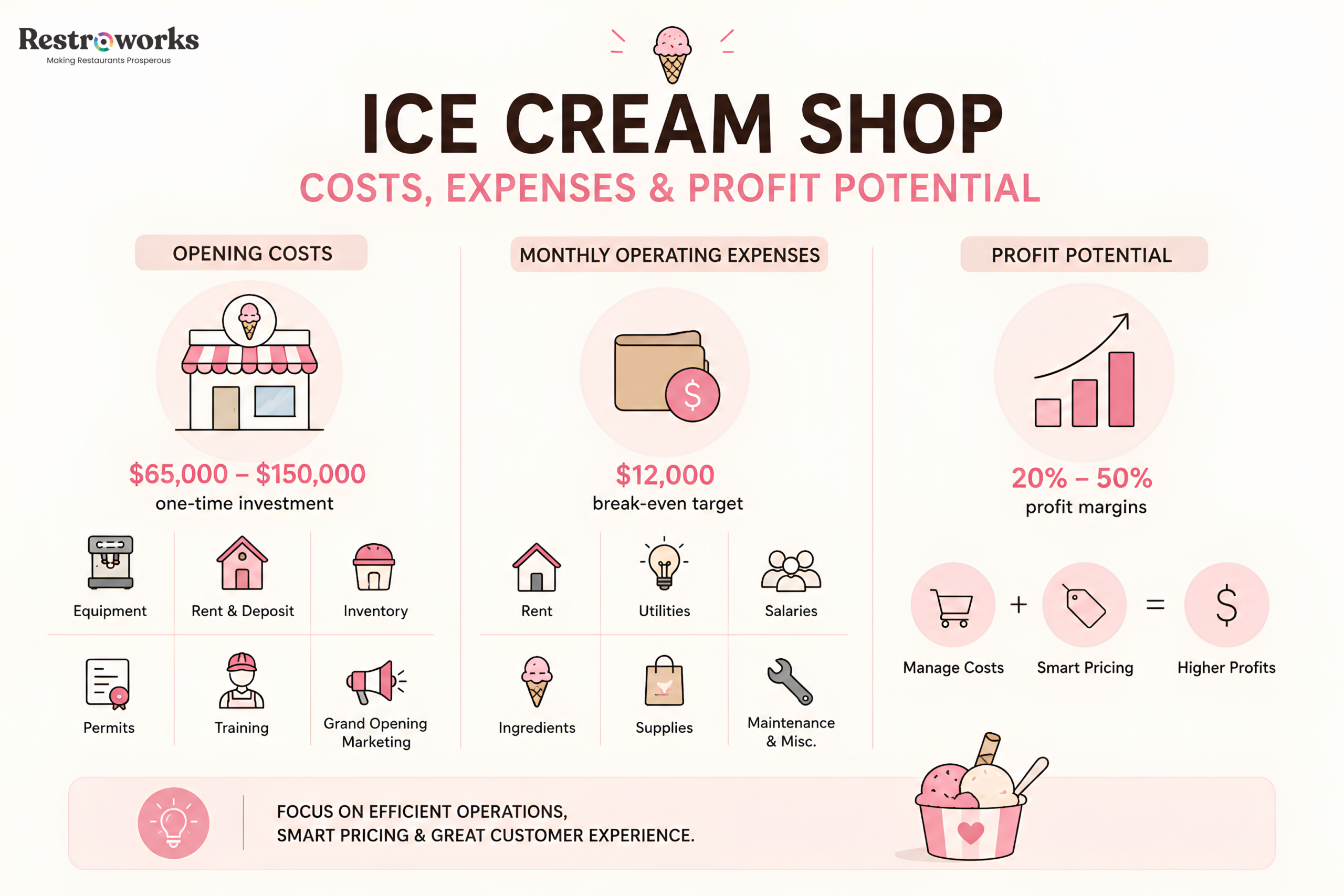
Opening costs for an ice cream shop can range significantly, with estimates often around $65,000 to $150,000, depending on factors like location, equipment, and initial inventory. Your plan needs to itemize every dollar of that range: equipment, first month’s rent, security deposit, initial inventory, permits, staff training, and the grand opening marketing spend that most people forget to include. Monthly operating expenses for an ice cream shop are typically projected to be around $12,000, which includes costs for rent, utilities, and salaries. That number should anchor your monthly revenue projections, because until you’re clearing $12,000 in revenue each month, you’re not yet breaking even.

Ice cream shops can achieve profit margins of 20 to 50%, influenced by factors such as operating costs, menu pricing, and customer visits. That is a wide range, intentionally. A boutique shop making everything in-house with a premium price point in a high-foot-traffic urban location can reach the upper end. 

A franchise in a suburban strip mall with high royalty fees and moderate traffic will sit closer to the middle. Your plan needs to position your specific shop within that range with an honest assessment of where you expect to land in year one, year two, and year three.

Checklist
  • Startup costs itemized with sourcing notes (equipment quotes, lease terms)
  • Sales forecasts built from daily estimates, not industry averages alone
  • Monthly operating expenses broken into fixed and variable categories
  • Breakeven analysis showing the exact monthly sales volume needed to cover costs
  • Three-year cash flow projection with seasonal dips modeled in
  • Detailed financial projections for the first 12 months, month by month
  • Funding sources and repayment timeline if using loans
  • Contingency reserve of at least two to three months of operating expenses

Revenue projections are where seasonal demand makes itself felt most painfully. Summer can account for up to 70% of annual revenue for an ice cream shop, which means your financial plan needs to show how you survive January and February. Ice cream shops that do not plan for seasonal fluctuations face cash flow issues even when their annual numbers look fine. 

The financial plan should explicitly model the slow season and show the strategies, hot desserts, online ordering, catering, and branded merchandise that will generate income when foot traffic drops.

Step 6: Marketing, Your Operations Plan, and Your Team

The marketing section of your ice cream shop business plan tends to get written last and read first by potential investors after the opening section. But strategic marketing is what turns a great product into a sustainable operation, so it deserves serious attention and a solid strategy. Implementing a mix of online and offline marketing strategies can help ice cream shops reach a broad audience and attract customers. 

Social media platforms like Instagram and Facebook are effective tools for engaging with customers and promoting ice cream shops. Your plan should specify which platforms you’ll use, what content you’ll post, how often, and what the budget is, because “we’ll do social media” is not a marketing plan.

Creating loyalty programs, such as offering a free ice cream after a certain number of purchases, can encourage repeat visits and build customer loyalty. Community engagement programs, partnerships with local events, and school fundraising days are all cost-effective marketing strategies with high conversion for an ice cream shop. An online ordering system is increasingly a standard expectation rather than a differentiator, and your plan should address how online ordering will integrate with your operations and track sales data.

The operational plan section should describe daily operations in enough detail that someone unfamiliar with your business could understand how it runs. Daily operations in an ice cream shop should focus on efficient operations and quality, with the product made in small batches to ensure freshness. Smooth operations from day one signal to your team and your customers that you take the business seriously. 

Efficient operations in an ice cream shop are especially important because the product is perishable and margins are unforgiving. Your operations plan needs a floor plan overview, a description of equipment and layout, a supplier list, and an explanation of how you’ll manage initial inventory and reordering cycles, all designed to help the shop operate smoothly from opening day. Effective inventory management is essential in an ice cream shop to prevent wastage and financial loss, particularly due to the perishable nature of ice cream.

A well-trained staff is crucial for customer satisfaction and customer experience in an ice cream shop, requiring training in hygiene, product knowledge, and customer service. Your management team section should name key personnel, describe their roles, and acknowledge any gaps you plan to fill through hiring or advisors. Even if you’re a solo founder running a small ice cream shop today, showing you’ve thought through who leads what signals to investors that you understand the business will need to outgrow its founder.

Building Your Cream Shop Business on Community Engagement

One of the sections that separates a sample plan from a truly great business plan is the community engagement strategy. Ice cream has always been a social food, consumed at celebrations, shared between friends, and bought for children after good news. A shop that understands this builds its business model around community moments, not just transactions.

Local events are one of the highest-return marketing investments available to an ice cream shop. Showing up at a school fair, a neighborhood block party, or a local farmers’ market puts your product in front of potential loyal customers in a context where they’re already happy and open to buying. Retaining customers you meet at these events is easier than any online campaign. Online ordering extends that community relationship into the digital world, letting people pre-order for parties and local events from the comfort of their phone. An online ordering system that integrates with your POS helps you track sales by product and time of day, improving the customer experience, giving you the data you need to make smarter stocking and staffing decisions as the business grows.

Brand presence in a local community is built slowly and lost quickly. A successful ice cream shop that contributes to community engagement by sponsoring youth sports teams, donating to school fundraisers, and hosting birthday parties becomes part of the neighborhood’s identity. Keeping loyal customers in this business is not only about having a great product. It’s about giving people a reason to feel that your ice cream shop is theirs.

Finally, The Cream Shop Business Plan That Works Is the One You Use

A well-structured business plan helps define the concept of the ice cream shop, outlines goals, and provides a roadmap for operations, which is essential for attracting investors and ensuring long-term success. A detailed financial plan within that document is what turns ambition into credibility. But the best ice cream shop business plan is not the most polished one. It’s the one you actually return to, update, argue with, and use to make decisions.

The location of your ice cream shop significantly impacts its success, with high foot traffic areas, such as near schools, parks, or shopping centers, being ideal for attracting customers. Effective visibility through signage and an inviting storefront design can significantly enhance the ability of an ice cream shop to attract pedestrians and drivers. These are not afterthoughts. They’re decisions your business plan forces you to make before you sign a lease you can’t get out of.

Pedestrian patterns should be observed when selecting a location for an ice cream shop, as this can help identify the best spots for maximizing sales. These high-visibility spots don’t just bring more customers. They provide the organic exposure that reduces how much you need to spend on attracting customers through paid advertising, especially in the early months when cash is tightest.

Jeni Britton Bauer described her time at Ohio State as one of the best experiences she could have had. The education wasn’t specifically about making ice cream. It was about learning how to think rigorously about problems before acting on them. That’s precisely what a good ice cream shop business plan teaches you to do, and it’s precisely why the operators who write one, really write one, give themselves a measurable head start over those who skip straight to opening day.

Remember: Your Ice Cream Business Plan Is the First Product You Make

Before the first scoop is served, before the first customer walks through the door of your shop, and long before you see the repeat business and steady growth that make it worthwhile, the business plan is where your ice cream shop actually comes to life. Write it carefully. Use real data. Return to it often. And remember that the goal of planning is not to predict the future perfectly. It’s to make sure that when the future arrives, you’re not surprised by the questions it asks.

KEY TAKEAWAYS

  • A business plan turns your idea into a structured roadmap for launching and growing an ice cream shop.
  • Strong market research helps validate demand, identify competitors, and define your target customers.
  • Accurate financial projections, including startup costs, cash flow, and break-even analysis, are essential for securing funding.
  • A profitable menu balances classic best-sellers with seasonal and specialty offerings that encourage repeat visits.
  • Marketing, operational planning, and community engagement are just as important as serving great ice cream.

Frequently Asked Questions

1. How long does it take for an ice cream shop to break even?

Most independent ice cream shops reach break-even within 12 to 24 months, depending on startup costs, location, foot traffic, pricing, and operating expenses. Shops in high-traffic locations with effective marketing and strong customer retention often recover their initial investment faster, while seasonal businesses may take longer because revenue fluctuates throughout the year.

2. How much does an ice cream shop make a day?

Daily revenue varies widely based on location, season, and business model. A small neighborhood ice cream shop may generate $500 to $1,500 per day, while busy shops in tourist areas or premium locations can earn $2,000 to $5,000 or more during peak summer months. Sales typically slow during colder seasons, making cash flow planning an important part of the business plan.

Newsletter subscription banner

Talk to a restaurant expert today and learn how Restroworks can help your business.

Request Demo >

Share

Discover More Insights to Power Your Journey

Are Ice Cream Shops Profitable? What the Numbers Tell You

You love ice cream, we love ice cream, everyone loves ice cream - this part is easy and super obvious,…

How to Write an Ice Cream Shop Business Plan in the US

When Jeni Britton Bauer first started talking to people about her ice cream dream, someone gave her advice that changed…

How to Start an Ice Cream Shop: Your Complete US Startup Guide

Opening an ice cream shop feels like a dreamy, dreamy dream, doesn’t it? Maybe that’s why Jeni Britton Bauer, founder…

POS
The Complete Guide to Choosing a POS for Small Ice Cream Shops

If we were asked to describe an ice cream business in very few phrases, we'd sayIt's dreamlike - mostly white,…

POS
Best Features of Ice Cream Shop POS That Boost Sales and Efficiency

If you thought that you’re just an ice cream boutique and might “not need all the fancy tech stuff,” it’s…

How Kailash Parbat Built a 74-Year-Old, All Without a Single Rupee of Outside Funding

There is a stall near the Kailash Parbat office in Mumbai. The owner has been doing business there for 40…

Join. Learn. Grow.

Sign up to receive the latest hospitality insights and stories straight to your inbox

Streamline your operations with Restroworks