

If we were asked to describe an ice cream business in very few phrases, we’d say
- It’s dreamlike – mostly white, pink aesthetics
- It’s sweet – you can smell, hear, and see sweetness all around
- It has seasonal surges (literally, 70-80% of a brand’s annual revenue comes from just 16-20 summer weeks)
- There is a ton of perishable stock
- Lines move really fast – one person orders, then next, then next…it’s just a 15-second transaction each, given that customers have already thought their order through because most just decide everything at the counter.
- Staff is almost always friendly and joyful.
- There are multiple flavors on the menu and on display, etc., etc.
All this means whatever POS system you choose should be able to support such demands while keeping it all photogenic 24*7.
How do you do that? This guide will tell you the exact steps for choosing a POS for small ice cream shops.
What You’ll Learn
- Core POS features small ice cream parlors need
- How can you compare vendors based on cost, speed, inventory, and scalability?
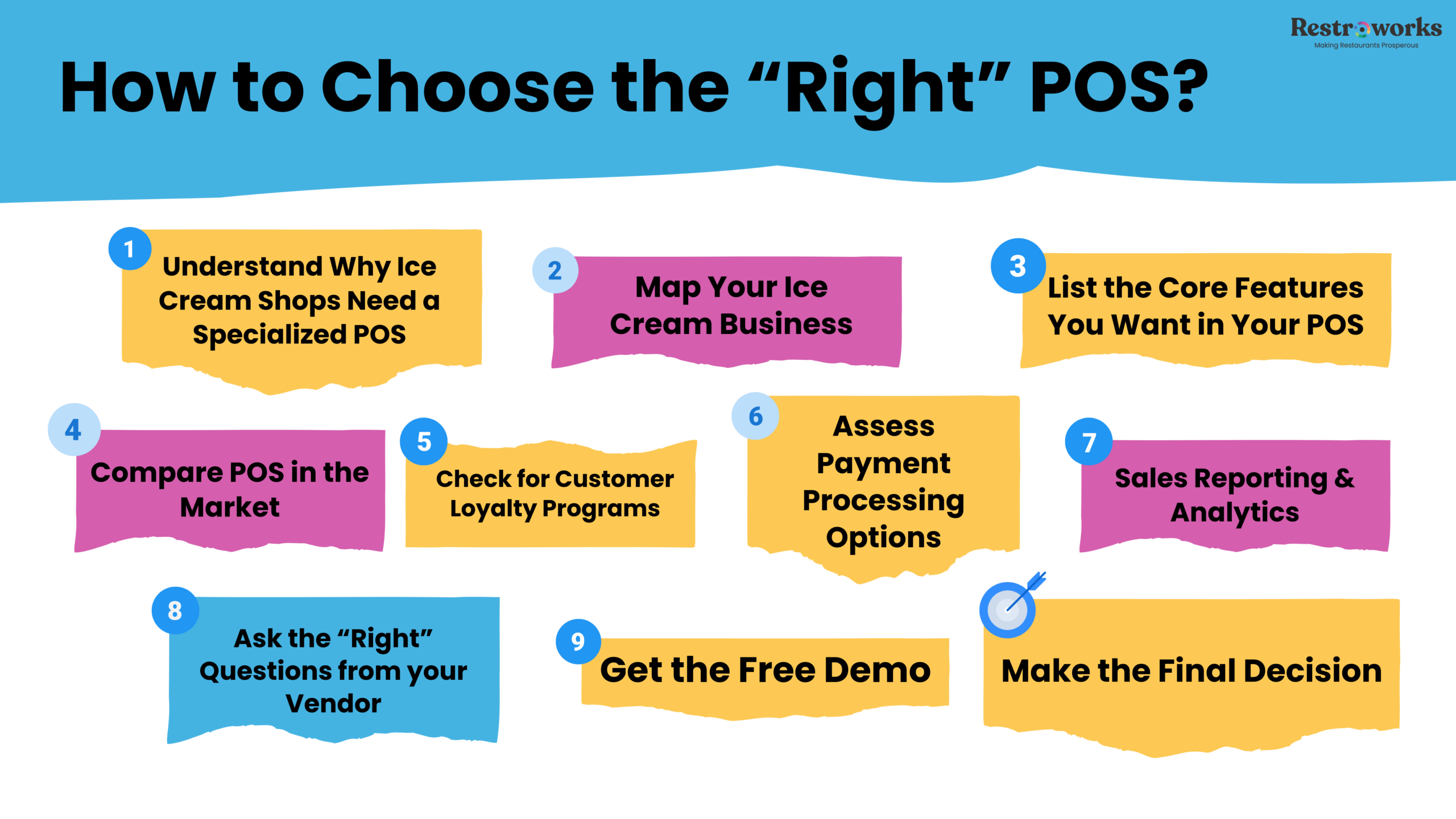
How Can You Choose the “Right” POS for Your Small Ice Cream Shop?
If you wish to truly choose the right POS system for your business, you’ll first need to note down these three things about it: your business needs, daily/monthly/quarterly transaction volume, and its long-term growth plans.
Then, use these steps (which are 10 steps to be precise) to evaluate different vendors in the market (both online and offline), compare the features their particular systems offer, and finally buy/or subscribe to one that supports your current operations and future expansion goals.
Step 1: First, Understand Why Ice Cream Shops Even Need a Specialized POS
Okay, so we invest in any piece of technology when we know that it will solve one or two of our key problems, right? When it comes to running an ice cream shop, you’ll need your software to be able to handle at least these three things.
The first is speed, and how quickly and “correctly” you wrap up the entire process will determine your customer experience. If you’re, by chance, taking too long to search for a topping, or to generate a bill, let’s say, it’s a lost sale, and it will keep piling up with every customer that walks through your door while you’re stuck with the monitor that shows “access denied”, “network lost,” “try again” or hundred other such errors.
Second is the season. The entire scoop business is built on you selling/earning more in the summer and maybe nothing (or very teeny-tiny) in the winter. In fact, the lion’s share of your annual revenue will come from April-July, and your POS system should be able to absorb that demand without, again, a cliché phrase, “disrupting your daily operations.”
Ice cream is also very unusual when it comes to product complexity, although the overall operations (and the product itself) seem too “simple” at first glance.
Your customers (and sometimes even prospective franchisees) might only see the row of tubs they have to choose from/deal with, but behind the counter, there is flavor rotation, perishable expiry windows, topping stock, scoop pricing tiers, cone types, plus staff. Generic point-of-sale systems see none of that complexity, which the Dining Services Director of Amica Senior Lifestyles also noted: “We had no data before…we had anecdotal evidence of what was going on. There was revenue that wasn’t being captured.”
Step 2: Map Your Ice Cream Business to the T
Again, when we said you need to note down a few things about your business needs before you start looking for any vendor, it will come down to these four areas:
| VOLUME |
How many transactions per hour at peak?Under 30 transactions per hour: Most modern POS systems will likely meet your needs. 60+ transactions per hour: You need sub-15-second billing and offline functionality. 100+ transactions per hour: You need queue-busting tools like QR self-ordering. |
| COMPLEXITY |
How many SKUs and modifiers?20 flavors × 3 scoop sizes × 2 cone types × 10 toppings = 1,200+ possible combinations Your POS should be able to manage these without staff having to do mental math every single time. |
| FOOTPRINT |
Single location or multiple?If you’re planning to operate from multiple locations, you’ll need a centralized dashboard, inter-branch stock visibility, and, overall, any features that could help you better manage each location remotely from one platform. |
| BUDGET |
What’s your real monthly ceiling?Entry-level POS systems start at $16/month. Specialized ice cream POS systems start at $155/month with all core features built in. When budgeting, consider the total cost of ownership you’ll bear, which will include the monthly cost of software subscriptions, payment processing fees, hardware (which you’ll probably have to buy separately), implementation, and ongoing support you may need throughout. |
Choosing the right POS system for your ice cream shop involves assessing your unique business needs and budget before comparing different options.
Step 3: List the Core Features That Are Non-Negotiable for Your Business & Those Working In It
Whatever POS you’ll put your finger on will have a lot of features and functionalities (at least what the vendor will make you count on), but that doesn’t mean you’ll need them all. You should know which exact capabilities are going to impact your day-to-day operations.
For example, one of them is:
1. Inventory Management
Effective inventory management in ice cream parlors is crucial due to the perishable nature of the product, requiring precise tracking to avoid waste and ensure popular flavors are always available. Ice cream has a shelf life, and whether you overstock or run out of the staples, both will result in lost sales and operational inefficiencies. (Needless to mention the disappointed customers)
That’s why a good POS system for ice cream shops should include real-time inventory management to track perishable products effectively and avoid waste. Real-time inventory management allows ice cream shop owners to monitor stock levels and sales trends, enabling them to make informed decisions about online ordering and menu adjustments.
Plus, automated inventory tracking systems can alert ice cream shop owners when stock levels are low, helping to prevent shortages and ensuring that popular flavors are consistently available.
The best POS systems will track raw materials (cream, fruit purées, mix-ins, etc.) and calculate how many servings remain from current stock.
Next is –
2. Speed and User-Friendly Interface Design for Better Employee & Customer Experience
Prioritize speedy, intuitive transactions in POS systems for ice cream shops, utilizing touchscreens and quick modifiers for toppings. The interface needs to function as a visual menu because when you have 30 flavors and a queue of 15 people, you can’t expect staff to scroll and scroll endlessly. All they should need to do is tap flavor → scoop count → container → toppings → done. And that entire sequence should take no more than 15 seconds in all.
A user-friendly POS system is essential for ice cream shops, as it minimizes training time and helps staff operate efficiently during busy periods. In an industry that hires seasonal staff every summer, a steep learning curve is an operational liability. If a new hire can’t process payments confidently within 30 minutes of training, your chosen system is probably wrong for your ice cream parlor.
3. Hardware Considerations
Compact POS systems are necessary for small counters in ice cream shops, especially since counter space is often limited. Durable, spill-resistant hardware is essential for POS systems in ice cream shops due to wet environments. Since you will be working a lot around ice, water, and dairy, POS terminals are exposed to spills and heavy daily use. Better yet, look for hardware options that are durable, easy to clean, and designed to withstand rush.
Most important of all, POS systems should support offline functionality to ensure uninterrupted service during internet outages.
Step 4: Essential Features Comparison: What the Best POS System Must Include
When evaluating any POS software, make sure they offer these features at least:
| Feature | Why Ice Cream Shops Need It |
|---|---|
| Real-time inventory tracking | Track perishable stock by flavor; auto low-stock alerts when tubs run low; minimize waste from expired product |
| Visual menu with one-tap ordering | 30+ flavors need an image-based grid; must be operable by first-day staff |
| Scoop-based / combo pricing | Single/double/triple scoop pricing; auto-apply bundle discounts |
| Offline functionality | Process payments without internet; essential during peak summer days when outages hit hardest |
| Customer loyalty programs | Capture phone numbers at billing; auto-track sales & visits; push birthday offers; retain off-season customers |
| Integrated payment processing | Cash, card, contactless payments, and mobile payments because customers expect every option. You’ve got no exception. |
| Sales reporting and analytics | Understand which flavors sell when, optimize in-store inventory ordering, and spot seasonal trends |
| Spill-resistant POS hardware | Dairy, water, and ice cream are constant hazards; hardware must survive wet counter conditions |
| Accounting software integration | Connect sales data directly to bookkeeping; eliminate manual reconciliation; spot margin leaks |
| Online ordering / QR menu | Let customers self-order; reduce counter queues during peak hours by up to 40% |
| Multi-location dashboard | Centralized sales tracking across all your locations; transfer inventory between multiple outlets |
| Remote access | Manage sales and inventory from off-site; essential for owner-operators not always on the floor |
Step 5: Customer Loyalty Programs for Off-Season Survival
Ice cream is a repeat business built on habits, and your point-of-sale systems should be able to either nurture those habits systematically or (which we don’t prefer) let them lapse during slow months.
Loyalty programs encourage customers to return to your shop during slower seasons by offering rewards for repeat business, which is essential for building a loyal customer base. A POS system with integrated loyalty programs can help ice cream shops track customer preferences and manage rewards, enhancing customer engagement and satisfaction.
Implementing a points-based loyalty program allows ice cream shops to reward customers for every purchase, which can significantly increase repeat visits. There’s even a case study in which Gochisou restaurant increased repeat customers by 27% and average customer spend by 45% after implementing a loyalty program integrated with their POS over four years. The integrated solution tracked customer purchases and enabled automated loyalty rewards and customer engagement directly through the point-of-sale systems.
Similarly, BoSa Donuts increased average customer spend by 19.8% using POS-integrated automated marketing. Carmela Coffee achieved an 117% increase in weekly repeat purchases and a 36% increase in average customer spend by using their POS loyalty tools to automatically nurture new customers.
What does this mean? You should look for a loyalty system that captures customer data at the point of billing and that auto-triggers rewards based on visit count, spend threshold, or birthday. That’s a must.
Step 6: Payment Processing Options: What to Compare & What to Keep Tabs On
The ability to process various payment options, including cash, credit, debit, and mobile payments, is essential for a POS system in an ice cream shop to enhance customer convenience. The demand for mobile POS solutions is growing, with mobile POS users expected to reach 3.55 billion by 2029, indicating a trend towards more flexible payment options in the food service industry. Now, one thing to note is that nearly every modern system offers multiple payment types. What you need to check out, though, is the cost associated with each.
| Cost Type | What to Watch | What Does It Look Like in Practice |
|---|---|---|
| Fee charged to process payments | Per-transaction % + flat fee (e.g. 2.6% + 10¢) | On a $5 cone, 2.6% + 10¢ is 23¢ which is nearly 5% margin loss per sale |
| Monthly software fee | $0 to $155+/month depending on provider | Low monthly fee with high per-transaction cost often totals more for high-volume shops |
| Hardware costs | Upfront purchase vs. lease vs. provided free | Factor in replacement cost for spill-damaged terminals |
| Additional costs for add-ons | Loyalty, gift cards, accounting software integration, etc., are billed separately | Some providers charge extra for each feature; others bundle everything |
| Payment gateways | Third-party gateway fees may stack on processor fees | Adds complexity and cost; prefer integrated payment processing |
Contactless payments, i.e., tap-to-pay cards and mobile wallet payments, are kind of expected by customers, particularly in high-traffic urban ice cream shops. If your hardware doesn’t support them, you create friction at exactly the moment you need speed. Every additional second at the counter has a multiplier effect during peak hours.
INDUSTRY INSIGHT
The shift toward mobile and cloud-based POS systems is accelerating across the food service industry. According to estimates, the global Mobile POS (mPOS) market is expected to grow at a CAGR of 21.2% through 2035, fueled by rising demand for digital payments and the widespread adoption of smartphones and tablets.
Consumer behavior is evolving just as quickly. The transaction value of the global mobile POS (point-of-sale) payments market was around $12.56 trillion in 2025. The number reflects a broader preference for contactless and mobile payments, particularly in high-volume, quick-service sectors where speed directly impacts customer satisfaction.
Step 7: Sales Reporting & Analytics: Using Data to Manage Inventory & Grow
A POS system should provide detailed analytics and sales reporting to help ice cream shop owners understand customer preferences and optimize inventory management.
Consider what Alexandre Bachir of Bachir Ice Cream, a 90-year-old Lebanese ice cream brand now franchising across the UAE, Qatar, France, and Brazil, discovered:
“We are analyzing, we see, we see that this is doing well and the customers also, customers told us, oh, why don’t you do that?… day by day, we understand which post [is] working more, thanks to data.”
POS systems for ice cream shops should include features like real-time inventory tracking, customizable menus, and integrated payment processing to enhance operational efficiency. But the analytics layer is what converts those operations into data-driven decisions. Which flavors are selling in which months? When does foot traffic peak on weekdays versus weekends? Which topping combinations are ordered together most often?
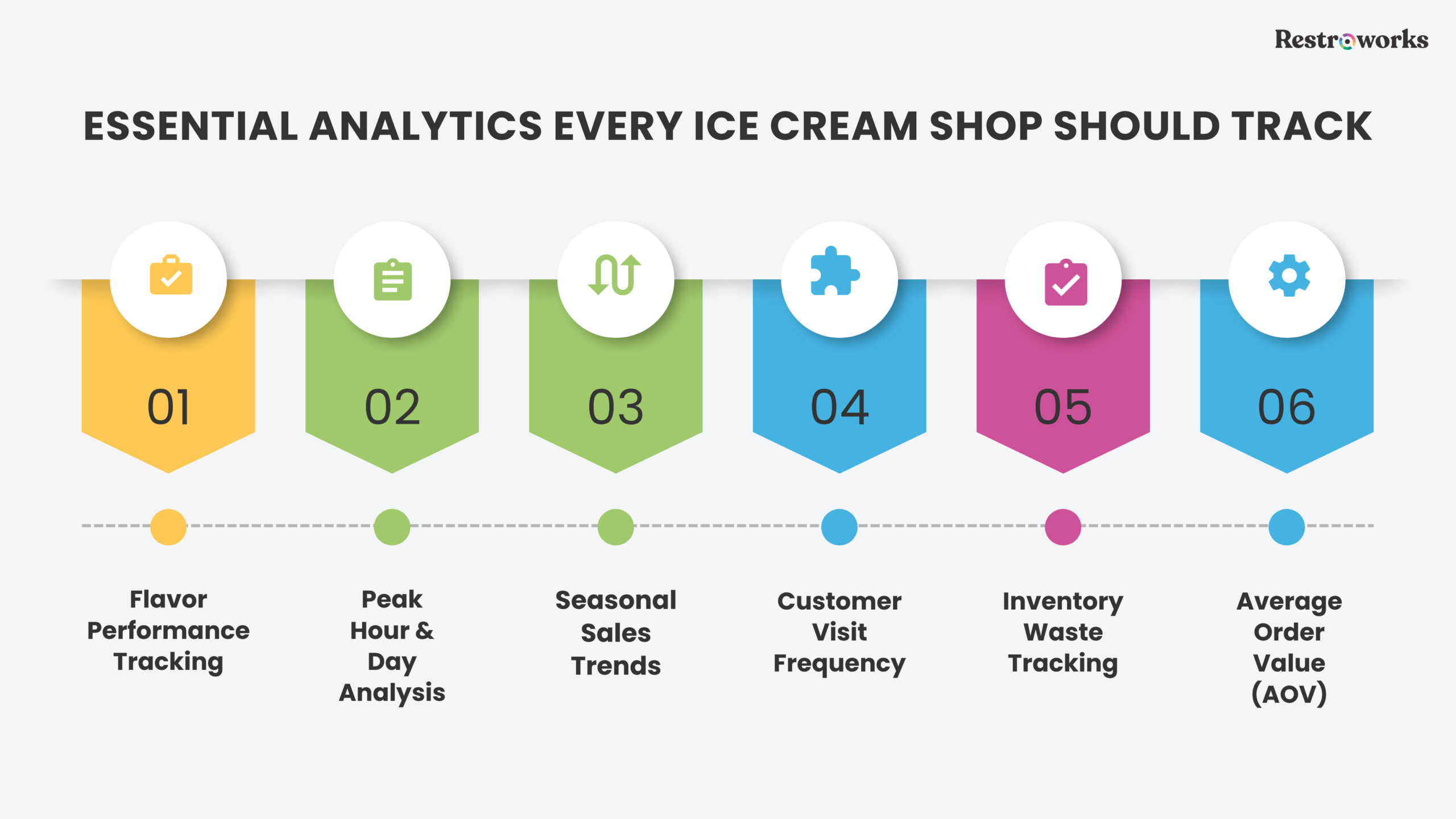
McKinsey noted that machine learning and big-data analytics techniques are ready to process the vast quantities of customer data that retailers already accumulate, enabling advanced operational insights. For an ice cream shop, this means knowing that mango outsells pistachio 3:1 in July, so you order accordingly, and that your Tuesday 3 pm lull is consistent enough to schedule one fewer staff member. Sales data is only valuable if your POS software surfaces it clearly.
Step 8: What Questions Should Every Ice Cream Shop Owner Ask Vendors
When selecting a POS software, consider the level of customer support offered by the provider, as responsive support can help resolve issues quickly and minimize downtime. Plus, ask them these questions:
- Does the POS system support offline functionality for processing payments?
- Does it have expiry date tracking to support better inventory management when handling perishable products?
- Can the menu be updated in real time?
- What are the actual total monthly costs, including processing fees, hardware costs, and any additional costs for loyalty or accounting software integration?
- Is there a free demo or trial period before commitment?
- What are the flexible plans – can we scale up in summer and down in winter?
- What does ongoing support look like – phone, chat, 24/7?
- How does the system handle multiple locations if we expand?
- Can the system configure the loyalty programs in such a way that staff won’t need to manually go and log each interaction?
- How long does the easy setup take, and what training is provided?
- Does the system integrate with my existing accounting software, and if so, may I see it in action?
- Are there any other more flexible hardware options available specifically for small counters?
Only go ahead with the vendor who can give you satisfactory answers to each of these questions.
Step 9: Comparing the Best POS System Options for Ice Cream Parlors in 2026
No one (absolutely no one) can name a single best POS system that will work for every kind of ice cream shop. Which one, however, is “right” for you will depend on your specific volume, budget, and operational complexity.
Some options that you may want to check out are BPA POS, Restroworks, Square POS, Clover, DineOpen, etc.
Step 10: Making the Final Decision
You now have everything you need to make an informed decision. Here is the final framework. Match your situation to the right path before you book a free demo or sign anything.
Scenario A
Solo operator, single location, under 100 transactions/day.
Prioritize ease of setup, low hardware costs, and offline functionality. Always watch for processing fees against your average ticket size.
Scenario B
Established shop, 100–300 transactions/day
Prioritize flat-fee pricing, full inventory management, and built-in loyalty. + Offline mode is non-negotiable at this volume.
Scenario C
Multiple locations or franchise model
You need centralized inventory control, multi-location dashboards, and the ability to manage all your locations from one platform. Accounting software integration is a must.
Scenario D
Premium/artisan gelato concept
You need CRM-level customer data, tasting notes in your menu, and branded loyalty programs. Prioritize advanced reporting, customizable menus, and deep customer profiles.
Remember: A reliable POS software for ice cream parlors can make or break your restaurant’s operations by handling long lines, tracking inventory, and managing seasonal demand fluctuations.
POS systems for ice cream shops allow business owners to track inventory, employee hours, and sales while helping create loyalty programs for customer retention, and this, mind you, is the baseline.
The right system goes further: it turns every transaction into data, every data point into a decision, and every decision into margin. The difference between a POS system that merely processes payments and one that actively helps you manage inventory, predict demand, and retain customers is the difference between surviving summer and building a business that lasts.
Alexandre Bachir built Bachir Ice Cream from a Lebanese family shop started in 1936 into an international franchise spanning Lebanon, the UAE, Qatar, France, and Brazil. When asked how he keeps learning as a leader, his answer is –
“I hear a lot… when I decide something, I ask a lot… to make a decision, I don’t make a decision alone in my room. Of course, first I talk with my family, my wife, and my kids. And after I take advice, but when I make a decision, I finish.”
That’s exactly what you should do when choosing a POS software – sit with your team members. Since they are the ones who work on the floor, they’d better know what features are must-have or nice-to-have. Gather all the information you can, ask the right questions, and only then decide with commitment. Pick the POS software that fits your business efficiently and can scale with the ice cream brand you’re building for tomorrow.
KEY TAKEAWAYS
- A strong POS system is essential for ice cream brands to handle seasonal revenue spikes, as 70% of their yearly income typically arrives in just four summer months.
- Features such as real-time inventory tracking, fast order entry, and offline functionality can directly impact the day-to-day performance of your shop.
- Loyalty programs and sales analytics help attract repeat visitors while improving inventory data and competitive pricing decisions.
- The best POS system is not the one with the most features but the one that aligns with your current operations and future growth plans.
- Any ice cream shop choosing a tech stack must assess key factors like their transaction volume, inventory complexity, and growth plans before comparing advanced features that could help small businesses streamline operations.
- Prioritize a POS with real-time sales, real-time tracking, online ordering, and table service support so you can optimize operations better.
- The best POS for small businesses combines online ordering, inventory monitoring, and analytics with the right pricing model.
Frequently Asked Questions
1. Do small business POS systems require long-term contracts?
No, small business POS systems don’t require long-term contracts. You can easily look into their monthly plans, although there are better chances of you getting good discounts if you agree to their annual terms.
2. Can small ice cream shops use the same POS as large chains?
Yes, yes, ice cream parlors can use the same POS as large chains, but the condition is that you’ve thoroughly checked if it really meets your operational needs. You may benefit more from simple, low-cost solutions, however, because you don’t need advanced multi-location and reporting capabilities at the moment.
3. What are the biggest expenses for a creamery?
The biggest expenses for a small ice cream parlor include inventory, labor, rent, utilities, and payment processing.