

You love ice cream, we love ice cream, everyone loves ice cream – this part is easy and super obvious, but what’s not easy is building a real, sustainable ice cream business around “your love for ice cream” because you loving scoops, pinks, and sprinkles won’t pay rent, pay staff, or ensure profit at the end of the month. You will have to be on the ground, working, grinding hard to make sure your business works…and passes the five-year test where 50% of such small businesses are mostly doomed to shut down.
But before you actually get into it, you must have the answer to the very question this article deals with – Are ice cream shops profitable?
And while we can just say “yes” and call the day, it would be wise for you to know – by how much – because the profit margin range here is wide, and where you land on that range depends on various decisions you make along the way.
So, if you are excited to start your own ice cream business, you definitely should, but let’s get your foundation right first.
What You’ll Learn
- How to evaluate whether an ice cream shop is a profitable investment using market research.
- The real costs, revenue benchmarks, and profit margins ice cream shop owners should expect.
- Practical strategies to improve cash flow and maximize profitability year-round.
How Much Does An Ice Cream Shop Make?
If you go around your city to ask different ice cream shops how much they earn/make, exactly…the answer will vary widely depending on who you ask, how big the shop is, where it is located, and what format/kind of ice cream business they’re operating.
Still, if we are to give you a rough estimate based on data that’s repeated across the industry sources, it would be:
- Many ice cream shops in the US make $20,000 to $50,000 a month.
- Annual revenue for a typical shop is somewhere between $200,000 and $500,000, with high-performing shops crossing even the $1 million mark.
- Some sources put the wider annual revenue ranges at $100,000 to $600,000, depending heavily on size and location.
- Startup costs to open an ice cream shop are anywhere from $20,000 on the low end to $200,000 for a premium brand.
Ice Cream Shop’s Revenue Ranges By Business Model
| Business Model | Monthly Revenue Range | Profit Margins |
|---|---|---|
| Independent ice cream shops | $20,000 to $50,000 | 15% to 25% |
| Franchise ice cream shops | $40,000 to $100,000 | 12% to 20% |
| Mobile ice cream businesses (trucks, carts) | $5,000 to $20,000 | 20% to 30% |
Independent shops usually tend to run much leaner, and since they have to deal with comparatively lower overhead costs and no royalty payments, they sometimes out-earn a franchisee on margin, even though they pull in less top-line revenue overall.
Franchise ice cream shops, on the other hand, see much stronger monthly sales thanks to brand recognition and built-in marketing support, but franchise fees and royalties most often eat into that advantage.
If you’re running a mobile ice cream business that includes a truck or cart, you neither have to worry about rent or a long lease, nor do you need to hire a lot of staff members, so basically you end up with even higher profit margins.
How Much Profit Does an Ice Cream Business Actually Make?
Across the industry, profit margins for ice cream shops are said to be between 12-30%, but after accounting for all the expenses like payroll taxes and rent, most established shops fall in the 10% to 20% range.
As for the gross margins, they are between 60% and 75% pr sale, especially because the raw cost of making ice cream is very low.
With this, there are some numbers that you should definitely look into:
- Data confirms that shops with strong cost control, prime locations, and efficient operations can push margins up to 18% to 22%.
- Average shops with moderate foot traffic have a profit margin between 12% and 16%.
- Shops that might be struggling in low-traffic areas come close to the 5% to 10% range.
- New shops, especially ones in their first year, often operate at break-even, sometimes as low as 0% to 5%, as they still do not yet have an established customer base.
INDUSTRY INSIGHT
The Ice Cream Stores industry in the United States has expanded over the five years to 2025 at an annualized rate of 5.8% to $7.4 billion, including 0.9% growth in 2025 alone. If you zoom out a bit further, the United States Ice Cream Market in its totality is worth USD 20.03 billion in 2026 and is growing at a CAGR of 2.66% to reach USD 22.84 billion by 2031.
There is growth for sure, but if you think the overall market growth means you’ll automatically break even…that’s not right. A rising market rewards only those owners who have a clear target market, tight cost control, and a solid USP that entices customers to choose them over their competitor.
What Are the Fixed and Variable Costs of an Ice Cream Shop?
Okay, so there are two types of costs every ice cream business has to bear – Fixed costs and variable costs, and as the name suggests…one is fixed; that means if you have to pay $150 as rent, let’s say, then you’ll have to pay it every month no matter what – exactly $150, at that. As for the variable costs, they keep going up and down every month.
| Fixed Cost | Typical Monthly Range | % of Revenue |
|---|---|---|
| Rent/Lease | $2,000 to $8,000 | 5% to 20% |
| Utilities | $500 to $2,000 | 2% to 5% |
| Insurance | $100 to $500 | 0.5% to 1% |
| Loan payments / interest | $500 to $3,000 | 1% to 6% |
| Equipment leasing / maintenance | $200 to $1,000 | 0.5% to 2% |
One table for variable expenses, as well:
| Variable Cost | Typical Monthly Range | % of Revenue |
|---|---|---|
| Ingredients/Supplies | $5,000 to $15,000 | 25% to 35% |
| Labor | $6,000 to $20,000 | 30% to 40% |
| Marketing/Advertising | $500 to $3,000 | 1% to 5% |
| Packaging | $300 to $1,000 | 1% to 3% |
| Taxes | Varies significantly | 5% to 10% |
Out of all these, labor cost is one of the biggest expenses that is actually controllable, and you should strive to keep labor costs between 30% and 40% of total revenue. How can you do that? By –
- Smart scheduling
- Cross-training employees so fewer of them can cover more tasks, or if someone is on leave, others can take on their shift easily.
- Seasonal hires – because 60-70% of ice cream sales happen in summer.
Moreover, you should keep your cost of goods sold (COGS) in check. Careful inventory management can also help reduce ingredient waste every week.
As for the rent, it’s going to be very, very different per location. Rent in busy areas can take up 9% to 15% of an ice cream shop’s revenue, while suburban or neighborhood locations typically cost less, ideally around 5% to 8% of revenue. (Again, even though high-traffic areas do charge more rent, it doesn’t automatically make them a no-no deal because visibility brings extra customers, and that will always work in your favor)
How Many Customers Do You Actually Need Each Day?
Most shops need somewhere close to 80 to 150 customers a day to hit profitability, assuming an average ticket size of $10 to $12. Shops with lower operating costs can get there with 60 to 80 daily customers too, while premium locations with higher rent may need 120 to 150 customers per day to hit the same target.
Of course, daily sales look very different in summer and winter. Summer can account for up to 70% of annual revenue, while winter months see monthly revenue drop by 30% or more.
What Makes an Ice Cream Business More Profitable?
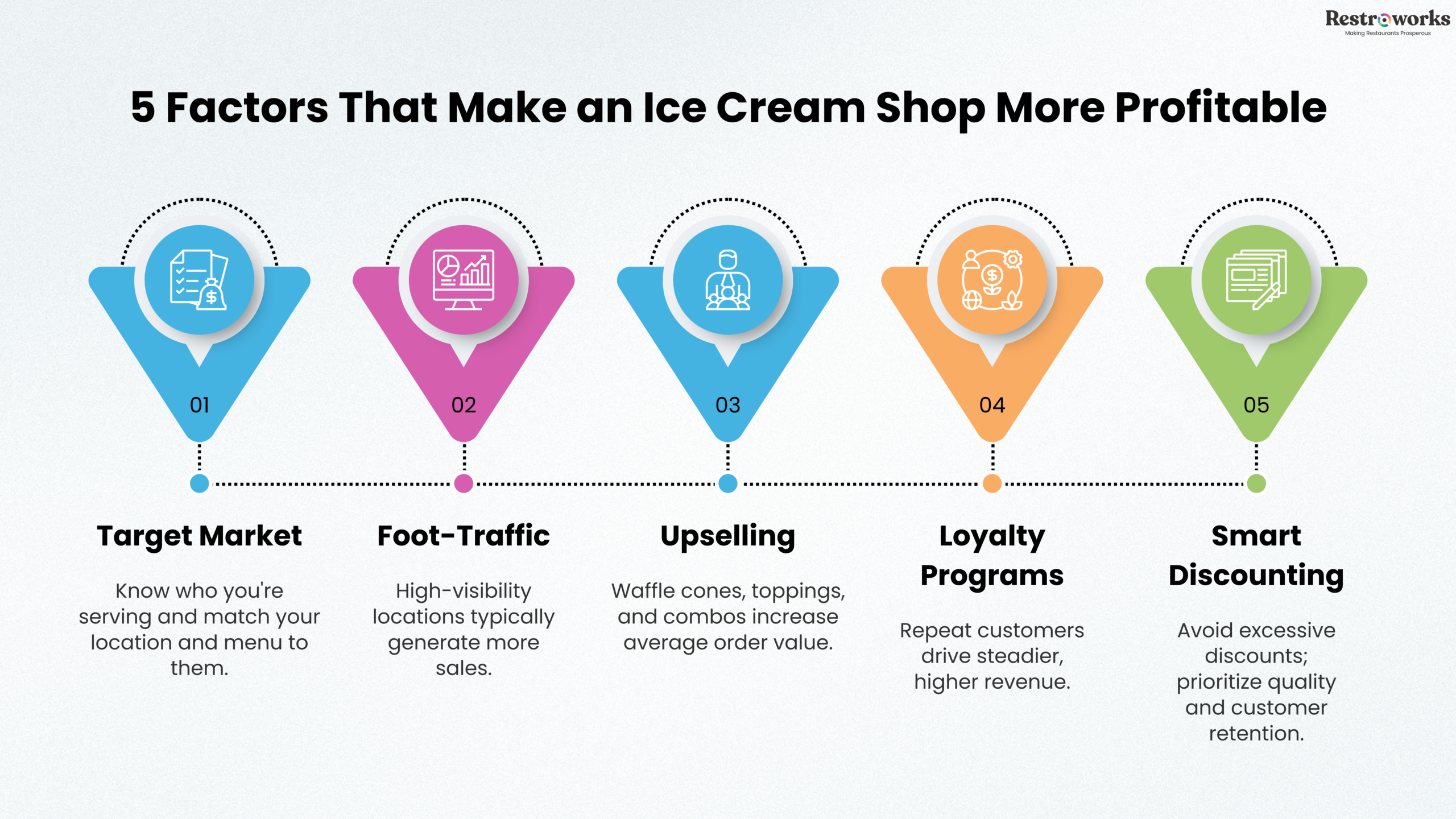
See, every ice cream shop sells the same core product – ice cream, of course. Now, the thing is, if both X and Y are selling ice cream, what even decides whether X is a more profitable business or Y is more profitable? There are some key factors, though.
#1: Your target market: If you’re a neighborhood shop, families with young kids are your valuable customers, but if you serve in a touristy area, you’ll see different customers every time – rarely do people return to the same place “just to travel & have a scoop.”
#2: Foot traffic: If you choose a cheap location (price-wise) with minimal foot traffic, your ice cream shop’s revenue is going to be much lower than if you choose to operate in high-traffic areas.
#3: Upsell opportunities: Offering combo deals, waffle cones, and specialty toppings is an awesome way to increase your average order value…and you don’t even need to attract customers for that. Sundaes and specialty items alone represent 35% to 45% of total gross profit despite making up a smaller share of overall sales.
#4: Loyalty programs: It’s pretty obvious that customers who come to your store three to five times a month spend much more per visit than one-time customers ever will, and that’s where loyalty programs and a functioning rewards system come in.
A strong loyalty program boosts the number of repeat visits you see each month, plus revenue during slow months. Similarly, birthday clubs and punch cards encourage customers to come back on a schedule, so that’s an ultimate win.
#5: Discounting: Yes, we understand when you have no other plan, offering discounts on every product you sell seems like the most viable option, but it’s unfortunately not that great.
Alexandre Bachir, whose family has run Bachir Ice Cream since 1936, says, “We try not to do that [offer discounts blindly]. But of course, especially with aggregators, you need to do discounts to be visible. But we are trying to, to, to have less discount.” He adds, “I don’t think doing a discount will help the brand,” as much as visibility and consistent quality do.
How Can You Boost Revenue With Ice Cream Flavors and Local Partnerships?
People need no convincing to want sweet treats; they need a reason to choose YOUR shop over any other, and so if you think making tasty ice cream can be your USP…sorry, but that’s a baseline.
What drives repeat business is your story (story behind how each flavor in your store came to be), local events you show up to, how excellent your customer service is at the counter, etc.
On the topic of introducing new flavors, Co-founder of Salt & Straw, Tyler Malek, says, “Instead of ‘Let’s try it,’ it’s more like, ‘Let’s learn about this and how has this been used in culinary purposes over the last 1,000 years and is there any intersection that can inspire us from that perspective? Internally, we call ourselves the taste provocateurs. You don’t provoke people just to piss them off; you provoke people to have a conversation to dive into something.”
Another strategy that can help you is local partnerships. Cross-promotions with a nearby bakery, sponsoring community events, or setting up at a school fundraiser all put your ice cream in front of more customers without paying for a single ad. Similarly, introducing creative flavors attracts customers who might otherwise skip having any ice cream in a particular season entirely.
Did you know? Studies show that 75% of consumers are open to trying new ice cream flavors, which means it is really important for ice cream shops to offer a wide variety of flavors in the first place. Plus, 80% of ice cream consumers prioritize flavor and quality, meaning you can’t just make do with any variety; they should be really high-quality too. |
Branded Merchandise, Add-Ons, And Other Ways To Increase Sales & Average Order Value
The best thing about branded merchandise is that it walks around the town advertising you absolutely for free.
Say, a customer walks around wearing a T-shirt, or carrying a tote bag with your brand name printed on it…won’t it be awesome – like how many people will see it?
Branded merchandise also tends to carry excellent margins since the cost is fixed regardless of foot traffic that day. Every ice cream shop, whether it sells merchandise or not, benefits from that kind of free, walking-around visibility.
Other than merchandise, you can also try:
- Adding fresh fruit, gourmet syrups, and specialty mix-ins to justify a premium price point for your items.
- Building a diverse menu that satiates every type of customer.
- Running seasonal promotions, like you may sell pumpkin flavor ice cream in fall, fresh berry blends in summer, and more.
- Offering exclusive flavors through email or app-based customer loyalty programs.
- Introducing hot beverages in colder months to offset the seasonal drop.
All of these ideas can be really profitable if you can execute them well. + This video discusses some more really good ice cream business ideas. Hope it helps you make real money…a lot of it.
KEY TAKEAWAYS
- Profit margins for ice cream shops vary based on business model, with independent shops averaging 15% to 25%, franchises 12% to 20%, and mobile businesses 20% to 30%.
- To improve profit margins, ice cream shops should focus on optimizing both fixed and variable costs, including inventory management, labor costs, energy efficiency, supplier negotiation, and marketing efficiency.
- Effective inventory control can help reduce waste by closely monitoring stock levels, ordering the right quantities, and minimizing spoilage, which is crucial for controlling costs in an ice cream shop.
- Ice cream shops located in areas such as downtown strips, busy malls, or popular foodie districts can significantly boost their revenue by attracting more customers.
- Ice cream shops that are strategically located near schools, parks, or tourist spots tend to perform better due to increased foot traffic, while poor location choices are a leading cause of failure.
- Offering a variety of flavors, toppings, and desserts, such as milkshakes and sundaes, can attract a broader range of customers and generate higher sales.
- Introducing premium, artisanal ice cream offerings can attract health-conscious or gourmet customers willing to spend more for quality and uniqueness, boosting profit margins.
- Showcasing unique offerings on social media platforms like Instagram and Facebook can significantly increase visibility and attract local followers for ice cream shops.
- Collaborating with local businesses and events can create unique cross-promotional offers that drive traffic back to ice cream shops, enhancing community engagement and brand loyalty.
- Implementing a loyalty program that rewards frequent visitors can encourage repeat visits and foster a deeper connection with customers, making them ambassadors for the brand.
- Running seasonal flavor promotions can keep customers returning by creating excitement and urgency around limited-time offerings, which can be promoted through email newsletters and social media.
- Ice cream shops can diversify their revenue streams by offering catering services for events, which can significantly increase sales during off-peak seasons.
- Implementing a subscription service for ice cream enthusiasts, where customers receive exclusive flavors or discounts, can create a steady revenue stream throughout the year.
Frequently Asked Questions
1. How long does it take for an ice cream shop to become profitable?
Most businesses take 12 to 24 months to become consistently profitable, although exact timelines do vary by location, competition, and startup costs.
A typical ice cream shop reaches profitability faster when it:
- Builds a steady flow of enough customers throughout the week.
- Manages operational costs, including rent, inventory, and utilities.
- Keeps labor costs in check.
- Maintains healthy profit margins through smart menu pricing.
- Creates customer loyalty with a memorable ice cream experience, keeping customers coming back.
Seasonality also plays a major role. Strong summer sales often offset slower winter months.
2. Do ice cream shop owners take a salary or just profit?
Honestly, it depends on how your business is structured and how profitable it has become.
Many ice cream shop owners pay themselves a modest salary to cover personal expenses while leaving additional earnings in the business for growth. Others rely primarily on profit distributions once cash flow becomes more predictable.
Most successful owners focus on:
- Maintaining positive cash flow.
- Reinvesting in equipment and marketing.
- Balancing salary with long-term business growth.
3. Do specialty ice cream shops make more money than traditional shops?
They can, especially when serving a well-defined niche market.
For example, gourmet ice cream shops often charge premium prices because customers perceive higher value in them. Shops that offer unique flavors, gluten-free options, locally sourced ingredients, or an interactive ice cream-making experience can justify higher prices.
However, premium pricing only works if the business consistently delivers:
- Great ice cream
- Excellent customer service
- Products that encourage repeat business
Higher prices don’t automatically guarantee higher profit margins if ingredient and operating expenses rise just as quickly.
4. Are franchises more profitable than independent ice cream shops?
No, not always. Both models, a franchise as well as an independent ice cream shop, have advantages.
A franchise often benefits from established branding, supplier relationships, and proven systems that help attract customers faster. However, franchise fees and royalties reduce overall profit margins.
An independent ice cream shop has greater flexibility to adjust menus, experiment with seasonal promotions, and respond to local preferences. Owners also keep more of the profits but must build brand recognition from scratch.
Ultimately, profitability depends more on:
- Effective pricing strategies
- Strong cost control
- Consistent efficient operations
- Building a base of loyal customers
These factors usually matter more than whether the business is franchised.
5. Is a mobile ice cream truck more profitable than a brick-and-mortar shop?
A mobile business generally requires less upfront investment because it doesn’t have to bear high rent and many fixed expenses. That’s why many entrepreneurs start with an ice cream truck before opening a permanent ice cream parlor. Compared with traditional food service businesses, mobile ice cream businesses typically have lower overhead but depend heavily on weather, events, and seasonal demand. Like many food trucks, they also face location restrictions and limited storage.
A brick-and-mortar, albeit a small ice cream shop, on the other hand, usually has higher fixed expenses, including labor costs and rent, but it can generate more consistent traffic and maximize sales by expanding its menu with beverages, desserts, and other sweet treats.
Regardless of the format, success comes from managing the goods sold carefully, nurturing loyal customers, and maintaining healthy profit margins over time. Traditional marketing methods like print ads can also support local visibility, although many businesses now combine them with digital marketing.