
Pros and Cons of Owning a Franchise Restaurant: Is It the Right Investment for You?

Pros and Cons of Owning a Franchise Restaurant: Is It the Right Investment for You?

Home / Blog /
Pros and Cons of Owning a Franchise Restaurant: Is It the Right Investment for You?

Read summarized version with

In short: The top benefits of owning a franchise restaurant are that you get instant brand recognition, a proven business model, bulk purchasing power, and easier access to financing. But it involves high upfront investment, limited creative control, and a long contract that’s sometimes really difficult to get out of. So, whether it’s the right investment for you or not depends on your budget, business goals, and how willing you are to follow proven systems.

See, opening a restaurant is one of the biggest financial and personal decisions a person can make, and for many aspiring restaurant owners, the question is never whether they should or should not get into the food business in the first place. It’s whether they should build their own restaurant from scratch or just step into a franchise model that’s already proven itself.

There’s a study by the University of Michigan that sums up that while there is evidence of survival and growth advantage of franchising, “this advantage is rather small and concentrated in the first year or two,” so basically, pros and cons of owning a franchise restaurant come down to a simple trade: structure and support in exchange for fees and less creative freedom.

What You’ll Learn

  • The real advantages and disadvantages of buying into a franchise business.
  • How to weigh a franchise model against starting an independent restaurant based on your capital, risk tolerance, and goals.

What are the Advantages and Disadvantages of Franchise Ownership?

The biggest advantages of franchise ownership are a brand customers already recognize, a tested system, and shared buying and marketing power. The disadvantages are ongoing royalty fees, the franchisor’s rules, and heavy dependence on the franchisor.

To be specific, a restaurant franchise is a business model where a franchisee pays for the rights to operate a location under a franchisor’s brand, systems, and support, while the franchisor grows its footprint through a network of independent operators.

In fact, franchising is a large part of the U.S. economy. The International Franchise Association (IFA) projects 845,000 franchise establishments and franchise output of $921.4 billion in 2026. But still, Francine Lafontaine [U-M economist] said, “Franchising is no safer on average than independent business ownership, and in some cases is actually more risky. Of course, business failure is a fact of life. Our point is that this is just as true for franchisees as it is for other players in the economy.” So even with its many advantages, a franchise is no guarantee of success.

What are the Pros of Owning a Franchise Restaurant?
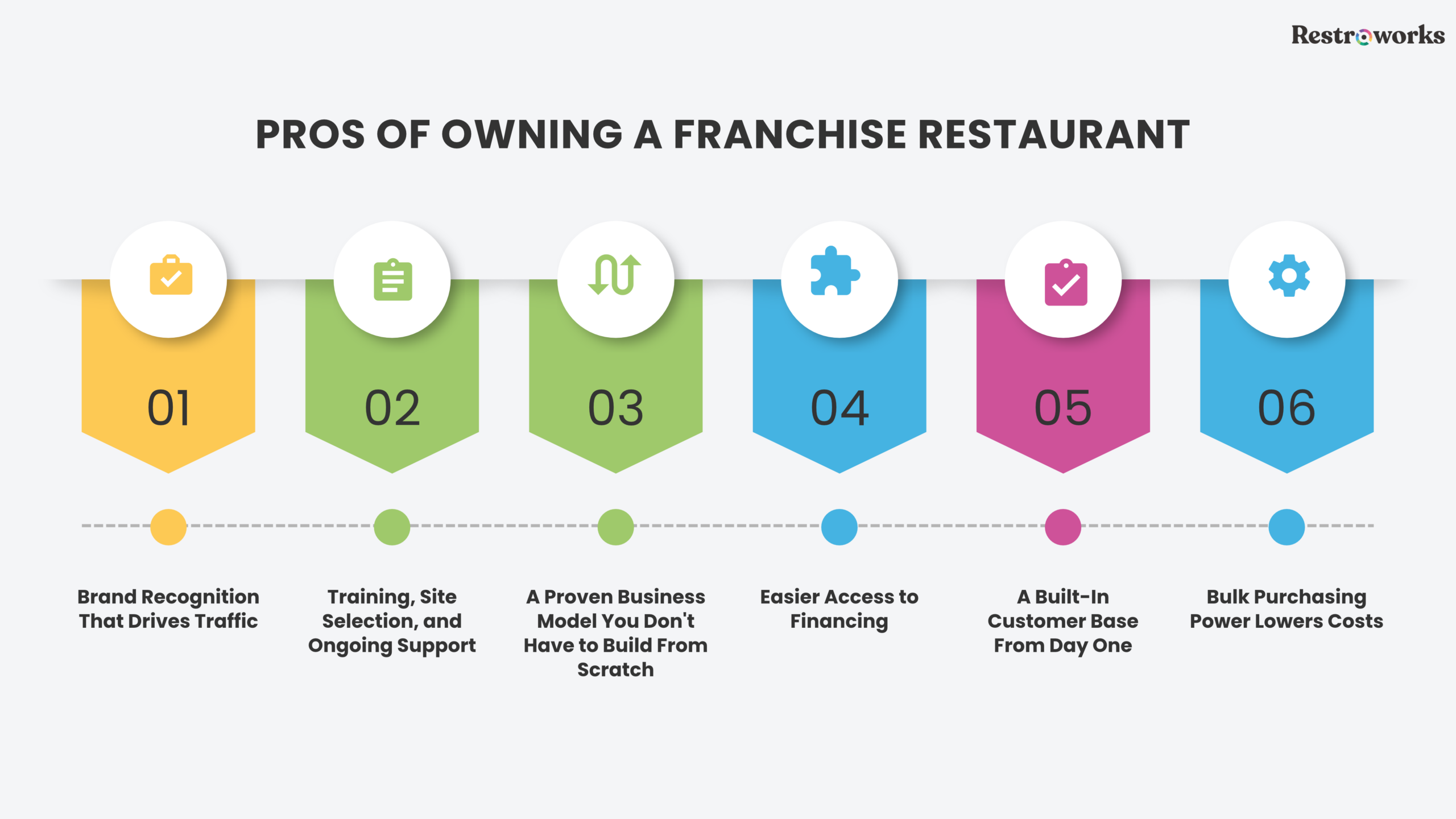
Pros of Owning a Franchise Restaurant

#1: Established Brand Recognition That Drives Traffic

One of the biggest advantages of a restaurant franchise is established brand recognition, which means you’re stepping into a brand people already know, and thus attract customers from day one.

A 2024 study in the Journal of Economics & Management Strategy found that franchising a restaurant increases its revenues by 7% compared with independent operation. This is particularly because customers are naturally more likely to return to a name they already trust, and that instant recognition means you and your team can now spend less time educating the market about who you are and more time actually running the business.

#2: A Proven Business Model You Don’t Have to Build From Scratch

Buying a franchise means you get a tried-and-tested business model: the franchisor has already worked out operations, supply chains, and training, so you don’t have to carry out trial and error for those from scratch. As per research by the University of Michigan, the new franchised businesses have a one-year survival rate of about 6.3 percentage points higher than independents, and 8.4 points higher at two years.

Jack in the Box, for example, has operated since 1951 and ended fiscal 2025 with 2,136 restaurants, 1,985 of them (which is 93%) franchised. Its established business model has been stress-tested through multiple recessions and shifts in consumer taste, which reduces the risk of your franchise failing at an early stage compared to launching an independent restaurant business venture.

#3: Training, Site Selection, and Ongoing Support

Good franchisors provide training and support that first-time business owners would otherwise have to buy or learn the hard way. This covers operating procedures, site selection, grand opening marketing, and ongoing operational guidance.

According to the U.S. Small Business Administration, franchisors’ real estate teams typically start working on your location right after the agreement is signed, and marketing help is included in the upfront and ongoing fees. Franchisors also provide continuous support for your marketing efforts through shared programs. A bubble tea franchise, Happy Lemon USA, for example, enrolled more than 200,000 loyalty members across 135 U.S. stores in the first two years through a system-wide program that still let franchisees run local campaigns.

#4: Easier Access to Financing

Lenders and investors often see franchise owners as a lower-risk investment compared to independent restaurant owners, because banks recognize the proven track record and corporate support behind the brand. This can be especially valuable for new restaurant owners who don’t yet have the capital or credit history to cover the startup costs of a standalone concept on their own.

The Small Business Administration guaranteed $31.1 billion in 7(a) loans in fiscal 2024. As for the loan allotment specifically, franchises have historically represented about 20% of SBA loans by dollar volume. Some franchisors offer franchise owners their own incentives too. Like, Jack in the Box may lend qualifying multi-unit developers $150,000 at 0% interest toward development costs.

#5: Bulk Purchasing Power Lowers Costs

As part of a larger network, you buy alongside hundreds of other franchisees and benefit from the franchisor’s system-wide buying power. This often results in lower operational costs for food supplies, kitchen equipment, and inventory than an independent operator could negotiate alone, which helps protect profit margins from day one.

#6: A Built-In Customer Base From Day One

Franchises come with a loyal customer base of people who already know and trust the brand. These are customers who are more likely to try new menu items, return often, and spend more per visit, giving a new location a steady stream of customers that an unknown startup restaurant rarely sees in its first year.

For example, as per item 19 of the FDD, franchised McDonald’s restaurants open at least a year averaged $4,057,000 in 2025 sales. Similarly, franchise-operated Jack in the Box restaurants averaged $1,913,335 in the 12 months ending September 30, 2025 – all this without you having to go an extra mile with marketing.

INDUSTRY INSIGHT

Market trends favor franchising, too. Franchise employment is anticipated to increase by more than 150,000 jobs, or 1.8%, to nearly 8.9 million jobs in 2026. Plus, total franchise GDP will grow from $549.9 billion to $558.4 billion by the end of this year.

The Cons of Owning a Franchise Business
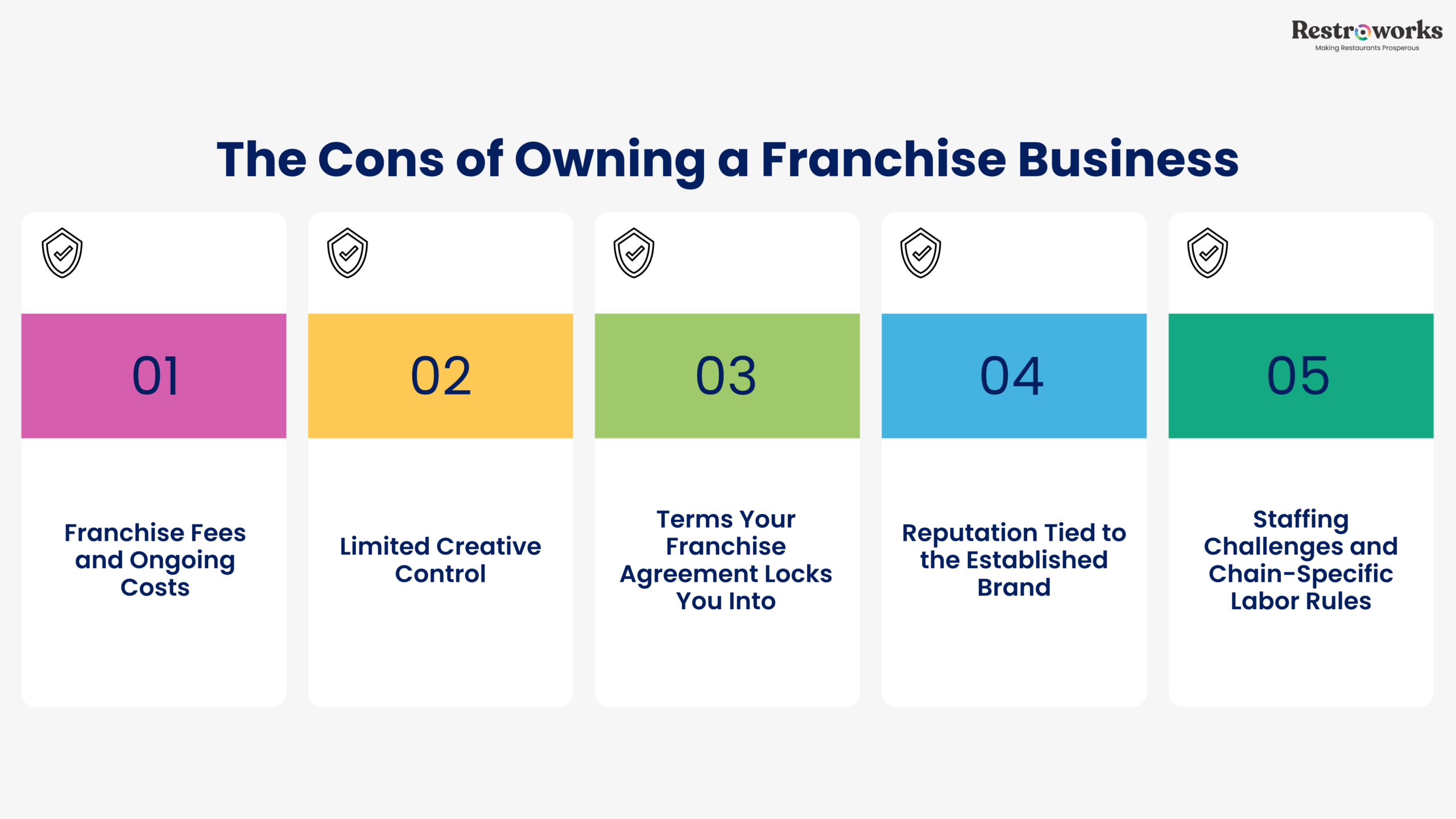
Cons of Owning a Franchise Business

#1: Franchise Fees and Ongoing Costs

The most obvious potential disadvantage is cost, since franchise ownership is expensive twice – once to open, and every month after through ongoing royalty payments and marketing fees calculated on gross sales. At major quick-service brands, initial costs including franchise fees, build-out, and equipment run well over $1 million per restaurant before land. Let’s break this down with an example of two very popular brands –

Comparison of McDonald's and Jack in the Box franchise costs, fees, rent, and average annual sales based on their 2026 Franchise Disclosure Documents.
Cost item McDonald's (2026 FDD) Jack in the Box (2026 FDD)
Initial franchise fee $45,000 $50,000
Total estimated initial investment $1,472,000 to $2,807,000 $1,909,500 to $4,041,500 (excludes land and financing)
Royalty or service fee 4% or 5% of gross sales 5% standard (FDD range 0% to 12.5%)
Advertising/marketing fee At least 4% of gross sales 5% of gross sales
Rent paid to franchisor Effective rent ranged from 0% to 33.37% of sales in 2025 NA
Average annual sales (Item 19) $4,057,000 (franchised, open 1+ year, 2025) $1,913,335 (franchise-operated, FY ending Sept. 30, 2025)

Across the industry, royalties range from 4% of revenue to 12% or more, depending on the franchise type. To put that in dollars: a Jack in the Box restaurant at the system-average $1,913,335 in sales would pay about $191,000 a year in combined 5% royalty and 5% marketing fees.

And you’ll need to make these payments whether you turn a profit or not. “Fixed obligations, including royalties, ad-fund contributions, rent, and debt service, don’t soften when sales do,” said Bradford Sandler, partner at the corporate restructuring law firm, Pachulski Stang Ziehl & Jones.

#2: Limited Creative Control

Operating under a well-known brand comes with real limits on what you can change. Franchisees must adhere to strict guidelines set by the franchisor covering menu items, store design, and marketing, which can feel restrictive for restaurant owners who thrive on personal creativity or want to experiment outside the established framework. For example, effective January 1, 2026, McDonald’s added a value standard to its global franchising standards. Franchisees still set their own prices, but McDonald’s now assesses those decisions, including use of its pricing tools and support for system promotions, against its goal of delivering value to customers.

#3: Terms Your Franchise Agreement Locks You Into

Before you pay ongoing royalties for the next several years, read the franchise agreement closely. These agreements typically run for a fixed term with no automatic right of renewal, and they spell out specific curable and non-curable grounds for termination, from missed payments to failing food safety standards. Jack in the Box agreements, for example, run 20 years.

Territorial restrictions in franchise agreements can also limit expansion opportunities, preventing franchisees from opening new locations in certain areas even if the market looks promising.

When things go wrong, the agreement decides who keeps the restaurants. In 2018, Applebee’s parent Dine Brands sought control of 146 restaurants run by franchisee RMH Franchise Holdings, arguing RMH had terminated its contract by not paying royalties and claiming more than $23 million in unpaid and lost future fees. A Delaware bankruptcy court ruled RMH could keep operating, and the eventual settlement required RMH to pay all past-due royalty and advertising fees.

#4: Reputation Tied to the Established Brand

Your location’s reputation is tied to the overall performance of the brand across all franchise locations.

Negative publicity, a lawsuit, or a poorly run location elsewhere in the system can change how customers see your restaurant regardless of how well you personally run it, which is why regular quality checks and management oversight matter so much across the whole franchise network.

Franchise owners must also watch for brand saturation, since too many locations packed into one market can create competition among franchisees and dilute the brand’s overall pull.

#5: Staffing Challenges and Chain-Specific Labor Rules

A restaurant franchise faces high employee turnover and, in some states, wage rules that apply only to large chains. Both raise labor costs that the franchisor’s fee structure often fails to adjust for.

Needless to say, turnover in the hospitality industry hovers around 70%, which means constant hiring, training, and shift-filling. In California, AB 1228 set a $20 hourly minimum wage, effective April 1, 2024, for workers at fast food chains with more than 60 locations nationally, and lets a Fast Food Council raise it annually. An independent restaurant is not covered by that wage floor.

The Case of Restaurant Franchisee Bankruptcies in 2026

Bankruptcies among restaurant franchise operators have climbed back to pre-pandemic levels in 2026, with at least 10 significant multi-unit filings across chains by mid-September. Sandler called the pattern “systemic, not cuisine or brand-specific.” For example, here are a few cases from this year:

Restaurant franchisee bankruptcy filings in 2026, including filing dates, franchisees, brands, and reported business size.
Filed (2026) Franchisee Brand Size at filing
September Meritage Hospitality Group (Chapter 11) Wendy's 314 Wendy's; Wendy's claims about $146.9M owed.
July Superior Star Corp. (Chapter 11) Hardee's $10M to $50M in assets
April ARC Burger LLC (Chapter 7) Hardee's 77 restaurants closed in December. Hardee's had sued for $6.5M
April Friendly Franchisees Corporation (Chapter 11) Carl's Jr. 65 locations
March Neighborhood Restaurant Partners Florida (Chapter 11) Applebee's 53 locations
January Sailormen (Chapter 11) Popeyes 136 restaurants
January MTF Enterprises (Chapter 11) Subway 43 stores

*Source: Restaurant Dive

Franchisor responses have varied on this. Burger King committed more than $2 billion to remodel and support programs, while Hardee’s pursued its distressed franchisee in court. So, the takeaway is that before you sign any contract, ask how your franchisor supports struggling business owners (because who knows when you might need that extra support?)

Is a Food Franchise the Right Investment for You?

A food franchise is the right investment if you have substantial capital, prefer following a proven system over inventing one, and can live with paying royalties on every dollar of sales. It is the wrong fit if creative control matters more to you than a head start.

After weighing the pros and cons, what matters most is matching the model to your own capital position, appetite for risk, and operational background before you sign. Under the FTC Franchise Rule, prospective franchisees get the FDD at least 14 calendar days before they sign or pay anything, so use that time.

KEY TAKEAWAYS

  • Owning a franchise restaurant offers a “business in a box” with brand recognition, a loyal customer base, training, and support, but it requires substantial capital and sacrifices creative freedom.
  • Franchising raises a restaurant’s revenue by about 7% on average, but franchises are no safer than independents after the first one to two years.
  • Most franchises provide comprehensive training programs, essential for franchisee success, covering operating procedures through marketing strategies.
  • Franchisees benefit from a structured support system that helps them navigate the challenges of running a new business, especially if new to the industry.
  • Access to national or regional marketing campaigns funded by the franchisor enhances marketing reach.
  • High employee turnover is a common challenge in the restaurant industry, requiring significant effort in staffing.
  • The need for menu standardization and consistency can restrict franchisees’ creative freedom, making it challenging to introduce new dishes or unique ideas.
  • A poorly managed franchise location can damage the entire brand’s reputation, necessitating regular quality checks and oversight.

Frequently Asked Questions

1. What is the average profit margin for franchise restaurants? 

Franchise restaurant profit margins are thin, typically 3% to 5% pre-tax, according to restructuring attorney Bradford Sandler. Margins vary by brand, market, and management. Item 19 of a brand’s FDD, where provided, gives the clearest picture: Jack in the Box’s 2026 FDD shows a 2025 operating margin of about 7.1% before rent, interest, and taxes.

2. What is the 7-day rule for a franchise? 

The 7-day rule is part of the federal FTC Franchise Rule: if a franchisor unilaterally makes material changes to the standard franchise agreement, it must give you the completed agreement at least 7 calendar days before you sign. It works alongside the 14-day rule, which requires you to receive the Franchise Disclosure Document at least 14 calendar days before signing a binding agreement or paying any money. Some states use business-day waiting periods that can run longer, so confirm your state’s rules with a franchise attorney.

3. What should I look for in a Franchise Disclosure Document?

In a Franchise Disclosure Document, focus on Items 5 and 6 for franchise fees, Item 7 for total initial investment, Item 17 for termination and renewal terms, Item 19 for financial performance representations if provided, Item 20 for a list of current and former franchisees to call, and Item 21 for audited financials.

Newsletter subscription banner

Talk to a restaurant expert today and learn how Restroworks can help your business.

Request Demo >

Share

Discover More Insights to Power Your Journey

Sharing the Love, One Taco at a Time: Eric Knott on Scaling TikiTaco the Right Way

Ask Eric Knott, CEO of TikiTaco, what business restaurants are really in, and you’ll get an answer that has evolved…

POS
Best Restaurant POS Software in Qatar
Best Restaurant POS Software in Qatar for Every Type of Restaurant

During a Friday dinner rush in Doha, the Talabat tablet at the pass is often where service breaks down: orders…

How to Start an Ice Cream Truck Business in the US

No other business out there can combine nostalgia with profit as well as an ice cream truck does. Like, it's…

Customer Review Strategy for Restaurant Franchises: Build Trust & Boost Local Reputation

A single bad shift can live online forever. A single great one can, too. That is the reality every restaurant…

Franchise Restaurant Business Plan: A Complete Guide to Launch & Scale Successfully

In short: A franchise restaurant business plan is the document that proves to a lender and a franchisor that your…

Real-Time Analytics for Restaurant Franchises: Smarter Insights for Faster Decisions

Real-time analytics for restaurant franchises gives owners and franchisors live data on sales, labor, inventory, and guest activity across every…

Join. Learn. Grow.

Sign up to receive the latest hospitality insights and stories straight to your inbox

Streamline your operations with Restroworks