


1. Restroworks: Centralized Operations for Enterprises and Multi-Brands
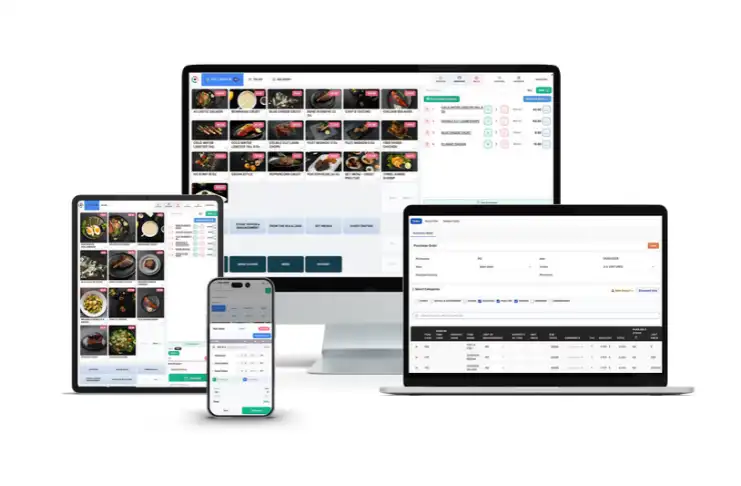
A restaurant group running several concepts needs more than a billing app. Every outlet must take orders the same way, each brand needs its own menus and pricing, and the front of house must handle counter, table, kiosk, and delivery orders without new hardware. Restroworks runs all of this on one POS. Its BFCD (Brand, Format, Cluster, Deployment) architecture lets head office set menus and prices once at brand level and push them to every format, region, and outlet, with local changes only where head office allows. More than 30,000 restaurants in 52 countries run on Restroworks, including Gulf chains such as Al Baik, Herfy, Café Bateel, Caribou Coffee and Zaatar w Zeit. Herfy moved 400+ outlets onto it in 150 days.
Key Features That Improve Operational Efficiency
- Hardware-independent POS: Keep your existing compatible terminals, printers, and cash drawers.
- Handheld POS: Waiters take orders and process payments on handhelds at the table, and the orders go straight to the kitchen.
- Kitchen Display System: Orders enter the kitchen queue, allowing tracking of cooking progress instead of relying only on paper tickets.
- Self-ordering from RestroGO kiosk: Clients can choose their meals, customize them, and pay at a self-ordering kiosk without asking anyone at the counter
- Ordering via RestroSCAN QR: Guests scan the QR code and order from their table.
- Offline billing: Operations such as billing, orders, and kitchen tickets can continue offline and sync later when the restaurant comes back online.
- Receipts in Arabic and English: Support for multilingual customer documentation for restaurants catering to people who speak Arabic and English.
- More than 500 integrations: The restaurant management software integrates with more than 500 applications related to payments, deliveries, loyalty programs, accounting, etc., used by restaurants.
- 24/7 customer support: The round-the-clock support team helps with restaurant operations.
Neo, Restroworks’ integration middleware, connects the POS natively to Talabat, Snoonu, Keeta, web and QR ordering. From one dashboard, teams manage menus, prices, offers, and item availability across every channel and outlet; schedule changes such as Ramadan menus and trading hours in advance; open or close storefronts and adjust prep times; and see live orders and out-of-stock items across all outlets in a single view. Changes can also be made through plain-language AI prompts (Beta).
Where It Excels
Restroworks is strongest where operations are most complex: several brands, formats and outlets run on one system, with each concept tailored to its own menus and pricing while head office stays in control.
What Could Be Better
An independent café might not need all the enterprise capabilities. Because custom deployment and pricing are included, operators should request an estimate for their outlets before comparing it with simpler subscription plans.
Pricing & Ratings
Custom pricing based on business requirements. G2: 4.8/5 · Capterra: 4.9/5
2. Foodics: Best Restaurant POS for Delivery & Financing
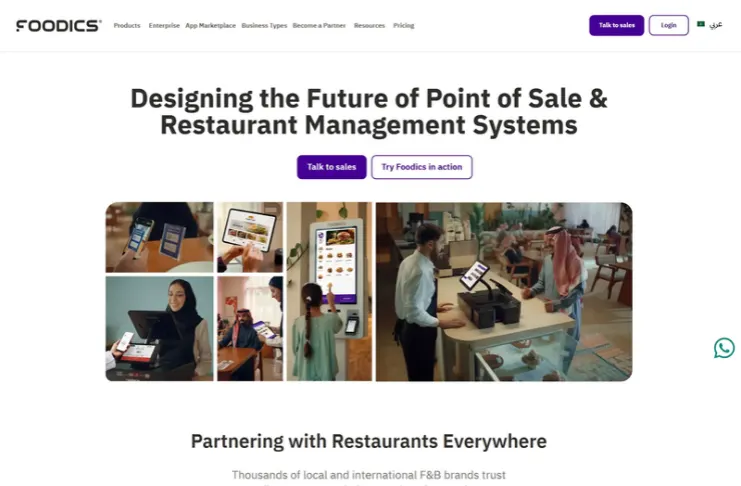
Foodics’ POS and restaurant management solution is tailored to the operational requirements of food and beverage businesses in the GCC region. The platform combines order management and payment functionality with order delivery management and restaurant operations, including inventory management.
An interesting feature that might be useful for Qatar restaurants is consolidating order delivery requests in one place, rather than having staff check orders on different aggregator tablets. Through wi-Q Connect, a third-party integration, Foodics supports Talabat, Snoonu, and Keeta in Qatar, with orders and menus managed centrally
Key Features That Improve Operational Efficiency
- POS billing and integrated payment processing.
- Centralized delivery order management through supported integrations.
- Automatic order routing to POS and kitchen printers or screens.
- Menu and catalog synchronization across delivery partners.
- Multi-brand and multi-location capabilities.
- Arabic and English language support.
- Micro-lending and financing services for eligible businesses.
Where It Excels
The Foodics solution integrates the transaction and delivery aspects of the restaurants’ business processes. Foodics’ finance solution is another unique value proposition for companies that need both software and working capital. The delivery integration is particularly important for places that accept orders through multiple channels.
G2 users indicate an implementation period of about one month on average, with return on investment achieved within 14 months.
What Could Be Better
Restaurants need to evaluate the total cost of the POS system, including integrations and other components, not just the subscription fee. Also check whether certain delivery service providers are available at each restaurant location.
Pricing & Ratings
Custom pricing by module. G2: 4.6/5 · Capterra: 3.6/5
3. Sapaad: Best Restaurant POS Software for Home Delivery & Call-Centre Ordering
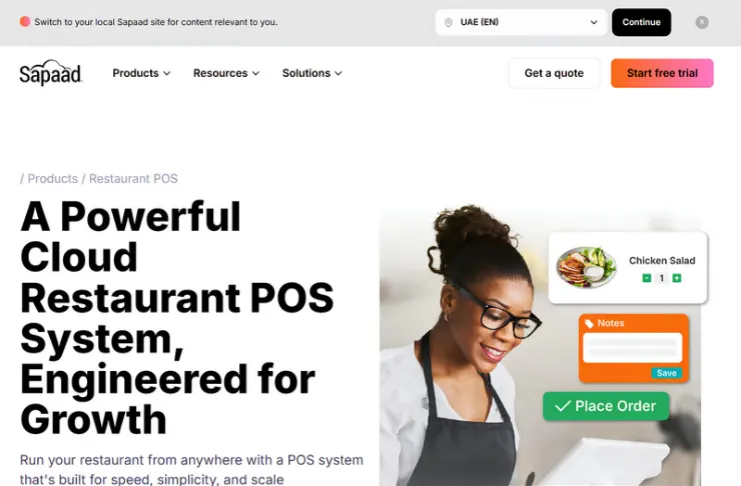
Sapaad is intended for those restaurants that also get a lot of orders through the phone; the delivery process requires more than just receiving the order and printing out a kitchen ticket. Employees must select the right branch, record customer details, coordinate the preparation process, and track the delivery process until completion. Sapaad is a cloud-based restaurant POS and management system designed for dine-in, takeaway, delivery, and online orders. Sapaad’s documentation specifies its Home Delivery Manager, which is used to control and monitor all orders, and the software also covers table management, menu customization, inventory management, recipe costing, CRM, and reporting functions.
Key Features That Improve Operational Efficiency
- Order processing system and its centralization with respect to the restaurant delivery operations.
- Delivery Manager that may be used for order tracking.
- Point-of-sale transactions, table reservations, and waiter services.
- Display of order status along with management of food production.
- Inventory management and recipe cost control.
- Customer relationship management, customer knowledge, and loyalty programs.
- Reporting for multiple outlets along with menu duplication.
- Offline operation followed by synchronization when the internet connection is restored.
Where It Excels
Sapaad’s home delivery management system can be very useful for restaurants that depend on telephone orders and have established delivery operations. Each business should review its system for the right technology and see whether the platform solves its issues with call handling, auto-branching, order assignment, and delivery coordination without additional software.
What Could Be Better
Sapaad’s published delivery integrations include Talabat but not Snoonu or Keeta, so confirm Qatar integrations and local support before signing.
Pricing and Ratings
Listed from $39.99/month on a two-year plan. G2: 4.6/5, Capterra: 4.4/5 from 38 reviews, with 4.5/5 for ease of use, 4.6/5 for customer service, and 3.8/5 for value for money.
4. Lightspeed: Best Restaurant POS System for Retail and Restaurant Crossover
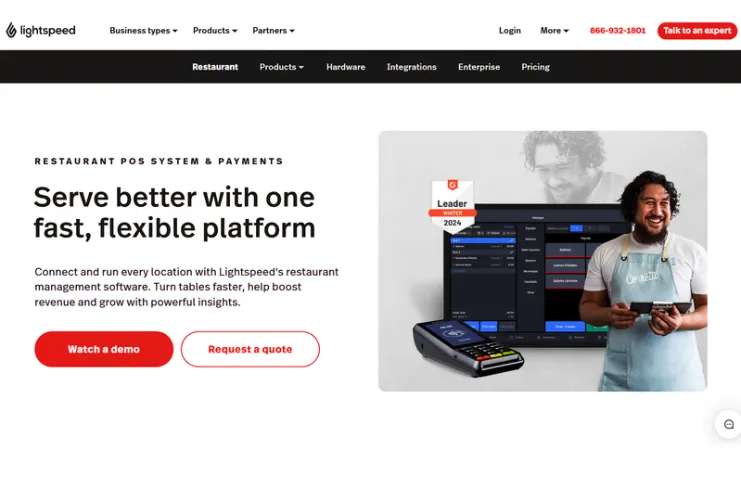
Hospitality establishments don’t just sell products at the restaurant counter; they may also sell packaged products and merchandise, so they need a POS system that can record transactions across different product categories.
The Lightspeed POS system caters to both restaurants and retail businesses. Its features include inventory control, customer details, and reporting systems that help monitor sales across product categories.
Key Features That Improve Operational Efficiency
- Processing of POS transactions and checkout
- Tracking of inventory by sales categories
- Information about customer and sales history
- Sales and inventory reporting
- Payment methods and hardware within the markets it serves.
Where It Excels
Companies that combine food services with retail operations may consider Lightspeed. Lightspeed’s reporting capabilities let managers review sales and inventory performance across locations and distribution channels, not just transaction history.
What Could Be Better
Lightspeed has limited presence in Qatar and the wider GCC, and no published Talabat, Snoonu or Keeta integration, so confirm local payments, Arabic support and delivery integrations before choosing it for a Qatar restaurant.
Pricing & Ratings
Custom pricing by module. G2: 4.0/5 · Capterra: 3.9/5
5. Focus e-RMS: Best Restaurant POS for Hotels & Multi-Outlet Operations
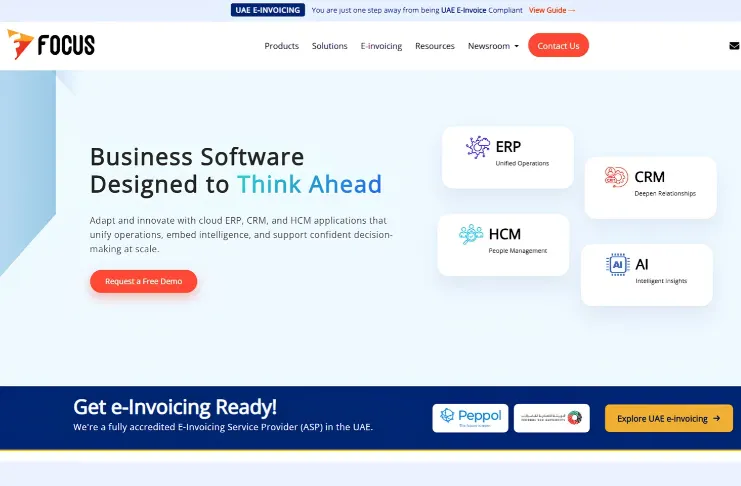
Restaurant POS systems tend to get complicated when a restaurant is in a hotel setting or runs multiple outlets. Reservation systems, mobile ordering, inventory, staff operations, and payment systems should be both independent and integrated into one system.
Focus Softnet designed the Focus e-RMS as a restaurant and hospitality management solution. According to the website, the Focus e-RMS product page for Qatar includes features such as reservations, table management, order processing, billing, inventory management, reports, and mobile POS.
Key Features That Improve Operational Efficiency
- Waiter-assisted ordering with mobile POS tools.
- Table management and table reservation management.
- Order management, split bills, and various payment methods.
- Customizable menus and pricing system.
- Synchronization of multi-site data and reporting.
- Inventory management, purchasing, and stock management.
- CRM and loyalty management.
- Cloud, on-premise, and hybrid deployment.
Where It Excels
Focus e-RMS has a clear regional strategy. The company has an office in Doha, Qatar, with a local contact phone number and address.
What Could Be Better
Focus doesn’t publish Talabat, Snoonu or Keeta integrations or offline billing, so ask to see both in a demo.
Pricing & Ratings
Custom pricing based on outlets, users, deployment, and customization requirements. No G2 or Capterra ratings published.
6. Online eMenu: Best Qatar-Native Budget POS
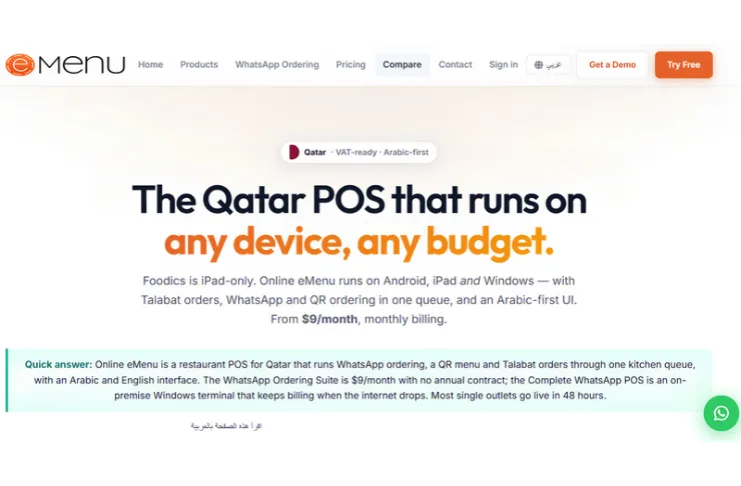
Online eMenu is a Dubai-built, low-cost POS with a dedicated Qatar offering that covers local payments, delivery, and an Arabic interface. Its Qatar page lists payment system integration, Talabat and Snoonu integrations, an Arabic and English user interface, WhatsApp ordering, and offline billing.
Key Features That Improve Operational Efficiency
- Payment system integration for local payment processing.
- Arabic & English User Interface with Right-to-Left support.
- Integration with Talabat, Snoonu, and Rafeeq orders.
- Ordering via WhatsApp.
- Order printing and printing routing for the kitchen.
- Supports Android, iPad, and Windows.
- Ability to accept orders offline and bill customers.
Where It Excels
Online eMenu’s local positioning differentiates it most. The published Qatar-based menu meets practical needs that other POS services would require additional integrations to support. In addition, WhatsApp ordering gives people another way to order food from restaurants without downloading an app.
What Could Be Better
The system would probably suit independent and smaller establishments better than big chain restaurants, which need more control mechanisms in place. The bigger companies need to decide how extensive their multi-brand features, reporting, and branch management capabilities will be.
Pricing & Ratings
From around $9/month. No G2 or Capterra ratings published yet.
Which POS Fits Your Restaurant Format?
All POS systems may not be appropriate for every establishment. For instance, a counter-service café, a full-service dining restaurant, and a cloud kitchen that handles multiple delivery apps have very different needs. Here’s how the systems on this list match up by restaurant format.