How to Franchise a Quick Service Restaurant: A Complete Guide to Scaling Your Brand

How to Franchise a Quick Service Restaurant: A Complete Guide to Scaling Your Brand

Home / Blog /
How to Franchise a Quick Service Restaurant: A Complete Guide to Scaling Your Brand

Read summarized version with

In short: To franchise a quick-service restaurant, prove your concept is profitable without you behind the counter, document every process in an operations manual, protect your restaurant’s brand with a registered trademark, prepare an FDD and franchise agreement with a specialized attorney, set your fees, and build the training and support system that new owners will lean on.

See, it’s awesome that you built a restaurant that works. Customers return, your team knows the flow, and the brand has room to grow. Now you may be thinking about how to turn your existing concept into a system that other operators can follow. But growth through franchising takes more than a popular menu or a busy location. It takes a clear business model, a protected brand identity, and the legal and financial groundwork to support every new franchisee.

Data shows that an estimated 122,042 limited-service franchise restaurants make up approximately 54 percent of all fast-food establishments in the United States, and U.S. restaurant industry sales are projected to reach $1.55 trillion nationwide in 2026. What does this mean? Opportunity is MASSIVE. All you have to do is make space for yourself and your brand.

This step-by-step guide walks through how to franchise a quick service restaurant, or, even before that, what it actually takes to prepare your quick-service restaurant, or fast-casual restaurant, for franchise growth.

What You’ll Learn

  • How to turn a single restaurant concept into a repeatable system, protected brand identity, and compliant FDD.
  • What franchise fees, startup investment, and ongoing costs a franchisee should expect before signing a franchise agreement.

Building the Business Model and Brand Identity Behind Your Franchise

To build a franchisable concept, you need three things: a location that already performs without you, a system written down so precisely that a stranger can run it, and a brand that customers recognize and want to buy into. Get those right, and everything else in your franchising journey gets easier.

Franchising starts with proving your restaurant concept can perform well beyond its original location. Limited-service restaurants are already the backbone of American franchising: the 2017 Economic Census counted 144,941 franchise-owned limited-service restaurants, more than any other industry, and the IFA projects about 281,000 QSR franchise units in 2026, roughly one in three of the 845,000 franchised businesses nationwide.

Is Your Fast Casual Restaurant Ready to Become a Food Franchise?
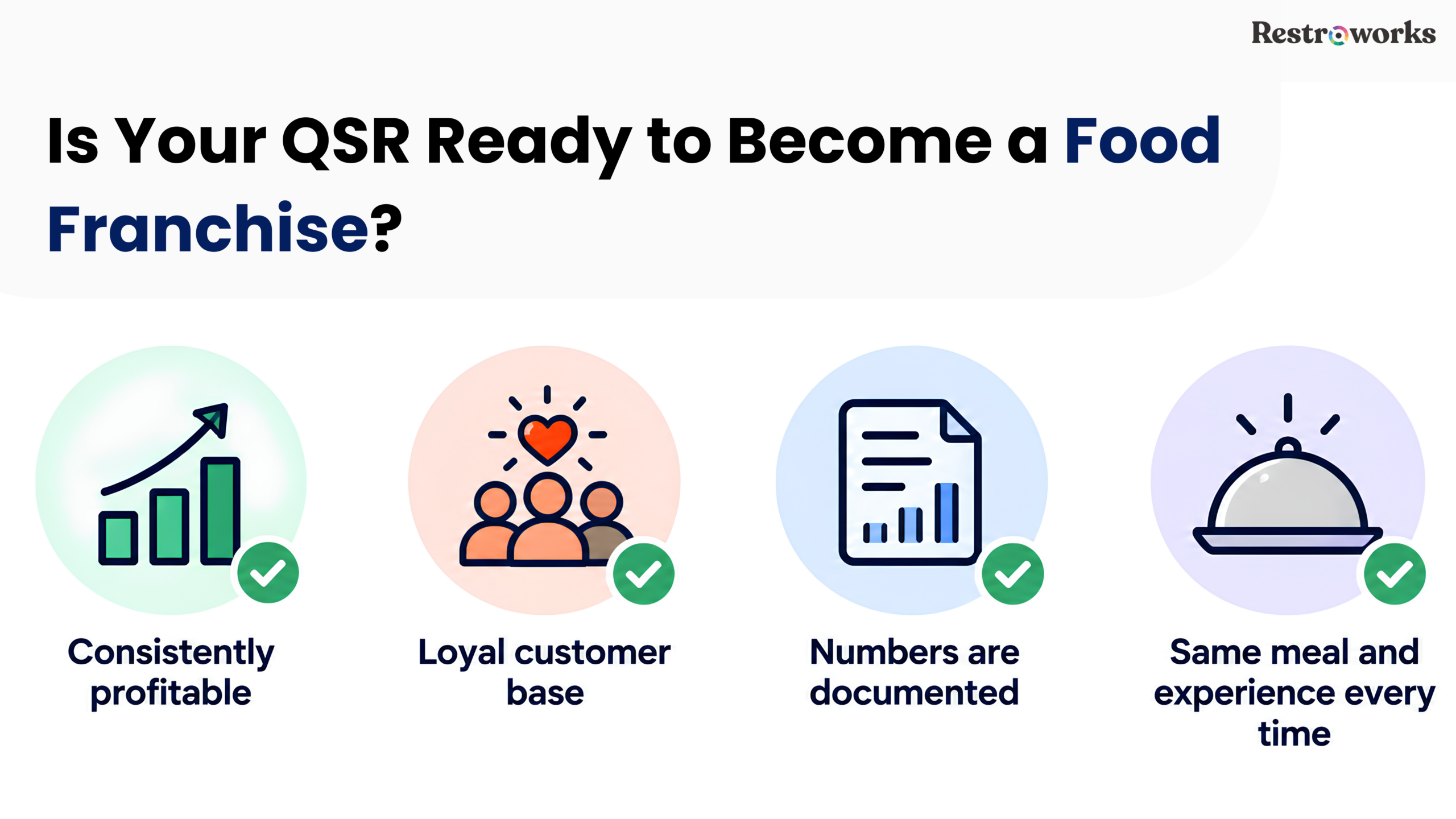
Is Your Fast Casual Restaurant Ready to Become a Food Franchise?

Your fast casual restaurant is ready to become a food franchise when it has been consistently profitable, has a loyal customer base, its numbers are documented, and customers get the same meal on days you aren’t there. If any of those is shaky, fix it before you sell a single unit.

Start by reviewing sales trends, profit margins, food costs, labor costs, and daily operating routines at your existing location. A proven concept should operate profitably before franchising (franchise attorneys at Hall Estill point to several years of a profitable model as a prerequisite), and the business must be able to operate effectively without the founder’s daily presence for scalability. If your restaurant still depends heavily on your daily involvement and long hours, strengthen the systems before you offer a franchise opportunity.

Standardizing Kitchen Equipment, Menu, and Store Format

To standardize your concept, lock down the ideal store size, kitchen equipment list, staffing plan, menu structure, service flow, and daily sales targets so every location can prepare food the same way and customers taste no difference.

Success in franchising hinges on a highly replicable model that prioritizes speed and consistent food quality. Document every process in an operations manual, since a system’s success largely hinges on its ability to offer a consistent customer experience across various locations, which requires a well-documented operations manual for training each franchisee.

Brand identity matters just as much as operations. A strong brand identity enhances customer experience by providing an immersive experience that leaves a lasting impression, which is crucial for attracting both customers and potential franchisees. Protect your franchise brand early, too: federal trademark registration through the USPTO takes roughly twelve months, though you can offer franchises while the application is pending.

In a crowded, highly competitive marketplace, differentiation through a unique identity is key to success, as it helps a restaurant stand out, build brand recognition, and attract potential franchise owners looking for unique opportunities. Creative and innovative restaurant brands are attractive not only to consumers but also to investors, making a unique identity essential for breaking into franchising successfully.

Choosing Sites With High Foot Traffic and Drive-Thru Volume

Choose sites with clear, written criteria: traffic counts, visibility, access, parking, and room for a drive-thru lane if your concept depends on car traffic, so every new restaurant lands where your target audience and customer base already live and customers can find you easily. Every site decision shapes your restaurant’s brand in that market.

Location decisions carry outsized weight in this process. Location is the single most critical success factor in franchising a QSR, requiring clear site selection criteria, particularly for restaurant concepts that depend on high foot traffic or drive-thru volume to hit sales targets. Even fast casual players are building for cars now. For example, Chipotle opened 334 company-owned restaurants in 2025, 257 of them with a Chipotlane pickup lane, and expects about 80% of its new restaurants to include one.

Franchise Fee, Initial Investment, and the Franchise Disclosure Document
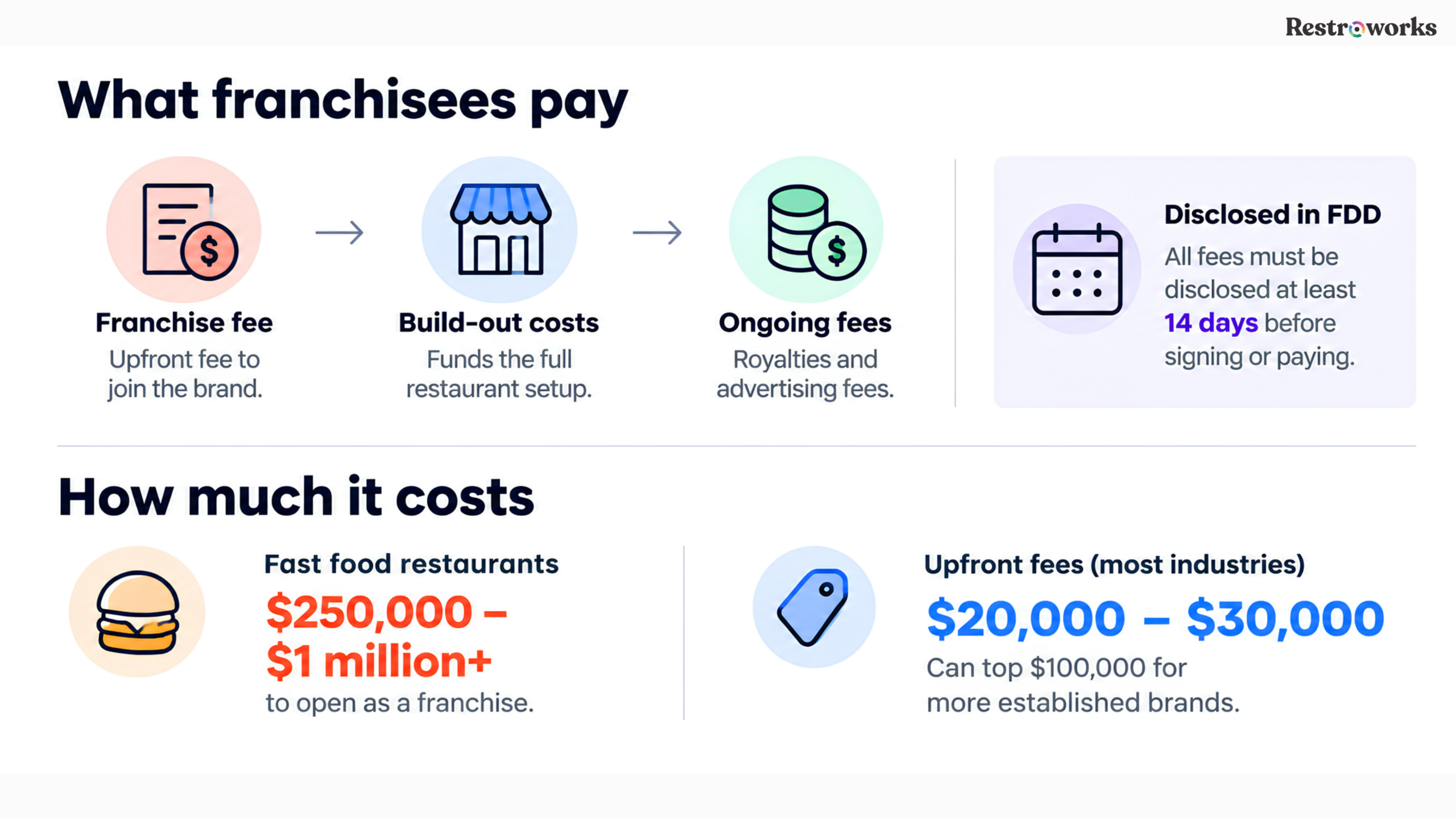
How to Franchise a Quick Service Restaurant - Total investment you'd need to make

A new franchisee pays an upfront franchise fee, funds the full build-out of the restaurant, and then pays ongoing royalties and advertising fees, all of which you must disclose in your FDD at least 14 days before anyone signs or pays.

Once your concept and identity are ready, franchisees need clarity on cost. Fast food restaurants cost from about $250,000 to $1 million or more to open as a franchise, while upfront fees across industries generally run in the $20,000 to $30,000 range and can top $100,000 for more established brands. Startup costs swing on many factors, including real estate, format, and build-out.

Restaurant format Typical startup costs
QSR $150,000-$300,000
Fast casual $200,000-$500,000
Full-service $300,000-$750,000+
Food trucks $50,000-$200,000
Franchise restaurant $250,000-$1,000,000+

Franchise fees are typically included in the total investment startup quote provided by franchisors, and these fees grant access to the brand recognition, training, and support.

In most franchises, ongoing fees include royalties, which often land between 4% and 8% of gross revenue each month, and many franchises add an advertising fund contribution that commonly ranges from 2% to 5%. Plan for those fees in your unit economics, because the Census Bureau found average sales per franchise establishment were $3.5 million, compared to $2.3 million for independent establishments, across the industries it covered in 2017, and buyers will expect your model to justify the premium.

What Does a Fast Food Franchise Cost? Real Brand Examples

The fast food franchise brands your future QSR franchise buyers will compare you against charge initial fees of $10,000 to $50,000, royalties of 4.5% to 6%, and advertising contributions of roughly 4% to 4.75%, with total build-out costs that can run into the millions.

Brand Initial franchise fee Estimated startup investment Royalty Ad fund
Taco Bell $25,000-$45,000 $934,750-$4,310,200 5.5% 4.25%
Burger King $50,000 (20-year agreement) Requires $500,000 liquid assets and $1M net worth 4.5% 4%
Pizza Hut $25,000 $462,000-$2,053,500 6% (6.5% in some cases) 4.75%
Wayback Burgers $35,000 $550,000-$650,000 for a typical restaurant 5% 4%
Chick-fil-A $10,000 Chick-fil-A pays for real estate, construction, and equipment 15% of sales plus 50% of remaining pretax profit N/A

What Must Go Into the FDD?

Your FDD must contain 23 specific items, from your litigation history to your fees and financial statements, and every prospective franchisee must receive it at least 14 calendar days before signing a contract or paying money to the franchisor.

Legal preparation is non-negotiable. You’ll also need a franchise contract covering operating standards, territory rules, renewal terms, and termination provisions.

FDD item What it covers
Item 3 Litigation history
Items 5–7 Initial fees, other fees, and the estimated initial investment
Item 11 Advertising and training
Item 12 Territory
Item 19 Financial performance representations (optional, but any earnings claim must appear here)
Item 20 Franchisee and franchise system information
Item 21 Financial statements

Source: FTC

Franchising a Quick Service Restaurant (QSR) is a strategic expansion that typically takes six to twelve months to launch, so build legal and financial preparation into your timeline early rather than treating it as a final step. Have a business plan and enough capital to carry you through that runway, because the legal work, registrations, and your first grand opening all land before royalties start flowing.

Milestone Typical timing
Franchise development (FDD, agreement, trademark filings, entity, financials) 90–120 days
State registration in registration states 60–120 days
FDD review period for a buyer At least 14 calendar days
Franchisee's path from first contact to opening 6–12 months

Sources: Law firm guide, FTC, Trembly Law

INDUSTRY INSIGHT

The global fast food and QSR market is projected to grow from $321.6 billion in 2026 to $461.7 billion by 2033, expanding at a 5.3% CAGR. Fast casual formats are capturing a growing share of that expansion as customers look for higher-quality ingredients without full-service prices.

Drive-thru service remains a defining feature of growth in QSR restaurants and fast casual chains as customers order from cars and phones, and the evidence is in where big brands put their capital. Take Chipotle, a fast casual chain, which added a Chipotlane to 257 of the 334 restaurants it opened in 2025. In fact, late-night dining is emerging as a standout growth story in limited-service restaurants, with sales climbing more than 10 percent annually since 2021, much of it driven by drive-thru and delivery access rather than dine-in traffic.

Technology is following the same trajectory. Key trends defining food franchising in 2026 include automation and AI integration, delivery-focused operations, and health-conscious menu options, all of which put pressure on QSR franchise systems to run a diverse set of ordering channels on modern technology before scaling to new locations.

Across the restaurant industry, full-service operators achieve 3–8% net profit margins, fast casual restaurants achieve 4–10%, and quick-service restaurants achieve 5–12%, underscoring exactly why and how operational discipline drives long-term franchise profitability.

Training, Technology, and Recruiting the Right Franchisees

To support QSR franchise owners well, give them a POS system that works across locations, comprehensive training before the grand opening, and ongoing support after it, and recruit operators for leadership and local knowledge, not just capital.

A superior POS system is essential for multi-unit operations as it facilitates order processing, inventory management, staff scheduling, and customer relationship management, so you know which customers come back.

Establishing a franchise requires an operational and logistical infrastructure that can meet the demands of multiple outlets, including standardized procedures and effective supply chain management, so review your current tech stack before your first franchised opening rather than after.

Training is equally foundational. Franchise operations manuals are crucial for ensuring consistency across all locations, documenting all aspects of running the restaurant, and providing training for each new franchisee. Tell buyers exactly what they get: the FTC requires franchisors to describe their advertising and training programs in Item 11 of the FDD.

Franchisors should provide ongoing support to their franchisees, including operational training, marketing support, a local marketing strategy for each opening, and ongoing product development to maintain consistency and foster strong relationships.

Support structures often include dedicated roles such as franchise regional managers, marketing leads, and human resources personnel to assist each franchisee in various operational aspects.

Recruiting ideal franchisees, often operators who already run local businesses, typically involves looking for candidates with significant management experience and financial capacity, but capital alone doesn’t make a strong operator. The right candidates bring leadership, local market knowledge, and a willingness to follow your system. Burger King, for example, requires at least $500,000 in liquid assets and $1 million in net worth, while Chick-fil-A sets no net worth or liquid asset threshold at all, relying instead on a famously selective interview process.

The Case for Wayback Burgers: How an Established Brand Packages a Franchise Opportunity

Buyers want evidence of proven success before they sign, and this burger chain shows what a mature franchise opportunity looks like on paper: a signature product, published fees, and a support package spelled out for buyers.

The brand started as a single burger stand in Delaware in 1991 and has grown to more than 170 locations across the U.S. and internationally, built around made-to-order burgers, fresh-cut fries, and hand-dipped milkshakes. Its franchise page lists a $35,000 initial franchise fee, a typical startup investment of $550,000 to $650,000 covering construction, kitchen equipment, signage, and a POS system, a 5% royalty, and a 4% advertising fee split between national and local marketing campaigns. 

The point is buyers aren’t just buying burgers. They’re buying what they hope is a great business opportunity. That is the level of clarity your own offer needs before you pitch a single buyer.

KEY TAKEAWAYS

  • The franchise model distributes the risks of expansion to franchisees, while company-owned chains place the burden on the parent company.
  • QSRs account for roughly one in three U.S. franchise establishments, about 281,000 of 845,000 projected for 2026.
  • Fast food restaurants cost about $250,000 to $1 million to open as a franchise, and real brand investments run from about $462,000 (Pizza Hut’s low end) to $4.3 million (Taco Bell’s high end).
  • Ongoing fees typically include royalties of 4% to 8% of gross revenue, plus an advertising fund contribution of 2% to 5% in many systems.
  • A proven concept should operate profitably before franchising, and the business must run effectively without the founder’s daily presence.
  • Launching a QSR franchise system typically takes six to twelve months, including 90 to 120 days of legal development and up to 120 days for state registrations.
  • The FDD must contain 23 specific items, and franchisees must receive it at least 14 days before signing or paying.

Frequently Asked Questions

1. How much does it cost to open a quick-service restaurant?

An independent QSR typically costs $150,000 to $300,000 to start, while a franchise restaurant usually runs $250,000 to $1,000,000 or more. Major brands require even higher upfront investment. For example, Taco Bell’s estimated startup investment ranges from $934,750 to $4,310,200, depending on real estate, kitchen build-out, and fees.

2. Can you own a Chick-fil-A for $10,000?

No, you can not own a Chick-fil-A for $10,000. Chick-fil-A’s franchise model is unusual: the upfront fee is famously low at $10,000, but the company pays for the real estate, construction, and equipment and leases everything back to the operator for 15% of sales plus 50% of the remaining pretax profit, so the operator never owns the building or the business outright. Chick-fil-A has said it doesn’t set net worth or liquid capital thresholds, but operators must clear a highly selective process.

3. Should you hire a franchise attorney before signing a QSR agreement?

Yes, you definitely should. The franchise contract defines fees, territory rules, renewal terms, and termination provisions, and the FDD alone must contain 23 specific legal items. The FTC’s own cover-page language tells buyers to show the contract and disclosure document to an advisor such as a lawyer or accountant. Reviewing these documents with an experienced franchise attorney before signing helps prospective franchisees understand their obligations and avoid unexpected expenses down the line.

Newsletter subscription banner

Talk to a restaurant expert today and learn how Restroworks can help your business.

Request Demo >

Share

Discover More Insights to Power Your Journey

Sharing the Love, One Taco at a Time: Eric Knott on Scaling TikiTaco the Right Way

Ask Eric Knott, CEO of TikiTaco, what business restaurants are really in, and you’ll get an answer that has evolved…

POS
Best Restaurant POS Software in Qatar
Best Restaurant POS Software in Qatar for Every Type of Restaurant

During a Friday dinner rush in Doha, the Talabat tablet at the pass is often where service breaks down: orders…

How to Start an Ice Cream Truck Business in the US

No other business out there can combine nostalgia with profit as well as an ice cream truck does. Like, it's…

Customer Review Strategy for Restaurant Franchises: Build Trust & Boost Local Reputation

A single bad shift can live online forever. A single great one can, too. That is the reality every restaurant…

Franchise Restaurant Business Plan: A Complete Guide to Launch & Scale Successfully

In short: A franchise restaurant business plan is the document that proves to a lender and a franchisor that your…

Real-Time Analytics for Restaurant Franchises: Smarter Insights for Faster Decisions

Real-time analytics for restaurant franchises gives owners and franchisors live data on sales, labor, inventory, and guest activity across every…

Join. Learn. Grow.

Sign up to receive the latest hospitality insights and stories straight to your inbox

Streamline your operations with Restroworks