


If you don’t buy even an ice cream without checking its price, it’s only logical for you to have a full understanding of how much does it cost to open an ice cream shop (literally, a full-on ice cream shop) before you actually get into the business side of things. And hence this article.
What You’ll Learn
- How Much Does It Really Cost to Open an Ice Cream Shop?
- Learn how much an ice cream shop can earn and what drives profitability.
- Discover how to budget, choose the right location, secure permits, and launch a successful business.
Ice Cream Shop Startup Costs by Business Model – How Much Will It Cost You?
As per data across the internet, opening an ice cream shop typically costs between $50,000 and $250,000, depending on the location, shop size, and whether ice cream is produced on-site.
Here, any small scoop shop that requires minimal seating and uses pre-made products will be much closer to the lower end of the range, while a full-scale artisan shop that makes its own ice cream on-site will be towards the upper end…and maybe sometimes even past it if you add to it the costs related to production equipment and build-out.
Similarly, if you’re running a brick-and-mortar ice cream store, it will obviously cost more upfront than a mobile truck, a kiosk, or a cart, because then you’ll have to bear the cost of a full build-out, lease, equipment, etc.
Thus, based on what business model or format you choose, or where your shop is located, or how much of the overall production process you handle yourself, the total startup cost will vary accordingly.
What Is the Real Total Budget You Need to Have Ready?
The total startup budget required to open an ice cream shop is a minimum of $669,000. This includes:
- Capital expenditures
- Pre-opening costs
- Initial stock
- A necessary cash buffer
A well-planned budget will give you enough room to deal with unexpected expenses, sustain the business through its early months, maintain healthy cash flow, and eventually grow.
Where Does the Money Actually Go When You Open an Ice Cream Shop?
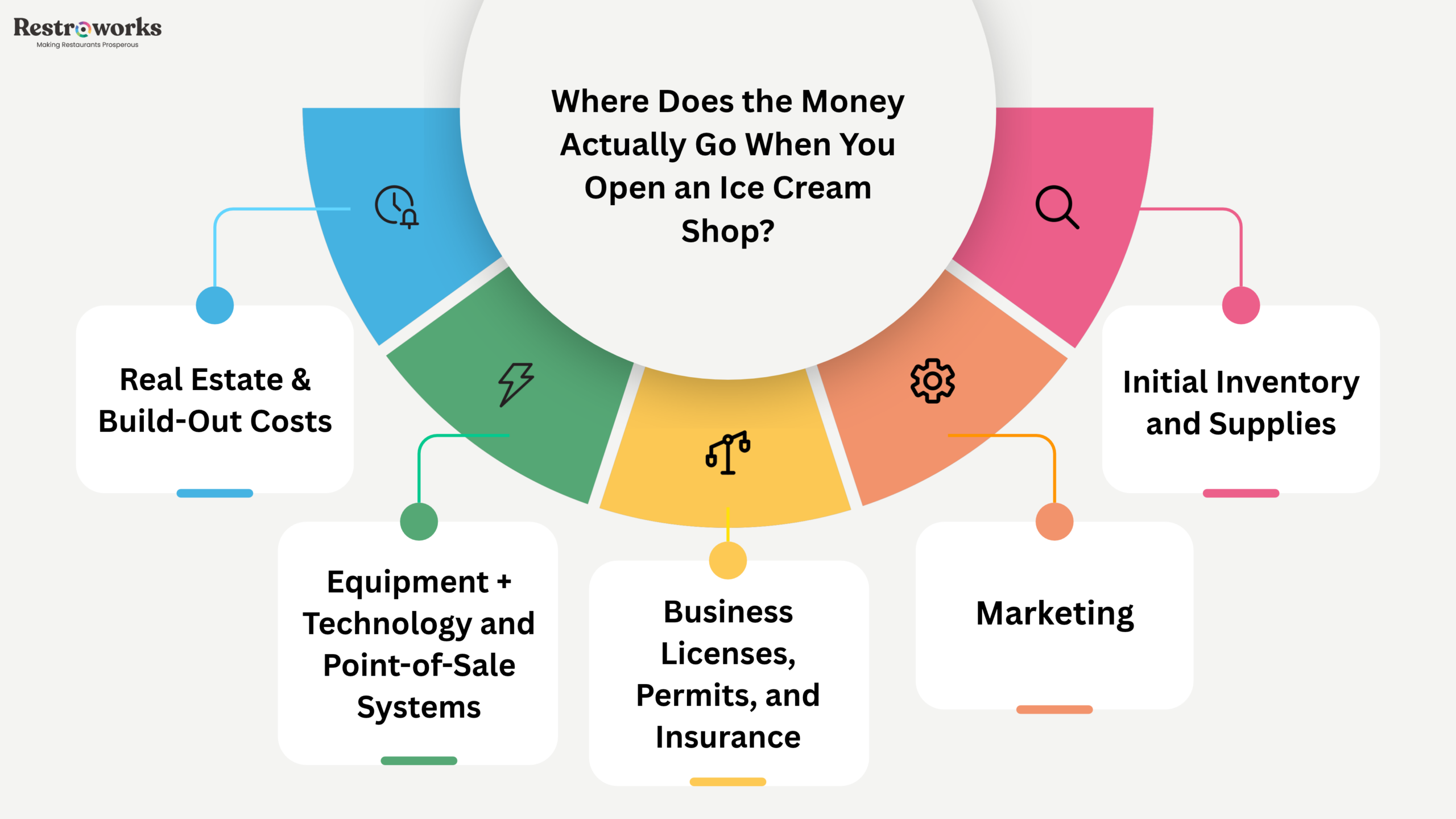
A few key areas where you can expect to spend most of your money are:
#1: Real Estate & Build-Out Costs (Lease vs. Gross Sales)
Monthly lease payments for a good location or a hot spot range from $500 to $15,000 depending on where you are; however, in any case, reasonable lease terms should not exceed 12% of your projected gross sales. On top of the lease, you’ll need to pay a security deposit, usually one to three months, plus leasehold improvements.
| Item | Cost Range |
|---|---|
| Security deposit | 1–3 months' rent |
| First month's rent | $500 – $15,000 |
| Leasehold improvements | $10,000 – $150,000 |
| Property/van purchase | Varies widely |
Similarly, there’ll be build-out costs that include plumbing, electrical, flooring, counters, sneeze guards, architectural drawings, or whatever fittings you’ll need to have done so the space is “workable.”
#2: Equipment Costs by Production Method
To start an ice cream shop, you’d need a few essential pieces of equipment like ice cream makers, commercial freezers, refrigerators, and mixers, plus kitchen appliances like blenders and scoopers.
| Equipment | Cost Range |
|---|---|
| Commercial batch freezers | $700 – $25,000 |
| Commercial gelato machines | $1,000 – $22,000 |
| Soft serve machines | $3,500 – $20,000 |
| Commercial chest freezers | $400 – $16,000 |
| Ice cream display freezers | $500 – $8,000 |
| Dipping cabinets | $800 – $42,000 |
| Milkshake machines and small equipment | $500 – $5,000 |
| POS system | $1,500 – $7,000 |
The cost of specialized kitchen equipment for an ice cream shop can be super high, with estimates around $120,000 for essential machinery needed for production, like for those shops that are making their own ice cream, gelato, or Italian ice in-house instead of buying them wholesale.
#3: Business Licenses, Permits, and Insurance
To operate an ice cream shop, it is your foremost duty to research and obtain all the necessary permits and licenses. This will include –
- A Business License
- Employer Identification Number (EIN)
- Health & Food Safety Permits
- Seller’s Permit for collecting sales tax, etc.
| Permit | Typical Cost |
|---|---|
| Business License | $15 – $400 annually |
| EIN | Free |
| Health & Food Safety Permit | $100 – $1,000 annually |
| Seller's Permit | Usually free, may require a deposit |
Keep in mind that licenses and permit requirements for ice cream shops can vary a lot from one location to another. This is because local regulations tend to influence or dictate the necessary compliance measures for food safety and business operations that you should be following, so I’d always suggest that you check with your local health department directly, because again, failure to secure the required licenses and permits for an ice cream shop can result in significant fines or even the closure of the business by local authorities.
And especially because you’re handling dairy products daily, a health inspector might look at your temperature logs and storage as well.
#4: Initial Inventory and Supplies
Initial inventory is whatever ingredients like cones, cups, toppings, syrups, and packaging materials you’d need as soon as you start your ice cream parlor. To buy all this, you would need a budget of around $5,000 to $20,000.
| Category | Cost Range |
|---|---|
| Base ingredients (cream, milk, sugar) | $2,000 – $8,000 |
| Flavoring agents and mix-ins | $1,000 – $5,000 |
| Packaging (cups, cones, containers) | $1,000 – $3,000 |
| Serving supplies | $500 – $2,000 |
| Cleaning supplies | $500 – $2,000 |
Based on what you’re planning to sell, be it just classic ice cream or with frozen yogurt, gelato, Italian ice, etc., sit down with your team and write down every single ingredient you would need for it, and then budget accordingly.
#5: Technology and Point-of-Sale Systems
If you have a reliable POS system in your tech stack, it will help you manage orders, track inventory in real time, record every sale, generate business reports, etc. Plus, most modern say POS software can even work offline for certain hours (and days) and is hardware agnostic too. They come with AI capabilities to make your work even simpler. You can expect to spend somewhere between $1,500 and $7,000 for a complete POS setup, which will include hardware (if any), printers, card readers, etc.
#6: Marketing (Grand Opening + Pre-Launch)
See, if no one knows about your brand or if you’re open or where you are, no matter how much you spend on interiors or ice cream…it’s useless. And that’s why you need to start your marketing campaign at least 30 to 60 days before your grand opening. You can hop on social media, reach out to local press, and offer pre-opening promotions to build awareness, attract new customers, and maybe even lay the first brick to build a loyal customer base.
| Item | Cost Range |
|---|---|
| Website development | $500 – $1,000 |
| Initial advertising campaign | $1,000 – $7,000 |
| Grand opening event | $500 – $3,000 |
| Signage | $500 – $5,000 |
| Branding materials | $500 – $2,000 |
Create a very simple marketing calendar, and make sure your brand voice, your signage, and whatever you post on your social media all sell the same story about who you are and why customers should pick you over any other ice cream business as such.
Post-grand opening, go all in with loyalty programs, seasonal promotions, and maintain a strong digital presence to keep customers coming back.
Train every employee to sell and upsell on toppings or bigger-size scoops.
#7: Hidden Costs
Initial running costs for an ice cream shop include rent, utilities, repairs, salaries, and other recurrent expenditures, which should be factored into the startup budget.
Plus, you should budget separately for payroll, uniforms, staff training, insurance, a repair fund, etc., during your first month or two.
Do You Actually Need a Written Business Plan?
Yes, you absolutely should have a well-documented business plan. And it should include every little detail about –
- Executive summary
- Your business concept and vision
- Company description and legal structure
- Market and competitor analysis
- Target audience
- Menu and pricing strategy
- Brand positioning
- Location
- Marketing and customer acquisition plan
- Daily operations plan
- Management and staffing structure
- Supplier and inventory plan
- Technology stack (POS, online ordering, accounting, etc.)
- Startup costs and funding requirements
- Revenue projections, operating expenses, cash flow, and break-even analysis
- Your growth strategy and future expansion plans
You should include your detailed staffing plan here (you may create a separate doc for it too) that includes details like your hiring process, staff retention strategies, training modules you provide to your new staff on food safety, customer service, workplace policies, and more.
What Are the Monthly Running Costs Once You’re Open?
Once you’ve finally opened your ice cream shop, your monthly operating budget would account for rent, utilities, ice cream ingredients, wages, insurance, taxes, license renewal fees, POS charges, supplies, and marketing, all of which repeat every month.
Is the Ice Cream Business Actually Profitable?
Yes, if you look at the overall ice cream industry, it is projected to reach approximately $132.32 billion by 2032, at a compound annual growth rate (CAGR) of 6.65%.
Plus, Ice cream shops typically have gross profit margins of 60-80% on house-made products and 40-60% on purchased wholesale products.
Well-managed ice cream shops can achieve net profit margins of 18-20% of total revenue. Very few food businesses hit those numbers consistently, which is exactly what makes an ice cream business profitable.
INDUSTRY INSIGHT
If you ask about whether an ice cream business is profitable or not, anyone would say it’s promising. For example, if you look at the global ice cream market, it was valued at $82.70 billion in 2025 and is projected to reach $151.96 billion by 2034, which is an 84% increase, and that’s HUGE. There will be a steady (or even growing) demand for ice cream in the future as well.
On the staffing side, too, data shows that the median hourly wage for food and beverage serving workers was $14.92 in May 2024, with roughly 1,159,600 job openings in the category.
For anyone weighing startup costs against long-term potential, this kind of sustained growth is exactly what works as a guarantee, and that’s why so many owners still see launching a new ice cream shop as a smart bet.
How Much Does an Ice Cream Shop Make in a Day?
How much exactly you’re going to make in a day depends so much on weather, location, advertising, and your product quality. Still, a well-established and managed ice cream shop should make between $1,000 and $3,200 a day.
Zoomed out to a full year, a single ice cream shop location is likely to return between $30,000 and $60,000 annually in profit.
Eventually, what an ice cream shop makes depends entirely on:
- How many customers you serve
- How much each customer spends, and
- How tightly you control costs.
Where Should You Locate Your Shop?
This is kinda obvious – the ideal location for any business that depends on foot traffic is a high-traffic area. Same goes for an ice cream shop as well. What are high-traffic areas? It can be at a beach, a park, a market street, or any entertainment venue that attracts a lot of people almost every day. Because people tend to make impulse purchases, and ice cream is something that almost everyone loves, foot traffic should definitely be your top concern when you’re looking for a good spot for your business. The
How can you find such a spot? Conduct market research to understand the demographics and preferences of the local population. Look at who lives nearby, who visits nearby, and what they’re already spending money on. Define your target market early, whether that’s families, teenagers, or tourists, since it shapes your menu, your pricing, and how you attract customers once you’re open.
Analyzing competitors in the area helps in understanding the market landscape and can inform the selection of a location that fills a gap in offerings or services. If every shop within a mile already sells the same classic ice cream flavors, think about what gap you can fill instead.
What Should Your Ice Cream Shop Menu Include?
You see, there are some classic flavors like vanilla, chocolate, and strawberry – you can go about them with your eyes closed, and they will still drive the bulk of your sales. In fact, if you don’t have these basic flavors that customers expect from every ice cream shop menu, you’re kinda losing. But again, yes, vanilla/chocolate/strawberry cookies and cream can round out the core lineup; you’d still need to experiment to stand out. Like, you offer –
- Seasonal drinks, like if it’s spring season, cherry blossoms are gold. If it’s autumn, try a pumpkin pie. Let me tell you, customers love it when you offer something new, especially when they can click a quick selfie and flex online.
- Include one or two signature house specialties
- Frozen yogurt and dairy-free options
- Italian ice or gelato
- Milkshakes made using dedicated milkshake machines
- Toppings and mix-ins with strong margins
Keep your menu very small (or no, small may not be the right word – but focused). Keep your menu focused and price every item at 20% product cost against sale price. Also, don’t forget to train your employees so they know the exact sugar content and allergen details behind every item. This way, if a customer asks for something specific, you can be sure that they are answered correctly.
Remember: Consistent flavor quality, clearly labeled menu items, and confident employees who’ve been through proper training all shape how customers remember your shop, sometimes more than the space or the decor around them.
How Do You Secure Funding for Your Ice Cream Shop?
First of all, it’s not like you have to have only one source of funding. You can combine some of your personal funds (your own savings, or you can ask for the same from your friends and family) with small business loans (including options through the Small Business Administration), crowdfunding, and equipment financing.
Whatever mix you choose, make sure your funding covers your cash buffer and not just the equipment and build-out.
KEY TAKEAWAYS
- Startup costs of an ice cream business (or basically any business, for that matter) include the costs you’ll need to secure permits, business licenses, insurance, a physical location, inventory, advertising, plus working capital you would need to get through the first few months and maybe even slower months, too.
- A pos system, steady inventory management, and a focused set of menu items keep things running once revenue starts flowing in after you launch.
- How you market your brand, what exact concept you choose to go with, and most importantly what your USP is – like, what do customers remember you for – all three of these factors shape how your store will be perceived by your target audience on the day and after the day of launch.
- How much an ice cream shop makes in a given month depends on traffic, pricing, permits, and how tightly you control costs.
- An ice cream shop requires a variety of tools and supplies, including scoopers, spoons, and knives. Plus, permits, a business plan, and quality equipment are just as important, and this holds whether you’re running a cart or a full store.
- Ice cream shop equipment and soft serve machines account for a big chunk of your initial cost, and how much you spend here will vary based on whether you make ice cream on-site or buy it wholesale.
Frequently Asked Questions
1. How long does it take for an ice cream shop to break even?
Well, as per industry standards, it takes about 12 to 24 months for an ice cream business to break even. But, again, this too would most probably depend on your startup costs, how much crowd you receive per day, and how tightly you can manage your budget. If you own a shop in a high-traffic area and are able to market it really well, you will be able to break even faster. On the other hand, if you only depend on seasonal sales and have no diverse revenue stream, it will take you a lot longer to see steady revenue.
2. What are the biggest revenue drivers for ice cream shops?
Honestly, there are two factors that have the most impact on how much you’ll be making: location and repeat customers. For the best location, you’ll need to do a lot of research. Like, you may have to physically visit every spot and see how the traffic is there…and whether that traffic has potential to turn into customers. To make sure your customers come back again and again, first – offer the best ice cream you can. Offer variations with exciting toppings, mix-ins, and even a bigger scoop size if the cost allows. Consistent marketing both online and offline too will keep you at the top of your customers’ minds as well as their Instagram feed.
3. Is it worth it to open an ice cream store?
Worth it or not, I’d say ice cream businesses do carry strong margins, and this industry seems very promising too – the sector keeps growing every year. But, again, just like opening any business, making your name in this industry too requires real commitment. You’ll need to invest a lot of money; you’ll need to research a lot, secure permits, manage employees, look for diverse sources of income, market your business, and more. If you’re up for all this, then it’s worth opening an ice cream store.
4. What are the main risks of opening an ice cream shop?
The biggest risk is going through seasonal dips, and you can’t do anything about it except look for other sources of income besides ice cream sales. Other risks may be rising costs, equipment breakdowns, not having a clear business plan, cash buffer, etc.
5. Is it cheaper to buy or make your own ice cream?
Of course, buying wholesale ice cream is much cheaper no matter what angle you look at it. Making your own ice cream in-house, on the other hand, means you’ll need all the ingredients, you’ll need proper equipment to make it, you’ll need a specialized team to do so, and so much more. But yes, you do get control over everything, at least, so depending on how hands-on you want production to be, you can make your call.
6. How long does it take to open an ice cream shop from start to finish?
It may take you somewhere between 6 and 12 months, to be honest. Within this timeframe, you’d have to sign a lease, open a business bank account, secure permits, look for proper build-out, equipment delivery, etc. I’d suggest you plan your schedule so you already have some extra days because you never know when there will be health inspections, and how much time licensing paperwork might take, which might cause unpredictable delays.
7. Do I need experience to open an ice cream shop?
No, you don’t necessarily have to have experience to open an ice cream shop. In fact, there are so many first-time owners who build really great/thriving businesses by having a strong business plan, hiring experienced employees, and learning while on the job. What matters more is being willing to create real systems and create good habits early, not just loving ice cream.