

What Makes Successful Ice Cream Franchises: A US Owner's Guide

What Makes Successful Ice Cream Franchises: A US Owner’s Guide

Home / Blog /
What Makes Successful Ice Cream Franchises: A US Owner’s Guide

Read summarized version with

The ice cream franchise industry might be one of the most promising segments in the overall food franchising sector. Why do we say that? Because if you go by industry data, the ice cream franchise market is expected to grow to USD 30 billion by 2035. Just last year, it was valued at USD 16.3 billion. So basically, between 2025-35, we’re expected to see a solid 6.4% CAGR, and the reasoning behind this growth is two trends:

  1. More and more consumers now prefer premium and artisanal experiences because why not? As people’s disposable income rises, so does their desire for premium stuff – of course, same goes for ice creams too.
  2. Most of them now seek health-conscious options. They especially look for labels like dairy-free, low-sugar (or no sugar, that’s even better), and check if it has organic flavors. 

As for the operators, ice cream franchises offer relatively low barriers to entry (i.e., you need an initial investment of only $50,000-$500,000) compared to other similar food concepts that cost much more. 

So, whether you’re looking to open a premium gelato shop or a cute little family-friendly ice cream parlor, this guide will walk you through what some of the successful ice cream franchises do to succeed and what you should look for when you are signing a franchise disclosure document.

What you’ll Learn

  • What are leading ice cream franchises doing differently to stand out in the market?
  • What does an initial investment and franchise fee actually cover?
  • How have brands like Cold Stone Creamery, Baskin-Robbins, and Dairy Queen built loyal customer bases?

How Big is the Ice Cream Franchise Industry Right Now?
How Big is the Ice Cream Franchise Industry Right Now?

Believe it or not, time and again, ice cream has proven to be one of the more durable categories in food and beverage franchising. 

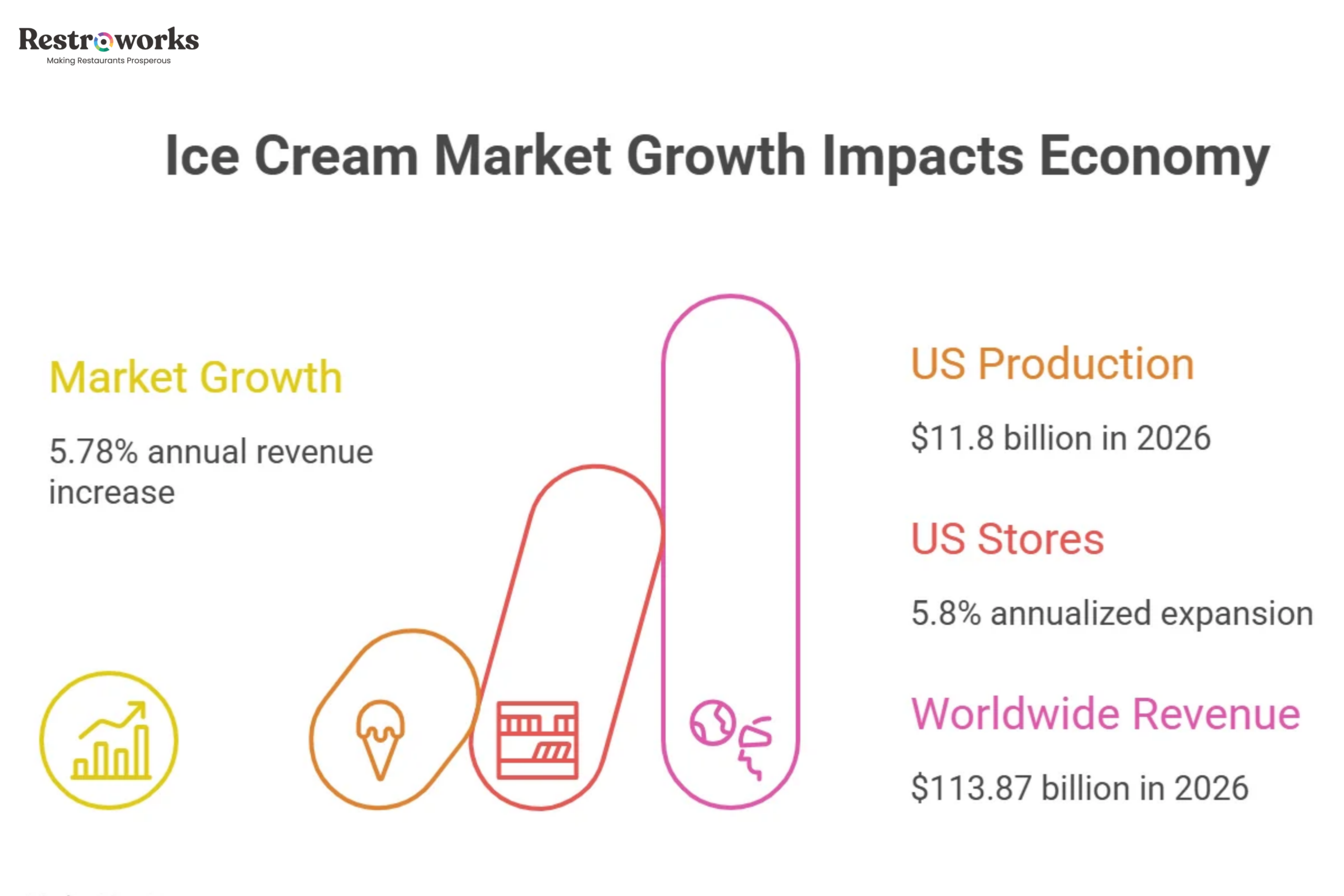
We already mentioned its global market size above, and beyond that, if you look at the ice cream production industry in the US, let’s say, that too seems very promising at $11.8 billion in 2026. Plus, data shows that the ice cream stores industry has grown at an annualized rate of at least 5.8% over the past years. In 2025, it was valued at $7.4 billion. Worldwide revenue in the ice cream market amounts to $113.87 billion in 2026 and is expected to grow annually by 5.78% through 2031.

The ice cream chain stores market alone was valued at $42.8 billion in 2025 and is projected to reach $72.6 billion by 2034, and franchise employment overall is anticipated to grow by more than 150,000 jobs in 2026. While this is all very, very technical right now… that’s proof of how big the ice cream sector is right now and what the future looks like. Basically, what we mean to say is if you have been seeking any F&B-forward franchise opportunity, you should definitely consider ice cream, as its demand seems pretty steady, brand loyalty runs deep, and we don’t see any sign of saturation for at least the next few years. 

What Makes Your Beloved Ice Cream Brand Stand Out?

Truth be told, we all have that one ice cream brand we absolutely love. But have you ever thought about what makes it so special that not only us, but it is a go-to choice for so many people? Like, at the end of the day, an ice cream is an ice cream, no?

Well, most successful ice cream franchises sell – 

  • Unique experiences
  • High-quality ingredients
  • Strong brand recognition

We don’t just choose one brand for a flavor but everything that comes along with it. On any given day, we’d choose a franchise that goes big on interactive customer experiences. For example, mix-ins or live counters tend to see really high customer satisfaction. The same is true for shops that lean into premium and artisanal positioning that could justify their high price too.

Take Cold Stone Creamery as an example. The brand opened its first franchise back in 1995. Today, it runs approximately 1,300 locations across 47 states and 16 countries, and it was only possible because they chose to build their entire identity around an experiential, entertainment-focused model. What they do is mix their ice cream on a frozen granite stone right in front of the customers.  

Also, there are so many studies that state that variety is an important driver of ice cream preference across different markets, with both complexity and variety ranking highest in consumer preference. This means offering a mix of classic favorites and unique signature flavors, alongside diet-friendly options like vegan and low-sugar alternatives, helps reinforce a brand’s commitment to sticking to quality. 

How Much Does It Cost to Open an Ice Cream Franchise?
How Much Does It Cost to Open an Ice Cream Franchise?

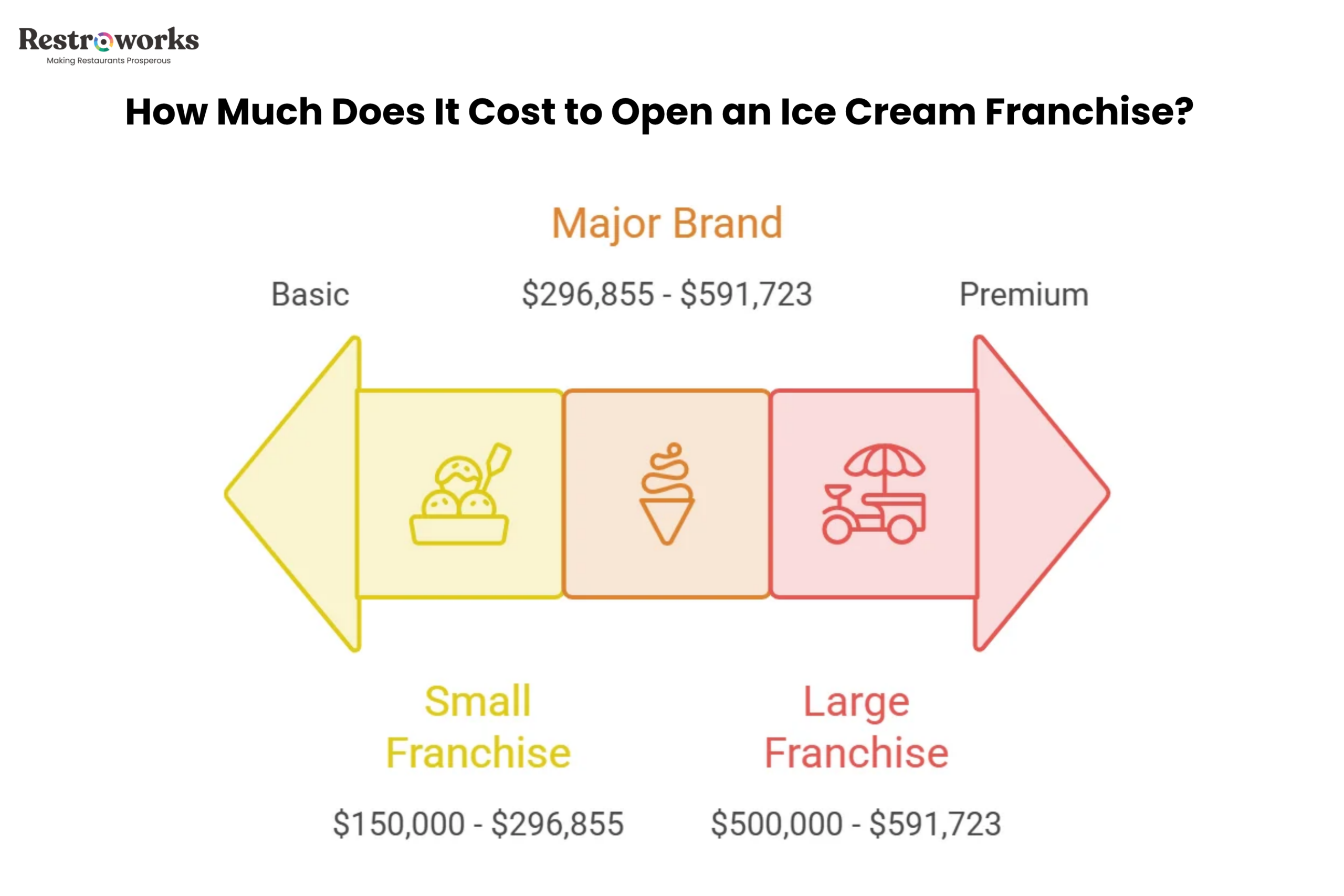
Honestly, the range is wide. In general, the total investment prospective franchisees should need to make to open an ice cream franchise is between $150,000 and $500,000, depending on the brand you’re targeting and its size. 

Some of the major ice cream brands out there require an initial investment of somewhere between $296,855 and $591,723. The exact number will, of course, be influenced by factors like the format of the business and your equipment needs.

Mind that this investment will cover – 

  • Franchisee fee
  • Build-out cost
  • Equipment
  • Initial inventory
  • Working capital

Every franchise disclosure document has a clear breakdown of how much investment you’d need to make for each category above…so please read that through and through before doing the final paperwork. 

Compared to many restaurant concepts, ice cream franchises still can be considered a much more affordable entry point into food franchising, especially because they come with lower overhead costs and a smaller footprint. 

What do Leading Ice Cream Franchises Do Differently?

If you look at the cream of the cream in ice cream franchise brands, you’ll see how each of them has a very distinct business model built around their specific USP. They tend to double down on their strengths. Let’s take some examples:

Cold Stone Creamery built its brand on experiential retail. As we’ve already covered this above, the frozen granite stone mixing process is the differentiator, and the franchise system has scaled it internationally.

Baskin-Robbins has built its identity around variety. It is historically known for rotating flavors and a broad permanent menu, and they do introduce any new item after months of dedicated consumer research. 

Dairy Queen diversified very early on by pairing soft serve and frozen treats with a broader food menu, which helped them offset the seasonality that pure ice cream shops often struggle with.

Many ice cream franchises now follow this exact same strategy – they diversify their menus with items like coffee and hot beverages so when there is a high chance that foot traffic or demand for ice cream drops in winter, there’s still a good enough reason for customers to come back.

And the most important thing, other than employing these strategies, most successful brands tend to do is be operationally consistent. 

Because customers expect the same taste and portion size across locations, franchisors that protect that consistency through comprehensive training and clear operational guidelines are always able to stand out and build the strongest loyal customer base over time.

INDUSTRY INSIGHT

Amy’s Ice Creams grew net income by 150% over a decade after implementing an open-book management framework that aligned every employee around a shared financial goal, turning staff into invested partners in the shop’s performance rather than just hourly workers.

Financing has also proven to be a common bottleneck for franchisees looking to scale beyond a single unit. One Ben & Jerry’s multi-unit franchisee scaled from a single bootstrapped shop to 24 units by partnering with a franchise-specific lender, describing the difference plainly: “They are very solution-oriented and passionately connected to our business success.”

Not every story is a straight line. There’s a Harvard Business School case study that documented how Ample Hills Creamery, which, btw, is a multimillion-dollar ice cream startup, went through a massive failure before it could rebound under new ownership. This time, they focused on more sustainable growth rather than blindly scaling.

What Menu Strategies Keep Customers Coming Back?

Ice cream is often an impulse purchase, which makes visibility and easy accessibility significant for sales volume, but the menu itself still matters for turning a first-time customer into a repeat one. Offering a mix of classic favorites and unique signature flavors can keep an ice cream menu exciting without alienating customers who just want a reliable go-to order.

A few patterns show up repeatedly among top performers:

  • Rotating seasonal specialties and local flavors to create a reason to return
  • Dietary-friendly options, including dairy-free and low-sugar alternatives, to broaden the customer base
  • Ice cream cakes and other bundled products to lift average ticket sales beyond a single scoop
  • Digital ordering and mobile apps to meet rising demand for convenience

Any store that goes really big on providing customizations and niche products to its customers sees higher average ticket sales per customer. When we say customization, we are referring to mix-in concepts and build-your-own formats…try to scale such unique concepts (research your own too) whenever possible. 

How Much Can an Ice Cream Franchise Owner Expect to Earn?

See, we’re going purely by what industry estimates say – Ice cream franchise units generate annual revenue of somewhere between $200,000 and $700,000, and one can easily expect profit margins of 20 to 30%. Sounds great, right? These margins are especially meaningful when it comes to appealing to entrepreneurs who want a proven system with predictable unit economics. 

Mind that it is very important to keep track of franchise-level customer engagement. Plus, you should know that the average Net Promoter Score for ice cream franchises is super excellent when it exceeds 30%, and if it can reach even higher, let’s say, 50%, that will be proof of your exceptional customer loyalty and satisfaction. The number of Google reviews you get on your outlet page also works as a real-time indicator of how your franchise is performing. 

What Support Should Franchisees Expect from a Franchisor?

Of course, every franchise needs at least some kind of operational support from their franchisor. This may include comprehensive training and ongoing support – both are really, really important for operational success in the ice cream franchise industry. 

Many ice cream franchises also help with marketing so as to help franchisees attract customers and build brand recognition in their local markets from the get-go. Also, they provide a tech stack like modern POS systems and real-time inventory tracking tools that they might already be using at other locations.

See, when you first made the plan to go with franchising, you should already know that you’ll be getting a proven business model (proven means it has already shown its market presence), plus they are obligated to provide you with full-on operational guidelines too. This will come in super handy for any new franchisee owner who is just starting to gain an understanding of how ice cream shops work. They might also help you with health inspections, staffing, and seasonal demand planning.

What we’d suggest is that when you’re evaluating a franchise opportunity, ask the owner directly how much branding support and continuous innovation they can provide you. 

What Should Prospective Franchisees Look for Before Signing?

Finally, you’re so close to signing the final agreement, and of course, you’ll need to pay a franchise fee at this step too. But before you do that, prospective franchisees (YOU!!) should look at a few things (yes, you’d need to look past the famous brand name) – 

  • Proven track record across every existing location they operate at
  • How transparent they are with every term in the franchise disclosure document
  • Their gross sales figures – that too, for units that are similar to yours, maybe in terms of size and how much foot traffic the area may expect
  • And what kind of and level of operational support can your franchisor give today and anytime in the future if the situation ever calls for it

If you want to make real profit out of ice cream franchises, you should always prioritize being at high-traffic locations, and that is why site selection is so important. And because ice cream culture varies by region, from ice cream-obsessed states like Rhode Island to smaller markets in South Dakota and North Dakota, you should factor in local demand and competition when doing site selection.

KEY TAKEAWAYS

  • Back in 2025, the global ice cream industry was valued at USD 16.3 billion. By 2035, it will be USD 30 billion, which is really good growth if you go by the numbers.
  • Similarly, franchised retail ice cream shops will grow to $35.7 billion from $21.3 billion in 2023.
  • Total investment to open an ice cream franchise can be anywhere between $150,000 and $500,000, and major brands even go more specific with a range of $296,855 to $591,723.
  • Ice cream franchise units generate annual revenue of $200,000 to $700,000 and profit margins of 20 to 30%.
  • An NPS above 30% is excellent for ice cream franchises, and scores above 50% tell customers very clearly that the brand has strong loyalty.
  • If you really want to stand out in the market like other best ice cream franchises out there do, it would be really useful if you can stick with consistency, use quality ingredients, and if you can get genuine franchisor support.

Frequently Asked Questions

1. What are the top 5 ice cream franchises? 

While rankings shift year to year, the names that consistently show up among the best ice cream franchises include Cold Stone Creamery, Baskin-Robbins, Dairy Queen, Ben & Jerry’s, and Handel’s Ice Cream. Each has built a distinct business model, whether that’s Cold Stone’s frozen granite stone mixing experience, Baskin-Robbins’ flavor variety, Dairy Queen’s diversified menu, Ben & Jerry’s brand-driven positioning, or Handel’s commitment to fresh daily production since 1945.

2. Which ice cream franchise is best? 

There isn’t a single answer, since “best” depends on your budget, target market, and preferred business model. A lower initial investment and smaller footprint might favor a soft-serve or mix-in concept, while an entrepreneur with more capital and a premium target market might do better with an established, experience-driven brand like Cold Stone Creamery. Reviewing the franchise disclosure document and talking to existing franchisees is the most reliable way to judge fit.

3. What is the ROI timeline for popular ice cream franchises? 

With annual revenue typically between $200,000 and $700,000 and profit margins around 20 to 30%, and initial investments ranging from $150,000 to over $590,000, ROI timelines vary significantly by brand, location, and how quickly a shop builds foot traffic and a loyal customer base. Prospective franchisees should request item 19 (financial performance representations) in the franchise disclosure document to see realistic gross sales and payback figures from existing units rather than relying on general industry averages.

Newsletter subscription banner

Talk to a restaurant expert today and learn how Restroworks can help your business.

Request Demo >

Share

Discover More Insights to Power Your Journey

Sharing the Love, One Taco at a Time: Eric Knott on Scaling TikiTaco the Right Way

Ask Eric Knott, CEO of TikiTaco, what business restaurants are really in, and you’ll get an answer that has evolved…

POS
Best Restaurant POS Software in Qatar
Best Restaurant POS Software in Qatar for Every Type of Restaurant

During a Friday dinner rush in Doha, the Talabat tablet at the pass is often where service breaks down: orders…

How to Start an Ice Cream Truck Business in the US

No other business out there can combine nostalgia with profit as well as an ice cream truck does. Like, it's…

Customer Review Strategy for Restaurant Franchises: Build Trust & Boost Local Reputation

A single bad shift can live online forever. A single great one can, too. That is the reality every restaurant…

Franchise Restaurant Business Plan: A Complete Guide to Launch & Scale Successfully

In short: A franchise restaurant business plan is the document that proves to a lender and a franchisor that your…

Real-Time Analytics for Restaurant Franchises: Smarter Insights for Faster Decisions

Real-time analytics for restaurant franchises gives owners and franchisors live data on sales, labor, inventory, and guest activity across every…

Join. Learn. Grow.

Sign up to receive the latest hospitality insights and stories straight to your inbox

Streamline your operations with Restroworks