


Managing menu updates for franchise locations is one of the most consequential operational challenges in the restaurant industry. A single pricing error or missed update, that too, when multiplied across dozens or hundreds of locations, erodes margins, confuses customers, and exposes the brand to compliance liability.
So, how do you exactly manage menu updates for franchise locations?
The short answer: Centralize all menu data in a single master database, tier updates by type (compliance, pricing, LTO, new items), sequence deployments POS first → digital boards → delivery platforms (except compliance updates, which must reach every channel at once), run a 48–72 hour pre-launch verification gate, and enforce audit trails at every step. The sections below cover each layer in detail.
What You’ll Learn
- How can you tier franchise menu updates (LTOs, pricing, compliance, 86’d items)?
- Which all compliance rules your menu updates must adhere to.
Why Effective Menu Management Matters for Franchise Success
Franchise brands are built on the promise of consistency. But when menus diverge, let’s say, through outdated pricing, missing items, or unauthorized changes, that promise breaks. Every inconsistency surfaces in front of a customer: a price that doesn’t match the app, or an item the board shows but the kitchen can’t make.
A botched rollout wastes signage, forces customer service recovery, strains franchisee relationships, and pushes back the next launch. Delivery menus on DoorDash, Uber Eats, and Grubhub don’t update themselves when the POS changes, so without an integration, every location’s listing on every platform is a separate edit. A single pricing error can lose money on every order for weeks before anyone notices.
Software alone doesn’t fix this: many update failures start with how changes are communicated to franchisees.
Common Challenges of Multi-Location Menu Updates
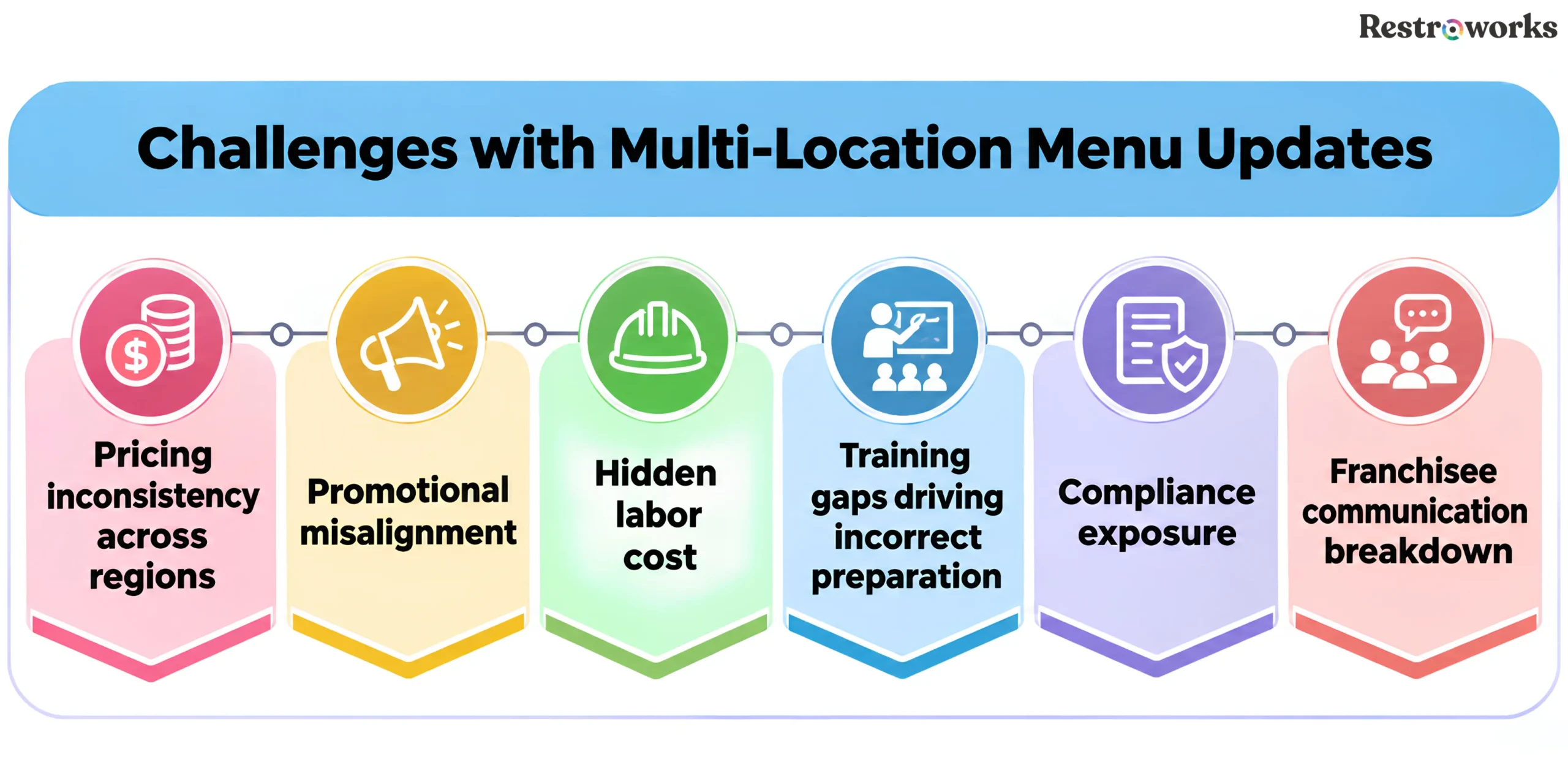
Multi location management breaks down in predictable ways. Franchise restaurant chains face six recurring pain points and each of them compounds the others if left unaddressed.
Pricing inconsistency across regions – Without a system for managing different prices across markets, operators either enforce an unprofitable standard or allow uncontrolled variation that breaks brand consistency.
Promotional misalignment – When a limited-time offer launches nationally, every touchpoint, be it in-store digital menu boards, the branded mobile app, or third-party delivery platforms, must display consistent information on the same date. Manual updates routinely fail this test.
Hidden labor cost – Manual menu management hides its cost in staff time, error correction, reprinting, and coordinating dozens of separate update processes.
Training gaps driving incorrect preparation – Training new items by PDF or email alone leaves room for preparation errors in the first weeks of a launch. The communication workflow is as critical as the technical one.
Compliance exposure – Allergen changes, calorie labeling, and fee disclosure requirements carry legal liability. One missed update on a third-party platform or a menu board creates risk beyond operational inconvenience.
Franchisee communication breakdown – When franchisees don’t understand the business reason for a change (or don’t receive timely, clear instructions) unauthorized substitutions and partial compliance follow. Clear, timely communication prevents many of these problems before launch day.
Types of Menu Updates Franchises Need to Manage
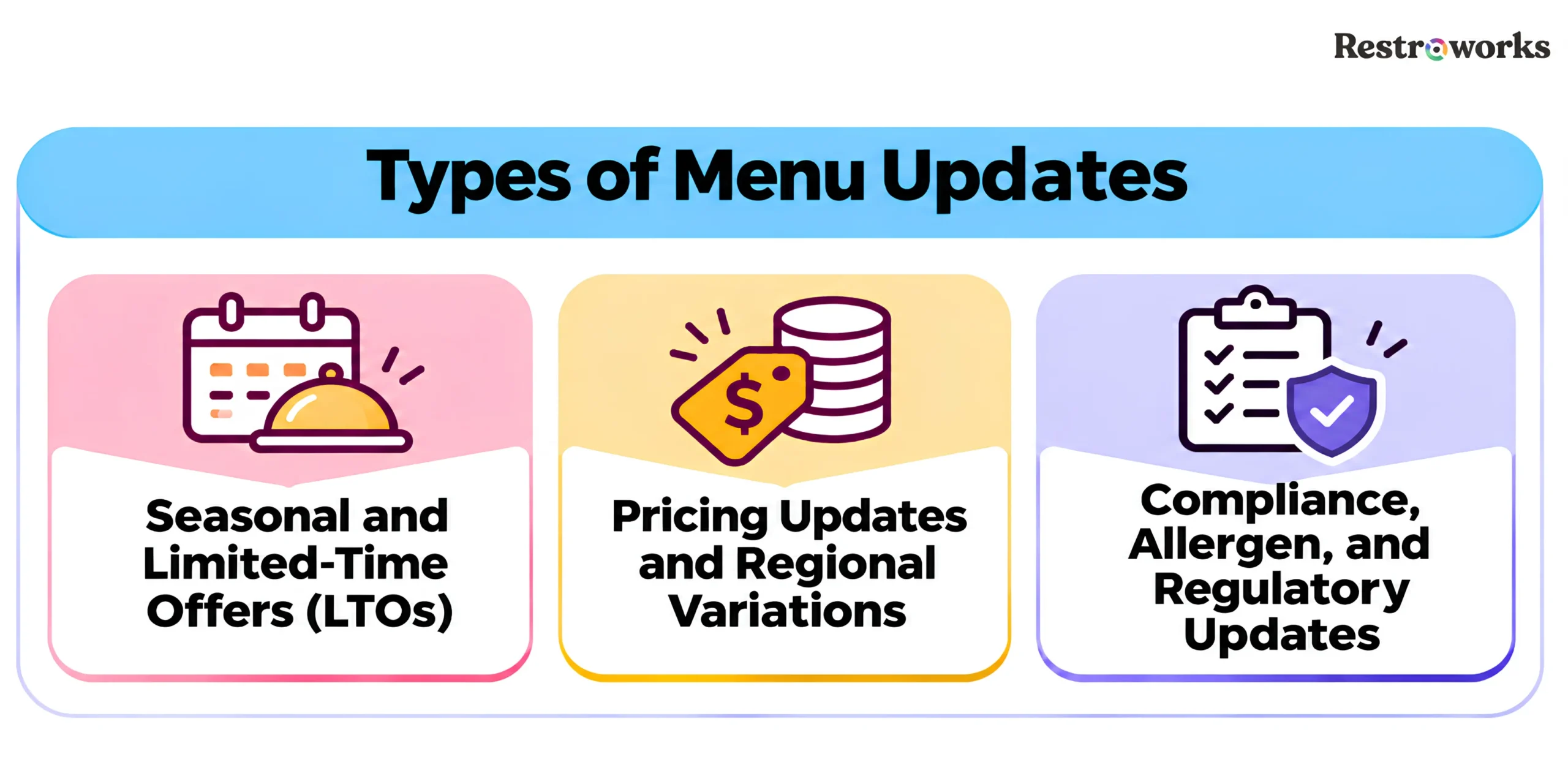
Segmenting updates by type lets operators build tiered workflows with appropriate lead times and approval paths for each.
Seasonal and Limited-Time Offers (LTOs)
Managing overlapping promotional calendars across locations requires choreography. In 2015, Tropical Smoothie Cafe was introducing LTOs every eight weeks and holding webinars before each one to walk franchisees through all the components.
New LTO items requiring supply chain sourcing and equipment changes need 12 weeks. Repeat seasonal LTOs already in the POS sandbox need 4–6 weeks. The 12-week plan:
- Week 12: Concept approval
- Week 8: Supply chain confirmation and ingredient deadlines
- Week 6: Asset finalization
- Week 4: Franchisee communication and training
- Week 2: POS and digital board programming
- 48–72 hours before launch: Pre-launch compliance verification
- Through week 2 post-launch: Monitoring and exception handling
Pricing Updates and Regional Variations
Centralized pricing control with regional price zones is a common architecture for franchise restaurant chains. Corporate sets baseline pricing and permitted ranges; franchisees adjust within approved bands for their market. When commodity prices shift quickly, every week a price update waits in the queue, eroding margin on each order.
Compliance, Allergen, and Regulatory Updates
Allergen updates can carry legal liability, not just operational risk. In fact, even though there is no federal allergen-menu requirement for restaurants, state laws such as California’s SB 68 mandate disclosure, and inaccurate allergen information can expose operators to negligence claims. When a supplier changes an ingredient formulation, every menu that’s on in-store boards, printed menus, QR menus, the branded app, and all third-party delivery platforms must reflect the change simultaneously.
US regulatory requirements that directly tie menu updates to compliance deadlines:
FDA calorie labeling (20+ locations) – Under the FDA menu labeling rule, with a compliance date of May 7, 2018, restaurants that are part of a chain with 20 or more locations must disclose calories for standard items on menus and menu boards.
Menus must also carry the statement “2,000 calories a day is used for general nutrition advice, but calorie needs vary” and a note that additional nutrition information is available upon request. Temporary menu items that appear on the menu for less than a total of 60 days per calendar year are exempt from this, though, which covers many short-run LTOs.
Every recipe change or portion adjustment to a standard item triggers a recalculation that must propagate across every in-store and digital menu channel.
Sesame as the 9th major allergen – The FASTER Act made sesame the ninth major food allergen, and as of January 1, 2023, it must be labeled as an allergen on packaged foods. At the federal level, it covers packaged items, not restaurant menus, but brands that publish allergen information should add sesame to it. In fact, in California it’s mandatory to do so for large chains (20 or more locations under the same name, with at least one in California).
California allergen disclosure (SB 68) – Since July 1, 2026, California’s SB 68 has required restaurant chains covered by the federal menu labeling rule to give written notice of which of the nine major food allergens, including sesame, are in each standard menu item. The information can appear on the menu next to each item or digitally (for example, through a QR code), and a digital option must be paired with a non-digital alternative such as an allergen menu or chart.
California fee and surcharge display (SB 478 / SB 1524) – California’s SB 478, in effect since July 1, 2024, bans hidden mandatory fees. SB 1524 lets restaurants keep a mandatory fee only if it is clearly and conspicuously displayed, with an explanation of its purpose, on the menu or display showing the item’s price. The exemption does not extend to food delivery platforms. For California locations, a fee change is a menu update.
Other state fee rules – Colorado’s HB25-1090 (effective January 1, 2026) requires restaurants to disclose the amount of any mandatory service charge and how it is distributed. Florida’s SB 606 (effective July 1, 2026) requires a notice of any operations charge, including its amount and purpose, on menus, websites, and ordering apps; and Minnesota’s junk-fee law (effective January 1, 2025) requires advertised prices to include mandatory fees, with automatic gratuities disclosed clearly and conspicuously.
New product launches are the most complex: a single item can trigger multiple updates across POS, digital boards, printed menus, mobile app, website, delivery platforms, and staff training.
Key Components of a Franchise Menu Management System
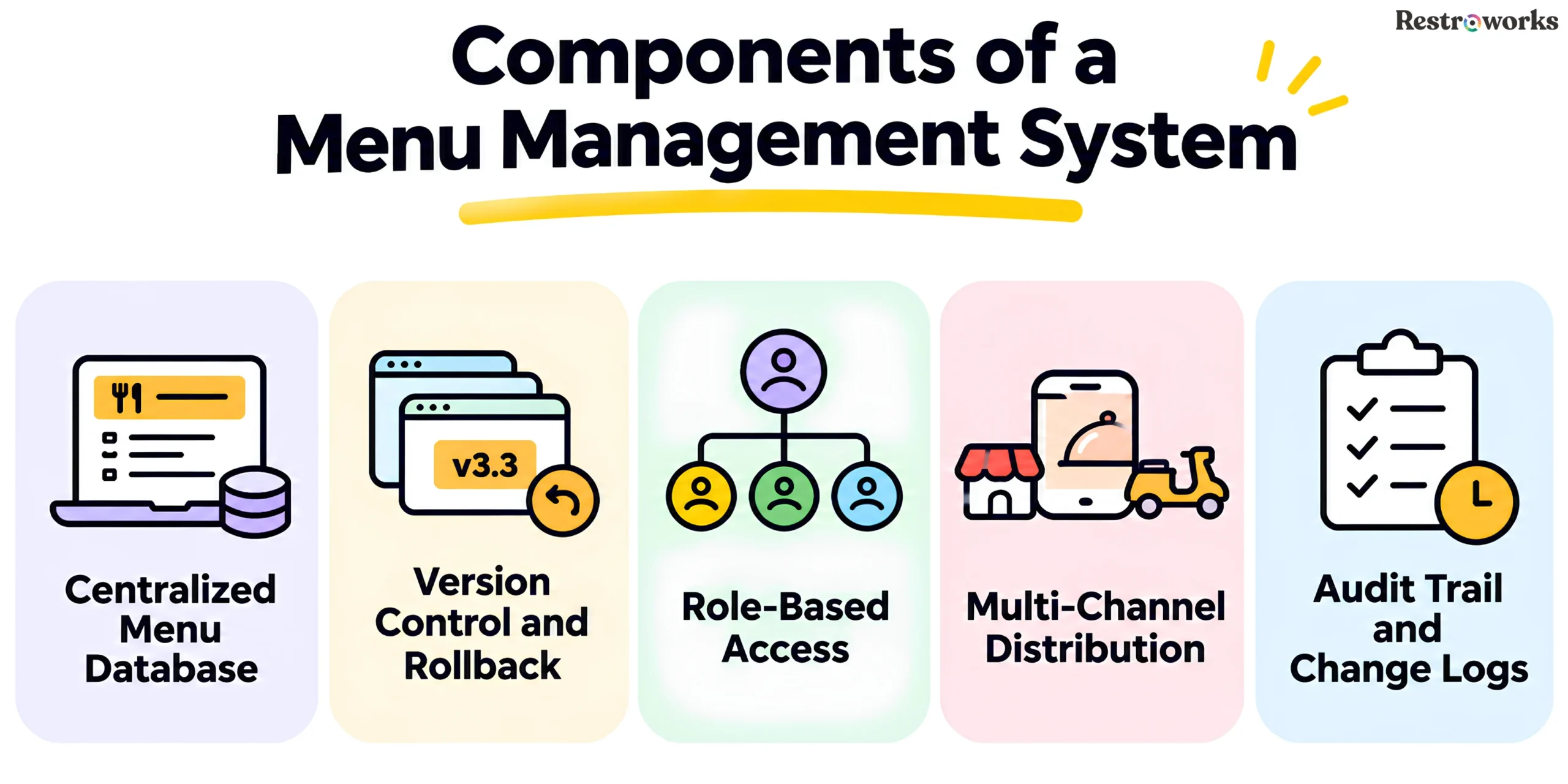
Scalable franchise menu management requires four infrastructure layers: a centralized menu database, role-based permission controls, multi-channel distribution, and version control with rollback capability.
Centralized Menu Database and Version Control
The master menu is the single source of truth: item IDs, pricing, allergen data, modifier sets, approved photography, and promotion schedules. Every downstream channel pulls from this master, never from location-level copies.
For example, Herfy, which is btw Saudi Arabia’s largest fast-food chain, manages over 550 unique menu items across 400+ outlets, with recipes synchronized from a centralized platform and dynamic combos created centrally. Still, with the right software, the complete rollout was done in less than 150 days.
Version control at the location level is where most systems fall short. If 12 locations run version 3.2, 45 run 3.3, and 8 run 3.1, a pricing error in 3.3 requires location-level tracking and selective rollback. Invest in infrastructure that can execute a full rollback across all locations within a few hours.
Role-Based Access and Multi-Channel Distribution
A well-designed role hierarchy: Corporate (full edit, approval authority) → Regional Directors (edit within approved range, approve local exceptions) → Franchisee (adjust pricing within approved bands, flag issues, submit exception requests) → Location Staff (view only). Every change generates a timestamped audit trail.
Modern franchise chains manage the same menu across multiple channels at once, including in-store digital displays, POS, mobile app, website, and third-party delivery platforms.
Each delivery platform sets its own rules for item names, descriptions, photos, and modifier structure. Check each platform’s current merchant guidelines before building menu templates, as requirements change. Cloud-based systems ensure real-time updates across all channels without per-location overhead.
Summary: Menu Update Types, Lead Times, and Ownership
Franchisee Communication and Training Workflows
Franchisee communication is the most underdeveloped and most consequential capability in franchise menu management. Technology without structured communication workflows leaves compliance to chance.
A recommended communication framework: 4-week advance notice for major updates, 2-week reminder with training materials, 1-week pre-launch confirmation request, 24-hour go-live alert, 48-hour post-launch check-in. All through one centralized channel, not scattered email, texts, and intranet posts.
Each communication must cover five elements: business rationale (franchisees comply more when they understand the why), ingredient and supplier details, training timeline, cost allocation (who pays for signage, POS programming, and printed materials), and consequences for non-compliance.
Prioritize training managers, who train their teams through direct demonstration. Short-format video (2–3 minutes per item) accessible on mobile is easier for crews to follow than PDF-only instruction. Two weeks minimum for standard updates; four weeks for new equipment requirements.
Managing Supply Chain Disruptions and Third-Party Delivery Sync
Supply chain disruptions require pre-built emergency protocols, not improvisation. Third-party delivery synchronization requires systematic API integration, not manual platform-by-platform updates.
The 86’d Item Protocol
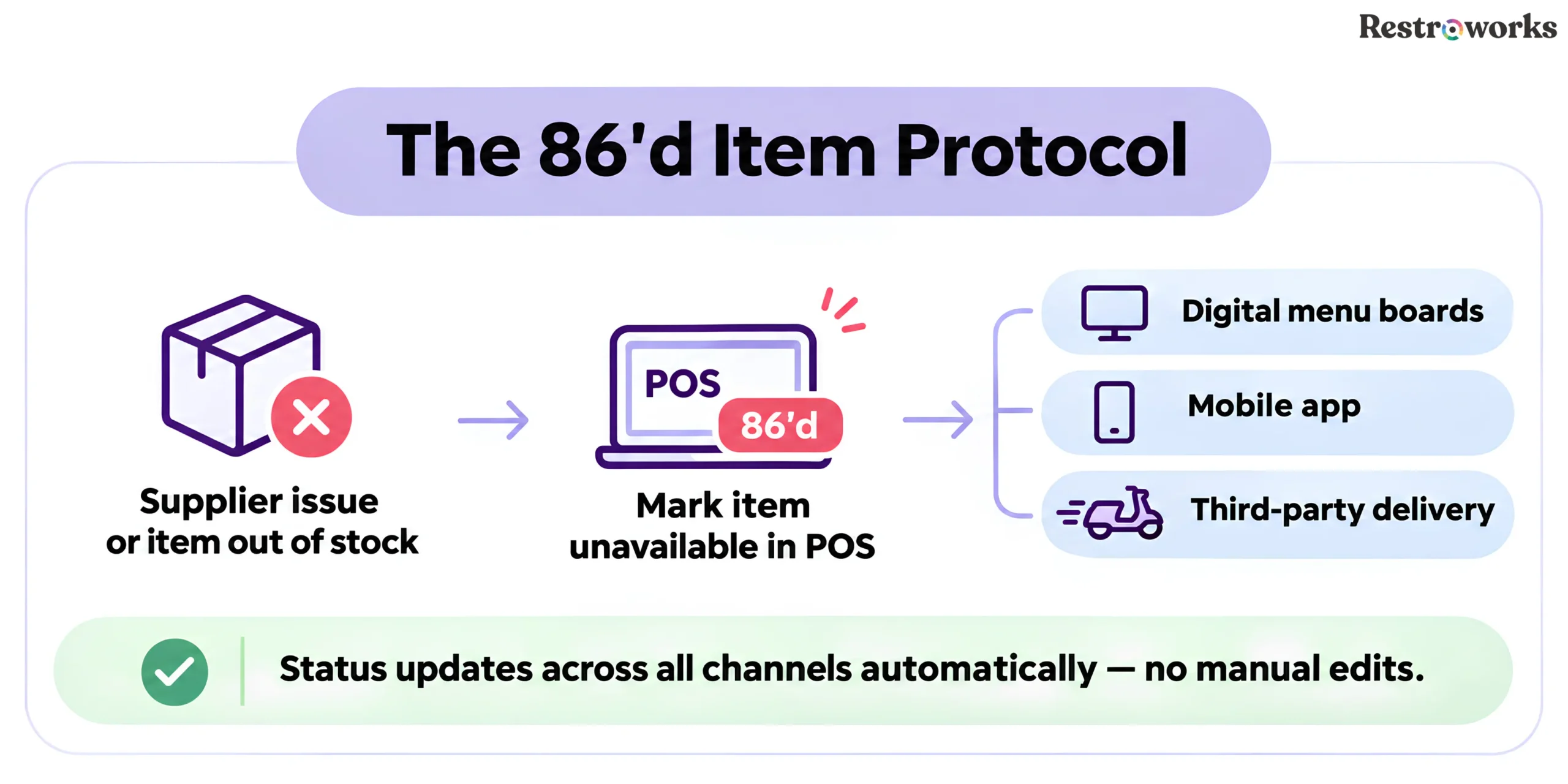
When a protein supplier fails Thursday, franchises need alternatives live by Friday lunch — but the standard communication cycle takes weeks. Pre-approved emergency menu templates that bypass the normal approval workflow are a solution many franchises don’t have until after their first crisis.
The 86’d item workflow must include automatic cross-channel deactivation: when a location marks an item unavailable in the POS, that status propagates to digital menu boards, mobile app, and third-party delivery platforms without a separate manual update at each. Pre-approved templates (pre-photographed, priced, and loaded into the POS sandbox) let a location switch to an approved alternative within hours instead of waiting on the standard cycle.
Third-Party Marketplace Synchronization
For a 50-location franchise on three platforms, a full menu update can mean up to 150 individual listing edits when no integration or bulk tool is in place. Done by hand, those edits land over days, so early-updated locations display different menus than late-updated ones. That gap generates the “why don’t you have X” complaints customers blame on the location.
API integration between your central menu system and each platform is the most reliable fix at scale. Build platform-specific templates as automated transformations from the master menu (applying correct character limits, image dimensions, and modifier structures) rather than manual exceptions.
Menu Compliance Auditing and Enforcement
Menu compliance auditing is what makes governance documents real. Without it, menu control clauses in the franchise agreement are advisory.
A systematic compliance framework operates at three levels: pre-launch (verify before go-live), post-launch (confirm compliance within 72 hours), and ongoing (quarterly price alignment audits, monthly spot-checks for allergens and LTO pricing). Tracking requires a location-level compliance dashboard, not system-wide averages, because when 15 locations miss a change by launch day, you need to know exactly which ones before the marketing campaign reaches them.
Governance should specify consequences explicitly: first violation triggers a support call and correction plan; second triggers formal notice and financial consequences per the franchise agreement. Experienced operators know when to negotiate — forcing compliance on a long-tenured 8-unit franchisee can damage the relationship across all areas.
Menu Engineering and Sales Data for Revenue Growth
Menu decisions show up directly in average order value. The four-quadrant menu engineering matrix classifies every item by profitability and popularity:
Stars (high profitability, high popularity): Feature prominently, protect pricing.
Plowhorses (low profitability, high popularity): Evaluate for price increases or recipe optimization.
Puzzles (high profitability, low popularity): Improve visibility and positioning before considering price changes.
Dogs (low profitability, low popularity): Candidates for retirement. Removing them simplifies kitchen operations and focuses supply chain resources.
Evaluate the menu every 2–3 months with quarterly pricing reviews for commodity cost changes. Monitor sales data by location, region, and format, not just brand-level aggregates; an item that underperforms nationally may be a meaningful revenue driver in specific markets.
Keep bundles and upsell prompts consistent across boards and kiosks; when they vary by location, revenue is left on the table.
Technology Requirements for Scalable Operations
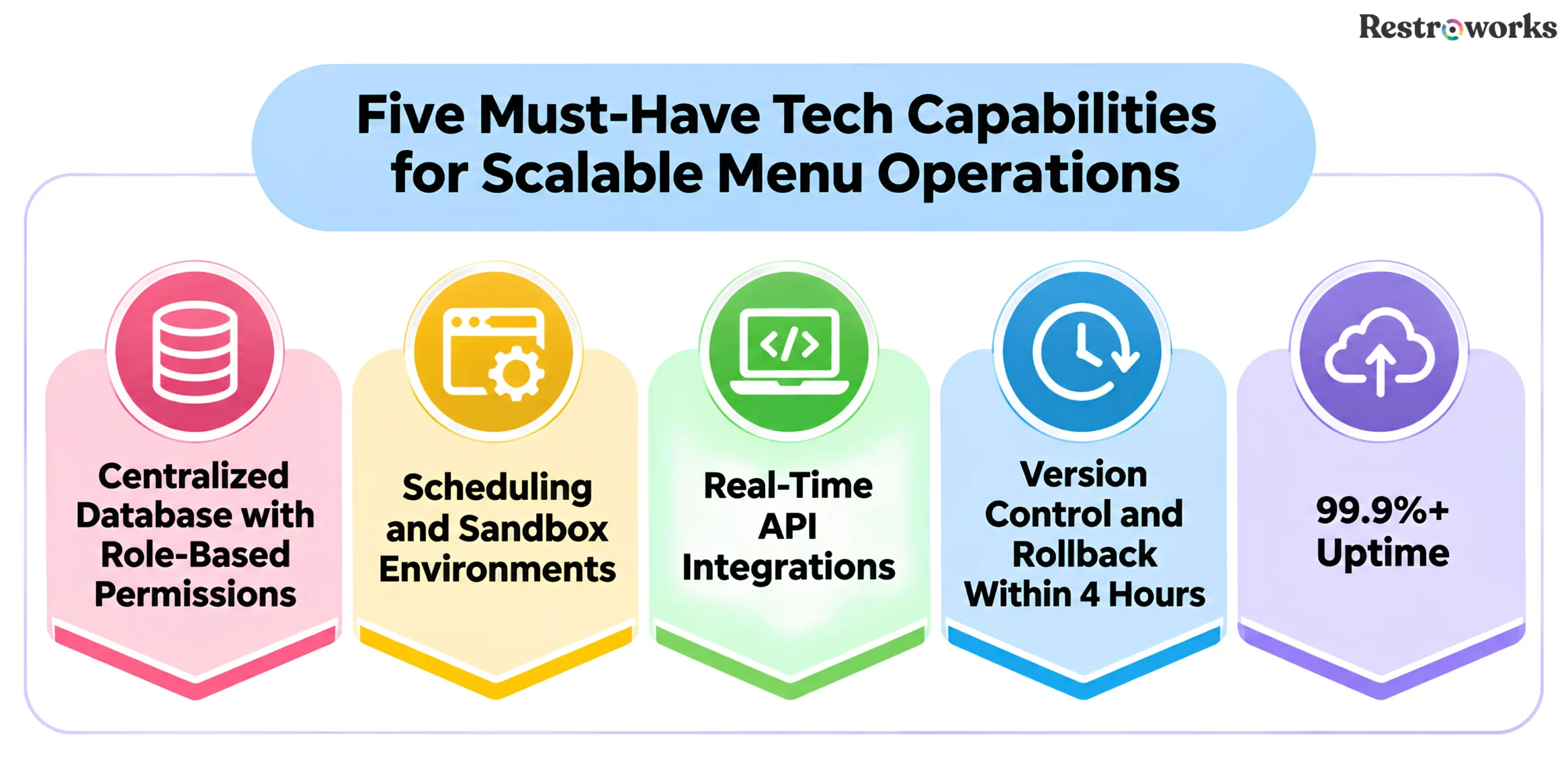
Five capabilities are non-negotiable for scalable operations:
Centralized database with role-based permissions – Every item version stored with a full audit trail, supporting regional content groups and price zones for multi-location management.
Scheduling and sandbox environments – Menu changes previewed in a sandbox before deployment, letting regional directors catch errors before they go live.
Real-time API integrations – Seamless integration with POS systems, digital menu board platforms, mobile apps, and third-party delivery APIs.
Version control and rollback within 4 hours – If a menu update causes pricing errors or safety issues, can you revert every location before the dinner rush? If not, delay launch until that capability exists.
99.9%+ uptime – Menu systems that go down during peak service create cascading failures across every channel. Uptime SLAs matter.
Measuring Success and Common Mistakes to Avoid
Key Metrics to Track
Six KPIs to track:
- Time to deploy – approval to full network compliance
- Update compliance rate – target 95%+
- Pricing error rate – per 1,000 orders
- AOV impact – before and after each update cycle
- Promotional campaign participation rate
- Franchisee feedback quality – via post-update survey
Tracking these after each launch identifies which locations consistently underperform, surfacing training gaps that predict future rollout failures.
Common Failure Modes
Five failure modes cause much of the trouble, and all are preventable with process design.
Insufficient lead time: Four weeks minimum for items requiring equipment or significant training. Two-week notice for complex LTOs produces lower compliance and more franchisee friction.
Simultaneous multi-system updates without sequencing: When something breaks (and it will), you can’t isolate which system failed. Sequence deployments: POS first, digital boards second, delivery platforms third. The exception is compliance and allergen updates, which must reach every channel at the same time.
Ignoring third-party platform updates: Delivery menus that lag in-store updates generate complaints and revenue loss. These channels deserve the same update discipline as in-store menus.
No pre-launch compliance verification: Discovering launch morning that 15 locations never updated forces a choice between wasting ad spend or confusing customers. A 48–72 hour pre-launch verification gate is non-negotiable.
Treating all franchisees identically: The 1-unit operator needs different support than the 25-unit operator with dedicated IT. One-size-fits-all instructions guarantee over-complication or under-serving.
Next Steps: Improving Your Franchise Menu Update Process
Centralized menu management is no longer a competitive advantage. It is the baseline for franchise chains serious about consistency, compliance, and growth.
Start with an audit: count how many systems require manual updates per menu change. POS, digital boards, printed menus, drive-thru boards, mobile app, website, and each third-party delivery platform typically add up to 6–12 touchpoints — your cost-per-update baseline and clearest measure of inefficiency.
For brands beginning to centralize: consolidate the system of record before addressing distribution. A single master menu database with version control delivers immediate compliance and audit benefits even before API integrations to downstream channels are complete.