
Freddy’s Frozen Custard & Steakburgers opened its 600th restaurant in October 2026, according to QSR Magazine. At that scale, the core tension of franchise social media is unavoidable: every location needs to feel like a local neighborhood spot, yet the brand has to look identical in every market it enters. A stricter rulebook doesn’t solve that. A governance architecture that makes consistency effortless and local relevance systematic does.
That tension is why social media strategy for restaurant franchises underperform. Corporate wants control; franchisees want flexibility; nobody builds the structure that delivers both. This guide shows you how to build it.
By the end, you’ll have six operational frameworks:
- A governance policy covering account ownership and crisis response
- A platform matrix matched to your concept type
- A content pillar framework with brand voice documentation
- A two-tier content calendar model
- A paid social co-op structure
- A measurement framework tying social activity to revenue
This is built for the multi-unit operator running 10 to 500 locations, not single-unit advice that breaks down at location two.
What You’ll Learn
- How to split social media control between HQ and franchisees?
- How to choose platforms, content, paid co-op spend, and KPIs for each location, and how can you tie your social activity back to POS sales?
How Social Media Drives Franchise-Wide Restaurant Sales
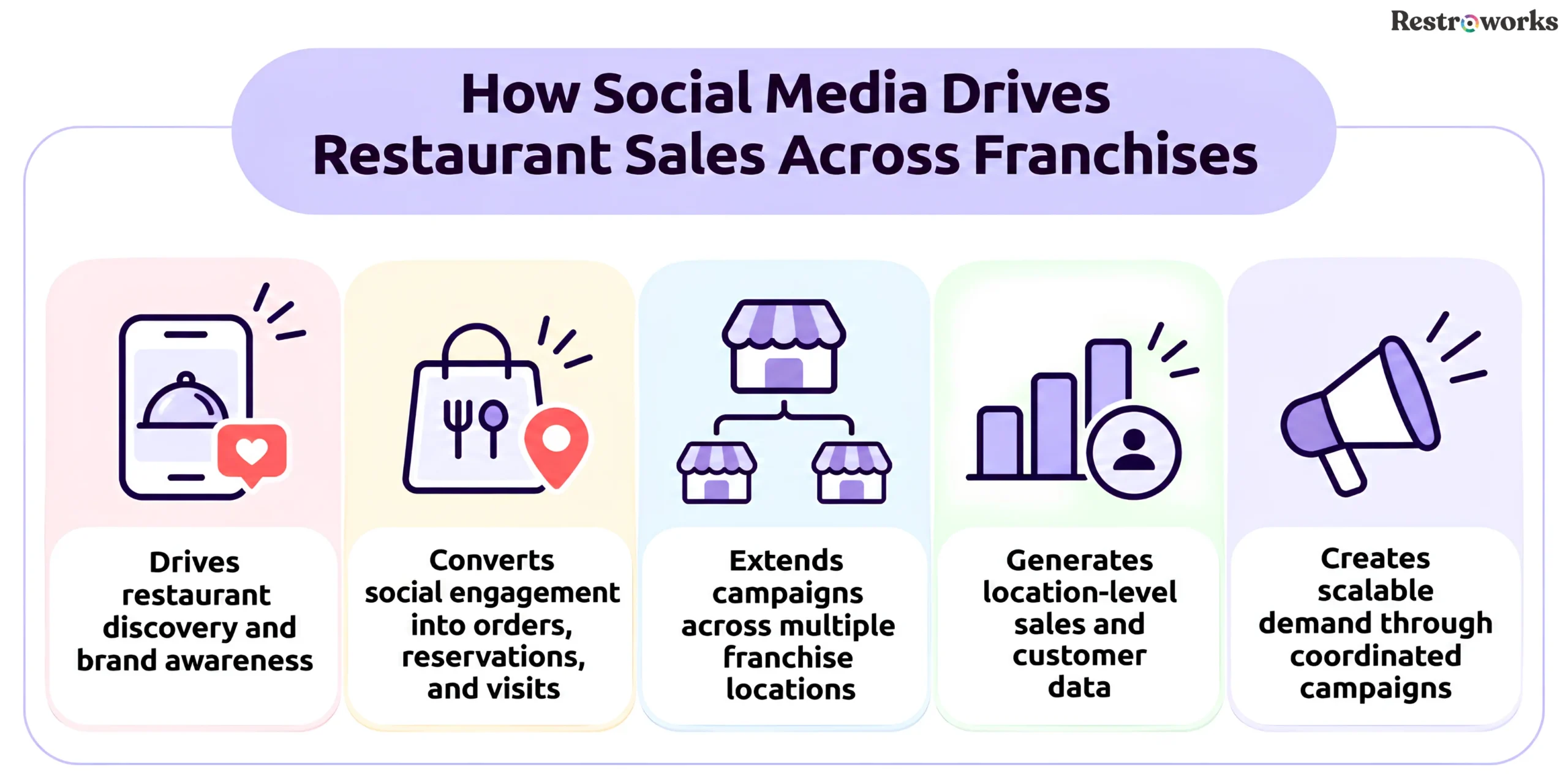
In 2024, restaurants reported an average 9.9% increase in B2C revenue as a direct result of their social media strategies, and social-first brands (those with the most successful social strategies) saw an average revenue increase of 14.1%, according to Deloitte Digital’s 2025 State of Social research.
Social platforms have become a major discovery channel for restaurant brands, and in fact the top one for Gen Z, impacting reservations, delivery orders, and franchise development leads simultaneously. Of course, social media is a front door for franchise brands as well, since many customers discover restaurants there before they ever walk in.
Plus, you must know that the social media funnel for franchise systems operates at two levels: brand-level (reach, share of voice, sentiment, follower growth) and location-level (check-ins, click-to-call, online order clicks, offer redemptions, foot traffic). This allows franchise brands to measure not only how much attention a campaign generates, but also how much of that attention brings in actual sales at each location.
What is the 30/30/30 rule for restaurants?
The 30/30/30 rule is an informal content split where 30% of the content is promotional (offers, LTOs, or limited-time offers), 30% is educational (food facts, cooking tips), and 30% is engagement (UGC, or user-generated customer content, reposts, community highlights, questions), with the remaining 10% reserved for trending content. This framework is a starting point for single-unit operators rather than a standard. Franchise systems more often use a modified 70/20/10 split.
A single viral post creates sudden traffic spikes, and that upside is only capturable if the governance structure is ready for the volume that follows.
The Two-Tier Governance Framework Every Franchise Needs
The central challenge in any restaurant social media strategy is not content: it is control architecture. Single-unit advice starts to break down as soon as a second location opens. A franchise operates two distinct social media layers that must be coordinated at all times:
Corporate (HQ) accounts manage brand campaigns, national promotions, franchise recruitment, product launches, and crisis communications. One consistent voice, professionally produced assets.
Franchisee accounts cover individual location pages on Facebook, Google Business Profile, and location-specific social media profiles on Instagram and TikTok where permitted. These drive local engagement (neighborhood events, staff stories, community partnerships) within brand guardrails.
Most franchise systems have social media guidelines, but far fewer have codified their enforcement mechanisms: the actual process for flagging, reviewing, and resolving off-brand content. Without that structure, brand drift follows: franchisees posting off-brand photography, unauthorized promotions, or inconsistent pricing. This typically surfaces first as a public customer complaint, not an internal audit.
The Core & Flex Model:
| Layer | Managed by | Content type |
|---|---|---|
| Core | HQ / Corporate | Templates, national campaigns, evergreen assets, approved photography, brand story content |
| Flex | Franchisees | Local events, staff spotlights, community partnerships, geo-tagged posts, local hashtags |
What franchisees can customize: caption copy (within tone guidelines), local offers (HQ approval required), geotags, location-specific hashtags, and community event shoutouts.
What must remain constant: logo placement, brand colors, core tone, menu naming conventions, promotional disclaimer language, and HQ approval for any offer post.
A 2023 Subway incident illustrates the cost of an absent policy: a franchised shop in Rincon, Georgia, displayed a sign reading “Our subs don’t implode,” a reference to the fatal OceanGate Titan submersible implosion. Social media users quickly connected the sign to the tragedy, and the story ran in national outlets. Subway said it had “been in contact with the franchise about this matter” and that the sign had been removed, as FOX 13 reported. One location’s judgment call became a national brand story. That kind of protocol is not bureaucracy: it is brand insurance.
Setting Up the Franchise Social Media Governance Structure
Build governance before the content calendar. Franchise operators who skip this step discover the cost at the worst possible moment: during a brand crisis, not before one.
The franchise social media policy must cover six areas:
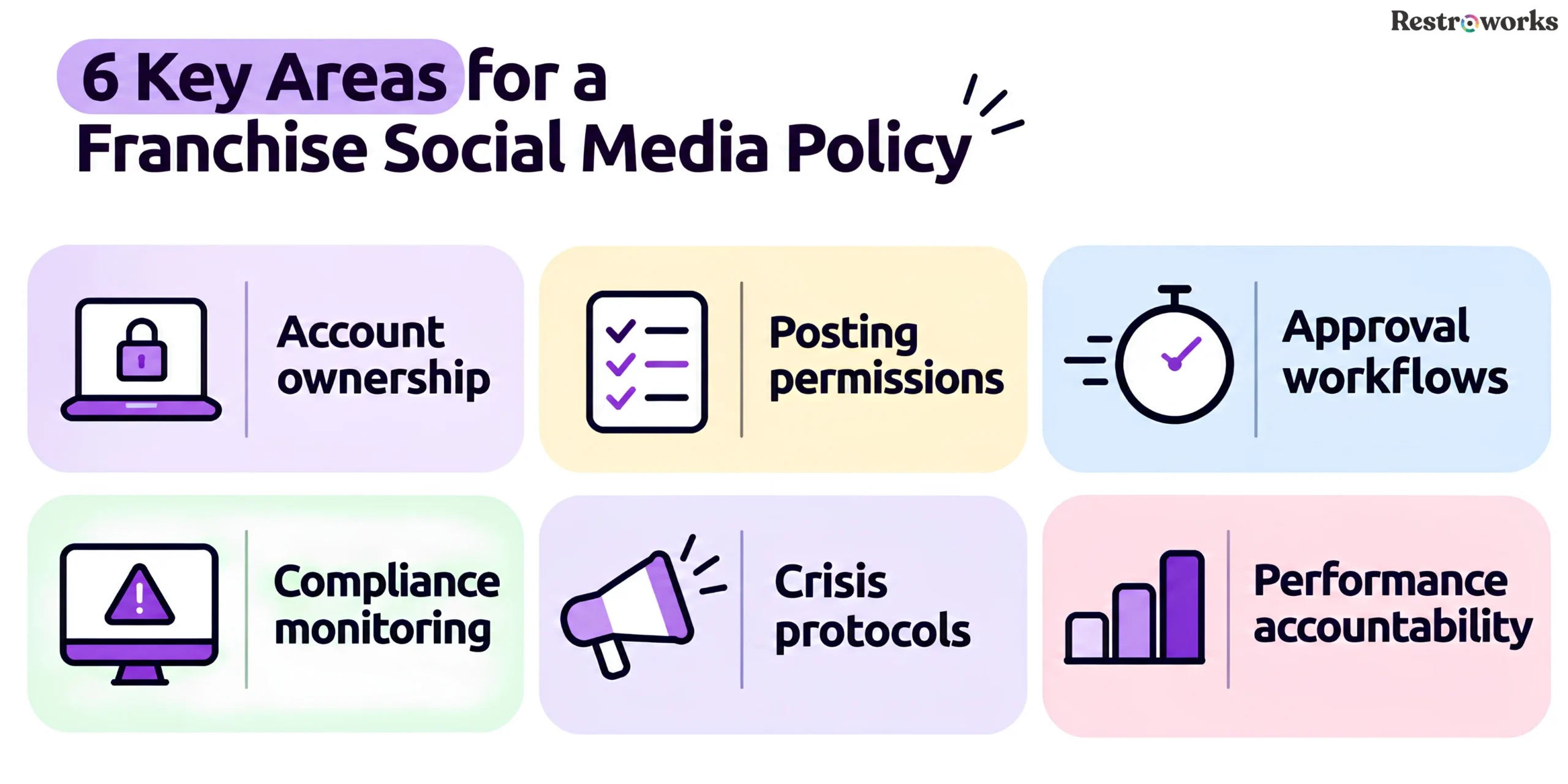
- Account ownership: Credentials belong to the franchisor. Handover protocols belong in the franchise agreement before Day 1.
- Posting permissions: Define what franchisees can post freely (within templates) and what requires HQ sign-off. Tiered permissions scale better than full central approval.
- Approval workflows: Set a response SLA (response-time commitment). A 4-hour turnaround for standard content and 1-hour for time-sensitive posts (flash sales, closures) is realistic with the right tooling.
- Compliance monitoring: Automate flagging of off-brand content. Do not rely on franchisees self-reporting.
- Crisis protocols: Negative comments require a written escalation tree (location, regional, corporate) with no 72-hour silences.
- Performance accountability: Franchisees who see their own data alongside system benchmarks engage more consistently. Share results monthly.
How the approval workflow actually runs: When a franchisee wants to post a local promotion, the decision path is:
- Is it a templated asset from the HQ library? → auto-approved, post immediately.
- Is it a local caption variation on an approved visual? → franchisee posts, flagged for weekly review.
- Is it a locally created offer, promotion, or claim? → routes to regional coordinator for approval within 4 hours.
- Is it crisis-related, brand-sensitive, or a response to a negative public event? → escalates directly to corporate marketing within 1 hour; account suspension available.
This tiered structure keeps local operators moving without exposing the brand to unmanaged content.
Account ownership on exit: Every franchise agreement should specify that social media accounts created under brand handles or with brand assets remain brand property. Franchisee admin access is revoked upon sale or exit; HQ retains primary admin credentials. Document account credentials in a secure central system, not only in the franchisee’s inbox, so an unexpected exit doesn’t strand the audience that location built.
Staff personal posting policy: Your governance framework should address what happens when a team member posts from inside the kitchen on their personal TikTok or Instagram. Most franchise systems handle this with three rules:
- Personal posts from the location must be positive and non-controversial
- No menu pricing, promotions, or unreleased items
- No filming of other staff without consent
This is separate from encouraging staff to share on-brand content; a policy that encourages sharing should also specify what’s off-limits.
Quick Start: Governance Implementation Timeline
- Week 1: Audit all existing location accounts; document current credentials and ownership gaps; secure all logins under franchisor control.
- Week 2: Draft the six-area policy document using the framework above; assign regional coordinators as the approval tier for standard content.
- Week 3: Run franchisee training on the approval workflow and posting permissions; distribute the social media kit (templates, style guide, caption library).
- Month 2: Monitor the first 100 posts across pilot locations; measure approval turnaround times against your SLAs; adjust the tiered permissions based on what actually gets submitted for review.
Should each franchise location have separate social media accounts?
Yes, each location should have its own Facebook page and Google Business Profile at minimum. Location-specific accounts enable geo-targeted advertising, local engagement, and accurate review management. Franchisees should not create Instagram or TikTok accounts without a governance framework. The risk is not the account itself; it is unmanaged content published under your brand name.
The Freddy’s Frozen Custard model illustrates a specific financial governance mechanism: per its 2026 FDD, franchisees contribute to a National Marketing Fund currently set at 2.5% of gross receipts, which the franchisor can set anywhere from 0% to 3%. That structure ensures every franchisee contributes to brand-level reach. It removes the negotiation about whether advertising is optional.
Choosing the Right Social Media Platforms for Franchise Restaurants
Platform selection is a content strategy decision as much as a budget one: franchise systems need reach, local discovery, and scalable paid advertising simultaneously.
| Platform | Primary role | Best for | Avg. engagement rate, dining and hospitality | Suggested franchisee time |
|---|---|---|---|---|
| Visual menu showcases, Reels, Stories | Food content, signature dish highlights | 3.7% | 3–5 hrs/week | |
| TikTok | Short-form video discovery | Gen Z/Millennial reach, viral potential | 1.3% | 5–8 hrs/week (video production-heavy) |
| Local community hub, event promotion | Location pages, geo-targeted ads, community partnerships | 2.4% | 2–3 hrs/week | |
| GBP / Google Business | Local search and maps | Must-have for every location; feeds AI recommendation tools | Not applicable (search asset) | 1 hr/week |
| YouTube Shorts | Video with longer shelf life | Behind-the-scenes and menu storytelling | Not reported | 3–4 hrs/week |
Engagement rates are from Hootsuite’s 2026 industry benchmarks for dining, hospitality, and tourism, measured per post against follower count for each platform’s best-performing content type.
TikTok’s lower follower-based rate understates its discovery value: in an MGH survey of 1,142 U.S. adults who watch TikTok, 58% said they had visited a restaurant after seeing it on TikTok, up from 38% in MGH’s 2022 survey.
Framework for platform selection by concept type:
- QSR (quick-service restaurant) / fast-casual: Prioritize Facebook + Google Business Profile first. They require the least production time, support geo-targeted ads, and feed local search. Add Instagram when you have consistent food photography. Hold TikTok until you have 5+ hours/week of dedicated video production capacity.
- Fast-casual targeting under-35 demographics: Add Instagram + TikTok once your Facebook and GBP presence is stable. Expect 5–8 hours per week of video production at the location level; without that capacity, TikTok accounts tend to go dormant and fragment your brand presence.
- Casual dining / full-service: Facebook + Instagram + YouTube Shorts. YouTube Shorts give longer shelf-life content for menu storytelling and chef profiles, without TikTok’s production frequency demands.
For location accounts, Facebook and GBP are non-negotiable regardless of concept type: both feed local search and AI-powered discovery tools. Set a consistent monthly paid floor for every location and test it against redemptions; a budget too thin to run continuously rarely moves foot traffic.
What social media platforms work best for restaurant franchises?
Among the consumer platforms covered here, Instagram delivers the highest engagement for the category: Hootsuite’s 2026 benchmarks put dining and hospitality brands at 3.7% on Instagram, 2.4% on Facebook, and 1.3% on TikTok.
TikTok earns its place through discovery rather than engagement rate. For location-level discoverability, Google Business Profile is the most critical platform: it feeds local search and AI recommendation tools. Facebook remains essential for community management and geo-targeted ads. Most franchise systems need Facebook and Google Business Profile running at every location, adding Instagram and TikTok as production capacity allows, each with platform-specific strategies.
Building Franchise-Wide Content Pillars and Brand Voice
Content pillars (4–6 recurring themes built around your core audience) ensure consistency, simplify planning, and give franchisees clear guidelines without requiring social media expertise.
Recommended content themes for restaurant franchises:
- Food photos and menu highlights of hero dishes, seasonal items, and signature dish close-ups.
- Behind the scenes: Kitchen prep, plating, training days, store opening day. Behind-the-scenes content humanizes the brand.
- People and culture: Staff spotlights, franchisee stories, hiring posts
- Community and events: Neighborhood involvement, charity nights, special events
- Offers and promos: Flash sales, LTOs, loyalty program pushes, gift cards
- Brand story: Origin, values, mission, milestones
Each pillar needs a content spec franchisees can execute without extra creative direction: approved image angles, caption tone examples, hashtag requirements, and CTA language. Voice documentation covering tone, vocabulary, and regional adaptation is what differentiates your brand in a crowded feed.
Villa Italian Kitchen (over 260 locations) is a documented example: its Instagram feed mixed original photography with low-quality phone images until the brand standardized its content strategy and visual style. After moving to a set monthly schedule across content categories and quarterly photoshoots, engagement increased 3x in the first three months, according to ATAK Interactive’s case study.
What is the 70/20/10 rule in social media?
The common version of the 70/20/10 rule divides content into 70% value-adding content, 20% content shared from others, and 10% promotional posts. For franchise systems, a useful adaptation of the same ratio splits content by who creates it: 70% from corporate (brand campaigns, national promotions, evergreen assets), 20% from local teams (community events, staff stories, neighborhood shoutouts), and 10% experimental or trending content. For restaurant franchises, this ratio maintains brand consistency while preserving the local flexibility that drives neighborhood relevance.
Visual Storytelling: Food Photos and Atmosphere That Convert
Visual quality is the price of entry. The franchise challenge is maintaining that standard across dozens of locations without a professional photographer at every site. The goal is not perfection: it is consistency.
What “good enough” looks like for a franchise:
- Consistent natural lighting (window light or a simple ring light)
- Standardized angles: overhead for platters, 45-degree for stacked items
- Clean backgrounds that match brand colors
- No cluttered tables, stained napkins, or half-eaten plates in frame
- Color grading presets shared across all locations for consistent static photos
A franchise-wide visual style guide should cover hero dish photography, plating standards, background and prop rules, logo placement, and brand-quality versus UGC-quality ratios.
Short-form video, especially behind-the-scenes content, drives the authenticity that turns followers into customers:
What to film:
- Morning kitchen prep, ingredient deliveries, and plating in action
- Store opening day, chef R&D sessions, franchisee origin stories
What to avoid:
- Footage showing food safety violations or proprietary recipes
- Customer faces without consent or messy back-of-house areas
Recurring series ideas: “Meet the Franchisee Friday” (60-second owner intro), “Prep Time” (kitchen setup timelapse), “60 Seconds on the Line” (rush POV), and “From HQ to Your Plate” (new menu item origin). Keep every series vertical, quick, and authentic; overproduction defeats the purpose.
Managing a Multi-Location Social Media Calendar
A franchise content strategy calendar works at two levels: the national calendar (brand campaigns, holidays, new menu launches) and local slots where each location plugs in its own content.
Sample weekly content map:
| Day | Pillar | Example post |
|---|---|---|
| Monday | Menu highlights | New seasonal item Reel |
| Tuesday | People and culture | Team member spotlight |
| Wednesday | Behind the scenes | Kitchen prep video |
| Thursday | Community | Local event shoutout |
| Friday | Offers | Weekend deal graphic |
| Saturday | UGC / customer photos | Repost a tagged diner photo |
| Sunday | Brand story | Franchise origin or milestone |
Posting frequency: brand handle: 3–5 Instagram posts per week + daily Stories; location handles: 3+ feed posts per week; TikTok: 3–5 per week; Facebook: 3–4 posts per week per location.
Build a 30-day calendar first, then extend to 90 days with key campaigns mapped: seasonal LTOs, loyalty pushes, store openings, holiday promotions. Every franchise calendar needs national dates locked in advance, flex slots for local content, a posting schedule with assigned owners, and asset links.
The two-tier calendar model works at scale: HQ locks national campaign windows (LTO countdowns, seasonal themes) 60–90 days out and distributes pre-built creative to franchisees. Locations fill the remaining weekly slots with local content using caption templates that take under five minutes to customize; no franchisee starts from a blank page, and corporate keeps visibility into everything published under the brand.
What is the 3-2-1 rule on Instagram?
Although there is no official Instagram 3-2-1 rule as such, marketers use the name for a suggested posting rhythm: 3 educational or value-add posts, 2 entertainment or behind-the-scenes posts, 1 promotional post. For restaurant franchises, this ratio avoids feed fatigue from over-promotional posting while keeping engagement strong. Instagram rewards consistency and variety, and the 3-2-1 rhythm delivers both.
Scaling Paid Social Media Advertising Across Franchise Locations
Organic reach for brand pages, especially on Facebook, has been squeezed for years in favor of paid distribution, making paid campaigns essential for reaching customers in competitive markets.
Central vs. Local Ad Structures:
HQ runs national brand campaigns, system-wide offers, and franchise recruitment ads. Franchisees run hyper-local campaigns using co-op budgets (shared ad budgets between HQ and location), with geo-targeting at a 3–5 mile radius around each location, interest targeting for cuisine type, Instagram stories placements, and retargeting for past website visitors and engaged followers.
Starter Campaign Types:
| Campaign goal | Format | When to use |
|---|---|---|
| Awareness | Reach campaign (video/Reel) | New openings, new brand launches, new markets |
| Traffic | Click-to-website/ordering | Online ordering pushes |
| Conversions | Lead form or landing page | Gift cards, catering, flash sales |
| Engagement | Boosted posts | Top-performing organic content |
Track every campaign with UTM parameters (campaign tracking codes) or unique promo codes to connect ad spend directly to restaurant sales. How the budget splits between brand-level campaigns and local co-op spend varies by system size and growth stage; what matters is that the split is written down, not negotiated campaign by campaign.
Freddy’s makes the national layer mandatory. Its 2026 FDD sets the National Marketing Fund at 2.5% of gross receipts, with cooperative advertising of up to 2%. Systemwide average annual gross receipts were about $1.894 million in 2025, per the same FDD, so a location at that volume sends roughly $47,400 a year (about $3,950 a month) to the national fund before any local ad spend.
That defined floor removes the variance that undermines system-wide benchmarking: every location participates, so aggregate data is meaningful.
Harnessing User-Generated Content Across a Franchise Network
User-generated content carries a peer credibility that brand content can’t buy. According to Emplifi’s Q3 2025 benchmarks, brands (across industries, not just restaurants) using its UGC solution saw conversion rates 10.38x higher than on posts not using UGC, up from 5.29x in Q2. Satisfied diners are already posting; the job is to make it easy for them and give the brand a system to capture it.
How to encourage UGC inside every location:
- Print branded hashtags on menus, table tents, takeout bags, and receipts
- Create Instagram-worthy wall art or neon signs that beg to be photographed
- Run seasonal photo contests that reward the best customer photos
- Train staff to mention the hashtag when delivering standout dishes
Use a global branded hashtag (e.g., #EatAtBrandName) plus location-specific variants (#BrandNameAustin, #BrandNameBrooklyn).
UGC redistribution process: Brand monitoring flags tagged posts; HQ or the local manager requests permission via DM; approved content gets reposted with credit.
This system turns every satisfied diner into a content creator. In practice, UGC builds the kind of authentic peer credibility that polished brand ads rarely achieve: potential customers see real diners enjoying the experience, not a studio shoot.
Working With Food Influencers and Creator Partnerships at Scale
Deloitte Digital’s 2025 State of Social research found that 83% of consumers surveyed view the influencers and creators they follow as trusted sources of information. Restaurants ranked creator partnerships as their lowest-priority tactic, yet 46% of restaurant respondents rated creator work their second-highest-return strategy, behind loyalty and rewards programs.
Influencer tier changes what you get. A 2026 study in the International Journal of Hospitality Management (three studies, 555 participants) found macro-influencers generally drive higher engagement because of their reach, while micro-influencers were more effective at promoting cause-related messages, an advantage the authors tie to perceived authenticity. For return on spend, the most-cited figure is Influencer Marketing Hub’s average earned media value of $5.78 per $1 spent, based on 2019 data across all creator tiers, so use it as a rough reference point rather than a micro-influencer benchmark.
Tiered food influencer structure for franchises:
- National creators: Brand campaigns, new product launches, major announcements
- Regional creators: New market entries, regional menu items, event promotion
- Local micro-influencers: Individual location support, authentic neighborhood content
Influencer agreements must cover: deliverables (posts, stories, reels), usage rights and duration, geo-targets and tagging requirements, tracking links or promo codes, and tone guidelines.
FTC disclosure requirement: Any influencer receiving payment, free meals, or product must disclose that relationship clearly, using plain terms such as “ad” or “sponsored” placed where they are hard to miss (for example, at the start of captions), not buried in hashtags. A platform’s “Paid partnership” label alone may not be enough. This applies to every tier. Franchise brands are responsible for partner compliance; include the requirement in every influencer agreement.
Typical U.S. cost ranges: Influencer Marketing Hub’s 2026 rate guide puts micro-influencers (10,000–100,000 followers) at roughly $150-$500 per Instagram feed post and $200-$800 per TikTok video. Complimentary dining can supplement cash fees for micro-influencers.
HQ should create an influencer playbook with approved outreach templates franchisees can use with local creators, so every location briefs creators the same way and every partnership carries a trackable code.
Tools and Technology for Multi-Location Social Media Management
Without purpose-built tooling, distributing assets and approvals across dozens of location accounts becomes a manual job that grows with every opening. The technology layer separates strategies that scale from those that collapse. Multi-location platforms such as SOCi and Rallio quote custom pricing based on location count, so request quotes early in planning. Below 10 locations, a general scheduler is usually sufficient: Hootsuite’s paid plans start at $99 per user per month and Sprout Social’s at $79 per seat per month for its Essentials plan, with Standard at $199 (both billed annually). Pricing changes often; confirm current rates directly with vendors.
Purpose-built social media management platforms:
| Platform | Best for | Key franchise feature | Typical monthly cost |
|---|---|---|---|
| SOCI | Enterprise franchise brands (100+ locations) | AI-powered local content generation, compliance monitoring, centralized asset library | Custom pricing; contact for quote |
| Rallio | Mid-size franchise systems (20–100 locations) | Franchisee-level posting with HQ approval workflows, reporting by location | Custom pricing; contact for quote |
| Hootsuite | Brands with complex approval workflows | Custom permission structures, multi-brand management | $99-$399/user/mo (Standard to Advanced, billed annually); Enterprise custom |
| Sprout Social | Analytics-forward teams | Advanced social media analytics; dashboards aggregate engagement across all accounts | $199-$399/seat/mo (Standard to Advanced); Enterprise custom |
The Human Bean, a drive-through coffee franchise with almost 200 U.S. locations, deployed SOCi and saw a 270%+ increase in Instagram reach and a 94%+ increase in published posts, comparing 2024 with 2023, according to SOCi’s customer story. For multi-unit brands, that reach growth from a single centralized platform is the operational case for purpose-built tooling.
Essential tooling checklist:
- Social media management platform (scheduling, monitoring, reporting across all accounts)
- Design tool with brand-locked templates (colors, fonts, logos)
- Shared asset library (approved photos, videos, logos, templates)
- Reporting dashboard pulling data from all channels
Content workflow: HQ builds quarterly master assets → brand approval → assets pushed to shared library → locations customize captions and schedule → HQ spot-checks weekly.
New franchisee social media kit: logo pack, visual style guide, voice/tone document, 30 pre-written caption templates, 60–90 days of content ideas, and a platform setup checklist. When templates beat starting from scratch, franchisees use them.
Measuring What Matters: Franchise Social Media Analytics
Without measurement, social media is content for content’s sake. Franchise analytics must operate at two levels simultaneously.
Brand-level KPIs (key performance indicators): total reach and impressions across all locations, share of voice versus competitor brands, brand sentiment, system-wide follower growth, quarter-over-quarter trends.
Location-level KPIs: engagement rate per post, clicks-to-call and direction requests from GBP, online order clicks via UTM, offer redemption rates, new followers and profile visits.
Measurement is what lets you tell a social-first program from a passive one: the brands Deloitte classifies as social-first are the ones with the most successful strategies, and you can only know which group you’re in if location-level results are tracked. Set alerts for brand mentions and competitor comparisons; aggregate them across all profiles through your management platform.
Monthly reporting should include: top-performing posts by region, engagement comparison across locations, campaign-specific results (reach, redemptions, revenue), and a “play of the month” tactic every location can copy.
Once you tie social activity to measurable outcomes (foot traffic, online orders, offer redemptions), the business case becomes self-evident.
Common Pitfalls in Franchise Social Media (and How to Avoid Them)
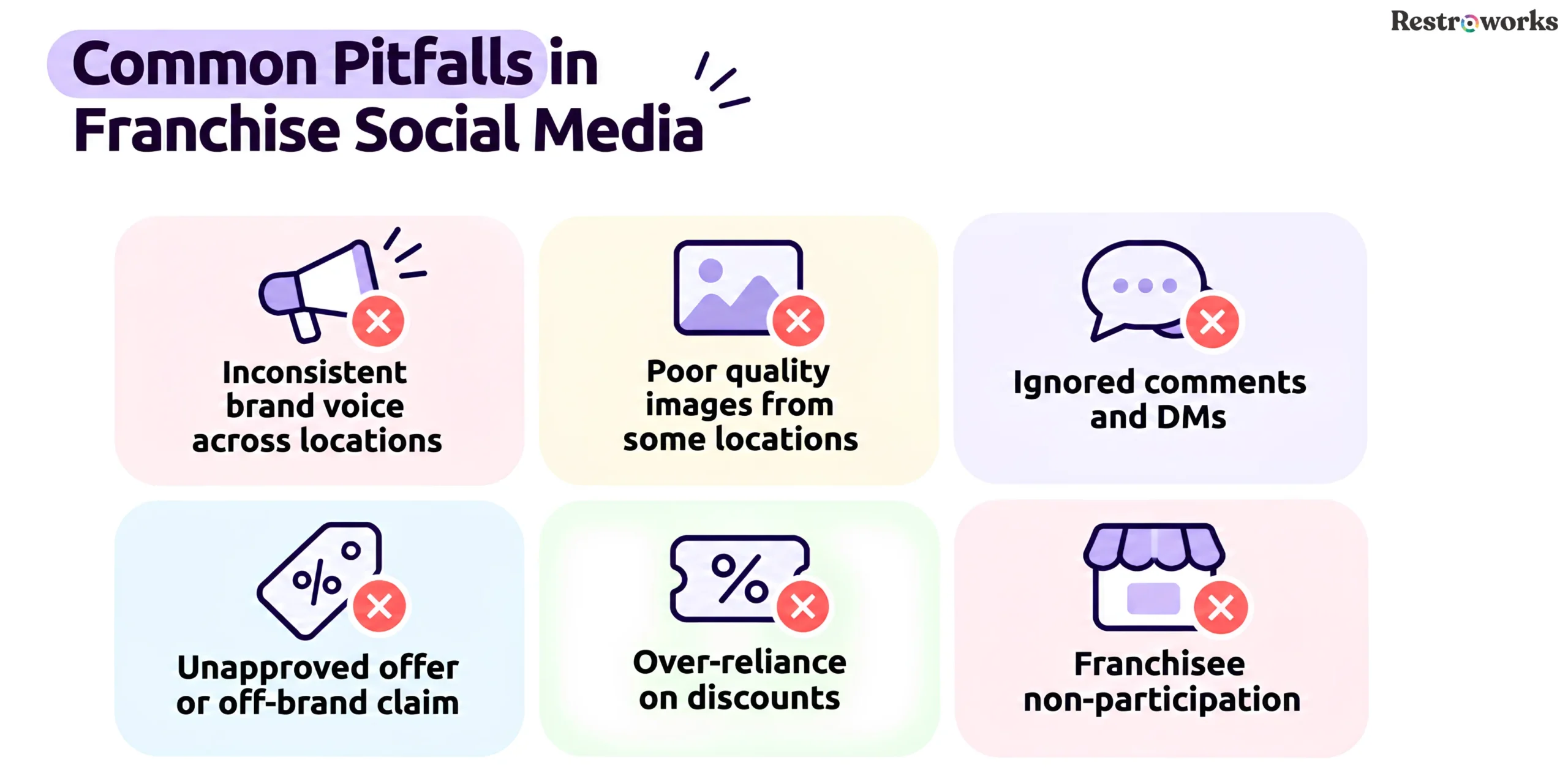
Every franchise system encounters these mistakes. Here is how to prevent them:
Inconsistent brand voice across locations → Distribute the tone guide and run quarterly refresher training
Poor quality images from some locations → Provide lighting kits, photo guides, and pre-approved stock photography as backup
Ignored comments and DMs on social media posts → Set response SLAs and monitor via analytics. Diners notice: in Toast’s 2024 survey, 43% called a restaurant’s responses to social comments very important and another 48% somewhat important.
Unapproved offer or off-brand claim → Require HQ approval for any offer post; build approval into your social media management platform
Over-reliance on discounts → Cap discount-related content at 15–20% of total posts; emphasize brand story, community, and food content instead
Franchisee non-participation → Some operators will struggle to execute social competently regardless of training. The answer is better systems. Like, using templates requires zero social media expertise, and they still drive higher participation rates.
INDUSTRY INSIGHT
According to DoorDash’s 2026 Restaurant Industry Trends Report (including a survey of 3,001 U.S. consumers), 22% of consumers have used AI to choose a restaurant. So, what you should do is optimize your Google Business Profile and delivery-app listings, photos, and reviews so AI tools surface your locations accurately. Apparently, according to Yext research cited in the same report, listing sites like DoorDash account for more than 41% of the sources AI tools cite when recommending restaurants.
Your 90-Day Restaurant Social Media Implementation Roadmap
Phase 1: Foundation (Days 1–30)
- Audit presence across all locations (profiles, visuals, engagement rates, response times)
- Define target audience demographics by concept and geography
- Document tone, content pillars, and governance rules
- Build the social media kit, select your management platform, and establish content creation standards
- Write the franchise social media policy covering account ownership, permissions, approval workflows, and crisis protocols
Phase 2: Rollout (Days 31–60)
- Launch with a pilot group of 5–10 locations; deploy the 30-day content calendar
- Begin outreach to local micro-influencers for pilot locations
- Activate user-generated content collection (branded hashtags, table tents)
- Start paid geo-targeted ad campaigns; train pilot franchisees via webinar
Phase 3: Optimization (Days 61–90)
- Measure pilot results: engagement, foot traffic, online orders, offer redemptions
- Share “play of the month” findings with the full system
- Roll out to remaining locations with refined templates and learnings
- Set quarterly review cadence for ongoing optimization
Start small. A phased approach measures impact before system-wide rollout; treat this as a living playbook, updated quarterly.
Franchise systems that lead share one trait: they treat social presence as infrastructure, investing in governance, tooling, and franchisee enablement the way they invest in kitchen equipment. The right strategy, executed consistently across every location, turns social media into your most measurable channel for customer acquisition, repeat visits, and attributable revenue.
Connecting Social to Your POS Data
Most social media measurement stops at clicks, impressions, and link-in-bio conversions. For restaurant franchise operators, this leaves the most actionable data on the table: the transactions your POS system captures at every location.
Location-level promo codes redeemed at POS are the cleanest attribution signal in restaurant social marketing. Assign a unique code to each campaign and each location, and your POS data tells you exactly which locations converted and which didn’t. No UTM guesswork, no last-click attribution gaps.
LTO menu sync is where social and operations intersect. A campaign that promotes an item before it’s live in the POS, or that runs after the item is discontinued, creates a customer service problem at the point of sale. Sync your campaign calendar with your POS menu management system before any LTO campaign goes live.
Loyalty capture via social closes the loop between first-touch awareness (an Instagram Reel) and long-term value (a loyalty member whose repeat visits you can track). Every social campaign should carry a loyalty enrollment CTA: a link-in-bio, a QR code at the table, or a post-visit email triggered by the POS. Operators using integrated POS and loyalty platforms can attribute a social-driven first visit to a loyalty member’s six-month LTV, not just a single cover.
Multi-location analytics require consistent POS reporting structures before social attribution is meaningful. If two franchisees categorize a delivery discount differently in their POS, aggregating “promo code redemptions from social” across the system is unreliable. Standardize item categories, discount types, and order channel labels before building a cross-location dashboard.
Social media drives intent. Your POS captures the conversion. Connecting the two, through promo codes, menu sync, loyalty enrollment, and unified reporting, is how franchise operators build a business case for every dollar in the social budget.
KEY TAKEAWAYS
- Franchise social media works best as two coordinated layers: HQ owns brand campaigns, templates, and crisis response, while franchisees handle local content inside clear guardrails.
- Settle governance before content: account ownership, tiered approvals, crisis escalation, and staff posting rules belong in writing, ideally in the franchise agreement, before a location goes live.
- Match platforms to each concept and each location’s real production capacity, starting with the essentials and adding video-heavy channels only when someone can sustain them.
- Make participation easy and consistent with shared content pillars, a two-tier calendar, ready-made templates, and a written co-op split, so every location publishes on-brand without starting from scratch.
- Measure at both the brand and the location level, and connect social activity to real outcomes such as promo code redemptions, online orders, and loyalty sign-ups in your POS.
Frequently Asked Questions
1. Who owns social media accounts when a franchisee leaves or sells?
Account ownership should be resolved in your franchise agreement before a location ever opens, not after the sale is signed. Brand-owned pages (Facebook Pages tied to the corporate page, Instagram pages created with the brand handle) should be administered by a corporate account, with the franchisee added as an editor, never as admin. When a franchisee exits, the corporate admin removes their access; the page, its history, and its followers stay with the brand. If the franchisee created the account independently and you lack admin access, recovering it is a legal and technical dispute that takes months and may be unwinnable. Audit account ownership annually.
2. Can franchisees run their own social media ads independently?
This depends on your franchise agreement and co-op structure. Most systems allow location-level paid social (boosted posts, geo-targeted lead ads) within brand-approved creative and offer parameters. What typically requires HQ approval: ads that name a price, ads that use brand imagery beyond the supplied asset library, ads targeting another franchisee’s geography, and any ad that modifies a national campaign’s core message. The safest structure: franchisees fund local ad spend through a pre-approved pool, use HQ-supplied creative, and submit offers for approval before boosting. Multi-location platforms such as Rallio and SOCi build this approval workflow into the posting tool, so offers are reviewed before they go live rather than after.
3. How much should a restaurant franchise spend on social media per location?
There is no single industry figure for social alone; social spend comes out of the local and co-op marketing layers. In a 2025 Franchise Update Media survey, most franchisors reported national marketing fund contributions of 1–2% of franchisee revenue, and among systems with a local, co-op or regional fund, most contributions ran 1–3%. Freddy’s is a concrete example: 2.5% to the national fund, with cooperative advertising up to 2% under its 2026 FDD.
The right split depends on your concept, market, and growth stage: new locations should weight local social heavily; mature locations can rely more on national campaigns. Track cost-per-cover or cost-per-order from social to set a location-specific efficiency floor.