
What Is a Franchise Restaurant? (Definition, How It Works, Pros & Cons)

What Is a Franchise Restaurant? (Definition, How It Works, Pros & Cons)

Home / Blog /
What Is a Franchise Restaurant? (Definition, How It Works, Pros & Cons)

Read summarized version with

Franchising has shaped the restaurant industry since 1925, when A&W began selling franchises and created what it calls the first franchise restaurant chain in America. Howard Johnson’s expanded the model in the 1930s, and Ray Kroc, who opened his first McDonald’s in Des Plaines, Illinois, in 1955, made it into a template that, from then on, every major QSR started to follow. 

Today, the U.S. restaurant industry spans more than 1 million restaurant and foodservice outlets, franchised and independent alike. Franchising is a large share of it; i.e., IFA and FRANdata’s 2026 Franchising Economic Outlook projects approximately 845,000 franchise establishments in the U.S. in 2026, and more than a third of them are quick-service or full-service restaurants. In fact, census survey data cited in the IFA’s January 2026 Value of Franchising report shows that franchise businesses, on average, reported sales 1.4 times as large as non-franchised businesses across all industries. 

That’s why, whether you’re evaluating a franchise investment or already running restaurants at scale, it is a must that you know how the model works (the economics, the obligations, and the real risks), to be exact. By the end of this guide, you’ll be able to estimate startup costs by restaurant type, compare franchise types, evaluate a Franchise Disclosure Document, and decide whether the model is right for you.

What You’ll Learn 

  • How the franchisor-franchisee relationship works, what it really costs to buy in, and which ongoing fees cut into restaurant margins.
  • How to read an FDD, compare brands, finance a location, and judge whether franchising or an independent restaurant fits your goals.

What is a Franchise Restaurant?

A franchise restaurant is a locally owned and operated restaurant that runs under the branding, menu, and operational systems of a larger parent company. Under the FTC Franchise Rule (16 C.F.R. Part 436), three elements define the relationship: the franchisor licenses a trademark, exercises significant control or provides significant assistance to the franchisee’s operations, and requires a payment in exchange. 

The franchisee is the independent business owner who pays an initial fee and ongoing royalties in exchange for the right to use the brand’s name, recipes, and proven systems. This structure is formally called business-format franchising, in which the franchisor licenses not just the brand but the entire operating system.

Let’s see some examples. Brands like McDonald’s, Taco Bell, Pizza Hut, and Denny’s all rely heavily on this model. In fact, approximately 95% of McDonald’s locations are franchised, not corporate-owned. Each location serves the same menu, uses the same branding, and delivers the same experience regardless of city or state. That standardization is the defining feature.

To be exact: A franchise restaurant is essentially a licensed copy of an established brand. You pay an upfront fee plus ongoing royalties to operate under a name customers already trust. McDonald’s and Subway are the most recognized examples in the U.S. The franchisor sets the rules; you run the location and keep the profit after fees. Below, we’ve discussed in detail the investment ranges, FDD guidance, and a framework for deciding if the model fits your goals.

To get started evaluating a franchise investment, request the brand’s Franchise Disclosure Document (FDD), verify your liquid capital meets the brand’s minimum requirement, and schedule a Discovery Day to meet the franchise development team in person.

How Restaurant Franchising Works: Franchisor vs. Franchisee
What is a Franchise Restaurant? How the model works?

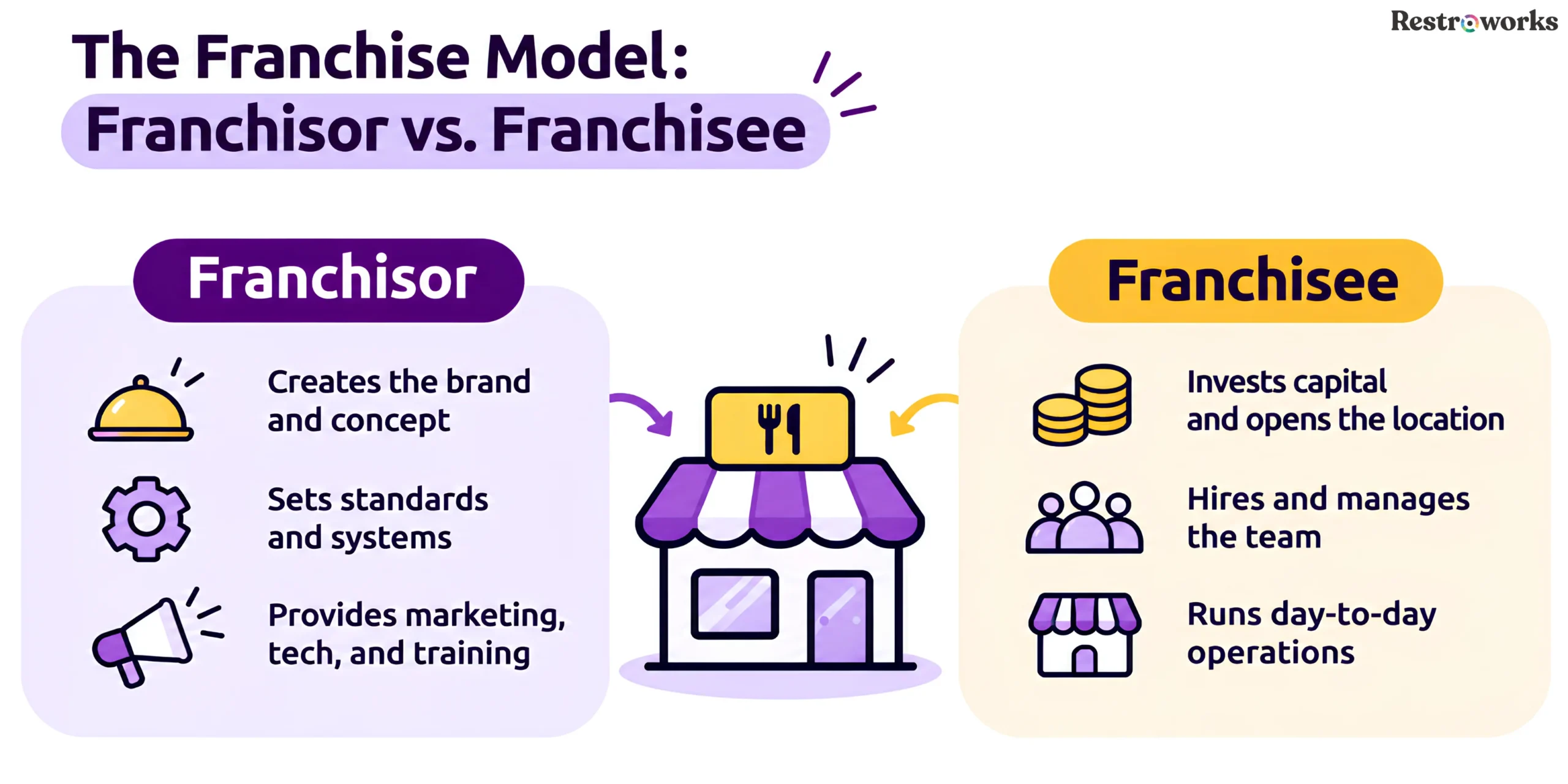
The franchise relationship is structured, contractual, and clearly divided between two parties with different obligations. Franchise agreements typically run 10–20 years. Understanding what each party owes the other is essential before committing to any brand.

The Franchisor’s Role

The franchisor develops the restaurant concept, owns the intellectual property, and builds the systems that make expansion scalable across hundreds or thousands of locations. This includes setting operating standards, running national marketing campaigns, providing technology platforms, negotiating supplier contracts, and delivering training. 

McDonald’s, for example, trains franchisees through Hamburger University, a structured curriculum covering operations, food safety, and management before any location opens. Yum! Brands (parent of Taco Bell and KFC; it sold Pizza Hut in September 2026) similarly operates a proprietary technology platform, Byte by Yum, that supplies ordering, POS, and kitchen systems across its brands. 

Franchisors also manage the brand’s collective reputation. One location’s poor performance affects every restaurant in the network. Franchise owners must follow the operations manual in detail and cannot change the menu, suppliers, or branding without approval. Franchisors may recommend prices, but franchisees in most U.S. systems set their own menu prices. 

Failure to comply can result in franchise termination or non-renewal, a consequence specified in the agreement and enforced regularly by established systems.

The Franchisee’s Role

The franchisee puts up most of the capital. They sign the franchise agreement, build out to brand specifications, hire and manage staff, and handle all daily operations. A typical franchisee’s pre-opening checklist (spanning roughly 8–18 months from application to opening) covers these stages:

  1. Secure financing and pay the initial franchise fee
  2. Complete site selection and lease negotiation (2–6 months)
  3. Execute build-out to brand specifications (typically a 3–6 month process after permits)
  4. Hire and train staff to the franchisor’s standards
  5. Pass the franchisor’s pre-opening inspection
  6. Execute the soft opening per the franchisor’s launch protocol

One concrete constraint: most agreements prohibit franchisees from sourcing local produce from unapproved suppliers without approval, even when local market conditions would justify it. 

Franchise Restaurant vs. Independent Restaurant: Key Differences

Understanding what separates a franchise from an independent restaurant explains why so many business owners choose the model despite its ongoing costs and constraints.

Factor Franchise Restaurants Independent Restaurants
Brand recognition Established from day one Built from scratch
Start-up speed Faster (proven playbook) Slower (built from scratch)
Creative freedom Limited by agreement Complete control
Ongoing fees Typically about 8% of gross sales (royalty + marketing fund) among the 100 largest restaurant franchises; many big brands charge 10%+ None
Support Franchisor + franchise network None unless outsourced
Financing access Easier (lenders do tend to favor franchises) Harder
Time to profitability Varies by brand and location Varies widely
Revenue data before you invest Item 19 of the FDD, when the franchisor provides it None; you build your own projections

The 1.4x sales gap mentioned above covers franchised businesses in every industry, not restaurants alone, so treat it as a signal about the model rather than a forecast for any one location. Brand-level performance is what matters, and Items 19 and 20 of each brand’s FDD are where you find it.

Restaurants stay hard to run under either model. In the National Restaurant Association’s 2026 State of the Restaurant Industry report, 42% of operators said their restaurant was not profitable in 2025. That figure covers all operators, franchised and independent alike, so individual results depend heavily on brand selection, location, and execution.

Margins are thin, too. The NRA’s 2025 Restaurant Operations Data Abstract put median income before taxes at 4.0% of sales for limited-service restaurants and 2.8% for full-service restaurants. Royalty and marketing fees of roughly 8% of gross sales (the typical level among the largest restaurant franchises; many big brands charge more), calculated on revenue rather than profit, are about double that limited-service median, so small differences in fee structure have a big effect on what you keep.

Restaurant Franchise Business Model and Fee Structure
Restaurant Franchise Business Model and Fee Structure

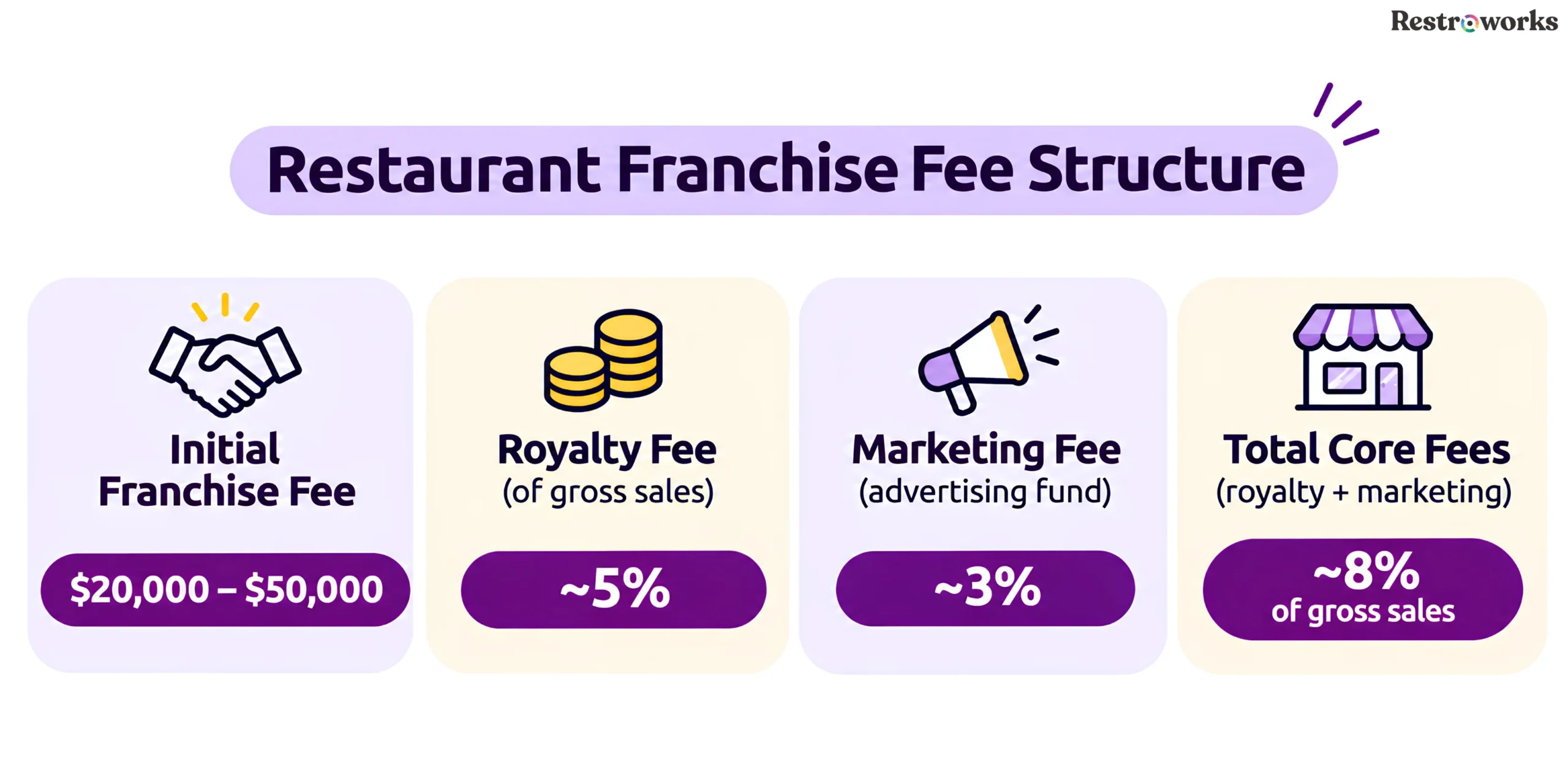
The economics of the model rest on shared revenue streams and long-term support obligations. Among the 100 largest restaurant franchises, a 2021 Restaurant Business analysis found that the typical royalty is 5% and the typical advertising fund is just over 3%. 

That gives a rough formula for the core fee burden: 5% royalty + 3% marketing fund = 8% of gross sales, before technology fees, local advertising requirements, and periodic remodel costs. Some systems charge well above that. Knowing the full cost structure is critical for any business owner evaluating franchise opportunities.

Startup Costs and Initial Investment

The initial franchise fee, the upfront payment for the right to operate under the brand, generally costs $20,000 to $50,000 across industries, according to Franzy, though some brands charge more and several restaurant brands charge less: Subway’s standard fee is $15,000, Jersey Mike’s is $18,500, and Chick-fil-A charges just $10,000. 

Total startup costs are a separate and much larger figure: total initial investment (fee + build-out + equipment + signage + opening inventory + working capital) runs from under $200,000 at the low end for a small Jersey Mike’s to nearly $5 million for a large Slim Chickens, based on current FDD Item 7 estimates. The franchise fee is one line item within that total, not the total itself.

Item 7 ranges for one well-known brand in each restaurant type show how widely costs vary:

Restaurant Type Example Brand Estimated Total Initial Investment (FDD Item 7)
Quick service (small footprint) Jersey Mike's (2025 FDD) $181,903 – $1,413,592
Fast casual Slim Chickens (2026 FDD) $1,188,900 – $4,944,000
Family dining Denny's (traditional diner, excludes land) $1.6 million – $3 million
Specialty/beverage Tropical Smoothie Cafe (end-cap and in-line cafes) $275,500 – $770,500

Delivery-only and virtual brands rarely publish a reliable, current Item 7, so ask any ghost kitchen franchisor for its latest FDD before comparing costs.

What drives variation within these ranges: real estate tier (A-market urban locations carry meaningfully higher build-out costs than suburban pads in smaller markets), format size (an end-cap conversion, meaning the end unit of a strip mall, vs. a freestanding building), and whether you’re converting an existing restaurant space or building ground-up. Ground-up builds consistently run more than conversions. Always compare your specific location’s Item 7 estimate (not the national range) before committing to a site.

Major startup line items include the franchise fee, real estate, build-out, equipment, signage, pre-opening training, opening inventory, and working capital before break-even.

To put these ranges in concrete terms: Subway’s 2026 FDD estimates an initial investment of $263,000 to $630,000. McDonald’s 2026 FDD puts total estimated costs at $1,472,000 to $2,807,000. Wingstop’s 2025 FDD estimates $298,200 to $1,013,500, excluding real estate purchase and lease costs. Comparing Item 7 across multiple brands before deciding is the single most useful financial step in the early evaluation process.

Ongoing Fees: Royalties, Marketing, and Additional Costs

Ongoing fees are where the real economics live. Franchisees pay royalties to the parent company as a percentage of gross sales, typically around 5% among the largest restaurant franchises, though some brands charge more (Subway charges 8%). 

Marketing fund contributions typically add 1–4% across industries, according to Franzy’s analysis of franchise fees, though large restaurant brands often charge more (Subway 4.5%, Taco Bell 4.25%, Wingstop 5.5%). 

Together, royalty and marketing usually come to about 8% of gross sales among the largest restaurant franchises before any other mandatory contributions, and well above that at some big brands. 

Some systems also have unusual structures. Chick-fil-A’s operator agreement takes a base fee of 15% of gross receipts (less equipment rent and a business-services fee) plus 50% of net profit, a much higher take than most systems. With an estimated $7.7 million average unit volume (AUV, or annual sales per location, per QSR Magazine’s 2026 QSR 50, based on 2025 sales), the model works for operators, but it’s a significant outlier in how the industry is typically structured.

Plus, there are some additional costs that new franchisees need to consider as well. These include: technology and POS platform fees, required local advertising spend beyond the national marketing fund, periodic remodel requirements, and training costs for new staff. 

Keep in mind that royalties are due on gross sales regardless of profitability. A slow January still triggers a full royalty obligation. Remodel mandates are frequently underbudgeted too; the franchise agreement sets when the franchisor can require one, so read that clause before you sign. All ongoing fees must be disclosed in Item 6 of the franchise disclosure document.

INDUSTRY INSIGHT

Did you know there are some hidden costs that you might need to bear in the future even if you’ve read Item 7? For the record, technology fees most often go up after you’ve signed the agreement. 

Brands that roll out new POS, ordering, or delivery platforms often pass those costs to franchisees through revised technology agreements, and the new fee structure may not have existed when you read the original Item 7. Similarly, annual brand conference attendance is mandatory at some systems and often omitted from initial projections. Plus, required contributions to a national advertising cooperative can increase as the system grows.

What you should do in such a case is budget a 10–15% contingency above your Item 7 estimate to absorb these variables in your first three years.

Financial Requirements: Net Worth and Liquid Capital

Most franchisors require prospective franchisees to meet minimum financial thresholds, and those thresholds vary widely by brand. McDonald’s typically requires at least $750,000 in non-borrowed personal funds. Taco Bell’s published requirements are $2 million in liquid cash and a $5 million net worth. At the other extreme, Chick-fil-A asks operators for $10,000 for the initial franchise fee.

In such cases, SBA loans are a common financing path for qualified franchise owners, as lenders favor brands with proven track records. 

Top Franchise Restaurants in the United States

The U.S. franchise restaurant industry is dominated by a few large systems. Understanding how the major brands are structured and how they compare helps prospective franchisees set realistic expectations.

Brand System Size Initial Investment (approx.) Royalty Notes
McDonald's ~13,700 U.S. restaurants (end of 2025) $1.47M – $2.81M 5% of gross sales (4% for some existing restaurants) Most franchisees also pay McDonald's rent based on sales
Subway Fewer than 19,000 U.S. restaurants (end of 2025) $263K – $630K 8% of gross sales Advertising fund adds 4.5% of gross sales
Chick-fil-A 3,000+ restaurants (incl. Puerto Rico and Canada) $10,000 initial fee (Chick-fil-A owns the restaurant and real estate) 15% of gross receipts (less equipment rent and services fee) + 50% of net profit Estimated $7.7M AUV (QSR 50 2026)
Taco Bell ~7,800 U.S. restaurants (end of 2025) $935K – $4.31M (inline/endcap to traditional) 5.5% of gross sales Marketing fee adds 4.25% of gross sales
Wingstop ~2,700 U.S. restaurants (mid-2026) $298K – $1.01M (excludes real estate) 6% of gross sales Ad fund adds 5.5% of gross sales

Investment and fee figures come from each brand’s most recent FDD as reported by franchise-industry publications; unit counts come from McDonald’s, Yum! Brands and Wingstop SEC filings and Chick-fil-A’s own website; AUV comes from QSR Magazine’s 2026 QSR 50. Every brand’s Item 7 and Item 6 are the authoritative sources; use those documents, not summary tables, for any investment decision.

Types of Franchise Restaurants

The model spans many formats. Each brings different costs, margins, and lifestyle requirements for franchise owners.

Quick service restaurants (QSR), including fast food chains like McDonald’s, Burger King, and Taco Bell, are the most recognizable. QSRs feature limited menus, counter service, and drive-thru windows. Bureau of Labor Statistics data shows limited-service restaurants employ about 4.6 million people, out of roughly 12.4 million in food services and drinking places overall. Within franchising, quick-service is the largest single business line: the 2026 Franchising Economic Outlook counts approximately 281,000 QSR franchise establishments, about a third of all U.S. franchise units.

Fast casual restaurant franchise concepts like Panera Bread and Slim Chickens sit between fast food and full-service. They offer a strong digital presence, a growing customer base, and loyal customers who follow the brand across locations. Note: Chipotle does not franchise in the U.S.; it owns and operates all its U.S. and Canadian restaurants. It is an example of a fast-casual chain, not a fast-casual franchise opportunity.

Casual dining franchise restaurants like IHOP, Chili’s, and Denny’s offer full table service and larger menus. These require bigger kitchens, more front-of-house staff, and significantly higher startup investment.

Specialty and beverage franchise restaurants (coffee chains, smoothie brands like Tropical Smoothie Cafe, and dessert concepts) offer smaller footprints and lower startup costs, making them accessible entry points for first-time franchise owners.

Ghost kitchen and virtual brand restaurants allow expansion through delivery-only operations with minimal real estate investment. Market-size estimates for ghost kitchens vary widely depending on the research firm and on whether they measure the U.S. or the world; IBISWorld puts the U.S. ghost kitchen market at $2.9 billion in 2025.

Key Advantages of Restaurant Franchising
Key Advantages of Restaurant Franchising

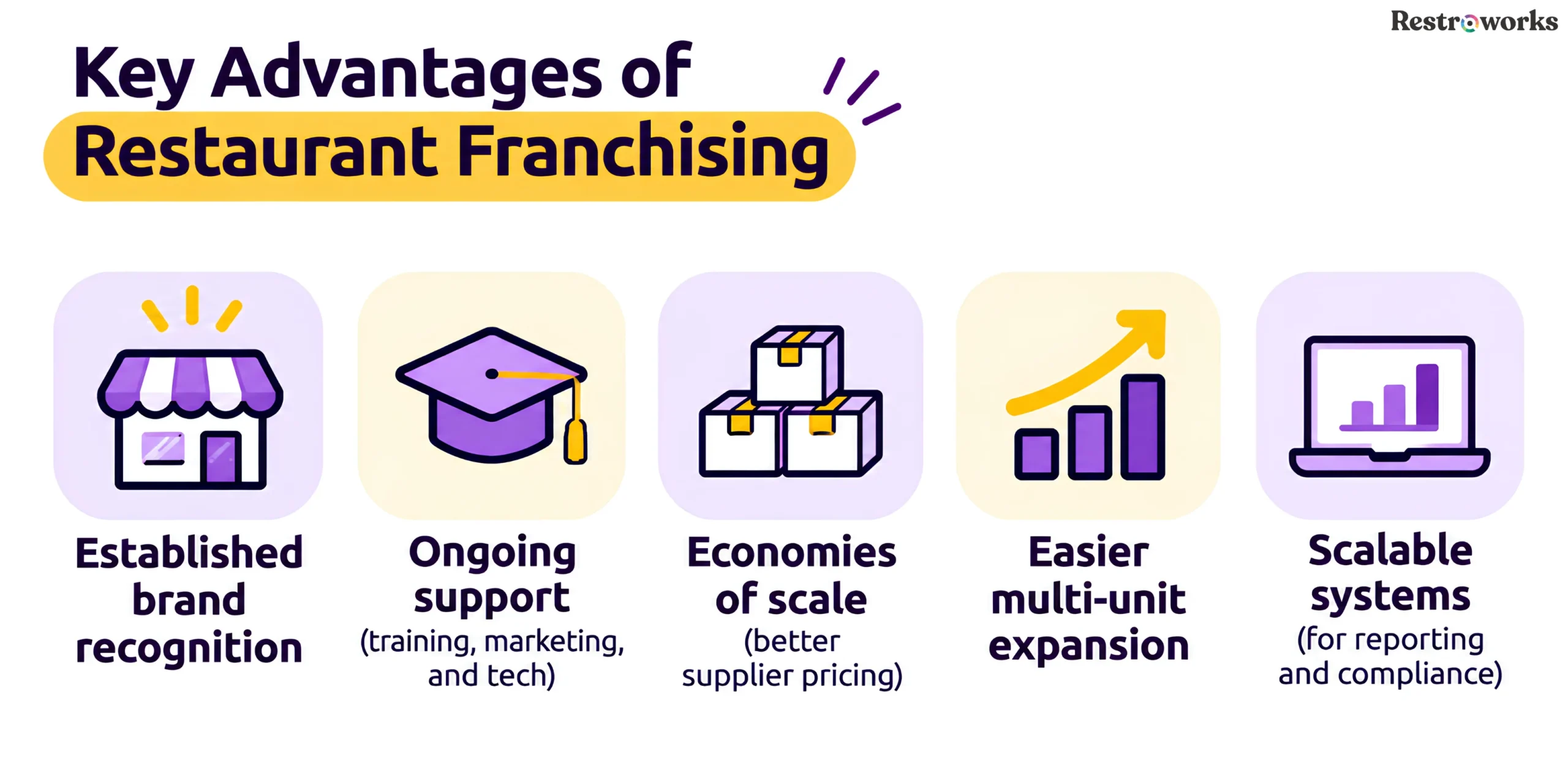
Many business owners choose the franchise model because it combines independence with a proven operating blueprint that reduces the guesswork of starting from scratch.

Established brand recognition means sales ramp up faster from day one. New franchisees receive ongoing support: training, marketing assistance, co-op marketing programs, technology platforms, and real estate guidance. Collective buying power delivers economies of scale that independent operators cannot match. A franchise system negotiating ingredient contracts across thousands of locations can achieve significantly lower per-unit costs than any independent operator.

Successful franchise owners often expand into multi-unit ownership. Marketing support, business systems, and franchising infrastructure all scale with each additional location. 

How Franchise Systems Standardize Operations and Technology

One structural advantage of franchise systems that prospective owners often underestimate is the operational infrastructure they inherit. Franchisors mandate specific POS platforms, inventory systems, and reporting tools across every location.

In practice: a new McDonald’s franchisee plugs into McDonald’s proprietary POS system, centralized menu management, and national supply chain from day one. Yum! Brands supplies its proprietary Byte by Yum platform, which integrates ordering, POS, and kitchen management across Taco Bell and KFC. This standardization enables franchisors to push menu updates, LTO (limited-time offer) activations, and operational updates to thousands of locations simultaneously. 

For multi-unit operators, the reporting layer is the real operational advantage. Centralized dashboards give owners visibility into same-store sales, labor cost percentages, and food cost variance across all locations without building custom analytics infrastructure. Franchise POS mandates also simplify compliance auditing, allowing the franchisor to verify operational adherence to brand standards remotely through transaction data.

The flip side: when the franchisor rolls out a new platform (new POS, ordering kiosks, loyalty integration), franchisees bear the upgrade cost. These technology refresh costs are often not captured in the original Item 7 estimate, so ask current franchisees what the last system-wide upgrade cost them per location.

Franchise Restaurant Success and Failure Rates

Industry data on franchise success is more nuanced than the headline numbers suggest. Item 20 of each brand’s FDD reports annual counts of locations transferred, closed, terminated, or not renewed in each of the past three years; divide those counts by the number of units to calculate a turnover rate. As a rule of thumb, a turnover rate above 10% annually is a significant red flag worth investigating before signing. 

Revenue varies enormously by brand. In a 2021 Restaurant Business analysis, the median average unit volume (AUV, annual sales per location) among the 100 largest restaurant franchises was just over $1 million, while the strongest systems post several times that.

Returns depend on careful brand selection, strong location economics, and disciplined cost management, none of which are guaranteed by the franchise system itself.

Breakeven timelines vary significantly by brand unit economics. Chick-fil-A’s estimated $7.7 million AUV gives well-run locations a faster path to recovering the initial investment, despite the higher royalty structure; the combination of volume and brand premium can compress the payback period considerably. Lower-volume systems require longer runways.

The franchise fee amount tells almost none of this story. Unit volume and margin structure are the variables that actually determine payback period. Always calculate your own payback period from Item 7 startup costs and Item 19 median revenue before committing to a brand.

Challenges and Risks of Owning a Restaurant Franchise
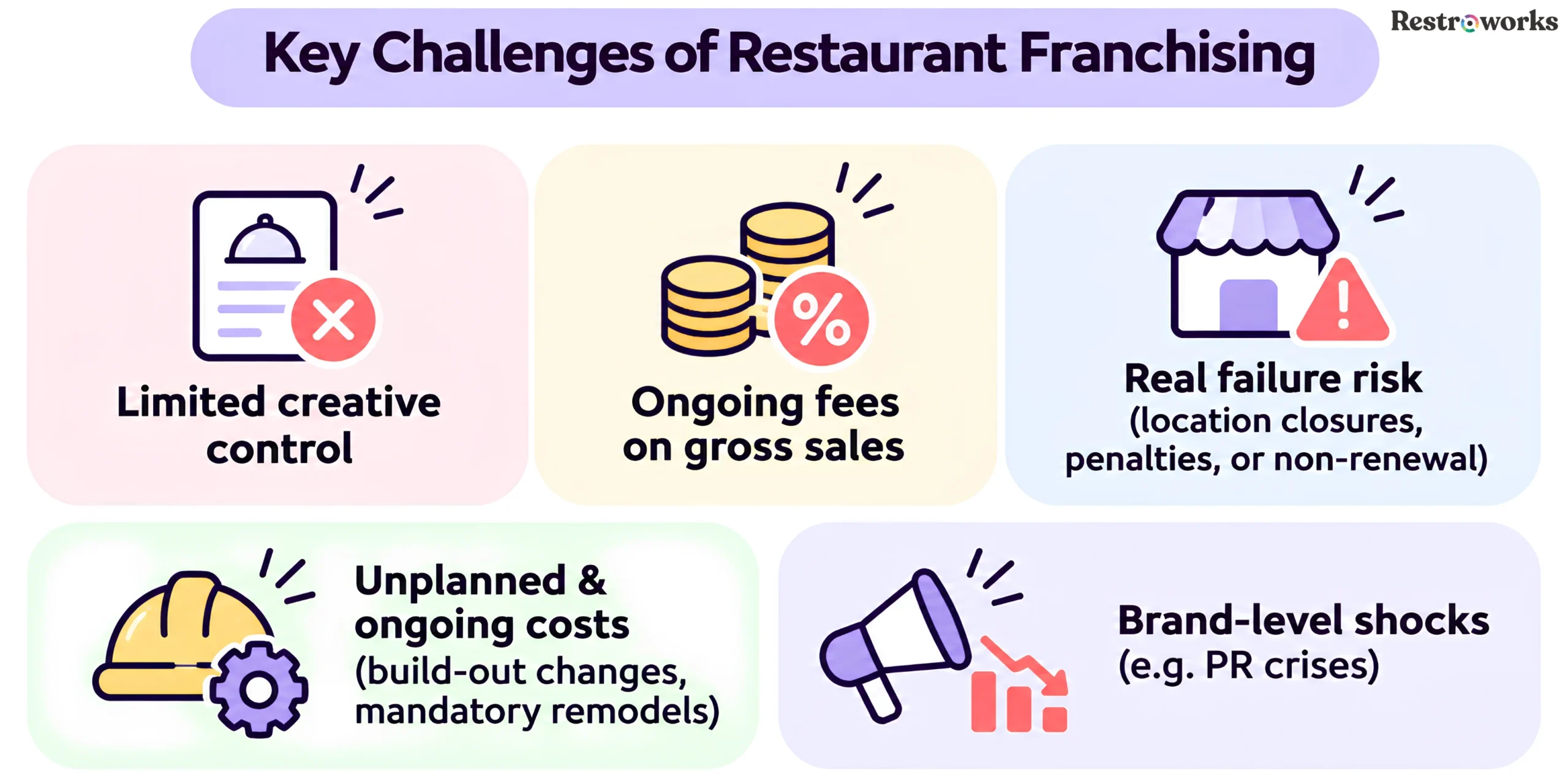
Challenges and Risks of Owning a Restaurant Franchise

Franchise restaurants are not guaranteed successes. The NRA profitability data above is a reminder that restaurants are difficult to run regardless of model.

Loss of creative control is the primary ongoing constraint. Franchise owners cannot change branding, menus, or suppliers without parent company approval. Even a local promotion or seasonal menu addition typically requires franchisor sign-off.

Financial pressure from fees calculated on gross sales (not profit) is structural. Even in a down month, royalty fees are still owed on whatever sales were generated. Royalty and marketing fees of around 8% of gross sales at a typical large brand (and 10% or more at some) are a significant burden against the thin restaurant margins described earlier. 

Real failure rates deserve honest discussion. Individual locations fail. Territory saturation is a growing risk as systems mature. Repeated violations or missed performance benchmarks can trigger penalties or non-renewal. Prospective franchisees should review Item 20 of the FDD to understand turnover rates across existing locations.

Two patterns illustrate how costs compound in practice. First: a franchisee may budget accurately for the Item 7 build-out estimate, only to find the landlord requiring HVAC upgrades or ADA compliance modifications mid-construction. Those costs fall outside the franchise agreement and have no cap.

Second: franchisees who fall behind on mandatory remodel timelines can face franchise termination, because the agreement gives the franchisor authority to terminate for non-compliance, and the initial franchise fee is not refunded. These are disclosed risks that most prospective franchisees underweight when reading the FDD for the first time.

Brand-level shocks are a unique risk. A national PR crisis at the corporate level can hurt every location in the system, even the best-run ones. No amount of excellent local operations insulates any individual franchise from brand-wide reputational damage.

Franchise Restaurant vs. Corporate-Owned Restaurants

A restaurant chain is a broader term than a franchise restaurant. Many chains include both corporate-owned and franchised locations. In a corporate-owned operation, the parent company owns and operates every restaurant. Franchising allows companies to expand faster without bearing all the capital risk.

To find out whether a brand uses a hybrid model, check Item 20 of the FDD or the franchisor’s most recent 10-K filing. Both report the ratio of franchised to corporate-owned locations. Three real examples illustrate the range:

Brand Approx. % Franchised Notes
McDonald's ~95% franchised Corporate retains a small number of owned locations
Starbucks Licensed in the U.S., not franchised Starbucks uses a licensing model for U.S. locations (airports, grocery stores, etc.); these are not franchise agreements. International markets include franchise structures.
Chipotle Does not franchise in the U.S. Entirely corporate-owned domestically; has partner-operated international units but no U.S. franchise program

Understanding the ratio matters because a brand shifting from franchise to corporate (or vice versa) signals something about unit economics and system health.

Legal Agreements, Territory Rights, and FDD

The franchise agreement is the legal backbone of every relationship, defining terms, fees, obligations, and exit conditions. In the United States, the model is governed by both the franchise agreement and the Franchise Disclosure Document (FDD), and both require careful review before signing.

Territory rights and exclusivity clauses are among the most critical and overlooked elements. Territory may be defined by radius, ZIP codes, or population count, but exclusivity protections sometimes explicitly exclude delivery zones and online orders. Read your territory definition carefully.

In the U.S., franchisors must provide a Franchise Disclosure Document before selling any franchise. The FDD contains 23 standardized items. Four items deserve the most attention:

Item 7: Estimated Initial Investment: the full startup cost breakdown for your location, including all major line items. Compare Item 7 across multiple opportunities before deciding.

Item 19: Financial Performance Representations: the closest thing to real unit economics from existing operators in the system. Look at median performance, not averages. Ask: what percentage of locations hit these numbers?

Item 20: Franchisee Turnover Data: annual counts of transfers, closures, and terminations. High turnover rates signal systemic problems. A turnover rate consistently above 10% annually deserves deep investigation before signing.

Item 21: Audited Financial Statements: the franchisor’s own financial health. A financially stressed franchisor cannot deliver the support its franchisees depend on.

Steps to Buy a Franchise Restaurant in the United States

The process from initial interest to opening day typically follows six stages:

  1. Research and shortlist brands: Use Item 7 investment ranges, Item 19 unit economics, and Item 20 turnover data to compare 3–5 serious candidates.
  2. Complete the franchise application: Most franchisors screen for liquid assets, net worth, and business experience before advancing candidates.
  3. Receive and review the FDD: The FTC Franchise Rule requires franchisors to provide the FDD at least 14 calendar days before you sign a binding agreement or make any payment. Hire a franchise attorney to review it.
  4. Attend Discovery Day: An in-person or virtual meeting with the franchise development team; the franchisor evaluates you as much as you evaluate them.
  5. Sign the franchise agreement and pay the initial fee: Once signed, the agreement is largely non-negotiable. The initial franchise fee is typically non-refundable.
  6. Execute site selection, build-out, and pre-opening training: Site selection is the longest variable. Plan for roughly 8–18 months total from application to first customer.

SBA Loans and Financing Options for U.S. Franchise Buyers

Most new franchise buyers cannot fund the full initial investment from savings. SBA 7(a) loans are the most common financing path, and the SBA Franchise Directory lists franchise brands eligible for SBA financing, which simplifies underwriting. 

The SBA eliminated the directory effective August 1, 2023, then reinstated it effective June 1, 2025 under SOP 50 10 8. Most 7(a) loans max out at $5 million, with terms of up to 25 years when the loan finances real estate and generally 10 years or less otherwise. SOP 50 10 8 also restored a 10% minimum cash injection for start-up businesses, and the updated SOP 50 10 8.1, which applies to loans assigned an SBA loan number on or after October 1, 2026, keeps a 10% injection for new units, so plan on funding at least that share yourself. 

Other options include conventional bank loans (which usually require a larger down payment than SBA-backed loans), franchisor-affiliated lender programs (McDonald’s, for example, does not lend directly but has established relationships with national lenders), and ROBS (Rollover for Business Startups, which uses 401(k) funds without early withdrawal penalties). Each carries different risks and qualification requirements. Consult a franchise-specialized lender or financial advisor before committing to any financing structure.

Single-Unit vs. Multi-Unit Franchisee Models

Many successful franchise owners operate multiple locations. A single-unit franchisee typically works on-site daily and generates value through hands-on management. Multi-unit operators rely on general managers and systems to maintain consistency across locations.

Multi-unit franchisees often negotiate area development agreements (ADAs): rights to open a set number of restaurants within a defined territory over a set timeline. The ADA sets how many locations you must open and by when, and some franchisors reduce the per-unit franchise fee in exchange. Multi-unit ownership is the norm in quick service: FRANdata’s 2026 multi-unit report found that 83% of QSR franchise locations are run by multi-unit operators, compared with 57% of franchised units across all industries. 

Multi-unit franchising creates efficiencies and accelerates growth, but also compounds risk: a second location doubles your capital exposure if the first hasn’t fully stabilized. A concrete scenario: if your first QSR required a $400,000 total investment and you sign an ADA for two more before year two, your total exposure reaches $1.2 million, before any of the three locations has reached breakeven.

Timeline: From Signing to Opening a Franchise Restaurant

Stage Typical Duration
Application, FDD review, and due diligence 4–8 weeks
Agreement signing 1–2 weeks
Site selection and lease negotiation 2–6 months
Build-out and construction 3–6 months
Pre-opening training 4–8 weeks
Soft opening to grand opening 2–4 weeks
Total estimated timeline About 8–18 months (from application) 

Site selection is the longest variable. Plan for the longer end of that range if your location needs ground-up construction. Most new franchisees underestimate permitting, build-out, and early marketing timelines.

Franchise Exit Strategies and Resale

Understanding how you exit a franchise investment is as important as understanding how you enter it. Franchise agreements typically include a right of first refusal for the franchisor, and Item 6 of the FDD discloses the transfer fee you’ll pay when you sell.

Franchise restaurant resale prices are usually quoted as a multiple of seller’s discretionary earnings (SDE), the owner’s profit plus any personal expenses run through the business. Four factors that most directly affect what your location will sell for: 

  1. Remaining lease term (a lease with 10+ years remaining is more valuable than one expiring in 3 years)
  2. Recent renovations and compliance status with current brand standards
  3. Trailing three-year same-store sales growth
  4. Item 20 transfer history for the brand; a system with frequent, smooth transfers signals a healthy resale market.

Always seek legal and financial advice before signing any franchise agreement, and review the parent company’s financial statements in Item 21.

How to Evaluate a Franchise Restaurant Opportunity

Start with financial readiness: do you have the liquid assets for startup costs plus 3–6 months of operating losses? Then apply a structured evaluation framework:

Red flags to screen out:

  • Item 20: franchisee turnover exceeding 10% annually
  • Item 19: median revenue below the breakeven threshold calculated from Item 7 startup costs
  • Franchisor operating for fewer than 5 years or with declining system size
  • Territory definitions that exclude delivery zones without clear explanation

Due diligence questions to ask current franchisees:

  • How long did it actually take to reach profitability?
  • How responsive is the franchisor’s support team when problems arise?
  • Were remodel costs and timing accurately disclosed upfront?
  • Would you sign this agreement again?

A weighted scoring approach: Rate each brand you’re evaluating on five criteria: (1) Item 19 unit economics vs. Item 7 startup costs, (2) Item 20 turnover rate, (3) brand growth trajectory (system size trend over 3 years), (4) franchisor financial health (Item 21), (5) territory protection terms. Score each on a 1–5 scale. A total score below 15 out of 25 warrants serious scrutiny before proceeding.

Is a Franchise Restaurant Right for You?

The franchise model offers significant advantages over building from scratch: established brand recognition, a proven operating system, marketing support, and access to a network of experienced operators. But the same systems that provide support also limit your freedom.

Use this self-assessment framework to evaluate your fit:

Dimension Franchise-Favorable Review Carefully Independent-Favorable
Available capital $250,000+ liquid (major QSR brands require far more) $100,000-$249,000 liquid (limits brand options) Under $100,000 liquid
Risk tolerance Prefers proven systems Moderate risk tolerance Comfortable with high uncertainty
Creative control Fine with brand guidelines Okay with some restrictions but there should be room for local marketing Needs full menu/concept control
Management experience Limited restaurant background, but solid business or management experience Some restaurant or supervisory experience, but no P&L ownership yet  Experienced independent operator 
Growth goal Multi-unit scale One or two units, open to more later  Single high-concept location

If you score 4 or 5 in the franchise-favorable column, the model likely fits your profile. If you score 4 or 5 in the independent column, the constraints of a franchise system may frustrate you more than the brand recognition helps you. If most of your answers fall in the middle column, talk to current franchisees of the brands you’re considering and review Items 7 and 19 of their FDDs before committing.

Also mind that royalty fees reduce net margins: McDonald’s charges 5% of gross sales (4% for some existing restaurants), plus rent based on sales; Chick-fil-A takes 15% of gross receipts plus 50% of net profit. The parent company’s brand decisions affect your locations regardless of how well you operate locally. Success in the model depends on selecting the right brand, the right market, and the right financing structure, then executing within the system rather than against it.

Your Next Steps: From Research to Restaurant Owner
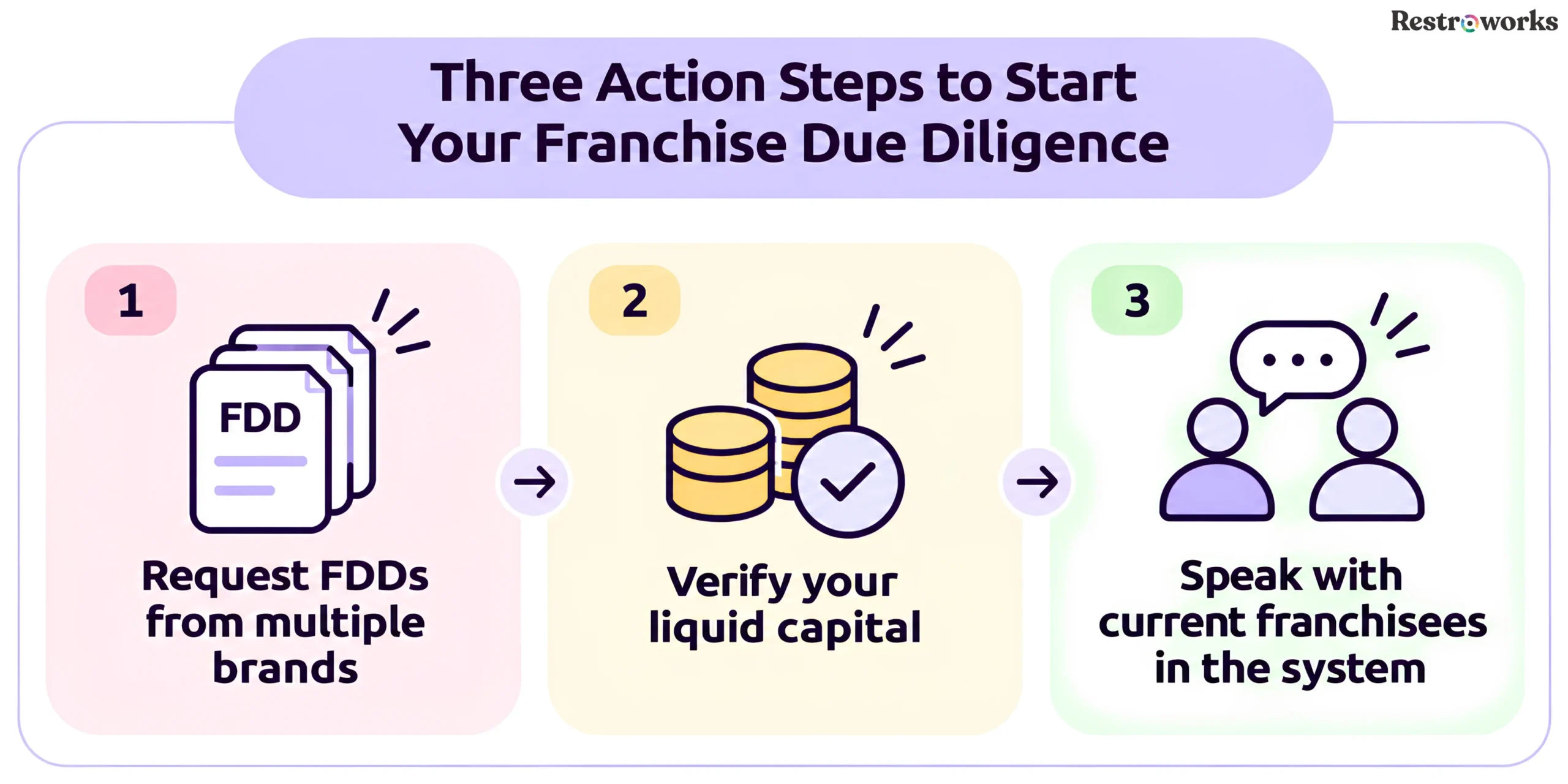
Three concrete actions that move you from research to real due diligence

If you’ve worked through this guide and the model fits your profile, three concrete actions move you from research to real due diligence:

  1. Request FDDs from multiple brands. Target brands in your investment range and market type. Download each brand’s current FDD from the franchisor directly, or through state franchise registries; California’s DFPI, Wisconsin’s DFI, and Minnesota’s CARDS database are among the most accessible public sources. The FTC requires franchisors to hand you the FDD, but it does not publish them. You’re looking for Item 7 (total investment), Item 19 (unit economics), and Item 20 (turnover data). Compare them side by side before speaking to any franchise development representative.
  2. Verify your liquid capital. Most serious franchise opportunities require verified liquid assets at or above the brand’s stated minimum (usually listed on its franchising website or application; Item 7 shows the total investment estimate) before you can advance in the process. Know your number before you start, so you’re evaluating realistic options rather than aspirational ones.
  3. Speak with current franchisees in the system. Item 20 gives you the data; franchisees give you the texture. Ask specifically: how responsive is franchisor support when problems arise, were remodel costs and timing accurately disclosed, and would they sign the same agreement again? Their answers will tell you more than any Item 19 projection.

The franchise model rewards preparation. The operators who struggle most are those who moved quickly on brand enthusiasm without completing FDD review or talking to enough existing franchisees. The ones who succeed typically spend several months in diligence before signing anything. 

KEY TAKEAWAYS

  • A franchise restaurant is an independently owned business that licenses a proven brand and operating system in exchange for upfront and ongoing fees.
  • The model trades creative control for a recognized brand, established systems, training, and buying power, so it suits operators who prefer a proven system.
  • Total startup costs and ongoing fees vary enormously by brand, and fees are charged on sales rather than profit, so compare each brand’s numbers carefully against thin restaurant margins.
  • The FDD is the most important research tool: use it to compare startup costs, unit economics, turnover, and the franchisor’s financial health, then confirm what you find with current franchisees.
  • Success depends less on the franchise model itself than on choosing the right brand, location, and financing, and on having the capital and patience for a long road to opening and break-even.

Frequently Asked Questions

1. Is Chick-fil-A a Franchise?

Yes, Chick-fil-A is a franchise restaurant, but it operates under one of the most franchisor-controlled models in the industry. Chick-fil-A takes a base fee of 15% of gross receipts plus half of net profit, significantly higher than standard terms. The initial fee is just $10,000, one of the lowest in the category.

In exchange, Chick-fil-A handles real estate itself: franchise restaurants are operated but not owned by the franchisee. Chick-fil-A’s estimated $7.7 million AUV (per QSR Magazine’s 2026 QSR 50, based on 2025 sales) makes it one of the highest-performing systems in the United States. That performance is why prospective franchisees compete fiercely for a Chick-fil-A location despite the unusual profit-sharing structure.

2. What Is the Difference Between a Franchise and a Chain Restaurant?

A chain restaurant is any group of restaurants under common branding and standards, a label that says nothing about ownership. A franchise restaurant is a specific legal and financial structure: an independently owned location that licenses the brand and operating system from a franchisor in exchange for fees.

McDonald’s is both a chain and a franchise system: ~95% of its locations are franchised, meaning independently owned. Starbucks is a chain but not a franchise system in the U.S.; domestic locations are company-operated or licensed (not franchised). Every franchise restaurant is part of a chain, but not every chain restaurant is franchised.

3. Who Owns a Franchise Restaurant?

The franchisee, an independent business owner, owns and operates the location. The franchisor owns the brand, the trademarks, and the operating system. One important exception: Chick-fil-A retains ownership of the real estate and the restaurant itself; the franchisee (called an “operator”) licenses the right to run it and splits profit with the franchisor, rather than owning the asset outright.

4. Do Franchises Make Money?

Many do, but profit is not guaranteed. In the NRA’s 2026 State of the Restaurant Industry report, 42% of operators said their restaurant was not profitable in 2025, a figure that covers franchised and independent restaurants alike. NRA operations data puts median income before taxes at 4.0% of sales for limited-service restaurants. Revenue varies widely by brand: the median AUV among the 100 largest restaurant franchises was just over $1 million in a 2021 Restaurant Business analysis, while Chick-fil-A’s is estimated at $7.7 million. Profitability depends on brand unit economics, location costs, labor, and operational execution, so check Item 19 and Item 20 of each brand’s FDD before you invest.

5. Is McDonald’s a Franchise?

Yes. McDonald’s is one of the world’s largest franchise systems: approximately 95% of its roughly 13,700 U.S. restaurants are operated by independent franchisees. The franchisor (McDonald’s Corporation) owns many of the real estate sites and leases them back to franchisees, meaning franchisees pay both a royalty (5% of gross sales, or 4% for some existing restaurants) and rent based on sales. McDonald’s corporate-owned locations are a small minority, which McDonald’s says helps it develop and refine operating standards, marketing, and product strategies and give staff a venue for operations training. 

6. How Much Does It Cost to Buy a Restaurant Franchise?

Total initial investment runs from under $200,000 for a small Jersey Mike’s to nearly $5 million for a large Slim Chickens, based on current FDD Item 7 estimates. Initial franchise fees generally cost $20,000 to $50,000 across industries (several restaurant brands charge less, such as Subway at $15,000) and are only one line item. Full startup costs include real estate, build-out, equipment, and working capital. 

Ongoing costs include a royalty (typically around 5% of gross sales among the largest restaurant franchises), a marketing fund contribution (typically 1–4% across industries, often 4–5.5% at large restaurant brands), and fees for technology, training, local advertising, and periodic renovations. Financial requirements vary by brand: McDonald’s typically requires at least $750,000 in non-borrowed personal funds, while Taco Bell’s published requirements are $2 million in liquid cash and a $5 million net worth.

Newsletter subscription banner

Talk to a restaurant expert today and learn how Restroworks can help your business.

Request Demo >

Share

Discover More Insights to Power Your Journey

Wok, Code, Repeat: Angell Tsang on Building the Restaurant That Codes Its Own Tech

Most restaurant leaders buy their technology. Angell Tsang builds his. As Chief AI Officer and Co-Founder of Tso Chinese Takeout…

Best Cloud Kitchen Software in UAE for Smarter, Faster Operations 

What is the best cloud kitchen software in UAE? Well, that’s subjective. If I were running a cloud kitchen or…

Restaurant Franchise Accounting: Building a Scalable Financial Foundation

Restaurant franchise accounting is the financial architecture that determines whether a multi-unit group can scale or stall under its own…

What Is a Franchise Restaurant? (Definition, How It Works, Pros & Cons)

Franchising has shaped the restaurant industry since 1925, when A&W began selling franchises and created what it calls the first…

Social Media Strategy for Restaurant Franchises: 2026 Guide

Freddy's Frozen Custard & Steakburgers opened its 600th restaurant in October 2026, according to QSR Magazine. At that scale, the…

POS
Best restaurant POS software in Dubai
Best Restaurant POS Software in Dubai for Faster, Smarter Operations

The best restaurant POS software in Dubai is the one that handles UAE VAT, Arabic and English, and every delivery…

Join. Learn. Grow.

Sign up to receive the latest hospitality insights and stories straight to your inbox

Streamline your operations with Restroworks