

Restaurant owners work on razor-thin profit margins where a 2% swing in food costs, or a single improperly staffed weekend, can wipe out every gain made the week before. The numbers simply don’t lie. US restaurants operate on slim profit margins, with average net margins running between 3% and 5%, leaving almost no room to absorb the consequences of poor forecasting of restaurant sales.
“Given the margin for error in the hospitality industry, the capability to forecast demand and plan accordingly can help make or break an otherwise thriving restaurant,” notes Elizabeth Stacks, Content Expert at Crunchtime.
Restaurant forecasting software is specifically built to eliminate uncertainty from decision-making. It uses your historical sales data—alongside external factors like weather conditions, local events, and seasonality—to produce reliable predictions of future sales, customer traffic, and required stock levels. This creates smarter restaurant operations grounded in solid foresight. And that, at its core, is what forecasting restaurant sales is all about.
What You Will Learn
- The main benefits of restaurant forecasting software
- Understand what separates good sales forecasting from poor forecasting
- Help restaurant owners and managers decide when investing in forecasting software actually makes sense.
What Restaurant Sales Forecasting Software Actually Does?
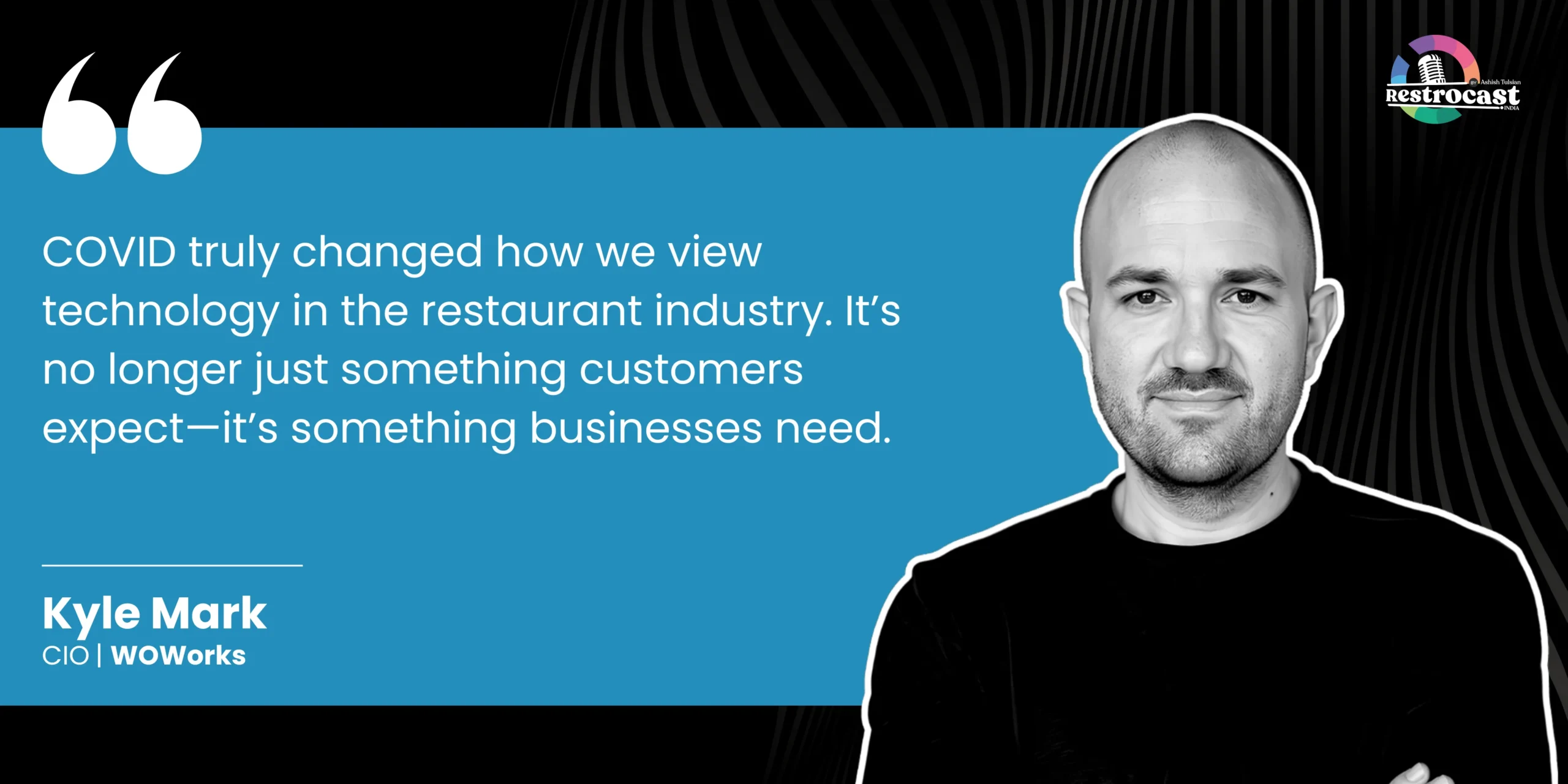
In the current era of technology, there have been numerous new advancements. Kyle Mark, CIO, Woworks reflects in his appearance on Restrocast how technology has changed post Covid.
Prior to discussing the advantages, it will be important to learn what is going on under the hood.
Sales forecasting software for restaurants studies your sales data gathered from your POS system, stock levels, and schedule entries. The software determines the way your sales have changed with regard to various days, periods, and seasons of the year. It considers both internal and external influences, along with holidays, events, weather conditions, and any other events that may have impacted your business.
“Forecasting in restaurants can drive smarter inventory ordering, more efficient scheduling and staffing, and improved cash flow management,” according to Herb Taylor, Industry Expert at EisnerAmper.
The advanced versions of AI integrate seamlessly into delivery systems such as DoorDash and Uber Eats, which implies that the forecasting process takes into account both the dine-in and delivery sides at once. Being able to analyze historical data together with real-world trends, these solutions enable business owners to make precise forecasts, which is impossible to achieve through any other means. Deloitte reports that 36% of restaurant operators think that AI can improve their business performance by making predictions, purchasing, and deliveries.
The Core Benefits of Restaurant Sales Forecasting Software
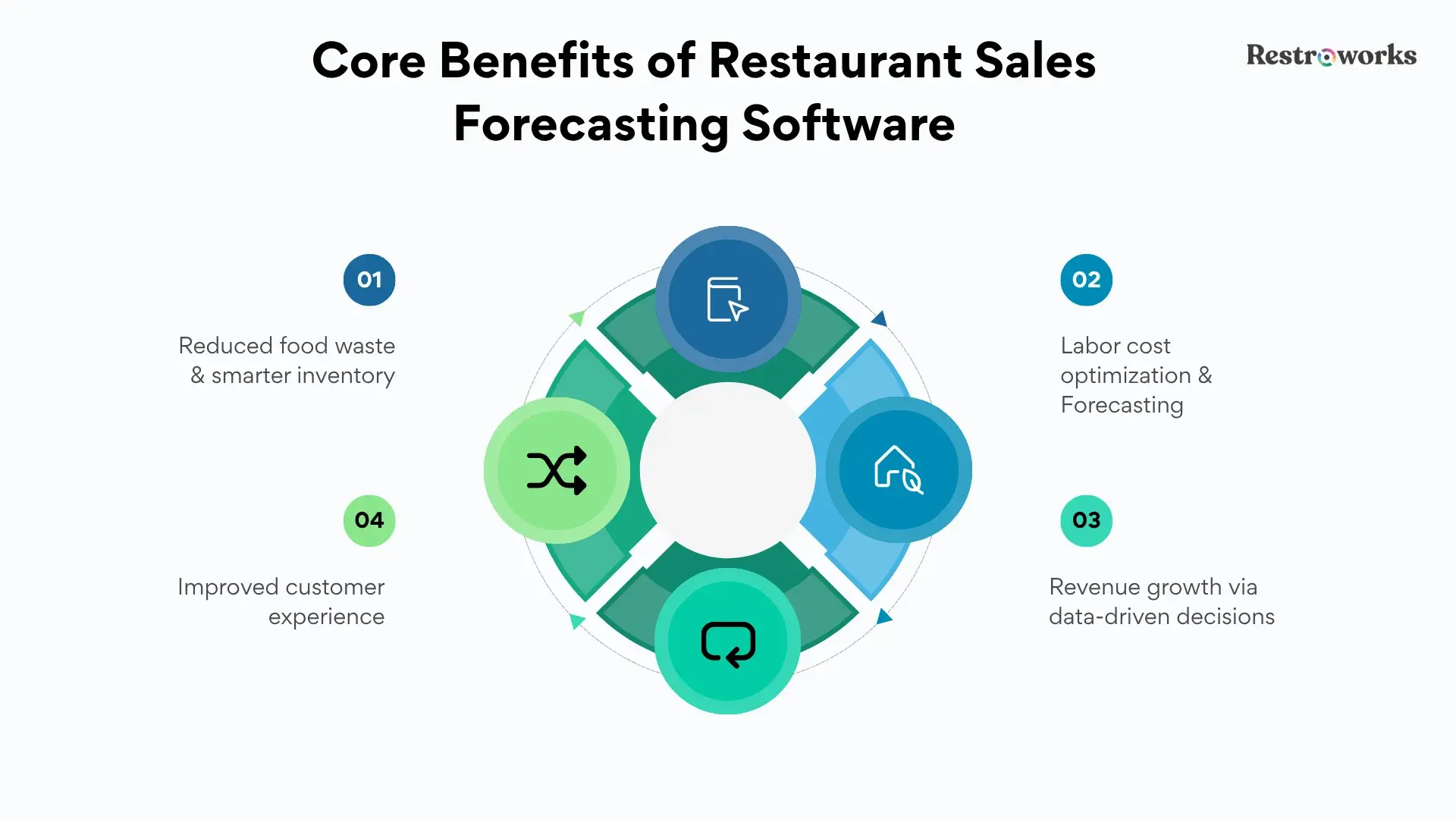
Reduced Food Waste and Smarter Inventory Management
One of the most avoidable costs in any restaurant business is food waste.
INDUSTRY INSIGHT
Stauff also puts the inventory ROI case in concrete terms: “For every dollar invested in improved inventorying and ordering practices, restaurants can achieve cost savings of approximately seven dollars.”This ratio shows that making precise forecasts for your restaurant is one of the most rewarding business decisions you can make.
By implementing the ClearCOGS AI demand forecast solution into its operations, a brand instantly improved its bottom line by 2%. Their response was: “To be honest, we couldn’t believe we were able to boost our bottom line instantly by 2%.” Given that this company was already operating on thin margins, this improvement was significant.
Improved Customer Experience and Satisfaction
Many restaurant owners don’t realize just how closely their restaurant forecasting processes are linked to customer satisfaction.
When restaurant sales forecasting is correct—that is, when you have enough staff to cook in-house on a busy Friday night—your tables will be turned around, wait times won’t be excessive, and your customers will go home happy. But if your forecasting is inaccurate and not enough staff are in the kitchen to cook what needs to be cooked, given the customer turnout, expect slow service, uneven food quality, and dissatisfied clients.
It’s the same thing with forecasting inventory levels. If people come to your restaurant expecting the signature dish but you run out halfway through service, they may choose something else off your menu or go home hungry. Either way, it does nothing to help build a satisfying dining experience or encourage repeat business.
Forecasts that allow you to accurately match demand lead to satisfied customers, and that’s because meeting customer demand leads to satisfaction. As reported by McKinsey, labor forecasting using AI recommendations is already improving restaurant operations for owners all over the world.
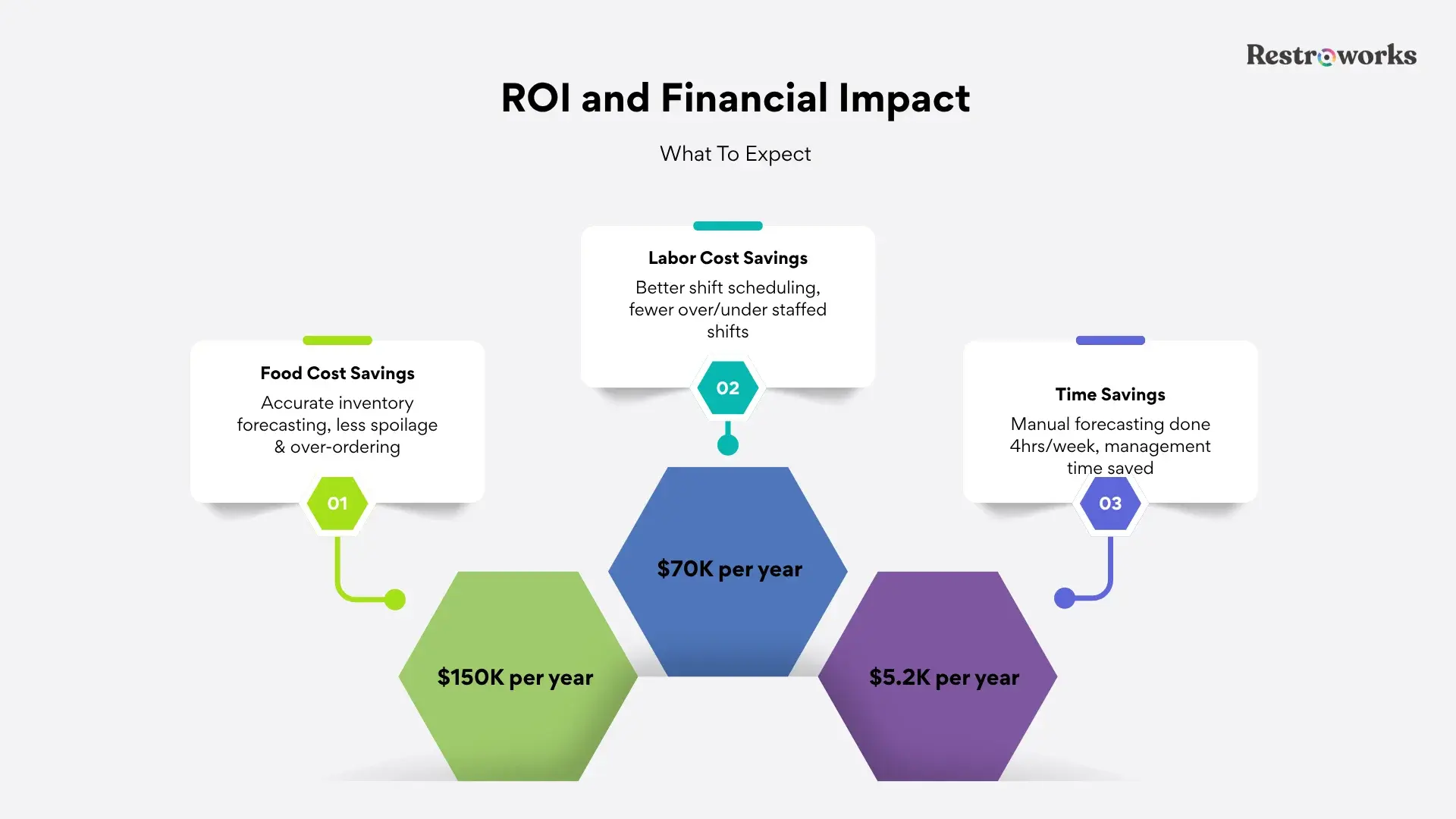
ROI and Financial Impact: What to Expect
“82 percent of restaurant business failures result from poor cash flow management skills or failure to understand cash flow mechanics,” claims Nick Stauff at Global Shared Services.
A good forecast system would solve this issue by generating accurate forecasts. If restaurant managers had these accurate forecasts, then they would be able to make cash flow forecasts, budget for purchases, and manage their business operations using facts and not conjectures.
Here is a realistic ROI framework for evaluating forecasting software:
Food cost savings
In case your restaurant makes one million dollars in food purchases annually, and you save fifteen percent of food waste via accurate inventory forecasting, you save $150,000 a year, even prior to considering anything else.
Labor cost savings
Labor cost accounting for thirty-five percent of your annual sales revenues totaling two million dollars, a ten percent improvement in labor forecasting means $70,000 annual savings.
Time savings
Sales forecasts without forecasting restaurant sales software take an average of four hours per week per manager, as stated by Elizabeth Stacks, CEO of Crunchtime. Assuming a $ 25-per-hour salary for the work performed by one manager, that means $5,200 per year in pure management time.
Assuming your two-million-dollar annual revenue restaurant is already running lean, the forecasted software, resulting in 15% food waste savings and 10% labor improvements, will deliver over $220,000 in benefits per year. Forecasting software costs between $200 and $600 monthly per restaurant location. The payback period here is between three and six months.
“Many restaurants achieve forecasting accuracy within a 3% to 6% margin with the right tools and systems,” according to Herb Taylor at EisnerAmper. At that accuracy level, projected sales are close enough to actual sales that operational planning becomes meaningfully more reliable than manual methods.
KFC achieved 95% forecasting accuracy after implementing cloud-based demand forecasting, immediately reducing both labor waste and inventory waste. Their own summary of the outcome: “Having a forecast you can trust is the first step in successful management of labor cost, food cost, and product availability and freshness.”
Manual vs Automated Forecasting: When to Switch
Many existing restaurants begin by forecasting restaurant sales manually, such as analyzing historical sales data in spreadsheets, reviewing past sales data week by week, and building sales projections in Excel. That approach is better than nothing, but it has real limitations.
“It takes an average of 4 hours for managers who manually calculate their sales forecast. Not only does this waste important hours, but manual forecasting is subject to inaccuracies, errors, and bias that may influence operations negatively,” says Elizabeth Stacks at Crunchtime.
Beyond the time cost, analyzing historical data manually makes it nearly impossible to account for all the internal and external factors that shape customer demand simultaneously. Incorporating local events, weather, seasonal trends, market trends, and delivery demand into a single coherent forecast requires capabilities most restaurant managers simply do not have the bandwidth to apply by hand.
Automated restaurant forecasting tools account for all of these factors, internal factors like historical consumption patterns and sales patterns, external factors like seasonal variations and local events, and produce accurate predictions with no manual calculation required. If you are spending more than two hours a week on the forecasting process, or if your actual sales regularly deviate significantly from your projected sales, it is time to move to dedicated forecasting software.
Implementation Considerations
Restaurant owners and managers evaluating forecasting software should address three practical questions before committing to a platform.
POS integration
Is the software compatible with your existing POS system? Seamless integration is key for precise forecasting since the software will need access to detailed sales history data, preferably down to an individual item and broken down by daypart. In some cases, older POS systems may require a custom-built API integration, which can increase implementation costs by $5,000 to $15,000.
Data availability
Advanced algorithms can generate valuable predictions from sales histories ranging from 3 to 6 months, along with environmental factors. But the more historical data the system can access, the better it will be able to determine sales trends and seasonal variations, as well as how any local events affect the volume of customers. If you have sales history gaps, organizing and cleaning up such data prior to integrating the solution will lead to precise projections from day one.
Adoption
The most frequent cause of failure in implementing any forecasting solution is the lack of staff adoption. In most cases, the problem does not lie in the capabilities of the software itself but rather in restaurant managers who fail to check projected sales numbers at the beginning of the week and use them.
Restaurant forecasting software is what moves a restaurant business from accidental to intentional. It lets restaurant owners analyze historical sales data and create accurate forecasts that drive smarter inventory management, better staffing, more effective marketing strategies, and sounder financial management. It gives restaurant managers the ability to predict future sales with enough confidence to plan ahead, rather than simply reacting to whatever the week throws at them. And it provides the operational foundation that any successful restaurant needs to grow without taking avoidable hits along the way.