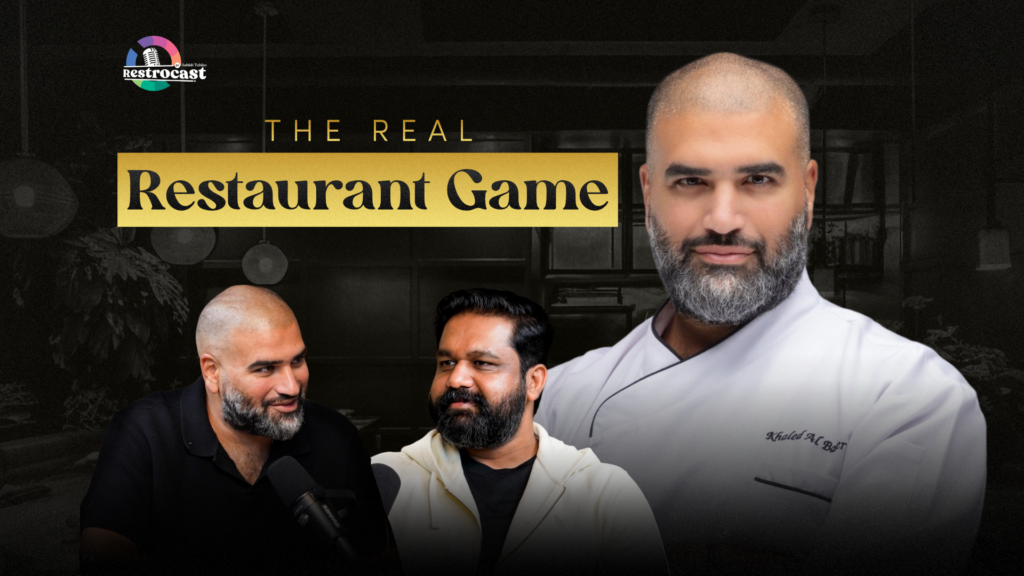

Restaurant careers don’t always start in kitchens. Sometimes they begin in boardrooms and spreadsheets, with the realization that you want to build value for yourself. In this Restrocast, Ashish Tulsian talks with Chef Khaled Albaker, co‑founder of Ventri Group, about earning credibility in food, creating brands with clear identities, and staying adaptable in a fast‑changing market.
At the center of the episode is a practical philosophy: restaurants succeed through detail, experience, and execution; and the operators who last are the ones willing to keep adjusting without ego.
How did your passion for food become a career?
Chef Khaled Albaker: I left my finance job, used my savings, and moved to Miami to study Culinary Arts at Johnson & Wales University. It wasn’t impulsive, I had actually discovered that same school years earlier, when I was 18, but couldn’t afford it then. Ten years later, I finally made it happen. Culinary school sped up my learning, but this industry is still about hands-on experience. You don’t need school if you’re willing to put in long hours in a real kitchen.
What did Miami and your time in professional kitchens teach you?
Chef Khaled Albaker: Working in South Beach under Danny Grant showed me the difference between just cooking and true craft. Great kitchens focus on every detail- portioning, slicing, timing, presentation, and service. Michelin-level kitchens run with surgical precision. I didn’t return wanting awards, but I did come back with a deep respect for discipline, detail, and high standards.
When you returned to Kuwait, were you ready to start your own restaurant?
Chef Khaled Albaker: Not at all. I thought I was ready, but I wasn’t. My first idea, a Kuwaiti taco arabe, had potential, but I knew nothing about suppliers, inventory, accounting, or operations. If I had opened then, I would have failed quickly. That’s why I joined MMC and worked at Meme Café as brand manager and executive chef. I needed real operating experience and industry depth before asking anyone to back me.
You’ve said you needed credibility before raising money. What did that look like?
Chef Khaled Albaker: For me, it meant learning every part of the business. I didn’t want to be the finance guy asking for investment without knowing how restaurants really work. So I worked across service, operations, nightlife, kitchens, and customer‑facing roles. That gave me confidence, credibility, and a clear perspective. By the time I met my partner and started Roto, I was far more prepared than I had been on my first attempt.
Tell us about the business you run today.
Chef Khaled Albaker: I’m the co‑founder of Ventri Group, which runs several food concepts in Kuwait like Yang Po, Dragon Bun, Roto, Little Ruby’s, Mike Mann Italian, and deli‑style formats. Some are dine‑in, others are cloud kitchens, because each concept needs its own model. What matters most to us is building brands with clear identities, not imposing a single approach on everything.
You have a strong view on dining out vs. delivery. How do you see the difference?
Chef Khaled Albaker: Delivery is about convenience. Dining out is about experience. Eating at home is practical, but it doesn’t carry the same emotion. A true dining experience starts before the food, with how you’re greeted, the atmosphere, the table, the menu, and the conversations. Some concepts work well for delivery, but others lose their soul outside the restaurant. That’s why I wouldn’t deliver Yang Po, it’s meant to be experienced in the room, not just eaten at home.
You also have a strong reaction to QR menus. Why?
Chef Khaled Albaker: Because a menu is part of the dining experience. I prefer physical menus; reading them builds anticipation. The names, design, and descriptions set the mood before you order. QR menus often reduce that moment to a transaction, and some dishes lose their story when shown only as pictures. Dining should start with curiosity and conversation, not just scrolling on a screen.
You still spend time on the floor yourself. Why is that important?
Chef Khaled Albaker: Because leadership has to be visible. I still greet guests, serve tables, recommend dishes, clear plates, and even mop the floor if needed. Nothing is beneath me. When the team sees that, it sets the tone, showing that the work matters more than hierarchy. It also matters for guests. If they visit a restaurant run by a Kuwaiti chef but never see the chef, something is missing. The human presence matters on both sides, with staff and with customers.
You’ve said there’s no single right answer in this business, only adaptation. What do you mean?
Chef Khaled Albaker: You adapt or you disappear. During COVID, while many shut down, we saw opportunities; cheaper locations, open investors, shifting timing. We expanded from three to eleven outlets, then later closed, flipped, and restructured as the market changed. There’s no fixed playbook. You have to keep reading the moment and adjusting.
How do you see the restaurant market in Kuwait today?
Chef Khaled Albaker: Kuwait used to be dominated by franchises, but that’s changed. Local concepts now lead in many categories and often outperform international brands. Customers actively seek out Kuwaiti chefs and homegrown ideas. Supporting local isn’t just talk, it’s real here, from dining experiences to suppliers. I think Kuwait is ahead of some neighboring markets in its support for local creativity, which has helped homegrown brands grow quickly.
What advice would you give someone entering the restaurant industry today?
Chef Khaled Albaker: Don’t enter casually; this business is tough. If you’re serious, come prepared with thick skin, a solid plan, market research, and a clear understanding of cash flow. Cash flow is everything; you can look profitable on paper and still fail if money isn’t managed. Discipline matters more than passion. Also, remember the industry has many paths- consulting, content, styling, photography, and product development. And if you do build a successful restaurant, reinvest. Don’t see one outlet in isolation—think bigger and build toward something lasting.
Conclusion
Khaled’s journey shows that building restaurants is never about shortcuts; it’s about detail, discipline, and adaptability. From kitchens in Miami to scaling brands in Kuwait, his philosophy stays clear: success comes when operators respect the craft, stay present with people, and keep adjusting as the market shifts.