
Crisis Management Plan for Restaurant Chains: Strategies to Protect Operations & Reputation

Crisis Management Plan for Restaurant Chains: Strategies to Protect Operations & Reputation

Home / Blog /  

Crisis Management Plan for Restaurant Chains: Strategies to Protect Operations & Reputation

Read summarized version with

Not to jinx, but what if your kitchen were on fire today? Seriously, how ready do you feel you are right now to handle the crisis? We’d bet most restaurant owners aren’t at least 90% of the time. Most often, they sit down on a Monday just to review how their previous week’s sales were, forecast for the upcoming days, pay the bills, and that’s it.

But then, let’s say, suddenly a fire breaks out, or a not-so-cliché example, a food influencer visits your restaurant, makes a reel of something that’s “not right,” your restaurant goes viral, you are held for inspection, and next thing you know, people out there are “canceling” you.  

And let me clarify this in very advance: if you thought you’d figure out what to do then in the moment, you won’t. You must already have a plan in place. Or, as I remember a line from one of the blogs I recently read, “You simply must have a crisis management plan. Don’t court a hellish crisis on the fly.”

How, though? This guide will let you double down on building the “right” crisis response.

What You’ll Learn

  • How can restaurant chains build a structured crisis management system?
  • What different types of restaurant crises look like & how should you respond to each?
  • How strong crisis communications and recovery strategies help protect customer trust and brand reputation?

How Different is Crisis Management for Restaurant Chains vs. Single Locations?

Well, running a restaurant chain does require a very different crisis management plan than running a single location. Why? Because imagine you run a small neighborhood restaurant, and one random evening, you find out that a customer has left a one-star review on Google because their pasta was cold, or maybe they found a hair in it. It would bother you, sure. Maybe you’ll even lose a few customers because of that review. You’ll later apologize, promise to fix the issue, and move on. 

Now, another scenario – you don’t have only that one restaurant, but let’s say, a restaurant chain with 200 locations across the country. 

At any one of our outlets in X city, a customer uploads a 20-second Instagram reel showing a cockroach/rat near your kitchen door. What do you think will happen at most? By morning, you’ll likely be getting calls from national media outlets, your franchisees, store inspectors, etc., etc. Not even that, but customers in Y and Z city who earlier reserved a spot at another one of our outlets will cancel the plan, because somehow a rat at X means there’s a possibility your team is not careful enough at any of 200 outlets as well. 

And that’s exactly what makes having an all-in-one crisis plan so much harder for restaurant chains.

INDUSTRY INSIGHT

Take this case of a global QSR brand that had been dealing with nearly 4 million social media mentions every year across its 15,000 restaurant pages simultaneously. Just one incident and customer complaints, spam, impersonator accounts, and offensive comments started piling up like no other. 

So the company completely rebuilt its social crisis response system, i.e., it introduced an AI-driven social care model powered by machine learning, automated prioritization, and dedicated social response teams operating for 18 hours a day.

As a result, the company could finally achieve a 400% year-over-year increase in productivity. Response times were cut in half, automation improved filtering efficiency by 20%, and teams were able to resolve more than 400,000 customer inquiries annually.

That’s the reality of crisis management at scale. At a single-location restaurant, you can walk out of your cabin and go personally calm the unsatisfied guest, but at a chain level, you’ll have to plan for who has the authority to speak publicly. Corporate, or the franchisee? If something goes wrong at X, do locations in Y have to shut down too? How will the cash flow be for the next few days? How do you keep your 500 managers from posting their own personal takes on social media while your legal team is still figuring out the liability?

In short, single-location operators need a good plan while chains need a system.

What are the Types of Crises that Impact the Restaurant Industry?

Before you can build any sort of plan, you need to understand what you’re even planning for because crises in food service don’t come in one type or flavor. For example, in 2013, an employee filmed a video of the Port Orange, FL location, storing raw meat (ribs, chicken, bacon, and hamburger patties) near the dumpster, purportedly while preparing for an inspection. Within 24 hours, the video had already accumulated 25,000 views, and later over 4 million and counting.

That was the case of “It only took one person and a six-second Vine clip to bring a multi-billion dollar company to its knees.”

More such incidents that triggered serious financial losses for respective chains and forced a change in food safety laws across the US restaurant industry are:

  • The 1993 E. coli outbreak at Jack in the Box sickened nearly 600 people and resulted in four deaths. 
  • Chi-Chi’s experienced the largest Hepatitis A outbreak in U.S. restaurant history in 2003, causing four deaths and hundreds of illnesses.
  • Pat & Oscar’s suffered an E. coli outbreak that same year. Over 40 illnesses. Sales dropped 70%, and they had to declare bankruptcy despite initial recovery efforts.
  • Wendy’s faced a manufactured crisis in 2005 when a customer falsely claimed to find a severed fingertip in a cup of chili. 
  • And who can even forget the 2020-22 global pandemic due to the outbreak of the coronavirus, when almost the whole market shut down for months at a stretch, and somehow, hospitality is still recovering from it.

Other than being in the headlines and losing customers, restaurant chains also face these types of crises, which are equally or sometimes even more disastrous for their reputation: 

Supply chain failures: According to the National Restaurant Association’s State of Restaurant Industry report, 96% of restaurant operators consistently report delays in supply chain deliveries. This is an obvious crisis because imagine your primary meat supplier is not responding, and all your 80+ locations depend on them for their upcoming event. How are you gonna find a new supplier immediately, and if you fail to do so, how are you going to face your customers tomorrow?

Staffing shortages: Data has it that 77% of restaurant operators struggle with the recruitment and retention of skilled cooks, chefs, and managers due to labor market pressures. This means you’re just one employee calling out your toxic work culture online away from a crisis. 

Then there is financial pressure. Restaurant prices have jumped close to 40% since 2019 because fewer customers now prefer to eat out, and even when they dine out, they overall spend less. In such situations, businesses that already don’t have contingency plans feel financially cornered and tend to make desperate decisions, which often do as well as they expect. 

Technology failures: The worst thing that can happen at any given time is your POS system suddenly showing an “error” while customers are placing or paying for their order, and there is a huge queue for you to now deal with manually. You know what happens next? Most of your customers will simply walk out without ordering, and you’ll lose their trust, revenue, and any opportunity to deliver a good customer experience in the future, too.

How do You Build a Multi-Tiered Crisis Management Team Structure?

As per the NRA, for pre-crisis preparation, “the first and most important step in forming a crisis management plan is to select a crisis management team.

Unfortunately, this is where most restaurants, especially growing chains, get it wrong. They don’t build a crisis team; instead, they just expect “management” to handle it. But when a crisis happens for real, “management” suddenly looks a lot like three people texting each other question marks on WhatsApp or Slack at midnight.

In response, establishing a crisis team with specific roles is essential as it allows for organized decision-making during emergencies. To be precise, a crisis team typically includes roles such as a food safety lead, vendor liaison, communications team, and legal advisor, each responsible for different aspects of crisis response, and all of which operate at three different levels. 

For Handling Corporate Crisis

At the top is an executive-level crisis command center. These are the people who actually have decision-making authority. They determine what the official response to a crisis will be. They personally coordinate with lawyers, insurers, regulators, and media outlets. They approve the messaging/the voice before it goes live. 

And according to the NRA, you should “assemble a crisis management team in advance to assess potential crises to your operation and develop plans of action to mitigate impact.” This team should ideally include:

  • The business owner and most senior managers
  • Risk managers
  • Facility and operations managers
  • Food safety and quality assurance specialists
  • Supply chain specialists
  • Legal counsel
  • Human resources and trainers
  • Marketing, PR, or communications specialists

Plus, don’t forget to invite outside contributors as well, like your insurance agent, a local fire department rep, the health department contact, etc. These people know and catch the blind spots more easily, so even if they can’t be on the team permanently, at least ask them to review your finished plan. 

Mind that within this structure, one of the most important roles is that of a crisis spokesperson. This person is authorized to give public statements to the media as and when a crisis happens. This ensures one message is circulated throughout rather than conflicting opinions of every outlet involved. 

Regional Crisis Coordinators

For any chain with dozens or hundreds of locations, they need a regional coordinators who can serve as the link between corporate decisions and on-the-ground reality. When a crisis strikes one region, the regional coordinator assesses which other locations might be affected, communicates corporate direction to local managers, and keeps the command center informed of what’s actually happening in the field.

Without this layer, the corporation ends up playing telephone with 80 different general managers, and the message mutates with every relay.

How Smart Restaurant Chains Control the Narrative During a Crisis?

How you communicate about the crisis matters just as much as how you handle it in practice. 

In fact, according to QSR magazine, “without a thorough, actionable crisis plan, communication missteps can have a lasting and damaging impact on your brand.”

Crisis communications is its own discipline, and for restaurant chains, it has to operate on two tracks simultaneously: internal and external.

Internal Communication

See, whether something good happens at any of your outlets or something bad happens, your employees are, anyhow, going to find out about it, if not from you, then from social media. And nothing creates panic faster than a team that feels left in the dark.

That’s why internal messaging systems should be established before any crisis happens. Be it through a group chain, a mass SMS capability, a messaging platform, or whatever it is, it needs to be ready. Because when something goes wrong, your staff shouldn’t be learning about it from a customer’s Instagram story.

What does the team tell staff when customers ask questions? That matters too. You should have pre-written simple, honest, and most importantly, consistent talking points ready at all times, with a clear instruction: all media inquiries go to the spokesperson. Period.

External Communication

With the 24/7 nature of today’s news cycle, the ability to quickly and effectively respond to a crisis is critical to protect your brand and recover your reputation.”

This means you can’t wait. When a crisis strikes, you need to respond quickly; ideally, that should be before any other sources get the chance to tell your story for you.

A crisis communication plan should include:

  • Pre-written message templates for the most likely crisis scenarios (food safety issue, facility incident, social media blowup, potential disaster)
  • Designated social channels where official updates will appear
  • A press release template that can be filled in quickly
  • Public statements are approved at the corporate level before they go anywhere
  • A process for monitoring social media and online reviews in real time

Reconsider the case we mentioned of a global QSR brand that implemented AI-driven social media crisis management, resulting in a 50% reduction in response times and a 400% increase in agent productivity. 

Important Note: During any crisis, it’s super important to be as upfront and honest as possible. Customers can forgive mistakes, but they have a much harder time forgiving cover-ups.

How Does Food Safety Crisis Management Work in Restaurant Chains? 

Let’s spend some real time here, because food safety is the crisis category that has bankrupted chains, ended careers, and — most importantly — genuinely hurt people.

A comprehensive crisis management plan is essential for restaurants to prepare for foodborne illness outbreaks. However, your response has to be super fast, coordinated, and visible. 

Plus, your crisis team should have a designated food safety lead who can typically be someone from your kitchen operations or quality assurance function. This person is responsible for the immediate operational response, such as identifying the source, pulling affected products, coordinating with suppliers, and liaising with the health department.

“The safety of employees and guests should be the first consideration when you conduct your risk assessment.”

When a food safety issue arises, your action plan should move in this order:

  1. Isolate and remove the suspected food immediately
  2. Notify the health department and cooperate fully 
  3. Activate your crisis communications plan
  4. Retrain relevant staff as part of your documented response
  5. Document everything for legal and insurance purposes

As a pre-step, it’s better to train employees on proper food handling techniques and hygiene practices. Trust me, you don’t know how many crises you can actually prevent just by doing this one step. 

What Does a “Good” Crisis Management Plan Look Like?

Okay, let me put it straight – A good crisis plan is a living document. That means you should (YOU SHOULD) keep on updating it whenever you add new locations, when your supplier relationships change, when you learn something new from a near-miss, and more. 

This plan should very clearly include evacuation routes, vendor contact lists, phone numbers for key contacts, pre-written message templates, and specific roles for every member of your crisis team.

To help you a bit better, we’ve made a practical crisis management plan checklist for a restaurant business:
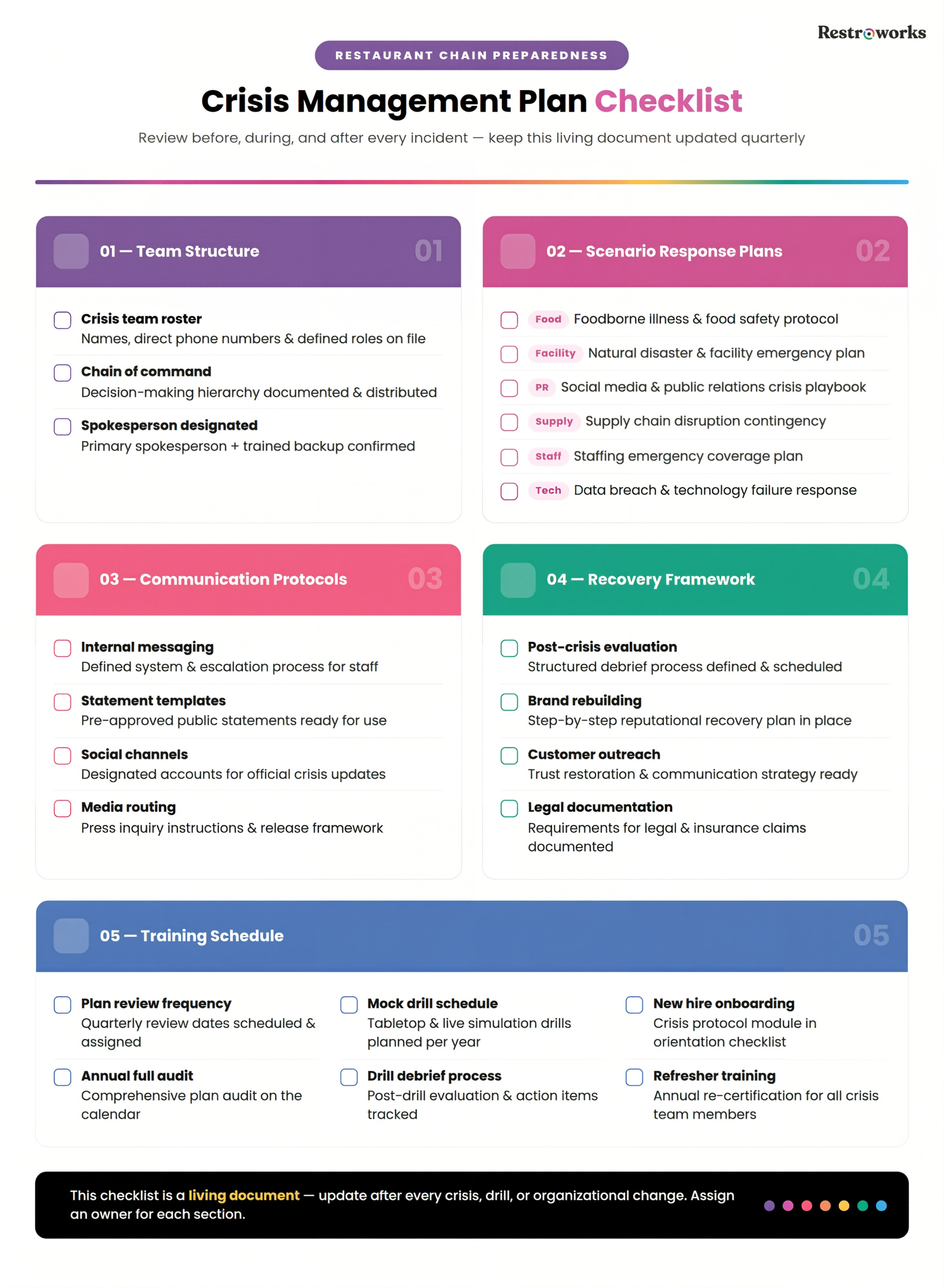
How to make a good Crisis Management Plan for Restaurant Chains?

How Does Technology Help Manage and Recover From a Crisis?

We all know that technology helps improve operational efficiency, but when it comes to crisis management:

  1. Real-time inventory tracking helps you spot supply chain issues in advance. 
  2. POS data analysis can flag anomalies like unusual return rates, complaint spikes, etc., that might indicate a food safety problem. 
  3. Social media monitoring tools give you visibility into what customers are saying in real time, so you’re not the last person to know about a developing situation.

The Waffle House model is famous for a reason. Their systematic approach to crisis management (particularly around potential disasters) has been cited 105 times in academic research as a benchmark for operational resilience. The “Waffle House Index” actually became a tool FEMA uses to assess storm severity, because the chain’s ability to stay open correlates with community stability. That kind of operational preparedness comes only when you have technology, systems, and rigorous planning in place.

For chains dealing with franchise partners, technology is also how you maintain consistent crisis communications across a network of independently owned locations. An emergency communication platform that can reach every franchisee simultaneously (with the same message, at the same time) is worth its weight in gold when a crisis strikes.

How to Handle Post-Crisis Brand Recovery?

Congrats, you’ve managed the crisis. The media has probably moved on. Now what?

The post-crisis period is actually when customer trust is most fragile. People are watching to see if you follow through on the commitments you made during the crisis, or whether the apology was just damage control.

And if you actually stop communicating during this period, you are hammering a nail into your own feet. What should you do instead? Train your staff, enhance your food safety testing, organize events to bring people back, and offer promotions to show appreciation for customer loyalty.

Conducting a post-crisis evaluation is essential. Every crisis, no matter how it was handled, has a lesson for you to learn. Document what worked, what didn’t, where communication broke down, which parts of your plan held up, and which needed adjustment. Now, work on it. 

Tip: Talk to your insurance agent and review your coverage to see if it has recall, product contamination, and crisis-management endorsements in place because many restaurant owners find out during a crisis that their coverage doesn’t extend where they thought it did.

And lastly, be proactive. 

A blog mentions: “Part of the spirit of our industry is to express compassion, trust, empathy, care, respect, and service to others.”

That spirit has to be most visible in a crisis when customers are watching to see if you’re really the business you claim to be.

A proactive crisis management plan is how you honor that spirit under pressure. It’s how you protect your employees, who depend on this business for their livelihood. It’s how you protect your customers, who trusted you with their health and their experience. It’s how you protect everything you built so far.

The restaurant industry is hard enough when things go right. So, always, always be ready to “survive” and even come out stronger when something goes wrong. Build the plan before you need it. Because when crisis strikes, and at some point it will, the window for figuring it out doesn’t open. 

KEY TAKEAWAYS

  • A crisis management plan should include external communication strategies to prevent misinformation.
  • Monitoring social media and online reviews during a crisis helps restaurants track public sentiment and respond faster.
  • Internal messaging systems are essential to keep all staff informed and aligned during emergencies.
  • Conducting a post-crisis evaluation helps identify weaknesses and improve future crisis response plans.
  • Regular training sessions and mock drills are critical to ensure staff can execute crisis protocols under pressure.

Frequently Asked Questions

1. How much does it cost to develop a crisis management plan for restaurant chains?

Well, the total cost you’ll incur when developing a crisis management plan for your restaurant chain will depend on factors like the actual size of your chain, its locations, and risk exposure at each outlet. 

Small chains usually have to spend a few thousand dollars on staff training and emergency systems, while larger brands have to invest, in addition, heavily into legal reviews, PR consultants, crisis software, and simulations. 

2. Should restaurant chains hire external crisis management consultants?

Sometimes, yes, especially for growing chains, we recommend hiring external crisis management consultants. Why? More often than not, internal teams become too used to operational gaps and stop noticing risks. External consultants bring fresh eyes, pressure-test your response systems, train spokespersons, and review food safety protocols much better. 

3. How do you test and drill crisis management plans in restaurant chains?

The best way to test your crisis management plan is by running mock food safety outbreaks, social media scandals, evacuation drills, POS outages, and supplier failure simulations. Because during a real crisis, your team probably won’t open the document to see what they should do, that needs to be fed to them as muscle memory.

Newsletter subscription banner

Talk to a restaurant expert today and learn how Restroworks can help your business.

Request Demo >

Share

Discover More Insights to Power Your Journey

Employee Training Modules for New Restaurant Chain Software: Improve Adoption & Efficiency

First of all, let us congratulate you on bringing in a new restaurant management platform, because you wouldn’t have looked…

Building a Forecasting Culture in Restaurants: Strategies for Data-Driven Success

For the most part, most owners have received the message that restaurant forecasting is essential. Some have invested in the…

Crisis Management Plan for Restaurant Chains: Strategies to Protect Operations & Reputation

Not to jinx, but what if your kitchen were on fire today? Seriously, how ready do you feel you are…

POS
Best bakery POS system
8 Best Bakery POS Systems & Software – Experts Pick [2026]

Here’s something interesting. The bakery industry is one of the fastest-growing adopters of management technology in foodservice, with the bakery…

Analyzing Sales Patterns in Restaurants: Improve Forecasting & Profits

Restaurants collect thousands of data points daily. Amount of orders, hours worked, inventory used, buying habits, delivery channel distribution, and…

Forecasting Beverage Sales in Restaurants: Strategies to Predict Drink Demand

There’s a very famous quote:"Companies that aren't good at budgets aren't good at predicting the future. If you're not good…

Join. Learn. Grow.

Sign up to receive the latest hospitality insights and stories straight to your inbox

Streamline your operations with Restroworks