

It goes without saying that most restaurant owners know they need to forecast. However, few actually do so. Even fewer are currently doing their restaurant sales forecasting the smart way.
Restaurant industry sales are estimated to reach $1.55 trillion by 2026, with the National Restaurant Association noting that the restaurant industry “continues to evolve with shifts in tastes and economic realities,” as analyst Moutray wrote in the 2026 Culinary Forecast. In these conditions, relying on instincts and last week’s statistics simply won’t cut it when restaurant operators try to accurately predict future sales.
As Will Fleming, President of Global Shared Services, stated: “If a company isn’t good at budgets, it won’t be good at forecasting. And if it doesn’t know how to forecast, then it’s possible that running the business will be a mere coincidence.”
What You Will Learn
- Everything a successful restaurant needs for its forecasts
- The difference between simple and helpful software,
- And how to assess such software properly to support informed decisions.
What are the Core Restaurant Forecasting Features Every System Needs?
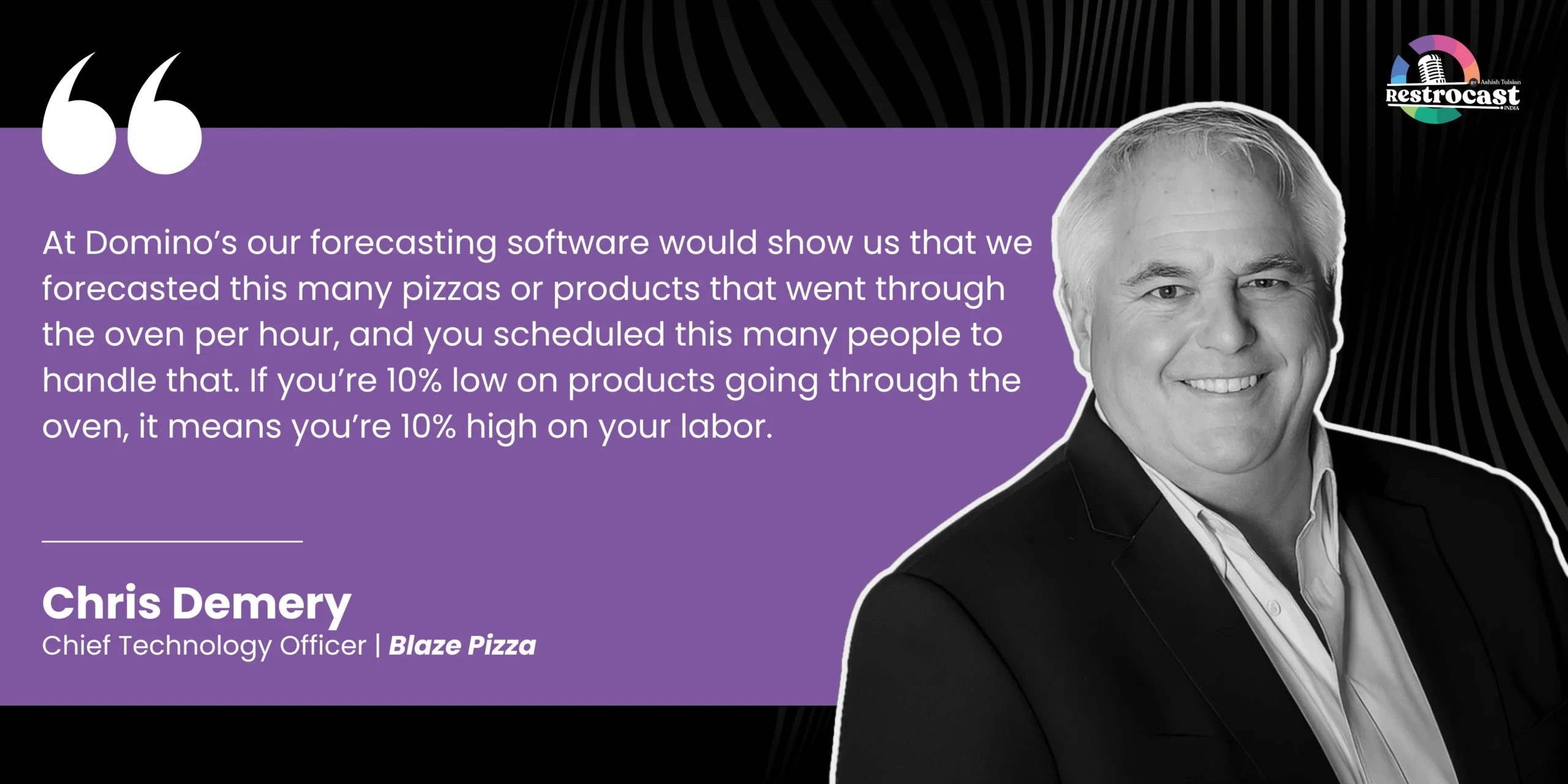
Before evaluating advanced capabilities, get clear on the fundamentals. A restaurant forecasting system that does not cover these basics is not worth the subscription cost. Chris Demery, CTO of Blaze Pizza, talked about how, back during his tenure at Domino’s, they used a forecasting software, and it gave them all the information they needed.
Historical Data Analysis and Pattern Recognition
The first thing any worthwhile forecasting system must have is historical sales data. It’s how the system uses that sales data that distinguishes the effective forecasting tool from a costly spreadsheet.
Studies have shown that the basic requirements for predicting daily customer traffic involve incorporating elements of time, including the day, month, and year, as well as external factors such as local weather. Failure to factor in these considerations when you analyze historical sales data would be tantamount to sacrificing accuracy and making it harder to identify patterns in customer demand.
Practically speaking, a good historical data analysis engine should:
- Use at least 2 years of historical sales data to identify seasonal fluctuations and trends.
- Weight recent past sales data more heavily than older data during trend shifts.
- Automatically adjust for anomalies like holidays, weather events, and local closures.
- Break sales data down by menu item, daypart, and revenue center, not just total daily restaurant sales.
Granularity in historical data is not just an option. It is a necessity for accurate restaurant sales forecasts.
Real-Time Forecast Adjustment and Mid-Day Pivoting
Static weekly sales forecasts are useful for planning. There are not enough when a lunch rush runs 40% above projection, or a rainstorm cuts Saturday customer traffic in half.
Forecasting future sales accurately requires taking into account sales data from one or more of the following external factors and sources:
- Weather APIs: temperature and precipitation influence customer traffic patterns and order types.
- Calendars of local events: concerts and sports games significantly impact customer demand and projected sales.
- Point of Sale data in real time.
- Market trends and competitor activity were available.
BCG research shows that accurate, real-time demand forecasts are crucial for success in food service delivery. Restaurant operators who incorporate external factors into their sales forecasting will consistently outperform those who rely solely on internal historical sales data.
Multi-Location and Chain Restaurant Features
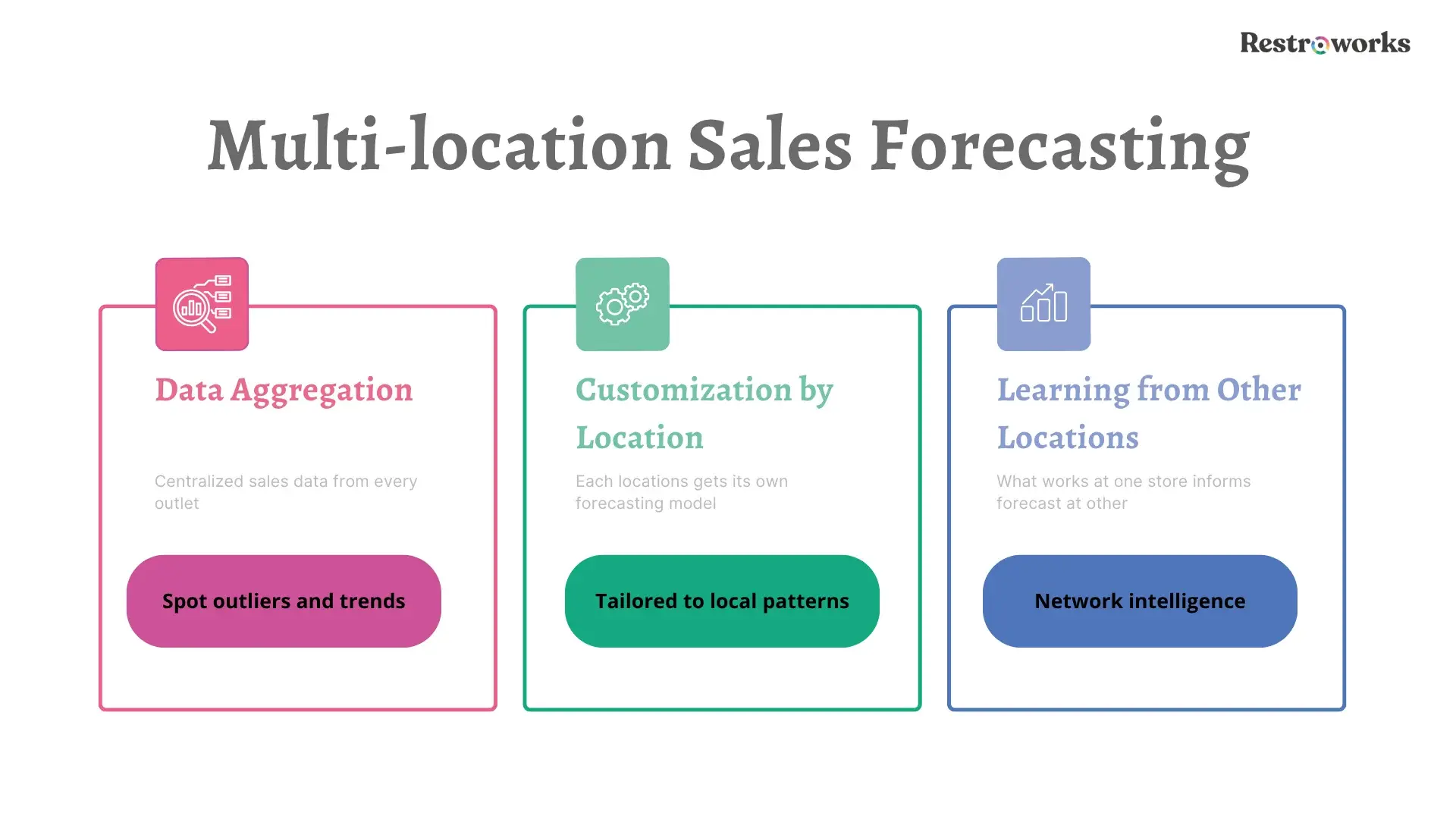
Single-store restaurant forecasting is fairly simple. However, multi-store sales forecasting poses a completely new challenge and requires specialized, accurate forecasting capabilities.
Multi-location forecasting requires specific capabilities that single-location tools often lack:
Data aggregation from all locations: All location-based sales data must be aggregated centrally to enable restaurant operators to analyze how each location is performing relative to others, identify outliers, and understand systemic market trends.
Customization by location: A location in Chicago’s downtown and one in its suburbs may serve entirely different customer expectations, with distinct historical sales patterns. This must be taken into consideration when building the restaurant sales forecasting engine.
Learning from other locations: If a promotion works well at one location or an unexpected spike in customer traffic happens, the past sales data must help forecast future sales at similar locations.
What are the Integration Requirements with Restaurant Systems?
Some integration requirements with restaurant systems are:
POS System Data Requirements and API Connections
The restaurant sales forecasting system is only as good as the sales data feeding it. The most important data source to integrate would be your POS, where all granular historical data on customer demand resides.
POS integration should include the following inputs to support accurate forecasting: sales at the item level by daypart, table, and order type; server data; comp and void sales; and modifiers selected. When your forecasting process works on daily average sales volume alone, you are using only a fraction of the available past sales data.
Menu Engineering and Profitability Integration
Restaurant forecasting is not an isolated process. The best restaurant forecasting systems link sales predictions directly to the profitability of individual menu items, enabling restaurant owners to identify which items will drive future sales and which should be prioritized.
At a minimum, the forecasting tools must show which items will drive average sales volume during a given period, which are rising or declining based on historical sales, and which high-margin items merit more focus to meet customer satisfaction and customer expectations.
Measuring Forecasting Accuracy and Performance
Restaurant forecasting without measurement is no more than guesswork. To determine whether their restaurant sales forecasting system is delivering accurate forecasts, operators need precise metrics based on actual sales and comparisons with projected sales.
Three key measures for effective restaurant sales forecasting:
- MAPE (Mean Absolute Percentage Error): Calculates the average percentage difference between the sales forecast and actual sales. Any MAPE under 10% is generally considered acceptable. Under 5% is outstanding for accurate restaurant forecasting.
- MAD (Mean Absolute Deviation): Calculates the average absolute difference between the sales forecast and actual sales. MAD helps determine raw forecasting accuracy in units rather than percentages, which is useful for inventory management and labor forecasting planning.
- Forecast Bias: Indicates whether the restaurant sales forecasting system is consistently over- or underestimating future sales. Even when MAPE is low, consistent bias can distort inventory needs, labor costs, and cash flow management decisions.
Research supports the notion that model interpretability is vital for cultivating trust in forecasting restaurant sales systems. In practical terms, if restaurant managers do not understand why the system has produced certain sales projections, they will neither trust it nor use it, instead relying on their instincts.
Implement a weekly review in which restaurant managers can compare actual sales with sales predictions from the forecasting process and flag systematic gaps.
What are Some Implementation and Staff Adoption Considerations?
Some implementation and staff adoption considerations are:
User Interface Design for High-Turnover Staff
It is widely known that the restaurant industry has one of the highest staff turnover rates in the US economy. Regardless of its quality, a restaurant sales forecasting system designed for data scientists will not work in this environment.
As Herb Taylor of EisnerAmper put it: “Apply forecasting principles to make a sales forecast and thereby help your restaurant managers become business-focused leaders.” That transformation only happens when accurate restaurant forecasting information becomes readily accessible without requiring specialized knowledge.
Early Girl Eatery went from the brink of bankruptcy to four successful restaurants after integrating restaurant forecasting through HotSchedules and the Restaurant Operations Suite from Fourth. The result was a significant improvement in operational efficiency and scheduling accuracy, demonstrating best practices in adopting forecasting sales tools across the team.
Interface design best practices for organizations with high turnover:
- Sales forecast data available on mobile devices, not just desktops.
- Sales predictions are presented in plain language summaries.
- Notifications for significant deviations between actual sales and the sales forecast during service.
- A small number of inputs is needed to confirm daily forecasts of restaurant sales.
Training is necessary, but good forecasting tools reduce the need for it. Choose software with built-in onboarding that helps existing restaurants get up and running quickly.
ROI Calculation and Cost-Benefit Analysis
“Restaurant forecasting assists in cash flow management, contributes to budgeting and turnaround strategies, and holds employees accountable against realistic expectations,” states Nick Stauff, Content Author at Global Shared Services.
The ROI case for investing in accurate forecasting must be built on specific figures. Here is how restaurant owners can calculate it:
- Labor savings: If the forecasting process takes 4 hours per manager per week at an average hourly wage of $25, that is $100 per week per location in direct labor costs. For a chain of 20 existing restaurants, that amounts to $104,000 per year in manager labor costs before any improvement in labor forecasting accuracy for scheduling.
- Reduced food costs: US-based restaurants generate about 11.4 million tons of food waste each year, at a cost of roughly $25 billion. A typical 50-seat restaurant may lose $3,000 to $4,000 per month in food and labor costs due to poor sales forecasting. AI-powered, accurate forecasting can reduce food waste by 30-40%, according to GeekyAnts research.
- Labor optimization: Full-service restaurant operators spent a median of 36.5% of sales on labor in 2024, based on the National Restaurant Association’s Restaurant Operations Data Abstract. Those who reported a pre-tax profit ran labor costs at 34.2% of sales. The difference in labor costs between 36.5% and 34.2% on $2 million in annual restaurant sales equals $46,000 in additional annual profit.
Given these numbers, most restaurant operators can justify investing in restaurant sales forecasting software.
Concerns about customer traffic and future revenue are expected to continue into 2026, with Restaurant Dive suggesting that cost savings become a priority in restaurant operations. In such an environment, accurately forecasting demand is no longer a discretionary purchase. It is a tool that directly protects profit margins and supports accurate sales forecasts going forward.
Accurate restaurant forecasting is not merely an advantage for big chains. For restaurant owners operating on tight budgets in high-cost environments, it is a question of survival.
“Forecasting helps balance guest experience with business profitability through proactive decision-making,” as stated by Herb Taylor from EisnerAmper. This kind of balance requires systems capable of analyzing historical data and past sales, forecasting future sales based on that data, and measuring the accuracy of each forecast.