
In short: The essential franchise restaurant marketing tools are Google Business Profile management, listings and local search software, review monitoring, social media management, email and SMS marketing, POS-connected loyalty programs, and a central reporting dashboard. Together, these digital marketing tools let a franchisor protect brand consistency while every location competes for customers in its own local markets.
The National Restaurant Association projects U.S. restaurant and foodservice sales will reach $1.55 trillion in 2026, and the International Franchise Association forecasts franchise economic output of $921.4 billion across about 845,000 franchise establishments the same year. Franchising is especially dominant in fast food. The U.S. Small Business Administration estimates that 122,042 franchise restaurants make up about 54% of all fast-food restaurants and contribute about 73% of fast-food restaurant sales.
Growth at that scale doesn’t happen on foot traffic and word of mouth alone. It happens because restaurant marketing tools let a brand run local SEO, reviews, social media, email, and loyalty across dozens or hundreds of locations without every franchisee reinventing the wheel. For restaurant owners weighing which tools actually earn a spot in the stack, here’s what matters in 2026.
What You’ll Learn
- Which marketing tools franchise systems and restaurant groups actually rely on to manage local SEO, reviews, social media, and loyalty.
- How marketing a restaurant franchise differs from marketing an independent restaurant, and what that means for choosing the right tools.
Why Does Digital Marketing Matter for Restaurant Franchise Brands?
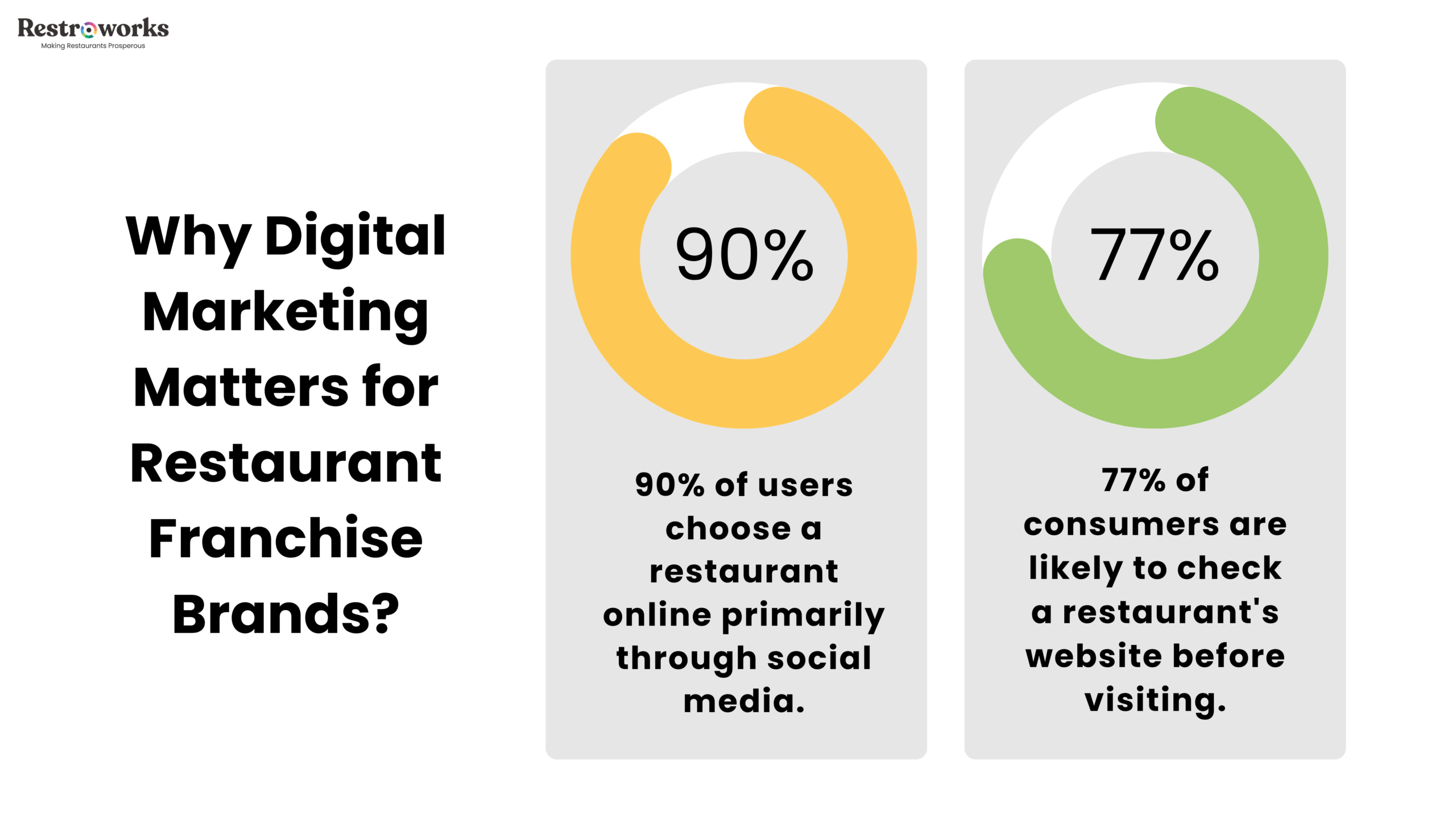
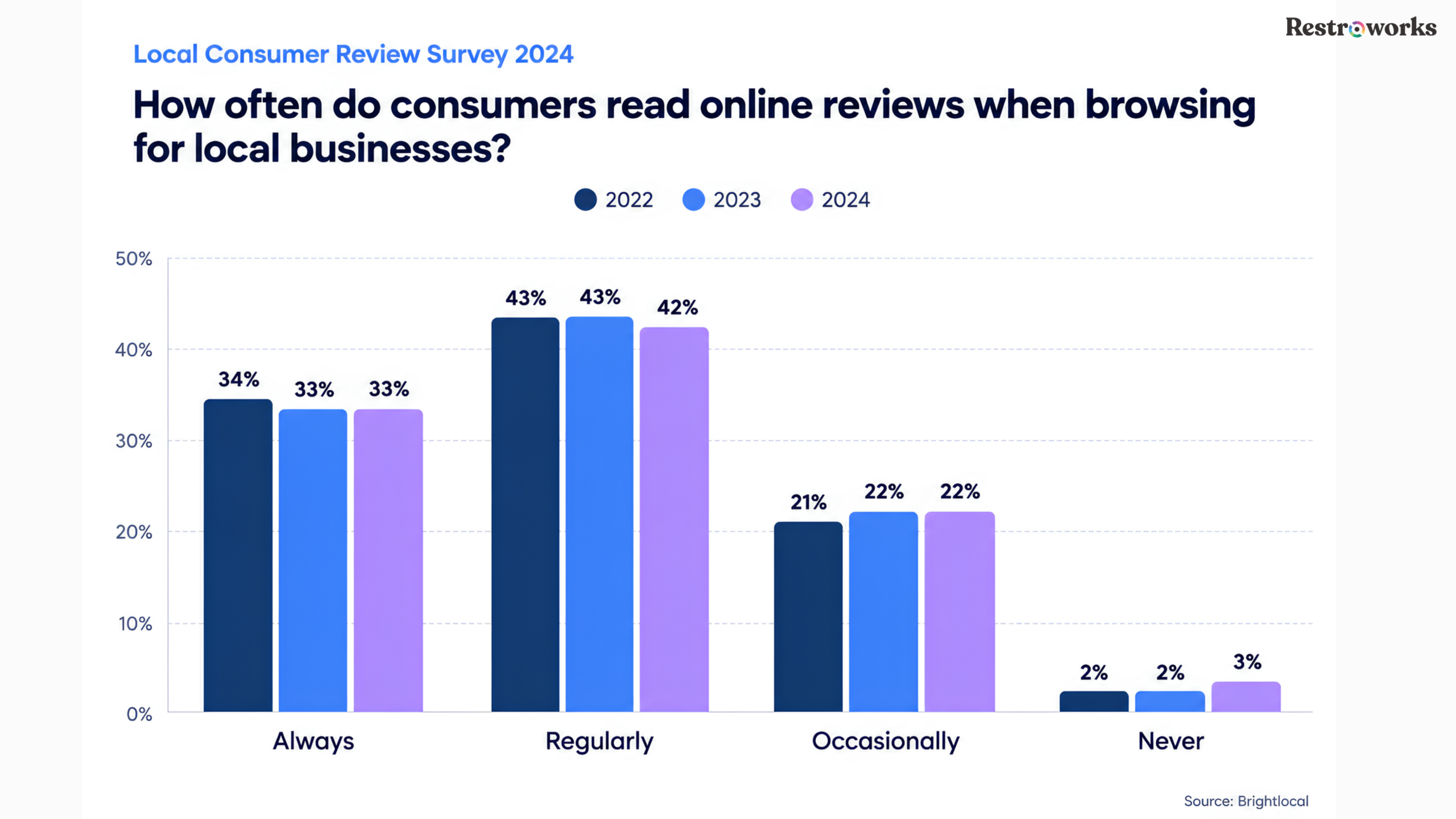
Digital marketing matters because diners now vet a restaurant online before they visit, and a restaurant franchise has to win that research step at every single location. According to BrightLocal’s 2026 survey of 1,002 U.S. adults, 97% of consumers read reviews for local businesses, and 41% “always” read them, up from 29% a year earlier.
Similarly, an MGH survey of 1,101 U.S. diners found 77% are likely to visit a restaurant website before they dine in or order, and 68% of that group have been discouraged from visiting a restaurant because of its website.
Discovery is also spread across many channels, especially social media. In a survey of 1,466 U.S. adults conducted in October 2025, Facebook (27%), Instagram (15%), YouTube (15%), and TikTok (14%) all played a role in how guests found new restaurants, and TikTok was the number one discovery channel for Gen Z at 38%. AI assistants are a new front door, too. BrightLocal found that the share of consumers using ChatGPT and similar tools for local business recommendations jumped from 6% to 45% in one year.
For a single independent restaurant, that means one website, one listing, and one set of reviews for customers to find. For restaurant franchise brands running dozens or hundreds of locations, it means the same tasks multiplied across every market, which is exactly why dedicated marketing tools exist in the first place.
| Marketing task | Independent restaurant | Restaurant franchise |
|---|---|---|
| Google listing | One profile, verified on its own | One profile per location. Google lets chains with more than 10 locations verify and update profiles in bulk |
| Website | One restaurant website | A brand site plus a page for every location |
| Reviews | The owner replies when time allows | Monitoring and replies across every location and platform |
| Social media | A few profiles run by the owner | Brand accounts plus local accounts that must stay on-brand |
| Budget | Set by the owner | Franchisees typically pay into a brand or ad fund and also fund local marketing |
| Customer records | One POS system | Shared guest records across locations for loyalty and email |
How Do Franchise Brands Balance National and Local Marketing?
Franchise systems balance national and local marketing by splitting the work: the franchisor runs brand-level digital marketing and national marketing campaigns funded by a shared ad fund, while each franchisee handles local store marketing in its own local markets.
U.S. franchise groups typically spend 4–5% of gross sales on marketing and brand funds. For example, look at Wingstop. The brand raised its domestic franchisees’ national ad fund contribution to 5.5% of gross sales at the start of fiscal 2025, up from 5.3% in 2024.
Franchise industry consultant Gary Occhiogrosso has written, “Every system in a franchise operation, marketing included, needs to be documented and repeatable through a confidential operations manual so any new location can run it consistently.”
Franchise attorney Harold Kestenbaum has similarly noted that when franchisees fund their own build-outs and local marketing, it gives them real skin in the game, which strengthens the whole system.
And franchise law expert Michael Einbinder said, “Franchising restaurant concepts allows for fast growth. If you expand your brand through franchising, the investment in new outlets comes from franchisees. Critically, franchising gives you an opportunity to grow in multiple markets simultaneously.“
That dual structure, corporate brand consistency paired with local store marketing, is the backbone of how franchise systems operate. It also explains which marketing tools work. In fact, the SBA’s 2017 list of local marketing strategies also suggests managing listings in search engines, targeting nearby social media users, and taking part in the community.
Now, back to our main question: which marketing tools can help your franchise gain “real” momentum in the market? Try these:
#1: Google Business Profile
Google Business Profile is the free tool that controls how each location appears in Google Search and Google Maps, and it is the first listing every restaurant franchise should get right. It runs on a free account, displays hours, address, phone number, menu, photos, posts, and reviews, and Google says customers are 2.7 times more likely to consider a business reputable when they find a complete profile, and 70% more likely to visit.
Google also offers chain-specific features. Chains with more than 10 locations can verify and update all of their profiles with a single spreadsheet upload, and bulk verification also resolves most duplicate listings. For a multi-location group, keeping dozens or hundreds of profiles fresh and accurate is one of the first jobs a real marketing tool needs to solve.
#2: Google Maps and Local Search Visibility
Whether a location appears when someone searches “restaurants near me” depends on three factors Google names: relevance, distance, and prominence. Google says –
- Prominence draws on links, articles, and directories across the web
- Review count and review score factor into local ranking
- There is no way to request or pay for a better position in local search results
Basically, maintaining consistent NAP data (name, address, and phone number) across every location is critical for ranking in these near-me searches. A franchise with minor inconsistencies between locations, such as a missing suite number here or an old phone number there, risks duplicate or conflicting listings that confuse both customers and search engines.
#3: Local SEO Across Every Location
To do local SEO for a restaurant franchise, build one optimized page for every location with consistent NAP data, hours, menu, ordering links, and structured data, and connect each page to that location’s Google profile. A strong restaurant website matters because customers size up a restaurant online and judge the brand before they ever arrive.
| Restaurant website finding (Based on survey of 1,101 U.S. diners) | Share of diners |
|---|---|
| Likely to visit a restaurant website before dining in or ordering | 77% |
| Discouraged from visiting a restaurant because of its website | 68% |
| Discouraged from ordering takeout or delivery because of its website | 62% |
| Turned off by difficult navigation | 33% |
| Turned off by a website that looks old or outdated | 30% |
| Discouraged from ordering because the site wasn't mobile-friendly | 36% |
Source: MGH, 2019
Structured data, or schema markup, helps search engines read menu items, prices, and locations, but it is hygiene, not a shortcut into AI answers. In a May 2026 study, Ahrefs found AI-cited pages were almost three times as likely to carry JSON-LD schema as uncited pages, yet when it tracked 1,885 pages that added schema, AI citations barely moved. That means clear, location-specific, optimized content does more of the work, and it pays off later in the customer journey. Like, see this – One customer leaves a review…another reads it a few months later and forms an opinion based on that review…then they visit and leave the review…and the cycle continues.
#4: Reputation Management for Multi-Location Brands
For a multi-location brand, review work is brand management. It means you must be able to monitor and answer reviews for every location, on every platform, from a single dashboard. Plus, reviews directly influence which customers walk in and how each location ranks, so review work is now as much a marketing function as a customer service one.
| What consumers expect from reviews (Based on Survey of 1,002 U.S. adults) | Share |
|---|---|
| Read reviews for local businesses | 97% |
| More likely to use a business after reading positive reviews | 85% |
| Less likely to use a business after reading negative ones | 77% |
| Expect business owners to respond to reviews | 89% |
| More likely to use a business that responds to all of its reviews | 80% |
| Will only use a business with 4 or more stars | 68% |
| Won't use a business with fewer than 20 reviews | 47% |
| Only care about reviews written in the last three months | 74% |
Ratings also move revenue. A Harvard Business School study by Michael Luca, using Seattle restaurant data from 2003 to 2009, found that a one-star increase in a restaurant’s Yelp rating led to a 5–9% increase in revenue. The effect was driven by independent restaurants, while ratings did not measurably affect chain-affiliated restaurants. As for franchises, diners appear to lean on the brand’s overall reputation, so a slip at one location can reflect on every location.
#5: Handling Negative Reviews at Scale
To handle negative reviews at scale, respond to every one quickly and personally so unhappy customers see the issue was handled, fix the underlying problem, and never try to bury them or fake your way around them. In fact, data shows that 42% of consumers are unlikely to use a business that ignores its reviews entirely, 50% are put off by templated or generic replies, and 19% now expect a same-day response.
AI-assisted review tools help a lean team keep up across dozens of locations by drafting replies that staff then tailor, which BrightLocal recommends as long as responses stay genuine. Faking it is not an option, so much so that the FTC’s rule on fake reviews, introduced in 2024, makes buying and writing fake reviews illegal.
INDUSTRY INSIGHT
“It is ‘show me the money’ time for digital transformations,” says McKinsey senior partner Rodney Zemmel. “To succeed in a digital transformation, it needs to be a CEO agenda item,” and needless to mention that for restaurant chains, the pressure to show returns is massive.
Boston Consulting Group reports restaurant prices have jumped close to 40% since 2019, a key reason people say they eat out less often and spend less when they do, and S&P Global says U.S. restaurant margins are tightening as costs stay elevated and pricing power weakens.
The franchise model in such a case itself is an advantage. A 2024 peer-reviewed study that tracked Applebee’s restaurants in Texas after they moved to franchisee ownership found that franchising a restaurant increased its revenues by 7%, with a substantial share of the gain coming at the expense of competing national chains. Restaurant budgets for this commonly follow a 3% to 6% of gross revenue rule of thumb, and the franchise benchmarks (4–5% for franchise groups) are in the upper half of that range, since the ad fund pays for brand awareness, digital infrastructure, and local support across every market.
#6: Social Media Marketing and Scheduling Tools
Social media management tools let a central team plan, approve, and schedule posts for every location’s social accounts from one content calendar, so the brand voice stays consistent while each restaurant still posts locally. That matters because social media is a major discovery channel, especially for younger customers. In MGH’s 2025 survey of U.S. TikTok users, 58% said they had visited a restaurant after seeing it on TikTok, up from 38% in 2022. Video is gaining ground, too. Platforms like YouTube, Instagram, and TikTok are all gaining traction as places consumers look for local recommendations.
User-generated content on social media plays a crucial role in building trust, since customers tend to trust other customers more than brand messaging. Here, the best thing you can do is encourage customers and creators to post video reviews and ask permission to reuse their clips in your marketing. That’s one reason social media marketing has become one of the most cost-efficient digital marketing channels for a franchise building reach across every location at once.
Social media scheduling tools like Buffer and Hootsuite can help you handle the mechanics well. Like, with them handy, you just have to write social media posts once, and they help publish those posts across Instagram, Facebook, and TikTok on a set schedule.
Similarly, there’s a design tool called Canva that lets local teams create on-brand Instagram posts and other social posts from a shared brand kit of approved logos, colors, and fonts.
Mind that a simpler, user-friendly scheduling tool works well for one location managing a handful of social accounts. Restaurant groups and franchises with dedicated in-house teams typically need advanced features such as team collaboration, approval workflows, and social listening that tracks brand mentions, usually at a higher price and with a steep learning curve. So before you sign up for any platform, check which of those capabilities are included and which are sold separately or reserved for top tiers.
#7: Email and SMS Marketing for Franchise Groups
Email and SMS platforms connected to a restaurant’s POS let a franchise send automated welcome, birthday, and win-back messages to the customers of each location without manual effort, using automation features triggered by visit and order data. Email marketing has long ranked among the highest-ROI marketing channels. In fact, Litmus research puts the average return of email marketing at $36 for every $1 spent.
Franchise groups and restaurant owners use email campaigns to introduce new menu items, promote special events, and run seasonal campaigns that drive reservations and orders. Marketing automation and behavioral targeting make that work at scale. For example, some POS-based platforms let restaurants send targeted messages to segments like lapsed guests, VIPs, or online-ordering customers.
#8: Loyalty Programs That Drive Repeat Visits
A loyalty program connected to the point-of-sale system lets every location recognize and reward the same customers the same way, instead of each franchisee running a different punch-card system with no shared customer data.
In fact, here’s how some of the largest U.S. franchise systems use loyalty programs and digital channels at scale.
| Franchise system | Result |
|---|---|
| McDonald's | Sales to loyalty members rose 20% to nearly $37 billion in 2025, with 90-day active loyalty users up 19% to nearly 210 million across 70 markets. |
| McDonald's | The company’s monopoly promotion was one of the company's largest digital customer acquisition events, with roughly 46 million 90-day active U.S. loyalty users. |
| Wingstop | Digital sales reached 73.2% of system-wide sales in fiscal 2025, as system-wide sales grew 12.1% to about $5.3 billion. |
| Yum! Brands (KFC, Taco Bell, Pizza Hut) | Systemwide digital sales approached $40 billion in 2025, accounting for nearly 60% of system sales and representing approximately 20% year-over-year growth. |
Franchise Restaurant Marketing Tools You Probably Need Right Away
Not every restaurant needs the same tools, but most franchise systems and restaurant groups converge on the same core categories of marketing tools:
| Category | What it solves | Why franchises need it | Tools |
|---|---|---|---|
| Listings and search visibility | Google ranking, listings, location pages | Keeps every location visible in local search | Google Business, Yext, Semrush, SOCi |
| Review management | Review collection and response | Protects brand-wide reputation from any single location's slip-up | Birdeye, Reputation, Google Business |
| Social media management | Centralized posting and scheduling | Uniform brand voice across every location's accounts | Hootsuite, Buffer, Sprout Social |
| Email marketing and SMS | Automated campaigns and offers | Turns first-time diners into repeat customers at scale | Mailchimp, Klaviyo, Constant Contact |
| Loyalty programs | Points, rewards, and visit tracking | Up to 50% of order volume can come from 7% of guests | Thanx, LoyaltyLion |
| Analytics and reporting | Revenue attribution across locations | Lets marketing teams prove ROI to franchise leadership | Google Analytics, Sprout Social, Looker Studio |
The Best Restaurant Marketing Tools for Multi-Location Growth
The best restaurant marketing tools for groups and franchises are: a combined listings and review platform, a direct ordering channel, a POS-connected loyalty and CRM tool, and a central reporting dashboard.
For listings, search visibility, and review automation, tools built specifically for multi-location groups tend to outperform general-purpose software because they manage every location from one platform.
For commission-free online ordering, a direct channel on the brand’s own website lets each location own its relationship with customers and keep more revenue than routing every order through third-party marketplaces.
For loyalty and CRM, tools that integrate directly with each location’s point-of-sale system automatically track visits and spending without requiring a separate app.
And for reporting, centralized dashboards that connect SEO, reviews, and social media marketing performance into one view let marketing teams prove ROI to leadership rather than guessing at it. That capability is still maturing across the industry, though. Only 45% of restaurant executives say their brands have created a dedicated revenue growth management team.
The common thread is that the top restaurant marketing tools for franchises are the ones built for multiple locations from day one.
KEY TAKEAWAYS
- Franchise groups typically spend 4–5% of gross sales on marketing and brand funds, and Wingstop’s national ad fund contribution is 5.5% of gross sales.
- The core digital marketing stack for a restaurant franchise covers listings and search, review management, social media, email marketing and SMS, loyalty, and reporting.
- Consistent NAP data and complete Google profiles are the foundation of local visibility, and Google bases local ranking on relevance, distance, and prominence.
- Mobile-friendly websites matter: 36% of diners in MGH’s survey had been discouraged from ordering because a restaurant’s site wasn’t mobile-friendly.
- Reviews drive choice: 97% of consumers read them, and 80% are more likely to use a business that responds to all of them.
- Collaborating with local creators and influencers can generate authentic reviews and reach new local customers, especially on TikTok, where 58% of surveyed users had visited a restaurant after seeing it there.
Frequently Asked Questions
1. What is the difference between corporate franchise marketing and local store marketing?
Corporate franchise marketing is the brand-level work the franchisor controls: national marketing campaigns, brand guidelines, and the ad fund that pays for system-wide advertising. Local store marketing is what an individual franchisee runs in their own local markets, such as local social media posts, community events, and responding to reviews for that specific location.
Effective franchise marketing depends on both working together, with national brand standards setting the framework and local execution filling in the details for local markets.
2. What are the 4 P’s of marketing for restaurants?
The 4 P’s- product, price, place, and promotion- translate directly to a restaurant.
The product is the menu and dining experience itself. Price covers what’s charged and how it compares to the local market and competition. Place is the location and how easily potential diners can find and reach it, both physically and online. Promotion is everything from social media marketing and email campaigns to loyalty programs and paid ads that bring new customers in the door.
3. What are the three C’s in a restaurant?
The three C’s commonly used in restaurant strategy are concept, consistency, and customer experience.
Concept is the overall identity, cuisine, and positioning that sets a restaurant apart. Consistency means delivering the same quality and experience whether it’s a guest’s first visit or fiftieth, which matters even more for a franchise trying to keep every location on-brand. Customer experience covers everything from service and atmosphere to how a guest is treated online, in reviews, and through every brand touchpoint.