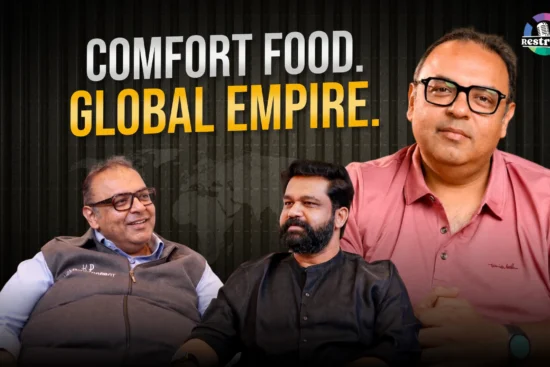
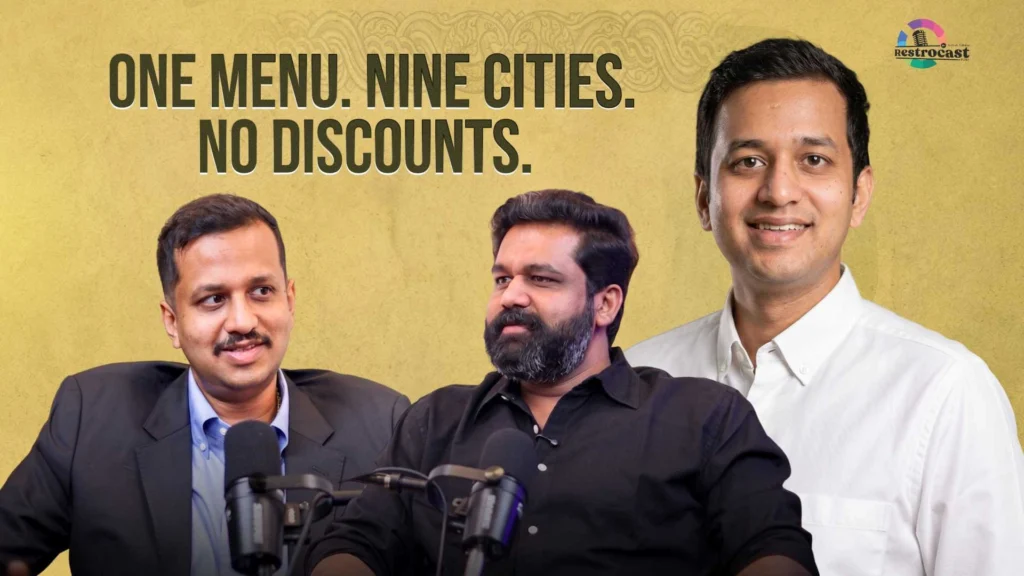

The restaurant industry runs on received wisdom. Master one city before you touch another. Never open a pure vegetarian, no-alcohol concept in casual dining. Keep your food costs below 30% and pray. Chirag Chhajer, a Marwari textile family’s son who taught himself to cook in a shared apartment in Australia, has spent twelve years proving that received wisdom is mostly just fear with a pedigree. Today, Burma Burma operates 22 restaurants across nine Indian cities and is eyeing an IPO. In this Restocast, Ashish Tulsian sits down with Chirag to talk about defensibility, P&L awareness, the brutal art of fundraising, and why food cost is the only number that never lies.
How does someone end up building India’s largest Burmese restaurant chain?
Chirag Chhajer: I was born and brought up in Bombay, and was a very average student. After grade 12, I went to Australia for three years, and that was my first real interaction with world food. I was a vegetarian in a country that had no roadmap for that. I got a job at a Safeway supermarket, started cooking with flatmates, four or five of us, all passionate about food. If you couldn’t cook, you cut onions. If you couldn’t cut onions, you washed the vessels. That was my culinary school.
I came back to India a week after graduation and joined my father’s textile business the next morning. That was always the plan. For the first year and a half, I just shadowed him. Sat in meetings I didn’t understand, ate whatever he ate in the evenings. In 2012, an old school friend, Ankit, who is now my co-founder, was working on a Burmese cafe concept; his mother is from Burma. We got together, converted the cafe into a casual dining restaurant, and I went to my father and said I want to do this. He asked me once: Are you sure? I said yes. He said fine. Showed his support to me.
Why did you go ahead even when everybody advised you not to open your restaurant?
Chirag Chhajer: Because 100% of people saying no is actually useful data. It tells you something hasn’t been tried, not that it can’t work. We coined the term aspirational vegetarian. There are vegetarian restaurants in this country that people go to out of nostalgia; you don’t plan the visit, you don’t talk about it afterward. What we wanted to build was a place you plan, that you take your family and your friends to, that you talk about after. The food is 100% authentic Burmese; we never took the liberty of adding Chinese, Thai, or any other cuisine to make people more comfortable. And yet Burmese happens to sit very close to the Indian palate. Our number one soup has a samosa in it. Our best-selling salad is raw mango. The leap wasn’t as far as people assumed.
We don’t like being typecast as a pure vegetarian restaurant. We are a Burmese restaurant that happens to be vegetarian and doesn’t serve alcohol. There’s a difference, and that difference is the whole business.
Every consultant in the country says to master one city first. What were you thinking with locations so far away?
Chirag Chhajer: The second restaurant came as an inbound from the DLF team at Cyberhub, which was just coming up in 2015. I have a policy: anyone related to business who asks for a meeting, I take it, even if I don’t fully understand why. So we flew down just to see the place. Cyberhub is a fabulous product, with offices that have high spending power, a cluster of restaurants, and people who visit ten or twelve times a year. Once they’ve covered every cuisine, they’re looking for something differentiated. That was us.
I still remember the first week in Gurgaon. People would walk in, sit down, look at the menu, have water, realize there’s no alcohol and no meat, and walk out. It took six to eight months for the market to settle. But after that, there was no looking back. The difficult part of going multi-city first is that it builds something a single-city brand can never buy: you have four zones of the country reading from one playbook. One menu, one price, one service standard, six different GSTs. Once you crack that, you’ve done the hard thing.
What happened between 2018 and 2022 when you were bootstrapped?
Chirag Chhajer: 2018 was humbling. We had four or five restaurants, I didn’t fully understand who I was pitching to, and the conversations kept shifting. Our biggest discussion was with a fund that came close, then started talking about a majority stake, then ghosted us completely after collecting every piece of data we had. At least tell us the valuation you’re comfortable with, we said. Too low, they said. Goodbye. And that was it.
There was a period of real self-doubt. Maybe we’ll never raise money. Maybe we’ll always be bootstrapped. But we were profitable, so we went back to building. In 2022, I followed a finance creator called Sarthak Ahuja, who had about 10,000 followers at the time, so I sent him a DM saying I like what you do, will you help me raise money? He replied because 10,000 followers. In 1,000 days, the conversation went from “why should we invest” to “please give us allocation.”
18% food cost. No central kitchen. Every dish is made fresh at every restaurant. How is that possible?
Chirag Chhajer: Asian food is about fresh preparation. The consumer is choosing Burma Burma over a hundred other options. Our job is to give them the best experience possible, and that means fresh. Our desserts are made in-house at every restaurant. We don’t pre-fry, we don’t pre-cut, we don’t pre-cook.
As for 18% food cost, a large part of that is buying efficiency, not just operational efficiency. I am in direct touch with all our major vendors. We pay 100% of our vendors within 45 days, sometimes 30. In a country where many restaurants stretch payments to 90 or 120 days, paying fast is a negotiating superpower. We always say: give us an additional 5%, take the money right now. They do. In March, when the dollar was volatile, and a lot of our imported ingredients were at risk of repricing, I sat down with our purchase head in one day and bought six months’ worth of imported produce, paying 50 lakh as an advance. For the next six months, our costs don’t move regardless of what the dollar does. That’s a traditional trading mindset applied to a restaurant business, and most restaurant operators simply don’t think that way.
By May 7th, you already know exactly how each order, customer, and outlet performed in April. How many restaurant operators in this country can say that?
Chirag Chhajer: Not enough. We have a cost control team of 32 people. If that sounds like a lot, it isn’t; we save more than we invest in that team. P&L awareness is not a finance function. It’s a cultural function. If your senior team doesn’t talk about it openly and constantly, you end up working for your landlord, your government, and your employees, in that order, and wondering at the end of the year where the money went.
We don’t discount dining. Our marketing spend is between 4 and 4.5% of revenue, which includes everything, brand-level marketing, and all spend on Zomato and Swiggy combined. I’ve heard 12% called lean in this industry. The moment you start discounting, you cannot stop. The moment you start spending heavily on performance marketing to drive traffic, the algorithm owns you. Low defensibility is the root cause of almost everything that is going wrong in Indian restaurants right now, and discounting is the symptom, not the disease.
Delivery is 12% of your business. You believe the commission model is broken. What’s the math?
Chirag Chhajer: It’s not complicated. Take a food cost of 25%, and we are well below that, but let’s be generous for the industry. Add a delivery commission of 18 to 20%, which is the reality for almost everyone, including brands you’d assume have negotiating power. Add packaging at 5%. You’re at 50% before you’ve paid a single employee, switched on a light, or paid rent. Rent in a good location runs 12 to 15%. Labor at 15 to 20%. Then add the cost of actually driving your delivery business on the platform. Organic traffic is shrinking, so you’re spending another 6 to 10% of your delivery revenue just to be visible. In a bad month like February, with fewer days, April, which is always soft, you are working for free. The business case for delivery at current commission rates only holds if your brand has unusual defensibility and you are at unusually lean food costs. Almost no one has both.
What has changed in you from 2014 to 2026?
Chirag Chhajer: In 2014, there were limitless possibilities but also a constant fear of failure. Every decision had that weight attached to it. Now, failure has become irrelevant in the short run, and so has money in the short run. When both of those things stop mattering day to day, you take better calls. I voluntarily told my team this year that I’m not increasing my own salary. Because what I want to build is not short-run profitability. I want to put a restaurant brand on the Indian stock exchange that is actually Indian. The Jubilants and the Devyani’s are listed, but they’re running American QSR brands. In a country of 140 crore people who eat three times a day, why isn’t there a list of 50 Indian restaurant brands on the exchange? That’s the question I wake up with.
What do you tell a new restaurateur thinking about entering this industry in 2026?
Chirag Chhajer: If you’re doing it half-heartedly, the result will be half of what you hope. The industry doesn’t reward passion alone; it rewards specialists. All-rounders don’t work here. You need a strong product, a clear backstory, and something on your menu that nobody else is doing or nobody else does as well as you. That defensibility, even 30 to 40% of your menu being genuinely yours, is what separates brands that last from restaurants that catch a wave and disappear with it.
One viral reel will get you a queue for three months. After that, you need R&D. Our team travels to Burma to understand regional cuisines and comes back to build. When someone copies us, and people do, they can’t copy our innovation pipeline. That’s the only moat that actually holds.
And I’d say, go customer-facing from day one. The dark kitchen model is very difficult to make profitable, and it removes the one thing that builds a brand: the experience of the room.
Conclusion
Chirag Chhajer is not a restaurateur by any conventional definition. He’s a builder who happened to find his material in food. The logic he brings from a textile trading family, pay your vendors fast, buy in bulk when the price is right, never confuse revenue with profit, sits in an industry that has almost no tradition of applying it. The result is a brand that has broken the rules on cuisine, geography, format, and finance, and built something that now has investors chasing allocation. Twelve years, nine cities, 22 restaurants, 18% food cost, and a founding principle he’s never deviated from: the product is the hero, defensibility is the moat, and the P&L is the only applause that matters.