
In short: To franchise a fast food restaurant, you prove the concept with one or two profitable locations, protect your brand with a federal trademark, document your operations and build a training program, prepare a Franchise Disclosure Document (FDD) and franchise agreement with an experienced attorney, register in the states that require it, set your fees and franchisee requirements, and then recruit and support franchisees. Most restaurant owners can complete the legal setup in about 90 to 120 days, at a typical cost of roughly $46,000 to $100,000 including early sales and marketing.
Franchising is one of the most proven ways to grow a fast food brand without putting up the capital for every new franchise restaurant yourself. A franchise is a contractual relationship in which you, the franchisor, license your brand, systems, and know-how to an entrepreneur who uses them to operate a new location under your name, serving your customers in a new market. In exchange, the franchisee pays an upfront fee and ongoing royalty payments, and invests their own capital in the build-out.
That is basically how some of the largest fast food franchise systems out there have scaled. For example: of McDonald’s 45,356 restaurants at the end of 2025, about 95% were franchised. Plus, research on more than 1,300 restaurant chains also found that franchised units grow faster as a chain gets bigger, while company-owned units do not, partly because more outlets build brand recognition.
The catch is that franchising turns your business into a kind of system that other people are (and must be) able to repeat. Menu consistency, supply-chain development, and documented operations all have to be in place before a restaurant’s success at one location can be trusted to repeat itself at fifty. So, how to franchise a fast food restaurant? This guide will walk you through it step by step.
What You’ll Learn
- How restaurant owners can tell whether their restaurant concept is ready to become a fast food franchise.
- The legal requirements, costs, fees, and franchisee standards involved.
Is Your Fast Food Restaurant Ready to Franchise?
Your fast food restaurant is ready to franchise when it is consistently profitable, easy to replicate without you on site, and attractive to both customers and potential franchisees who want their own business. If any of those is missing, fix it before you invest in legal documents.
Research supports proving the concept first, i.e., build the credibility of your restaurant first and then focus on franchising. Even McDonald’s says operating its own restaurants is what makes it a credible franchisor and gives it a place to test ideas and train staff.
| Readiness test | Ready if... | Warning sign |
|---|---|---|
| Profitability | Units are profitable after paying a manager | Profits depend on the owner working every shift |
| Replicability | Recipes, prep, and service are written down so any location can follow them | Key steps live only in your head |
| Menu | A focused menu that new staff can learn quickly | Many complex, chef-dependent items |
| Supply chain | Approved suppliers that can serve a new market | One local supplier with no backup |
| Brand | An established brand with real brand recognition among local customers | A generic name you can't trademark |
| Capital | Funds for legal setup, staff, and corporate support for operators | No budget for ongoing costs beyond the FDD |
How to Franchise Your Fast Food Restaurant: 7 Steps
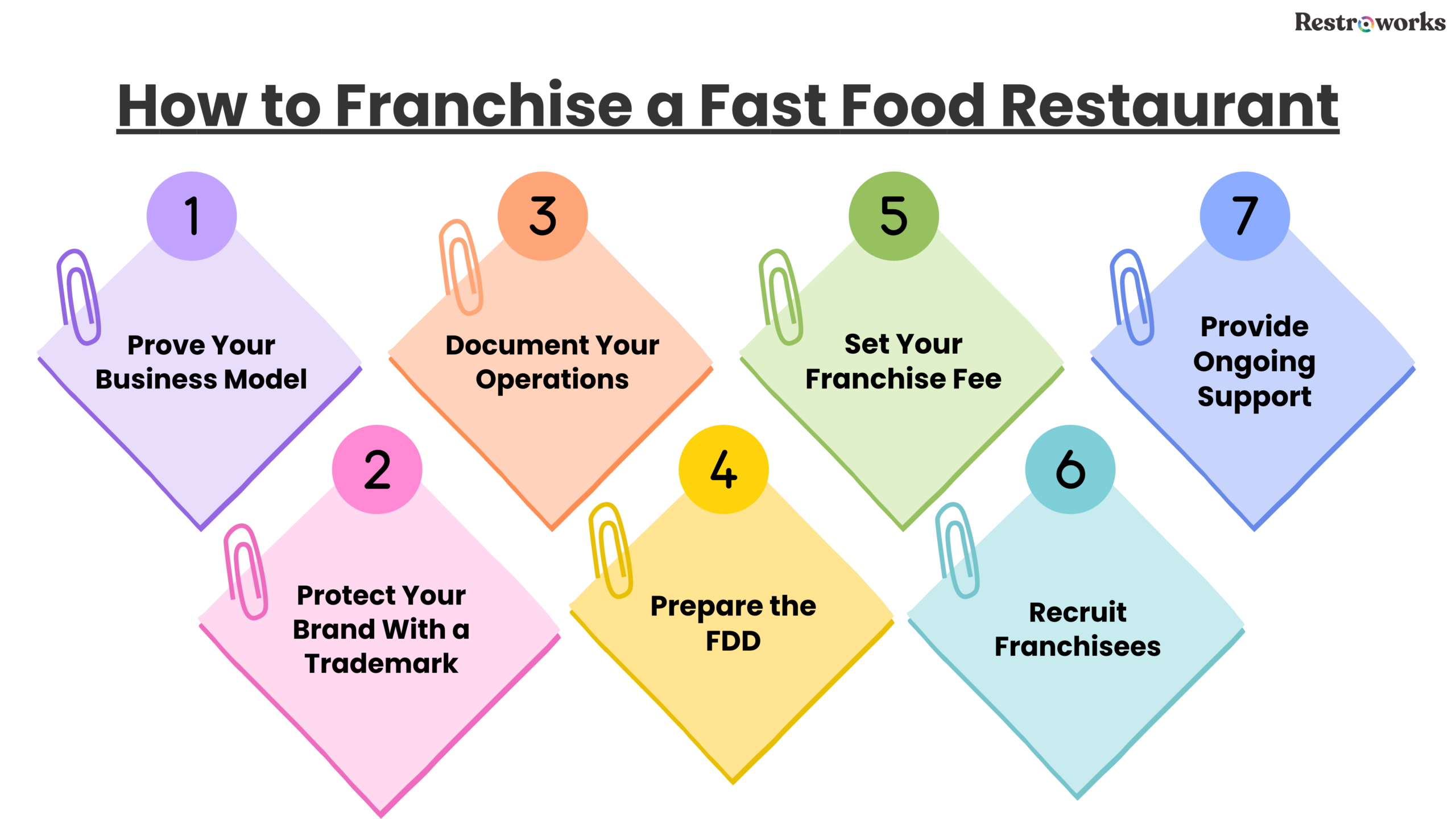
To franchise your fast food restaurant, follow seven steps in order: prove the model, protect the brand, document operations, prepare the FDD and contract, set fees, recruit franchisees, and support them after launch.
Step 1: Prove Your Business Model and Financial Readiness
Before you franchise, show that your flagship location makes money without you running it day to day, and that you have the capital to build a franchise business. Every potential operator will judge your franchise opportunity on unit economics, so your numbers need to be clean and repeatable.
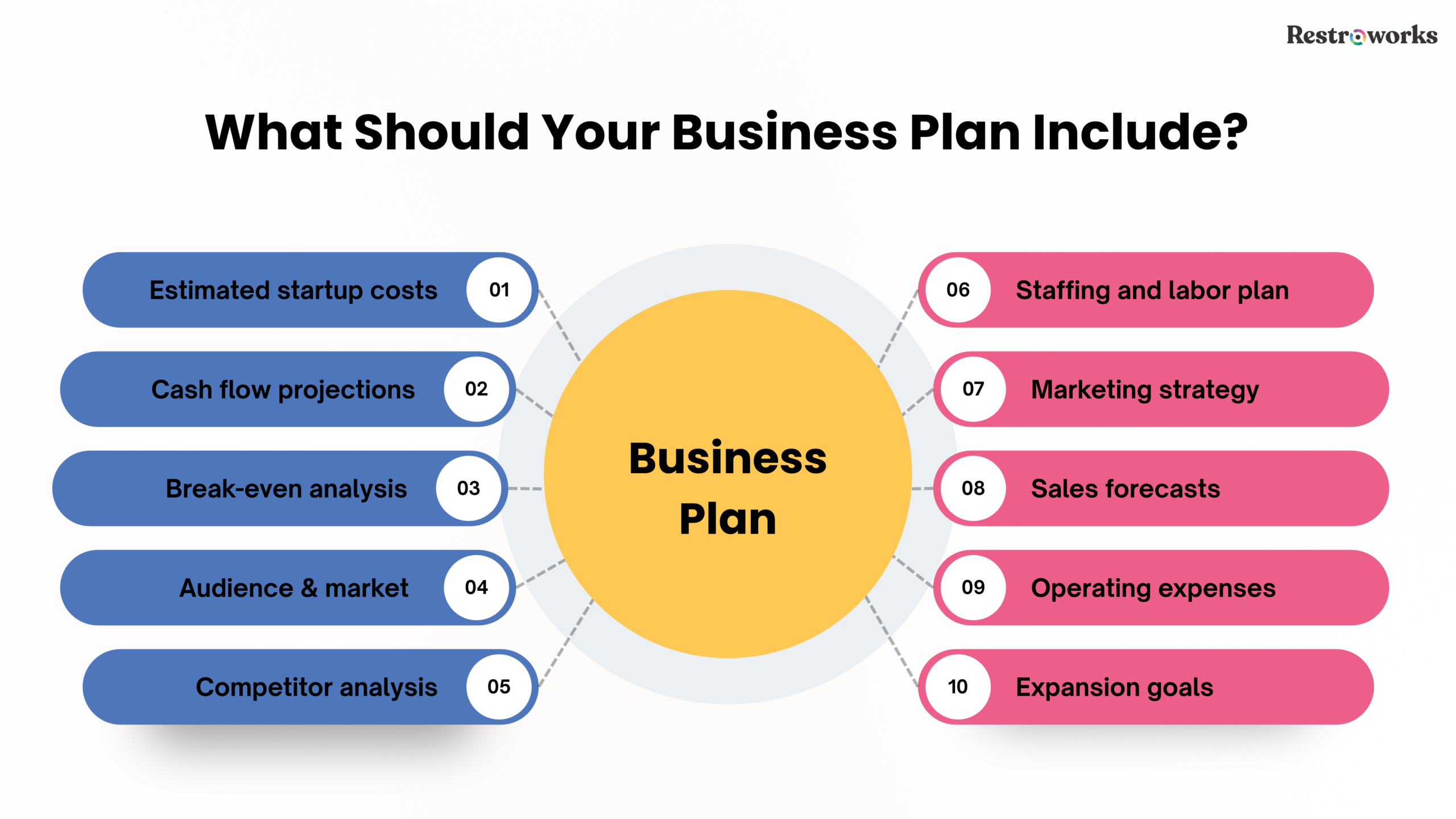
Build a business plan for the franchisor side of the business: start-up costs for the legal and operational setup, cash inflows from franchise fees and royalties, a break-even analysis, your target audience of prospective operators, a competitive and market analysis, and the staff you will need to support each franchise restaurant. Sound financial planning matters because many factors, from the local market to the size of the menu, affect how quickly a franchise system pays back.
Expect the payoff to take time. The Internicola Law Firm advises treating franchising as a five-year growth strategy and using the first 12 to 24 months to support a small group of operators and build proof that the system works.
Step 2: Protect Your Brand With a Trademark
Register your restaurant’s name and logo with the U.S. Patent and Trademark Office before you franchise, because franchising is essentially licensing your brand. If you can’t protect the name, you have nothing durable to sell in a new market.
The FDD must also tell potential franchisees whether your principal trademarks are registered (Item 13 of the FTC Franchise Rule). Trademark filings, company formation, and state filing fees together typically cost $1,000 to $4,500. Most franchisors form a separate franchise company to issue the FDD and sign contracts.
Step 3: Document Your Operations and Build Initial Training
Write down everything a franchisee needs to operate your restaurant the way you do, then turn it into an initial training program. The operations manual is the confidential playbook each operator receives after signing, covering daily routines, brand standards, menu specs, and how food is made and served to customers.
The typical cost of a professionally developed manual is $9,000 to $20,000, though some franchisors write parts of it themselves. If you consider any established brand, let’s say, Wayback Burgers – it includes In-Restaurant Training and Wayback Business School for up to two people in its upfront fee. Similarly, Capriotti’s also offers new owners a 180-day business coaching program.
Here, you’ll need to plan for staffing, too. Turnover is severe in this industry. In fact, the Bureau of Labor Statistics put restaurant-sector turnover at 81.9% for 2015 to 2017, and industry estimates for fast food restaurants reach 150%. The point is that your training resources must let each franchise restaurant hire and train new crew quickly.
Step 4: Prepare the Franchise Disclosure Document and Franchise Agreement
Hire an experienced attorney to prepare your Franchise Disclosure Document and the franchise contract, then register them in the states that require it. You cannot legally offer franchises until this is done, and mind you that legal work usually takes the biggest chunk of franchising cost, at about $26,000 to $32,000.
The FTC Franchise Rule requires your FDD to cover 23 specific items, including your background and parent companies, litigation history, fees, the franchisee’s estimated initial investment, obligations, territory, trademarks, and audited financial statements. Prospective franchisees must receive it at least 14 calendar days before they sign or pay anything.
On top of the federal rule, 13 states require you to register your FDD before any franchise sale there, and most emerging franchisors start by registering in only a few of them.
| FDD item | What you must disclose |
|---|---|
| Item 1 | Your company and any parent companies or affiliates |
| Item 3 | Litigation history |
| Items 5 and 6 | Upfront and ongoing fees (royalty, marketing, technology) |
| Item 7 | The franchisee's estimated initial investment |
| Item 11 | Your assistance, training, and opening support |
| Item 12 | Territory protections |
| Item 13 | Trademarks |
| Item 17 | Renewal, termination, and transfer terms (what happens on a sale) |
| Item 19 | Financial performance representations (optional) |
| Item 21 | Audited financial statements |
*Source: FTC Franchise Rule, 16 CFR 436.5
Step 5: Set Your Franchise Fee, Royalties, and Marketing Fees
Set an upfront franchise fee, an ongoing royalty, and a marketing fee that leave operators enough margin to succeed while covering your costs as the franchisor supporting them. Benchmark against established fast food franchise brands, then adjust for your brand’s size, sales, and local market.
Most major U.S. chains charge an upfront fee between $10,000 and $50,000 and royalties of roughly 4% to 8% of sales, plus a marketing fee. Across franchising generally, royalties range from 4% of revenue to 12% or more.
| Chain | Upfront fee | Royalty (share of sales) | Marketing/advertising fee |
|---|---|---|---|
| Burger King | $50,000 (20-year agreement) | 4.5% | 4.5% |
| Wendy's | $50,000 | 4% to 6% | 4% |
| Tim Hortons (U.S.) | $50,000 | 4.5% to 6.0% of gross sales | 4% |
| McDonald's | $45,000 | 4% or 5%, plus rent | At least 4% |
| Taco Bell | $45,000 | 5.5% | 4.25% |
| Wayback Burgers | $35,000 | 6% | 2.0% |
| Pizza Hut | $25,000 | 6% (6.5% in some cases) | 4.75% |
| Subway | $15,000 | 8% | 4.5% |
*Sources: Business Insider, May 2025; company franchising FAQs; Wayback Burgers; Franzy, etc.
Be careful not to price operators out of profitability. Franchisee margins in restaurants typically run only 3% to 5% pre-tax, and royalties come off the top of every sale whether or not a unit is profitable. Some franchises charge additional technology fees, so decide early which ongoing fees you will disclose in Items 5 and 6.
Step 6: Set Franchisee Requirements and Recruit Franchisees
As the franchisor, set minimum net worth and liquid assets requirements, write a profile of your ideal entrepreneur, and recruit a small number of highly qualified franchisees first, ideally in a market close to your headquarters. Your early operators become the proof that helps you sell the next fast food franchise.
Established fast food franchise brands publish clear net worth minimums, and yours should reflect the initial investment and cost of opening a franchise restaurant in your system. Higher net worth and liquidity floors narrow your candidate pool but reduce the risk of undercapitalized operators. Spell out what franchise ownership involves, from hours to hands-on duties, so candidates can self-select.
| Chain | Minimum liquid assets | Minimum net worth | Franchisee startup costs |
|---|---|---|---|
| Taco Bell | $2,000,000 | $5,000,000 | $1.9M to $4.3M |
| McDonald's | $500,000 non-borrowed funds | $750,000 | $1.5M to $2.7M |
| Burger King | $500,000 | $1,000,000 | $363,400 to $4.7M |
| Wayback Burgers | $250,000 (plus a 700 credit score) | $500,000 | $550,000 to $650,000 (typical) |
| Subway | $100,000 | $150,000 | $199,135 to $536,745 |
Mind that Wayback Burgers awards one unit at a time and lets operators add units only once both sides agree they are ready. Capriotti’s, though, took the opposite route with multi-unit deals – the sandwich chain, founded in 1976, signed 48 franchise development deals in the first six months of 2019 alone. The Internicola Law Firm recommends that most emerging franchisors focus on a handful of strong franchisees in the first two years rather than chasing volume.
Step 7: Launch Units and Provide Ongoing Support
Help each franchisee find a location, open strong, stay consistent for customers, and keep providing ongoing support long after the ribbon is cut. Your royalties depend on their sales, so as the franchisor, franchisee success is your success.
Site selection is where new owners will probably need you most. Help them choose real estate with strong traffic, visibility, and parking near their target audience, and avoid a market already saturated with existing franchises. Many franchisors assign a real estate team to each new franchise restaurant right after signing. Wayback Burgers, for example, helps each owner analyze every potential location and manage design and build-out, while the owner signs the lease.
After opening, franchisors typically provide marketing support, operational guidance, and access to proprietary systems and technology, such as point-of-sale software, while franchisees operate the unit day to day, handling daily management, staffing, and customer experience. Wayback Burgers’ marketing team works with creative agencies and PR firms on national campaigns, and the brand gives franchisees access to a national network of approved food distributors. Many franchisors keep regional field teams for continuous support and encourage a support network so other franchisees can share what works on cost control, staffing, and keeping customers coming back.
How Much Does It Cost to Franchise a Fast Food Restaurant?
Franchising a fast food restaurant typically costs about $46,000 to $100,000 in the first year, including legal work, an operations manual, audited financials, registration fees, and early sales and marketing. The legal and operational foundation alone costs $30,000 to $60,000.
| Cost component | Typical cost |
|---|---|
| Attorney-led legal foundation (FDD, franchise contract, trademark filing, entity formation) | $26,000 to $32,000 |
| Operations manual (professionally developed) | $9,000 to $20,000 |
| Audited financial statements | $2,500 to $5,000 |
| State registration fees | $100 to $1,865 per registration state |
| Sales stage (website, PR, lead generation) | $15,000 to $50,000+ |
| Total typical range | $46,000 to $100,000 |
*Source: The Internicola Law Firm, July 2026
Government filing fees are the smallest cost. Audited financials are an ongoing cost, not a one-time one: registration states require them with your FDD each year, and the audit typically costs more than all state filing fees combined. Budget, too, for the staff and time spent supporting each franchise restaurant, which never shows up on a legal invoice.
INDUSTRY INSIGHT
Fast food is the largest segment of U.S. franchising, accounting for more than a third of franchise economic output and nearly half of franchise jobs. One thing to note here is that this growth is increasingly coming from smaller brands like yours, even in a crowded market.
A 2026 RestaurantData review of about 250 FDDs found the smallest quarter of restaurant franchise systems grew roughly 14% over two years, while the 10 largest brands posted a slight net decline in locations. Franchising can also lift a restaurant’s revenue by about 7%, with much of that market share taken from competing national chains.
Ownership at the top can change, too. On September 1, 2026, Yum Brands completed the sale of Pizza Hut (outside mainland China) to private equity firm LongRange Capital for roughly $1.5 billion – a reminder that Item 1 of the FDD asks franchisors to disclose their parent companies.
Younger customers are a key growth target. Gen Z made 5 billion restaurant visits in the 12 months ending July 2022, 4.3 billion of them at fast food restaurants (quick-service restaurants, in NPD’s terms). “Restaurant operators can differentiate their brand with Gen Zs by focusing on creative spins on classic foods, engaging relevant messaging, and generating value beyond price,” said David Portalatin, NPD food industry advisor.
Common Mistakes to Avoid When Franchising a Fast Food Restaurant
The most common mistakes are franchising before the concept is proven, using template legal documents, overcharging franchisees, selling too many franchises too fast, and underinvesting in support.
| Mistake | Why it hurts | How to avoid it |
|---|---|---|
| Franchising too early | Operators inherit a model that isn't profitable yet | Prove one or two units first and write a business plan |
| Cheap legal templates | FDD errors create legal liability in every state you sell in | Use an experienced franchise attorney |
| Fees that squeeze operators | Margins already run just 3% to 5% pre-tax | Benchmark fees against peers and model franchisee returns |
| Selling too fast | Support teams can't keep up, and quality slips | Recruit a few strong franchisees first |
| Thin support | One inconsistent franchise restaurant can damage the whole brand | Budget for training, field visits, and marketing |
Maintaining consistent taste and service for customers across multiple fast food restaurants is difficult, which is why comprehensive manuals matter so much for quality across a franchise system. Franchisees are also required to follow strict operating guidelines, which can frustrate owners who want to experiment, so explain your standards clearly before they sign.
Struggling operators hurt the franchisor, too. At least 10 significant multi-unit restaurant franchisees, across chains including Hardee’s, Subway, Popeyes, Carl’s Jr., and Applebee’s, had filed for bankruptcy by mid-September 2026, citing high labor and food costs and slumping traffic. Franchising’s speed only pays off when the underlying business model, operations manual, and support system are strong enough to withstand rapid replication.
KEY TAKEAWAYS
- Franchising requires turning a proven concept into a scalable, documented system; prove one or two profitable units first.
- The franchise agreement defines the obligations and rights of both the franchisor and the franchisee for the full term, often 20 years at major chains.
- Becoming a franchisor typically costs $46,000 to $100,000 in the first year and takes about 90 to 120 days to set up legally.
- Royalty fees at major fast food chains run from about 4% to 8% of sales, plus marketing fees, in exchange for continued access to the franchisor’s brand and resources.
- Your FDD must be delivered at least 14 days before any franchisee signs or pays, and 13 states require registration first.
- Early success at each franchise restaurant, not advertising, is what sells your next franchises.
Frequently Asked Questions
1. Does it cost $10,000 to open a Chick-fil-A?
No. Chick-fil-A’s franchise fee is $10,000, but startup costs run from $426,735 to $2.3 million, and operators pay a 15% base operating service fee plus rent capped at 6% of sales. For restaurant owners designing a franchise, it shows one alternative model: a low upfront cost paired with a much larger share of ongoing sales.
2. What are the cheapest fast food franchises to open?
Subway is one of the lowest-cost major fast food franchises to open, with startup costs of $199,135 to $536,745 and a $15,000 fee. Wayback Burgers can cost far less than the national burger giants, at a typical $550,000 to $650,000. A lower franchisee investment widens the pool of candidates for your franchise opportunity.
3. Can you get financing for a fast food franchise with bad credit?
It is harder, but possible through SBA loans, equipment financing, or franchisor-referred lenders. The SBA guaranteed $31.1 billion in 7(a) loans in fiscal 2024, and franchises have historically accounted for about 20% of SBA lending by dollar volume. Many franchisors still set credit floors; Wayback Burgers asks for a 700 credit score.
4. How profitable is a fast food franchise?
Profitability depends on the brand, location, and management, and franchisee margins typically run 3% to 5% pre-tax. Top brands make up for it with volume: Chick-fil-A locations averaged about $9.3 million in 2024 sales and McDonald’s about $4 million.
5. Do you need restaurant experience to own a fast food franchise?
Not always. Many franchisors accept an entrepreneur who has never had to operate a restaurant, and they provide training and ongoing support, though some prefer candidates with management or business ownership experience. As a franchisor, decide early which background you will require and spell it out in your franchisee profile.