
You don’t need a dining room to run a restaurant business anymore.
Less than a decade ago, opening a restaurant meant investing in a high-rent retail space and hiring a full front-of-house team. But today? All you need is a fully-functional kitchen to build a profitable restaurant brand that delivers deliciousness, right at customers’ doorsteps.
And with the US online food delivery market expected to reach $75.4 Billion by 2034, there’s no better way to enter the restaurant industry than opening a cloud kitchen. These delivery-only business models exist without brick-and-mortar locations and are built entirely on digital visibility.
But what makes them highly appealing is their flexibility. You can launch faster because you’re not building a dining space. You can test a new cuisine without committing to a full-scale restaurant. And you can run multiple brands from the same kitchen. That kind of agility is hard to achieve in a traditional setup.
This guide will discuss what a cloud kitchen is, how to set it up, and how establishing one can help you stay ahead in the restaurant industry.
What you will learn
- What is a cloud kitchen business and how it operates?
- What are the different types of cloud kitchens you can operate?
- How to start a cloud kitchen and its revenue model.
What is a Cloud Kitchen?
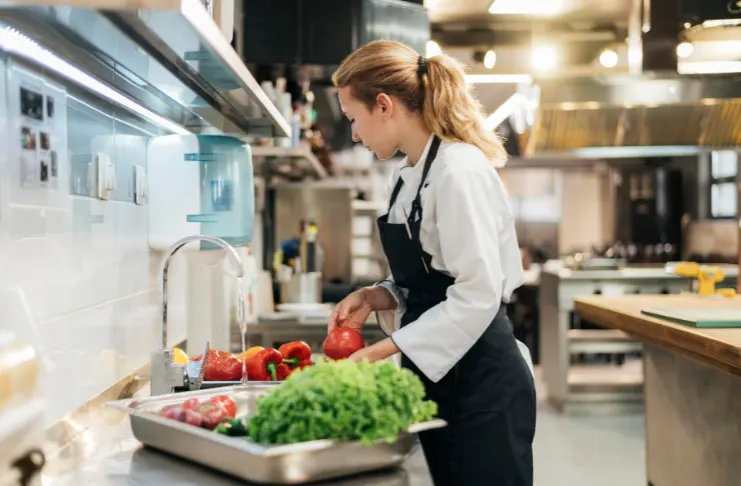
A cloud kitchen is a commercial space where you prepare food and deliver it to customers through online ordering platforms and apps. Customers can access these platforms and place an order. Once the kitchen receives the order, it prepares the food and delivers it directly to the customers.
Because there’s no investment in dining areas, décor, or service staff, a cloud kitchen restaurant becomes much more cost-effective. This also means operators can focus their resources on food quality, efficiency, and online visibility.
Given its appeal, the cloud kitchen market is expected to grow at an annual rate of 13.78% and could reach $112.53 billion by 2027.
How Does a Cloud Kitchen Business Model Work?
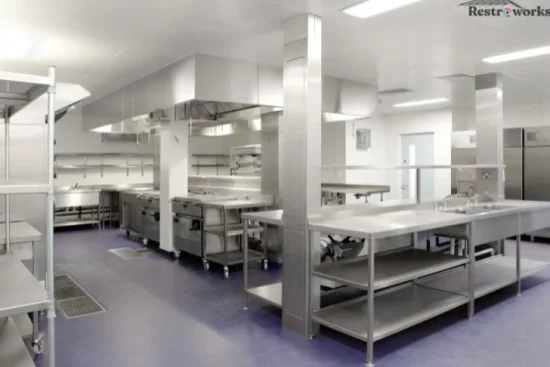
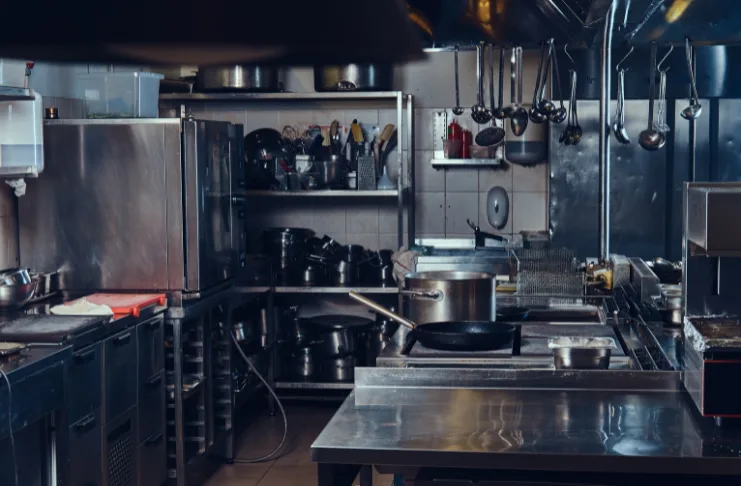
A cloud kitchen works as a centralized food production facility where multiple restaurant brands rent a space to deliver food to customers. You get access to all the basic facilities you’ll need in a kitchen: prep areas, cooking stations and equipment, ovens, refrigerators, sinks, and so on.
To understand how these kitchens function, let’s look at the key characteristics of a cloud kitchen business model–
- Operations Through Online Platforms: The cloud kitchen business model is run online, where customers place their orders via food delivery service apps. This helps the cloud kitchen restaurant streamline the ordering process by increasing efficiency and saving on serving staff salaries.
- Cost Efficiency: Maintaining a dining room to house and serve customers is extremely costly. Not only do you have to spend on a bigger space and better interiors, but you’ll have to hire more staff. On the other hand, a cloud kitchen can reach more customers online and allow them to order food at their convenience.
- Multiple Brands Under One Roof: As cloud kitchens run on online orders, multiple brands can easily operate from a single location. This could be a shared space with 1-2 teams cooking for multiple brands or a private space where different brands have their own setup. Isn’t that more cost-efficient?
- Use of Technology: Cloud kitchens completely rely on technology to manage and fulfill orders. Tools like cloud kitchen pos system, inventory management software, or kitchen production systems help manage orders and payments, track deliveries, maintain inventory levels, and more for enhanced customer experience.
What are the Benefits of Starting a Cloud Kitchen?
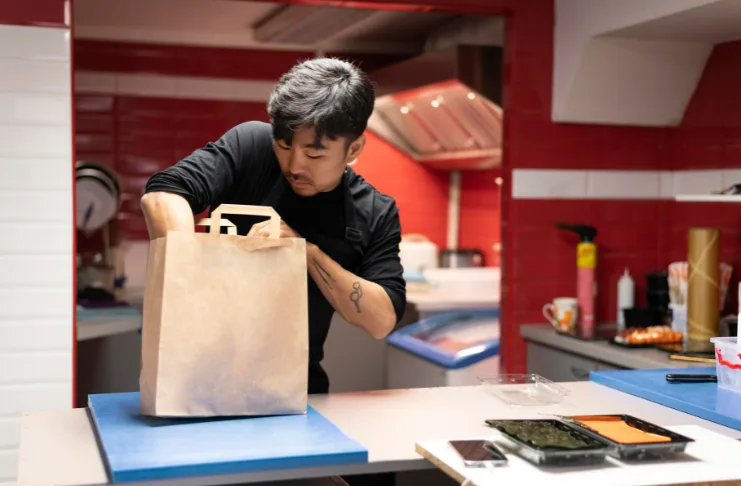
For millennials and younger consumers, cloud kitchens are appealing because a lot of them prefer digital, mobile-friendly food ordering solutions.
While for food entrepreneurs, some of the major benefits of opening a cloud kitchen include-
1. Lower Overhead Costs Than Brick and Mortar Restaurants
A traditional restaurant requires $175,500 to $750,000 or even more in startup costs, depending on concept and size. On the other hand, virtual kitchens can start at an average capital of $30,000, depending on location and equipment needs.
With a cloud kitchen model, you save on rent, staff, and interiors. Unlike a restaurant that needs to operate in a prime locality to ensure high customer footfall, a cloud kitchen can operate from low-rent areas to reduce costs.
2. Scalability
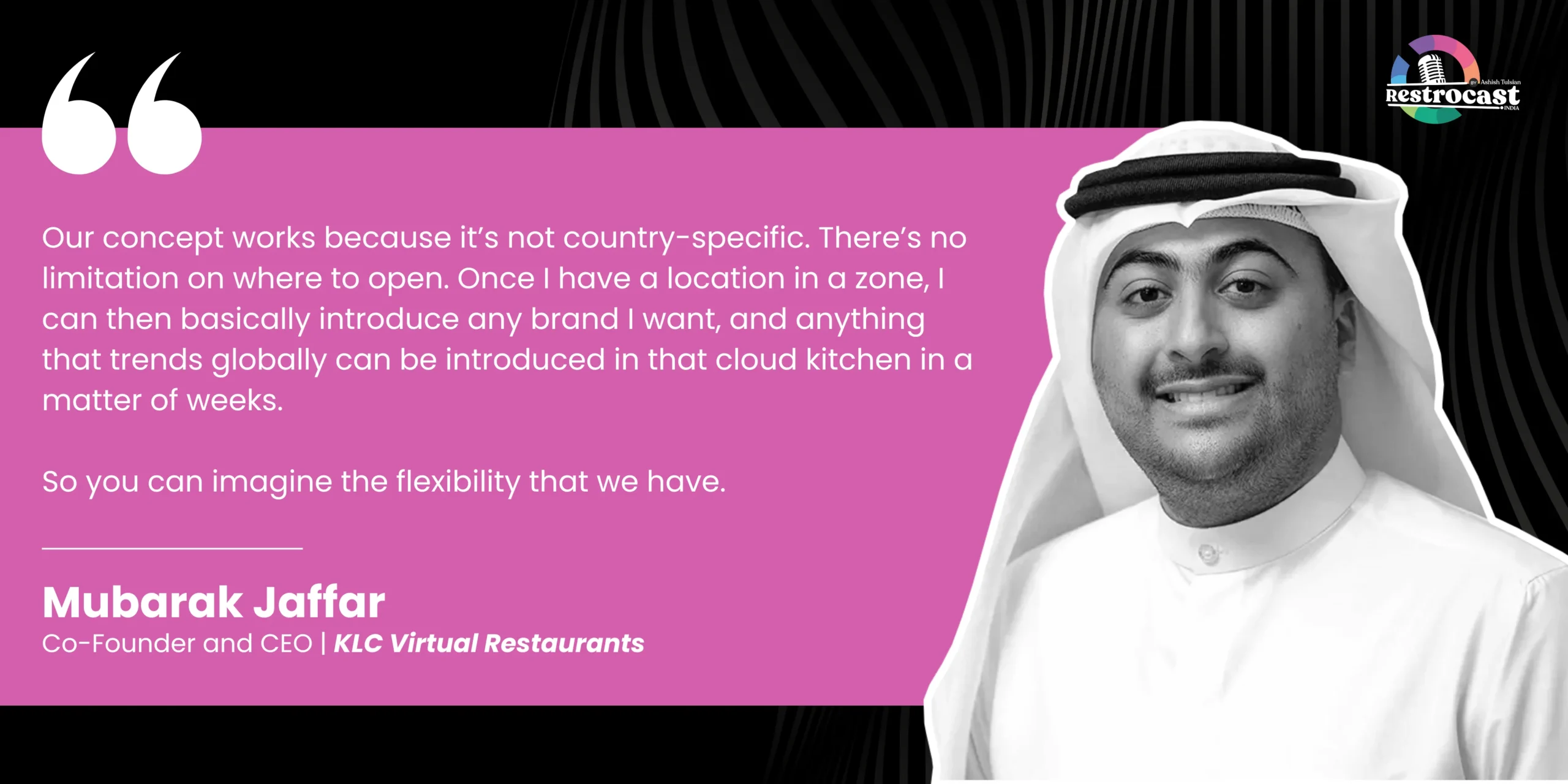
Why are cloud kitchens one of the most attractive investment opportunities for entrepreneurs and investors? Because they are conducive to high growth, and the operations can be scaled up quite easily. With less cost involved and a simple kitchen setup, it is easy to expand and open additional cloud kitchens.
Take it from Mubarak Jaffar, Co-Founder and CEO of KLC Virtual Restaurants. In a conversation on Restrocast, he mentions:
3. Vast Reach
Cloud kitchens have a huge advantage over traditional restaurants. They can reach a large number of customers through online delivery platforms and by setting up their kitchens at multiple locations.
At the same time, social media makes it easier for you to market your restaurant and menus at a faster pace. Put pictures of your menu, share behind-the-scenes videos, or online feedback from your customers on your social handles. That’s a sure-shot way to attract and engage with customers.
4. Better Efficiency
When you remove dine-in service from the equation, your operation becomes simpler by design. You’re no longer coordinating servers, managing table turns, or balancing walk-ins with delivery orders. Your entire workflow revolves around a simple objective: preparing and dispatching orders quickly.
What are the Potential Challenges of Running a Cloud Kitchen Business?
By the looks of it, a cloud kitchen business model seems extremely lucrative and an easy prospect. But not everything is perfect. A dark kitchen may face a lot of challenges, such as-
- High Competition in a Crowded Digital Market: Lower entry barriers mean more players enter the space. When your main channel is a delivery app, you’re competing with every brand visible in a customer’s search results. In dense urban markets, that can mean hundreds of options within the same cuisine category.
- Limited Brand Visibility: High competition and no physical presence also mean it is tough to get noticed. Customers won’t just walk past your restaurant and remember to give it a try. Online visibility and customer loyalty may take longer to build.
- No Direct Customer Interaction: Again, without a storefront, you and your customers don’t get to interact. There’s no warm welcome, no personal connection built. Plus, you often also miss out on direct feedback because of this lack of interaction.
- Reliance on Third-Party Delivery Apps: Most of the cloud kitchens rely heavily on third-party delivery partners like Uber Eats to reach the customer. While it requires less in-house effort, these platforms can take up to 30% of your revenue as commission.
Not to mention, the customer experience is dependent on the quality of service provided by the delivery partner, and you can only do so much to control it. Finally, these platforms use set algorithms to show restaurants to customers. As a result, the visibility of a cloud kitchen depends solely on the algorithm and ratings.
EXPERT OPINION
Talking about his experience and challenges of building shared cloud kitchen spaces, Joe Frem, CEO and co-founder of Matbakhi, shares:
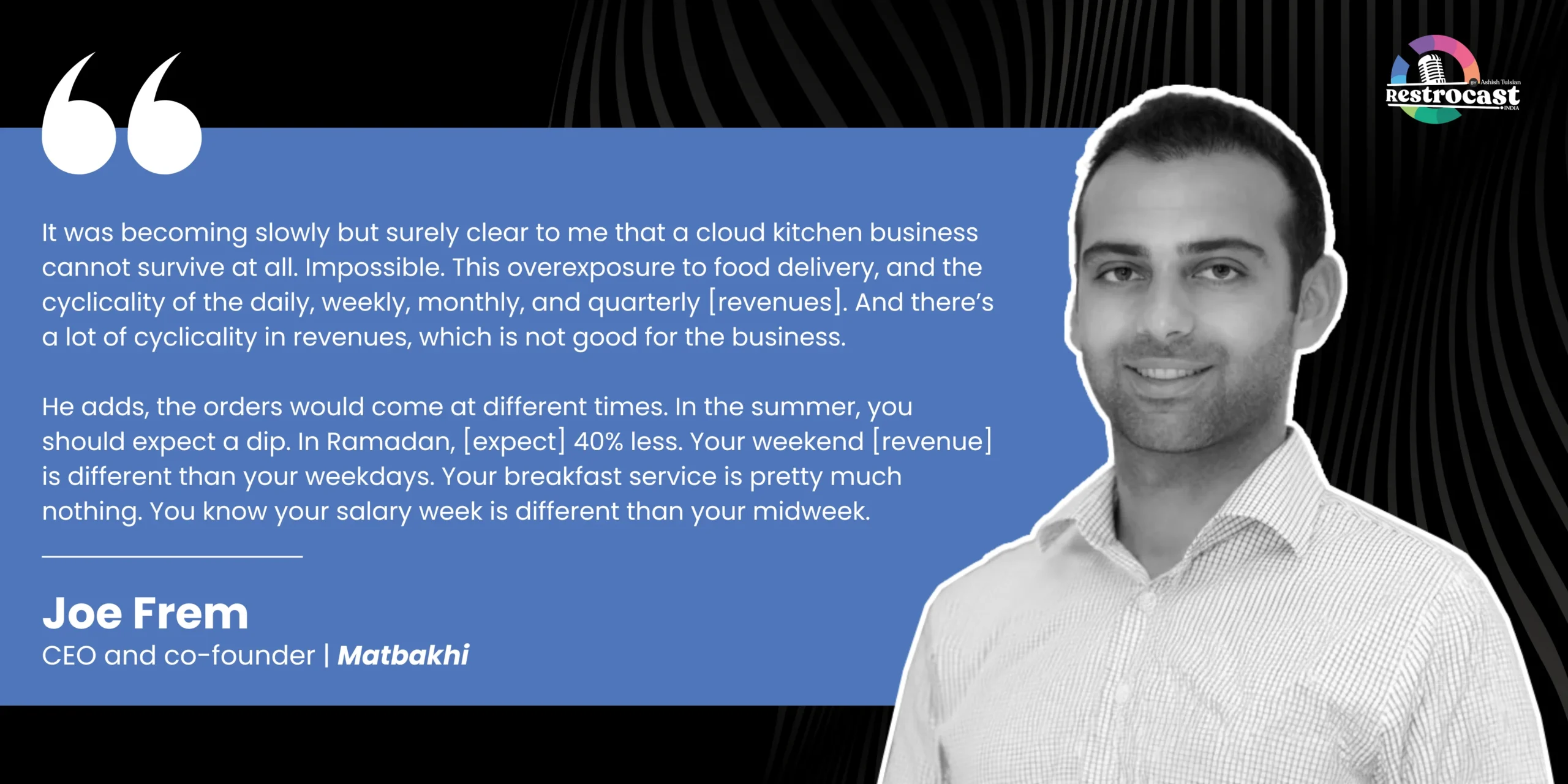
Catch up on more of this interesting conversation with Joe Ferm on Restrocast:
What are the Different Cloud Kitchen Concepts?
Depending on your capital, area of operations, and customer preferences, the different types of cloud kitchens are-
A. Independent Cloud Kitchens
When a single business operates a cloud kitchen, it is called an independent cloud kitchen. The kitchen’s operations, from procuring inventory to food preparation and delivery logistics, are controlled by the cloud kitchen restaurant. Here are some features-
- Better Control: As there is no third party involved, the owners of the kitchen have complete control over the cloud kitchen operations.
- Branding: By setting up an independent cloud kitchen, you get the opportunity to develop your operations and create a strong, recognizable brand.
- Directly Earn Profits: The kitchen owner receives all the profits directly, making the money flow easier.
B. Shared Cloud Kitchens
When multiple food businesses use the same kitchen area for their operations, it is called a shared cloud kitchen. Similar to the concept of shared office spaces, a shared cloud kitchen offers the following-
- Cost Sharing: The overhead costs, like rent and kitchen equipment, can be shared between multiple cloud kitchens, thereby reducing the burden on one kitchen.
- Flexibility: For an emerging food brand, it is most fruitful to use a shared kitchen space. It reduces the capital investment and operational costs.
An excellent example of shared cloud kitchens is “The Hive”, which supports multiple restaurant brands at a single location.
C. Third-Party Cloud Kitchens
As the name suggests, third-party cloud kitchens are owned and operated by an experienced business that manages all operations from food preparation to delivery. So, you can create a cloud kitchen brand, design the menu, and market your food. And the rest is taken care of by the third party.
D. Hybrid Cloud Kitchens
It is an independent cloud kitchen, but instead of solely delivering the food to the customer’s location, it also offers takeaway service. The customers can come and wait in a well-curated service area. The food is prepared, and the customers can take away their packages themselves.
Cloud Kitchen vs Ghost Kitchen vs Virtual Kitchen: Are They the Same?
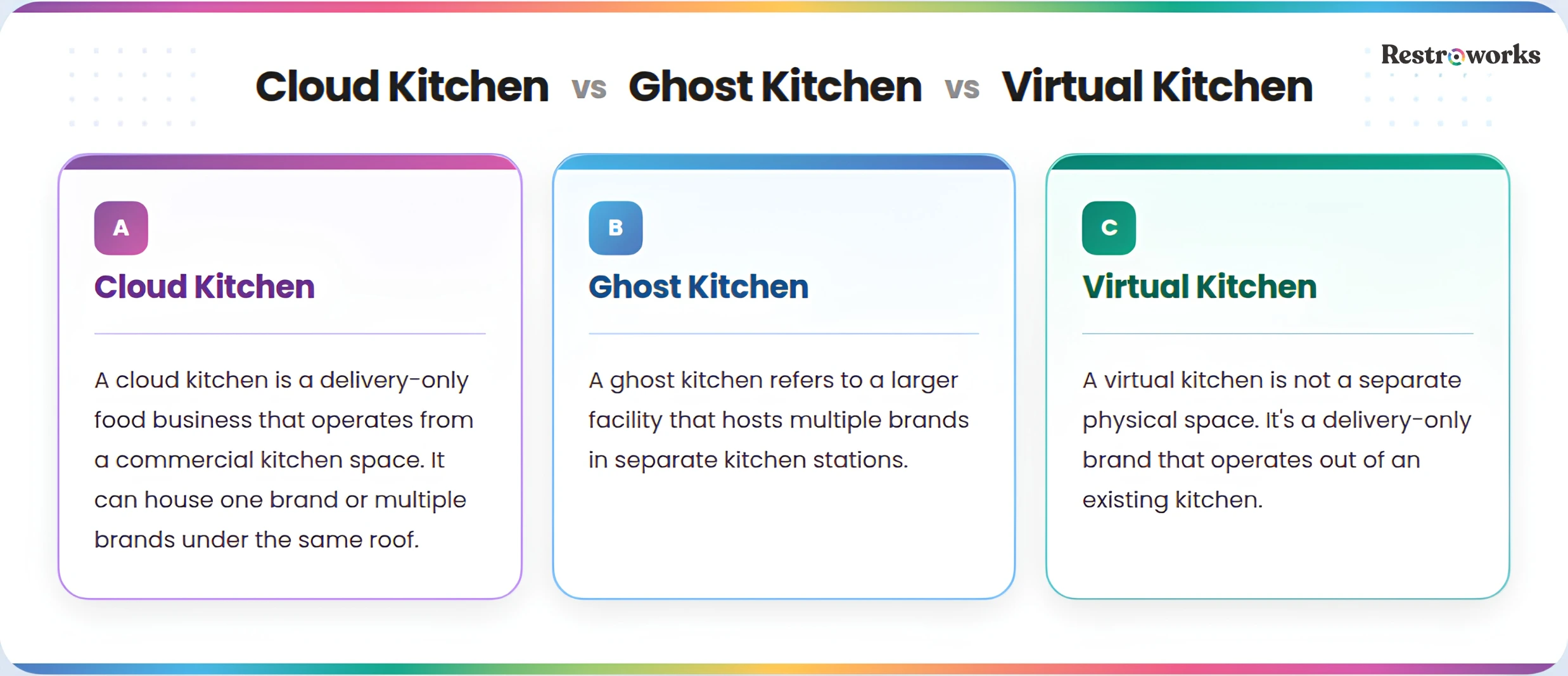
When you think of a cloud kitchen, you may use these terms interchangeably. But they refer to slightly different setups. The confusion usually happens because all three operate without a brick-and-mortar space. The difference lies in ownership, infrastructure, and branding.
A. Cloud Kitchen
A cloud kitchen is a delivery-only restaurant that operates from a commercial kitchen space. It can house one brand or multiple brands under the same roof. So as discussed-
- It is built specifically for online orders
- Has no dine-in or front-of-house operations
- It may be independently owned or shared
- Focuses on operational efficiency and delivery logistics
This is the broader umbrella term for delivery-first kitchen models.
B. Ghost Kitchen
A ghost kitchen is often used as another name for a cloud kitchen, but in many cases, it refers to a larger facility that hosts multiple brands in separate kitchen stations.
- It is a centralized facility with multiple food brands
- It offers shared infrastructure like utilities and equipment
- Individual brands can operate independently within the space
Think of it as a real estate and infrastructure model designed to support multiple delivery-only businesses.
C. Virtual Kitchen
A virtual kitchen is not a separate physical space. It’s a delivery-only brand that operates out of an existing kitchen. So basically, the infrastructure already exists, and the new concept only exists online on delivery platforms.
For example, a dine-in Italian restaurant might launch a separate brand online, called Late Night Wings, using the same kitchen and team. To customers browsing a delivery app, it appears as a completely different restaurant. But behind the scenes, it’s the same facility.
Virtual restaurants are an excellent way to increase revenue without expanding a physical location. You can easily test new cuisines, target new customer segments, and increase kitchen utilization.
How to Start a Cloud Kitchen?
Eager to start with your own virtual brand? Ghost kitchens are efficient, low-cost models, and here’s how you can launch one-
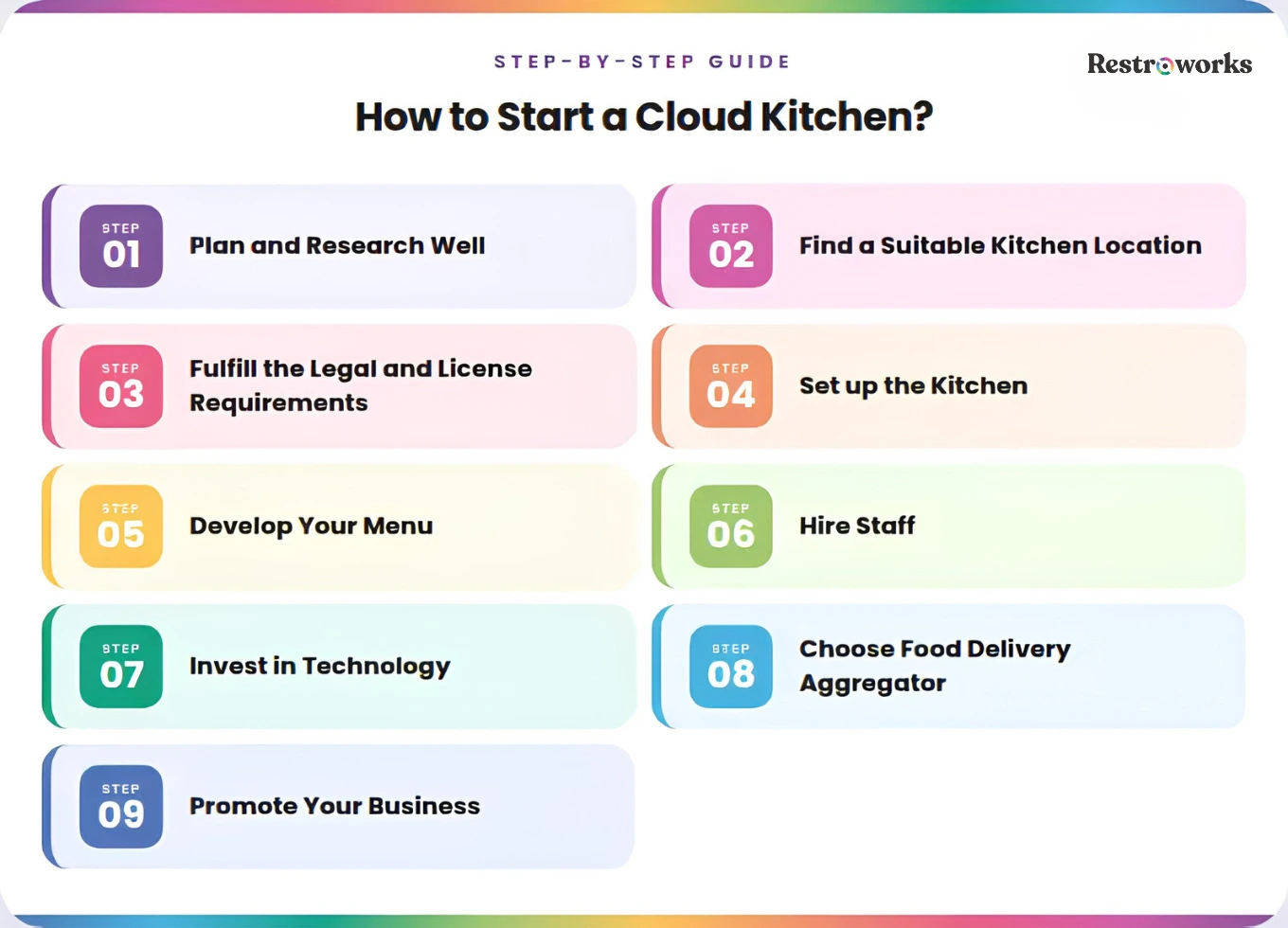
1. Plan and Research Well
To begin with, you should have a proper plan in place to set up the cloud kitchen. Understanding the market and identifying potential customers and your competitors is very important.
For this, you need to study the demand for different cuisines and dishes that are popular in your area. You can use online tools and forms to conduct social media surveys.
Additionally, identify the types of customers you want to target. What age group do they belong to, and what are their food preferences?
For example, it is a better idea to start a fast food joint as a cloud kitchen if the target customers are young students or professionals. You can also provide healthy alternatives to junk food as your USP to attract more students.
2. Find a Suitable Kitchen Location
The next step is to find an appropriate kitchen location. While you don’t need to find a prime, high-traffic location to attract customers, a strategic location will help you cater to a wider customer base.
- Radius of Access: The location of your dark kitchen should cover a larger delivery radius. Setting up in a central location works best for cloud kitchens.
- Cost Reduction: Opt for commercial spaces with a lower rent to reduce overhead costs.
- Prompt Delivery: Select a location closer to your target audience and with easy access for delivery drivers to ensure quick delivery.
3. Fulfill the Legal and License Requirements
Before officially starting operations, you need to register the business and obtain multiple permits for compliance. Here are the main local regulatory and licensing needs that cloud kitchens need to navigate-
- Health permits
- Business registration
- Employer Identification Number (EIN)
- Food handler’s permit
- Fire department permit
- Insurance
4. Set up the Kitchen
After completing the preliminaries, it is time to step up the game and start laying the foundation to build a successful cloud kitchen.
This is where you think about the kitchen layout, purchase the high-quality cooking equipment, and plan for the opening inventory. While designing the kitchen, make sure that the space is optimally utilized and that the design helps the staff to move smoothly. Plus, it should follow the safety precautions and protocols properly.
And if you’re planning to take up a shared kitchen space, check if the cloud kitchen provider offers you the necessary means to run a profitable business. Consider these factors-
- Do they offer high-quality equipment and appliances that you’ll need? Or do you need to invest in more?
- Do they ensure proper maintenance and cleanliness of the shared kitchen space?
- Do they follow compliance and legal requirements strictly?
5. Develop Your Menu
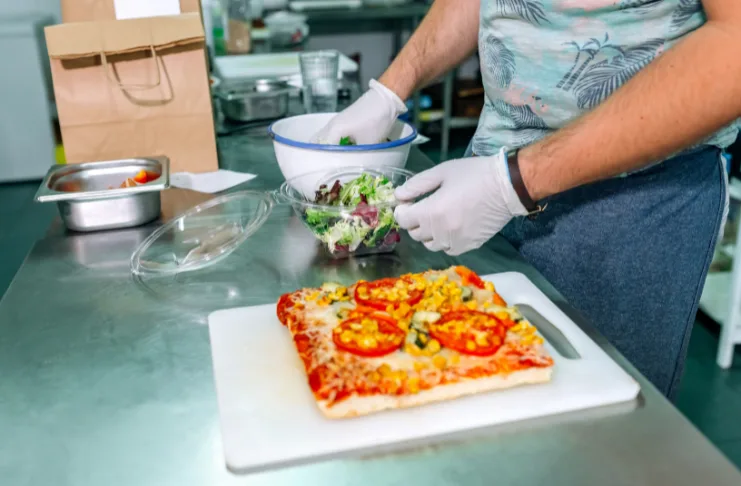
Your food is the only tangible connection between you and your customers. So the taste, consistency, and quality always have to be top-notch. But at the same time, think about the deliverability of your menu items. Are your food items easy to pack and deliver? Do they travel well without worrying about leakage or spoilage? Is your packaging secure and effective enough?
Last but not least, think about creating a menu that profits you. Plan your menu around an optimal food cost percentage and demand to make your business highly profitable.
6. Hire Staff
The staff you hire will eventually play an important role in the success or failure of your operations. Hire experienced chefs and helpers who can handle pressure and deliver consistency. Plus, invest in ongoing training to help them improve their skill and work efficiently based on established processes.
7. Invest in Technology
A cloud kitchen runs entirely on digital demand. Which means your restaurant tech stack has to be highly efficient and organized so you don’t miss any orders or delay deliveries.
At a minimum, you’ll need-
- A POS system that consolidates orders from multiple platforms and handles payments
- A kitchen display system to replace printed tickets
- Inventory tracking to control food costs
- Basic reporting tools to track daily sales, prep times, and best-selling items
Good systems reduce confusion during rush hours. They also give you data to help measure what’s working. Which menu items sell best? When do peak orders hit? Where are delays happening? Those insights let you adjust quickly instead of guessing.
8. Choose A Food Delivery Aggregator
Now, you can set up your account with third-party delivery partners. Most cloud kitchens rely on platforms like Uber Eats, DoorDash, or Grubhub to generate orders.
When evaluating aggregators, look at-
- Commission percentage
- Delivery coverage in your target area
- Visibility tools or promotional options
- Payout cycles
- Integration with your POS system
That being said, it’s not always wise to depend on just one. Diversify your ordering platforms to reduce risk if rankings drop or fees increase for one platform. Over time, you can also consider building your own direct ordering channel, such as a website or food delivery app, to save margins.
9. Promote Your Business
So your virtual restaurant brand is up and running. How are you going to earn visibility and attract customers? For this, start with your visuals. On delivery apps, photos sell. Have enticing menu pictures, clear descriptions, competitive pricing, and smart menu categorization.
Then focus on-
- Social media marketing with short food videos and real customer reviews
- Limited-time offers to generate early traction
- Encouraging satisfied customers to leave ratings
- Local SEO if you offer direct ordering through the website
Because you don’t have a physical presence, your brand lives online. That means your logo, packaging, tone, and customer experience must align to create a strong brand identity, as Wow Bao did.
What are the Technology Requirements for a Ghost Kitchen?
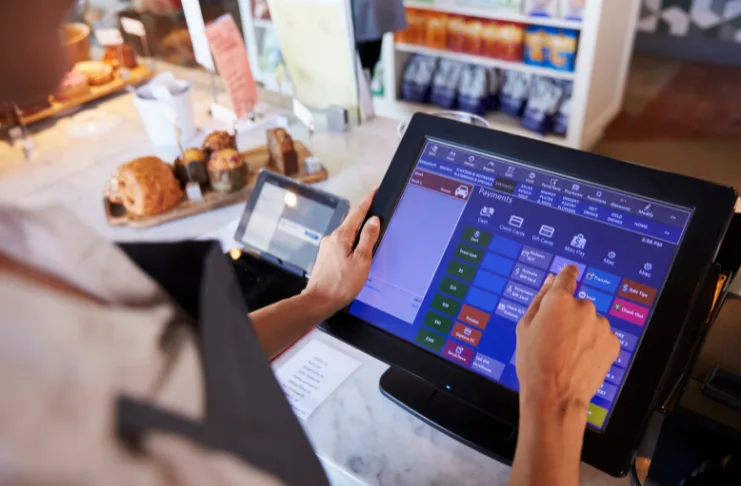
Smart technology is at the core of ghost kitchen operations. Once you start receiving orders via online platforms like Uber Eats, Grubhub, and DoorDash, you need a reliable tech stack to manage operations smoothly.
At a basic level, this is what you’ll need-
- Point of Sale System: Your POS system will be the central tool for everything, from orders to payments. Orders from different delivery platforms will be captured in one place instead of multiple tablets within the POS. It keeps billing, tracking, and reporting in sync and reduces missed or delayed orders.
- Order Management System: Once orders start coming in back-to-back, you’ll need a clear view of what’s incoming, what’s in prep, and what’s ready to go. Or else, coordination between the kitchen and dispatch will be messy.
- Kitchen Display System (KDS): Instead of using paper tickets, implement a live screen to manage orders in the kitchen. It helps your team prioritize orders and keeps everyone aligned during busy hours.
- Inventory Tracking: You don’t want to find out mid-service that you’ve run out of a key ingredient. Tracking stock properly helps avoid that and also keeps your food costs under control.
- Reporting and Analytics: With time, you’ll want to know which menu items consistently sell, and which don’t. Or perhaps which hours are the busiest for you. A reporting software is essential to track menu performance and modify it accordingly.
Cost Breakdown of a Delivery-Only Brand
The cost advantage of a cloud kitchen comes from eliminating dine-in infrastructure. But does that make it a cheaper model? Well, yes and no.
Yes, because you do get to avoid the cost of interiors or front-of-house staff. No, because the cost structure is different and it still requires heavy investment in kitchen setup, inventory, licensing, and marketing.
While the cost of opening a cloud kitchen varies significantly by location, concept, and scale, the primary costs include-
A. Startup Costs
Most of your initial capital will go toward-
- Commercial kitchen equipment such as ovens, refrigeration, cooking stations, prep tables, and storage can range from $10,000 to $50,000, depending on quality and scale.
- Lease deposits or shared kitchen fees, for the first 1-3 months, upfront.
- Licenses and health permits
- Technology systems, including POS, order aggregation tools, and kitchen display systems.
- Initial inventory and packaging materials, which must support early volume without over-purchasing.
- Branding and menu photography to promote the business and improve digital conversion rates.
If you choose a private kitchen space instead of a shared facility, rent will be your largest fixed commitment. For instance, commercial kitchen rent in urban markets can range from $2,000 to $10,000 per month, depending on size and location.
B. Operating Costs
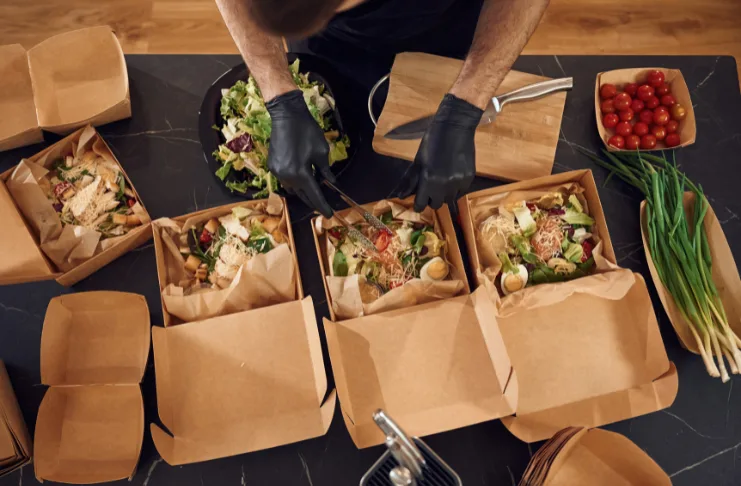
In cloud kitchens, most expenses fluctuate and are tied directly to order volume, which also makes your profits unpredictable. Your operating expenses will include-
- Rent or kitchen rental fees
- Kitchen staff wages
- Food and inventory costs
- Delivery platform commissions
- Utilities
- Packaging
- Paid promotions and discounts
To understand the ghost kitchen costs and profitability better, let’s consider a realistic scenario-
Consider
- Average order value: $25
- Monthly orders: 2,000
- Monthly revenue: $50,000
Now break it down per order at a 30 percent delivery aggregator commission-
- Commission (30%) = $7.50
- Food cost (30%) = $7.50
- Kitchen labor (20%) = $5.00
You are left with $5 per order before fixed costs. Now multiply that by 2,000 orders.
= $5 × 2,000 = $10,000 gross contribution before rent, utilities, packaging, and marketing.
Now, assume that your operating expenses include the following-
- Rent = $4,000
- Utilities (Internet, electricity, water, etc.) = $1,000
- Packaging = $1,500
- Marketing = $1,000
So, the total fixed and semi-fixed costs are $7,500. That leaves $2,500 in operating profit before taxes.
This is where volume becomes critical. If orders drop to 1,500 per month, your contribution drops to $7,500. At that level, profit nearly disappears.
The takeaway? While a ghost kitchen reduces upfront risk, you may operate on limited profits if you rely heavily on third-party platforms. So, it is crucial to understand your cost percentages in detail and price your menus in a way that protects margins.
What is the Revenue Model of a Cloud Kitchen?
Revenue in the cloud kitchen business comes from multiple sources and depends a lot on order volume. The same $30 meal can leave you with very different margins depending on where it was ordered, how it was priced, and what it included.
For instance, if most of your volume comes from delivery apps, commissions will be a major part of it before you even calculate food and labor. If you manage to get more direct orders, this margin will change significantly.
So the real question is not “How many orders can you get?” It’s “How much do you actually keep per order?” Let’s understand where your money actually comes from-
1. Delivery Apps Revenue
For most virtual restaurant operators, delivery platforms are the starting point. You get access to built-in demand and visibility, which is useful for launch and scale.
However, this higher visibility comes with commissions. Third-party delivery platforms such as DoorDash and Uber Eats charge 15% to 30% per order. So if your average order value is $28 and commission is 25%-
- $7 goes to the platform
- $21 remains before food and labor
This makes your pricing strategy all the more important to achieve better profits.
2. Direct Orders
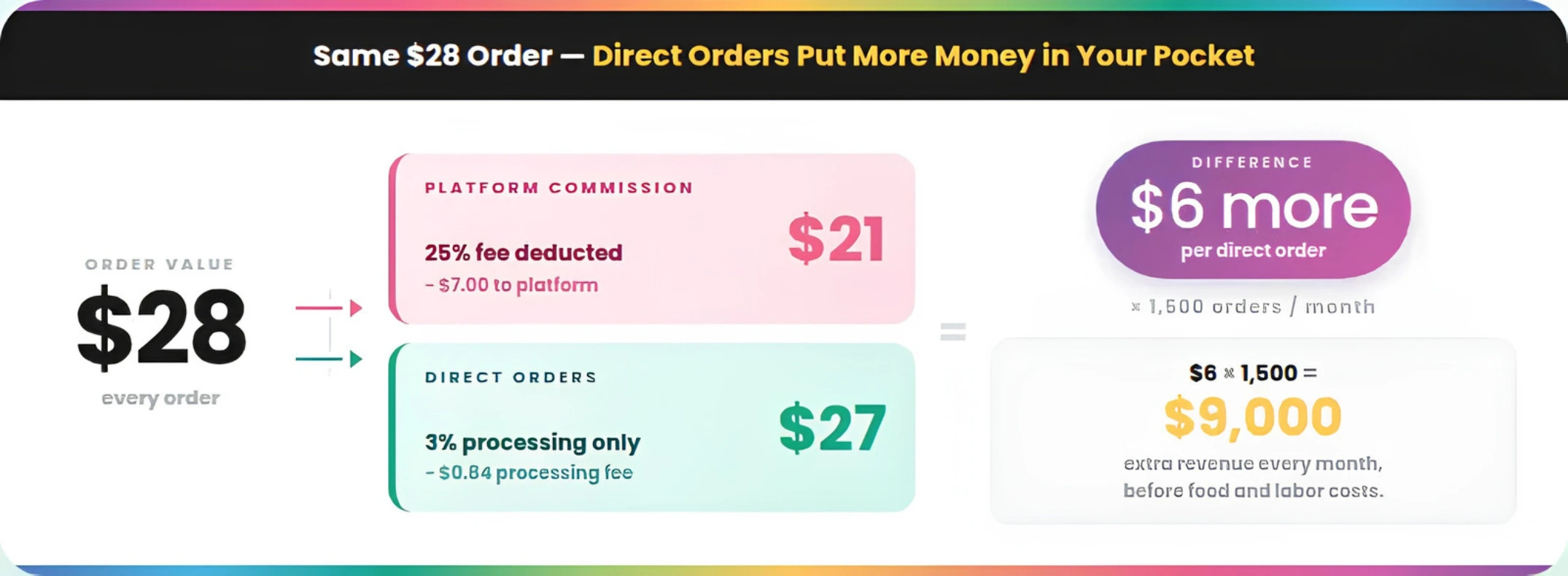
Direct orders are more profitable because you avoid heavy commissions. You may still pay 2-3% in payment processing fees, but the difference per order is impressive compared to 25% platform fees.
For example:
Using the same $28 example-
- In the absence of the 25% commission model, you eliminate the $7 fee and get to keep $21.
- Now, if you pay 3% payment processing fee or $0.84, that’s roughly $27 in your pocket.
That is a $6 difference per order. Say you achieve 1,500 monthly direct orders, this math means you get to retain roughly $9,000 extra revenue before food and labor costs.
3. Multiple Virtual Brands From One Kitchen
Cloud kitchens allow you to experiment with new menu items or launch a second brand without changing the main concept. This increases revenue without doubling fixed costs.
For example, you can have Brand A that sells burgers, Brand B that sells pizzas, and Brand C for late-night orders. Operating costs like rent, utilities, and much of the labor costs remain constant, and revenue from the same infrastructure will improve the overall contribution margin.
The delivery-only restaurants are definitely changing the restaurant industry. Not only are they successful, but they are also highly profitable. Plus, restaurant owners can develop multiple virtual restaurant brands and manage delivery operations effectively by working with a cloud kitchen provider or starting their own cloud kitchen business.
With more customers preferring to order in rather than dine out, the prospects for the food industry are only looking brighter.