what is the future of dining people discussing

Cloud Kitchen vs Restaurant: Key Differences, Costs & Which Is Better

Home / Blog /  

Cloud Kitchen vs Restaurant: Key Differences, Costs & Which Is Better

Read summarized version with

Bet you don’t hear about this stuff when you’re starting a food business.

The model you select will not only determine the success or failure of your launch, but it will also determine your margins, your relationship with your customers, your brand equity, and your chances of survival through the first three years. However, most food industry newcomers spend more time selecting a brand name than selecting a model.

The debate between the cloud kitchen model and the traditional restaurant model has been going on for a while. However, with the online food delivery market, which is a $1.22 trillion industry, or 40% of total US restaurant sales, as of 2025, the debate is no longer about industry trends. It’s about the kind of food business you want to open.

The cloud kitchen model provides lower costs, speed-to-market, and access to the exploding online food delivery market. The traditional restaurant model provides dine-in business, customer dialogue, brand equity, and establishment of presence in the world. The cloud kitchen model works, the traditional restaurant model works, but they both fail, and the reasons they fail are vastly different, and you should know about them.

What You’ll Learn

  • Clear definitions and how each model actually works day to day
  • A verified, US-specific cost and profit margin comparison
  • Which model fits which goals, budgets, and experience levels
  • Real examples from US operators, including Brinker International
  • How the hybrid model is reshaping the food industry in 2025
  • Common mistakes that kill both models

Why the Restaurant Industry Is at an Inflection Point

The old prescription for restaurant success was simple: good location, good restaurant design, good food, and enough repeat business to keep the doors open. The prescription still works. The prescription no longer describes what is possible. 

A parallel food service economy has developed. It has developed quietly over the past decade. US food service sales have been growing at 3 to 4 percent annually. US food delivery sales have been growing at almost twice that rate, 7 to 8 percent annually. 

COVID-19 hit, and the dining room business went away. The delivery business went on. The dining rooms opened again. Nothing changed. The habits formed during the pandemic have been locked in. The global cloud kitchen market size was valued at 73.18 billion dollars in 2024. The global cloud kitchen market is expected to reach $ 141.08 billion by 2030, growing at a CAGR of 11.9%. 42 percent of full-service restaurants in the US have at least one delivery-only concept. 

This is no longer a story of disruption. This is no longer a story of competition. Cloud kitchens and traditional restaurants have become allies. To make that alliance work, it is necessary to understand what each was designed to do.

What Is a Cloud Kitchen Business Model?

A cloud kitchen is a commercial kitchen that specializes in preparing food for online orders, without a storefront or any customer-facing presence.

Also known as a virtual kitchen or ghost kitchen, though these terms have slightly different meanings in terms of operations, a cloud kitchen business removes unnecessary elements from a food business. There are no host staff. There is no customer seating. There are no walk-in customers. It is a very simple business model based on a single principle: take in food orders from food delivery platforms, cook and package the food, and deliver it to food delivery services.

This is a very simple business. And a very economical business.

How a Cloud Kitchen Operates Day to Day

Orders are received through digital channels such as food delivery apps like DoorDash, Uber Eats, and Grubhub, as well as the restaurant’s own ordering system. These orders are then processed through a digital system, dispatched to the relevant station, cooked, packaged, and then collected by the delivery drivers.

There are no hosts, servers, or dining spaces to maintain. In fact, the labor costs are structurally lower. Cloud kitchens can save 30-40% of labor costs as compared to traditional restaurants.

One of the most powerful aspects of the cloud kitchen business model is its ability to operate multiple brands from the same facility. In other words, the same cloud kitchen can operate multiple brands, like a burger brand, a noodle brand, and a healthy grain bowl brand, all at the same facility. In other words, one facility, multiple revenue streams.

This aspect of the business model overlaps with the ghost kitchen concept, which operates on the same lines as the cloud kitchen. However, the difference lies in the fact that the cloud kitchen provides greater control, greater flexibility, and a more defined process for building a brand, whereas the ghost kitchen operates as a third-party facility.

Cloud Kitchen: What the Numbers Actually Look Like

Cloud kitchen costs look like:

  • Startup costs: $40,000–$200,000, depending on format; shared commissary spaces start as low as $16,000–$78,000
  • Profit margins (optimized): 20–25% for cloud kitchen tenants; ghost kitchens average around 15%
  • Break-even timeline: 12–18 months for well-managed operations
  • Monthly revenue potential: $20,000–$60,000 per well-positioned cloud kitchen unit

A cloud kitchen trades the dine-in experience and direct customer interaction for lower overhead costs, operational speed, and the ability to reach delivery customers entirely through online platforms. The trade-off is structural, not fixable with better packaging. Know what you’re giving up before you launch.

What Is a Traditional Restaurant?

A traditional restaurant is a foodservice establishment with a physical location where customers visit, dine, and interact with the brand.

This includes a tremendous range, from fast-casual restaurants in New York to full-service restaurants in California to neighborhood restaurants in Texas to fine-dining restaurants in Chicago. What all of these share is a customer experience that is beyond food, beyond the food environment, beyond food service quality, beyond ambiance, and beyond direct human interaction. It’s all part of the product.

Traditional restaurants can and do deliver food. They can and do have virtual brands. They can and do have all of these other things. The business operations, real estate, staffing, and loyalty of traditional restaurants are all based on dine-in customers.

How Traditional Restaurants Operate

The focus of the structure is on the visible, customer-centric operations. The customer walks in, gets seated, welcomed, and served. The food is being prepared, but the value does not stop there. It encompasses the entire customer experience, from the dining area and service to how the repeat customer is made to feel.

That’s a very complex operation, and it’s really hard to replicate when it’s done well.

The Operational Cost Stack of Running a Traditional Restaurant

Opening and running a traditional restaurant means carrying a cost structure that cloud kitchen operators simply don’t:

  • Startup costs: Counter-service restaurants cost $300,000–$1,900,000; full-service restaurants range from $500,000–$2,500,000 in the US
  • Rent for prime physical locations: In New York City, commercial dining space renovation costs run $200–$250 per square foot
  • Front of house staff wages: NYC restaurant workers earn $30–$115/hour across roles
  • Labor as a share of revenue: 25–35% of total sales, with 64% of operators exceeding their target labor costs in 2024
  • Utilities: $1,000–$2,500 monthly for a standard restaurant

The point isn’t that these costs are prohibitive; it’s that they’re structural. Every decision a traditional restaurant owner makes about location, dining area design, and staffing carries long-term financial consequences that don’t exist in a cloud kitchen.

Cloud Kitchen vs Restaurant: The Numbers That Matter

This is where most guides get it wrong. They compare startup costs and call it done. The more important comparison is ongoing operational costs, profit margins, and what you’re actually buying with each model.

Startup Cost Comparison

Model Typical US Startup Cost
Ghost kitchen (shared/commissary) $16,000–$78,000
Cloud kitchen (own facility) $75,000–$150,000
Counter-service restaurant $300,000–$1,900,000
Full-service restaurant $500,000–$2,500,000

The initial cost differential between opening a cloud kitchen and even a small traditional restaurant is considerable. In a high-demand market in the US, such as Los Angeles or New York, it takes 12-18 months and $750,000-$1.5 million to open a traditional restaurant. In contrast, it takes only 30-60 days to open a cloud kitchen in the same market.

Profit Margin Comparison

Restaurant Type Net Profit Margin
Full-service restaurant 2–5%
Fast casual / QSR 4–9%
Ghost kitchen (average) ~15%
Cloud kitchen (optimized) 20–25%

The average US restaurant operates at a net margin of just 3–5%, “on good days,” as Dr. Anne McBride has noted in several publications. Cloud kitchens with disciplined operations consistently outperform that benchmark. But that advantage disappears fast when delivery platform fees aren’t managed.

The Commission Problem Nobody Talks About

Here’s the basic structural tension in the cloud kitchen model that gets far less attention than it should.

“Third-party delivery apps, the same ones that provide cloud kitchens to their entire customer base, charge 15-30% commission per order. That’s $6-$12 per order before you even think about the cost of ingredients, packaging, or labor.”

Pauline Ibrahim, F&B CEO and thought leader and guest on Restrocast (the podcast of Restroworks CEO Ashish Tulsian), discussed this problem and the basic P&L of a healthy restaurant versus what most operators think the P&L of their restaurant should be, as it relates to the problem of delivery commissions, food costs, rent, and labor and how they combine to quietly destroy the profitability of most cloud kitchens that are not finely tuning these costs.

“Cloud kitchens are not profitable because the model is bad; they are not profitable because most operators go in without a clear understanding of the true economics of delivery.”

Key Differences: Cloud Kitchen vs Restaurant

Factor Cloud Kitchen Traditional Restaurant
Physical dining space None Required
Dine in space No Yes
Customer interaction Digital/delivery only In-person, multi-sensory
Front of house staff Not required Essential
Startup costs (US) $16,000–$150,000 $300,000–$2.5M
Profit margins 15–25% (optimized) 2–9% (varies by type)
Customer loyalty Harder to build Built through experience
Brand recognition Platform-dependent Location and experience-driven
Scalability Fast, capital-light Slower, capital-intensive
Time to launch 30–60 days 12–18 months
Revenue streams Delivery, direct orders Dine in, takeaway, delivery

The Customer Experience Gap That Doesn’t Close

This is the most important difference, and the one most operators fail to understand.

The product of the cloud kitchen is convenience. The product of the traditional restaurant is an experience. They are different products. They cannot be made different through improved packaging.

The product of your cloud kitchen, delivered through the apps, is something that you can control: the quality and appearance of the food. However, you cannot control the delivery driver, the bag’s temperature, or the 25 minutes it takes to get there. The entire customer experience is contained within the food.

The product of the traditional restaurant is not just the food. It is the dining area. It is the interaction with the server. It is the ambiance. It is the relationship that is built over time through excellent customer service. Your customers come back because of how they feel. They don’t come back because of what they ate. That is the difference.

Joseph Unger, current President and COO of GOSH Enterprises, leading non-traditional restaurant groups at REEF Technology during the height of ghost kitchen growth, shared his perspective on Restrocast: “The opportunity with ghost kitchens is real. The challenge is ensuring the format works with the concept, because without a physical space, it’s not always easy. Not all concepts translate.”

The discipline is knowing which category your concept falls into before you spend the money.

Choosing the Right Model: A Framework

Choose the right model for you:

If Budget Is the Primary Constraint

The cloud kitchen is the logical place to begin. The cost differential between a shared cloud kitchen and a small traditional restaurant can range from $50,000 to $500,000. Cloud kitchens are a risk-reducing option for first-time entrepreneurs or restaurant owners looking to try a new concept.

If Brand Building Is the Primary Goal

A traditional restaurant, when done correctly, provides a sense of place that a cloud kitchen may struggle to establish in a timely manner. People associate with a place. People bring people to a place to celebrate special occasions. People associate with a table. The idea of people being loyal to a place on a structural level is difficult to achieve as a delivery profile.

A cloud kitchen can establish a strong virtual brand. The problem is establishing a sense of place, and therefore, the need to build loyalty becomes a matter of greater focus on digital marketing and the quality of the digital experience to establish direct relationships with customers. It is possible; it just takes longer and is more intentional.

If Speed to Market Is Critical

Cloud kitchen. No ambiguity. A commissary-based cloud kitchen can be launched in Dallas, Houston, Los Angeles, and other markets in as little as 30 to 60 days to accept its first delivery order. A traditional restaurant takes 12 to 18 months to accept its first customer service order in these same markets. This is where they diverge most for food entrepreneurs who are looking to validate demand.

If You’re Scaling to 25–100+ Locations

This is where the two concepts diverge most.

The cloud kitchen can scale into new markets without spending money on new physical infrastructure. You’re not building dining spaces. You’re leasing kitchens and plugging into the food delivery ecosystem. This is a capital-efficient way to operate in multiple locations simultaneously.

For conventional restaurants, the cost of entry and exit is much slower and much costlier. But every restaurant creates its own brand equity, which compounds over time.

Mr. Mubarak Jaffar, Co-Founder and CEO of KLC Virtual Restaurants, one of the most scaled Cloud Kitchen operations in the GCC with over 20 virtual brands and 18+ kitchens, shared the basic rule for scaling a Cloud Kitchen operation on Restrocast: “A single kitchen location must need more than 500 orders a day to be viable. Below that, business economics doesn’t work.” He adopted a very thoughtful approach to scaling the business: one kitchen per demand zone, standardized menu and packaging, and every brand created based on a validated need, not opinion.

“Build multiple brands and capture a cuisine, as opposed to having one brand to capture a cuisine.” — Mubarak Jaffar, Co-Founder & CEO, KLC Virtual Restaurants.

For operators managing 25–100+ locations, that kind of systematic, data-led approach is the difference between a scalable food business and an operationally chaotic one.

The Hybrid Model: Where Smart Operators Are Landing

The cloud kitchen vs restaurant debate is becoming less binary. The most interesting operators in 2025 aren’t choosing one model; they’re using both.

The Brinker International Playbook

In June 2020, Brinker International, the Dallas-based parent company of Chili’s, announced the launch of It’s Just Wings, a delivery-only virtual brand created entirely within existing Chili’s and Maggiano’s kitchens, with delivery offered exclusively through the DoorDash network.

No new leases, no new dining rooms, no new kitchen staff, simply leveraging existing infrastructure to build a new revenue stream.

It’s Just Wings has surpassed its $150 million in predicted sales, reaching $170 million in the United States during the first year, as reported by Brinker CEO Wyman Roberts.

In the first month alone, 70% of sales came from new DoorDash customers who had never ordered from Chili’s before, without cannibalizing existing dine-in sales.

That’s the ghost kitchen model functioning exactly as designed: existing kitchen space, existing labor, new brand, new customers. Brinker’s CEO described it as proof that the casual dining sector “isn’t overbuilt, it’s just underutilized.”

IHOP, Applebee’s (Cosmic Wings), and Red Robin have since followed with their own delivery-only virtual brands, all operating from existing kitchen infrastructure.

Cloud Kitchens as Proof-of-Concept Platforms

The reverse hybrid model is just as compelling, and honestly, it’s a strategy more first-time food entrepreneurs should be having serious discussions about.

There have already been several instances of entrepreneurs using this strategy as a cost-efficient way to test their concepts. The concept is quite simple: instead of investing half a million dollars into a space, a lease in a high-traffic area, and a staff you’re not even sure you’ll need just yet, you test. You build a delivery presence. You determine what sells, what sells well but is returned, and which cuisines are truly popular in your target area. You build working capital. And you do it for a fraction of what it would have originally cost you.

This is because it is logical and not speculative. The vast majority of restaurants that have failed did not fail because the food was bad. They failed because the entrepreneur went all-in on the concept, the location, and the cost model without having enough data to support any of those decisions. A cloud kitchen greatly mitigates that. 

You can quickly figure out what works and what does not, and do so without much risk. Then, having figured out the demand, the brand equity, and the supporting data, you build the restaurant. Not as a risk, but as a next step. 

It’s not a detour. It’s the smartest way to build a successful restaurant. It’s one of the few in the food industry where the risk is actually front-loaded in your favor.

Common Mistakes That Kill Both Models
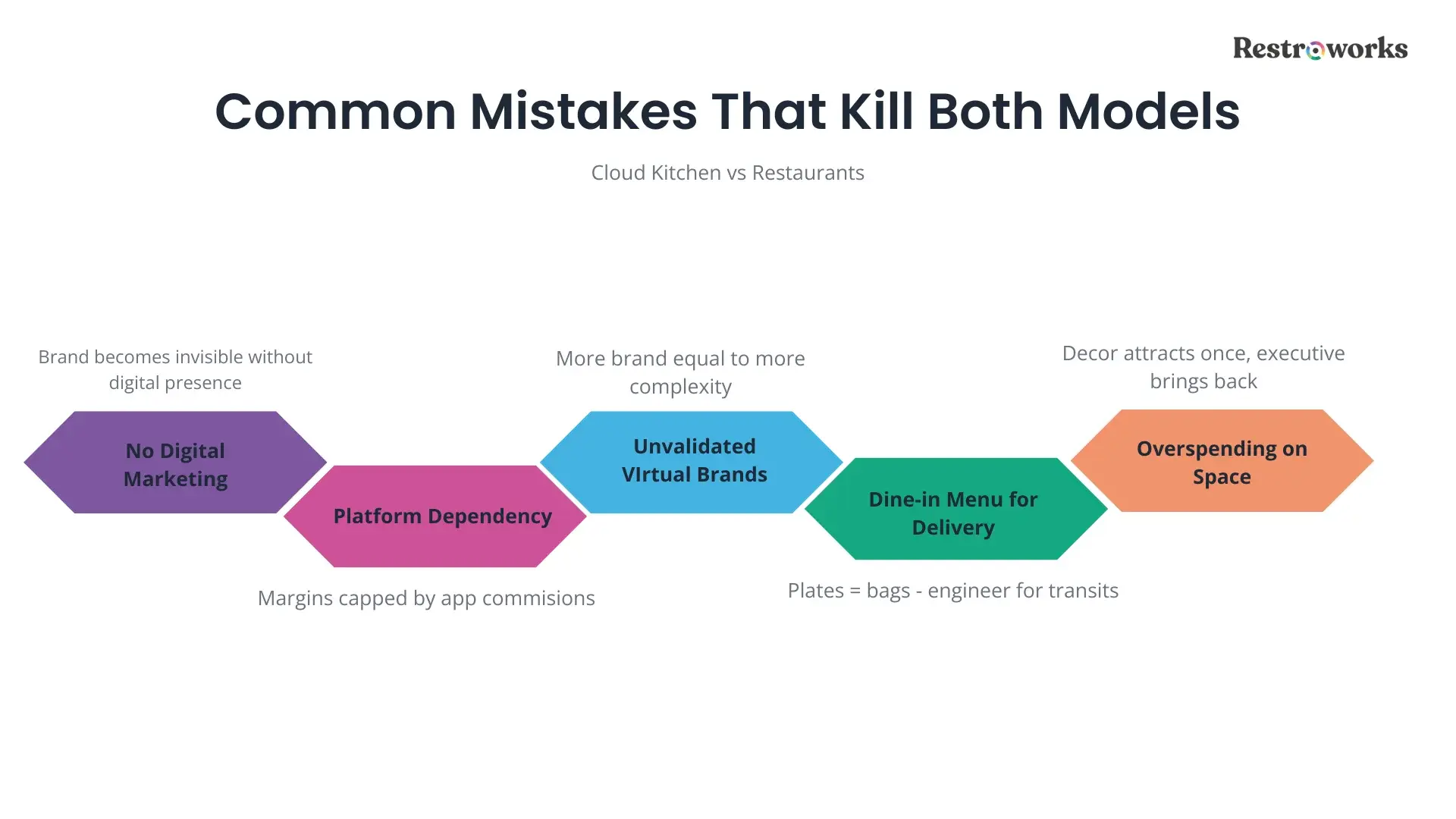
Cloud kitchen vs restaurant: common mistakes both make

Whether you’re building a cloud kitchen or a traditional restaurant, these failure patterns are common.

Underestimating dependency on delivery platforms.

A cloud kitchen that earns 90% of its income through third-party delivery platforms has permanently set the ceiling on its margins due to the third-party platform’s commission structure. The operators building durable food businesses are creating their own direct channels, websites, apps, and loyalty programs, in addition to the platforms. Talkin Tacos is a specialty taco restaurant in South Florida that was losing over $20,000 per month in delivery app commissions. They have since built their own direct ordering platform and now earn $120,000 monthly in direct online sales.

Launching too many virtual brands without validating demand.

The idea of launching multiple virtual brands does not translate to generating more revenue. Without validated demand, launching too many virtual brands will only add unnecessary complexity, increase food waste risks, and compromise execution quality across all virtual brands. The KLC approach to launching every brand to fill a particular cuisine gap is the discipline to learn from.

Designing menus for dine-in, not for delivery.

Food that looks great on a plate does not automatically translate to food quality after 25 minutes in a delivery bag. Menu engineering for delivery is a different discipline. The food must travel well, stay within acceptable temperature ranges, and arrive in a condition that justifies the price paid. Cloud kitchen operators with menus engineered for delivery will outperform those without.

Neglecting the total cost of a physical dining space.

Traditional restaurant owners may over-invest in dining-area build-out and front-of-house experience before getting the basics right. Impressing first-time customers with a beautiful dining area design is a good idea. Maintaining food quality and excellent customer service are what keep them coming back. However, excellent customer service and food quality are achieved through execution, not design.

Neglecting digital marketing for cloud kitchens.

A cloud kitchen without digital marketing investment is essentially invisible. Unlike traditional restaurants, which benefit from some brand awareness just by having a physical presence, cloud kitchens are only discovered through algorithmic recommendations on delivery apps and other digital platforms. Digital branding for cloud kitchens is just as essential as having a kitchen.

When Neither Model Is the Right Answer

This is worth saying plainly.

Not all food concepts are suited for the delivery-only model. If your restaurant business model relies on ambiance, service theatre, or experiences that require the patron to be physically present, then a traditional restaurant model with a proper dining space is non-negotiable. There are no cloud kitchens that offer this. Food entrepreneurs learn the hard way when they try to force experience-dependent models into the delivery-only model.

If your menu economics cannot sustain 15-30% delivery fees, then the issue isn’t the model. Is it your menu pricing or your food costs? Fix these first.

Consumer behavior has shifted permanently towards the convenience of delivery, and this isn’t going back. However, not all dining experiences have shifted. It’s the entrepreneurs who understand the nuances of these differences who build food businesses with staying power.

Practical Implementation Checklist

Most food businesses aren’t failing because their ideas were bad. They failed because the groundwork wasn’t done. These checklists are here to help bridge the gap, providing you with a working perspective to pressure-test your idea before you spend a dime on equipment, rent, or going live on a delivery service. Take the time to work through all of these. The questions you struggle with the most are the ones you should struggle with the most.

Before launching a cloud kitchen:

  • Validate demand for your cuisine in your target delivery zone using platform data
  • Engineer your menu specifically for delivery, not adapted from dine-in
  • Model unit economics with 15–30% delivery platform commissions included
  • Plan your direct ordering channel from day one, not as an afterthought
  • Choose a location within 3–5 miles of dense residential or office demand
  • Build a digital marketing strategy before launch, the algorithm is your storefront
  • Standardize kitchen workflows to maintain consistent service quality under order volume pressure

Before opening a traditional restaurant:

  • Confirm your concept genuinely requires in-person dining to deliver its core value
  • Model whether projected margins support the full startup costs of a physical location
  • Stress-test your staffing model across the kitchen and front of house
  • Consider whether a hybrid cloud kitchen addition could offset overhead costs and extend your reach
  • Calculate what happens to your profit margins if delivery grows to 30% or more of revenue

Conclusion

The debate between the cloud kitchen and the restaurant, in the end, is really not about which one is better, because, in fact, they aren’t. The debate is really about which one is better suited to what you want to create.

Cloud kitchens give you all of the advantages that come with speed, flexibility, and cost, while allowing you to get involved in online food delivery, since you are able to operate multiple brands out of one kitchen and significantly reduce your capital expenditures on building out a dining area, front-of-house staff, and a high-traffic location. The drawback of cloud kitchens is that you are at the mercy of delivery companies, have fewer opportunities for customer interaction, and are less able to build customer loyalty. While it is possible to build customer loyalty through cloud kitchens, it generally takes more sustained effort than through a brick-and-mortar establishment.

A traditional brick-and-mortar restaurant gives you something a cloud kitchen operation cannot offer: a location. A location that customers will associate with real experiences, a location that customers will return to for special occasions, and a location that customers will recommend to their friends and family. The drawback of brick-and-mortar establishments is that you can expect to spend five to ten times more in capital expenditures to develop a physical location, you will require a longer runway to profitability, and the operational complexity of running a brick-and-mortar establishment means that you will need to execute at an elite level every shift, every service, and every day.

Both cloud kitchens and traditional brick-and-mortar restaurants are viable business models, and both will fail if you do not have the fundamentals in place for success.

Restaurant industry operators who can keep their businesses going throughout tough times agree that the actual restaurant model is just a framework; it is only the container. The important parts are the operating products inside the container, such as food products, operations, and customer relationships, which are all more valuable than the restaurant itself.

Be consistent in the restaurant’s operations, measure quantities correctly, produce the same food in the same quantity each time, and understand how customers arrive and how you retain them.

This is the formula for success in the food industry; it will work in a cloud kitchen or a traditional restaurant every time.

Frequently Asked Questions

1. What are the disadvantages of CloudKitchens?

High reliance on third-party apps, high commission fees (25–30%), lack of brand visibility, no direct customer interaction to build loyalty, and intense competition are some of the disadvantages of cloudkitchens.

2. What is the average monthly cost for a cloud kitchen?

In the US, rental for a private, fully-equipped cloud kitchen unit often ranges from $3,000 to $5,000+ per month, excluding food costs, staff, and marketing.

3. What is the difference between a cloud kitchen and a restaurant?

Cloud kitchens are delivery-only, operating from low-cost, off-prime locations without dining space, whereas traditional restaurants rely on foot traffic and dine-in experiences.

4. Which is better for beginners, a cloud kitchen or a restaurant?

Cloud kitchens are generally better for beginners due to lower initial capital, faster setup times (6-12 months to break even), and reduced risk compared to high-overhead restaurants.

5. Is Oven Story only a cloud kitchen or a dine-in place as well?

Oven Story operates primarily as a cloud kitchen model (delivery-only) focused solely on timely, high-quality pizza delivery.

6. What skills do you need to run a cloud kitchen?

Some skills you need to run a cloud kitchen are: Proficiency in food safety/consistency, digital marketing, inventory management, logistics/supply chain optimization, and managing online platforms/POS systems.

7. How long does it take to set up a cloud kitchen vs. a restaurant?

Cloud kitchens can be operational in 1–3 months (utilizing existing infrastructure), whereas traditional restaurants often take 6–12 months or longer due to construction and permitting.

8. How do cloud kitchens handle customer complaints without face-to-face service?

Complaints are handled digitally through delivery app dashboards (e.g., DoorDash, Uber Eats), social media channels, or immediate phone follow-ups, prioritizing quick replacements or refunds to maintain online ratings.

Newsletter subscription banner

Talk to a restaurant expert today and learn how Restroworks can help your business.

Request Demo >

Share

Discover More Insights to Power Your Journey

Forecasting for Quick-Service Restaurants: Improve Demand & Sales Planning

The US quick-service restaurant industry is huge and highly competitive. Since restaurant owners operate under slim margins, there is very…

AI-Powered Forecasting in Restaurants: Smarter Demand Predictions

Just enter any restaurant during the weekday lunch hour, and you will find some empty seats. When you come back…

Impact of Weather on Restaurant Forecasts: How Weather Affects Demand

You forecast your restaurant demand because it's meant to reduce uncertainty. You look at past data, identify patterns, and plan…

Key Metrics for Forecasting Restaurant Demand: Essential KPIs Explained

Running a restaurant means you have a lot of important information at your disposal—sales reports, covers, table turns, online orders,…

Restaurant Demand Forecasting Techniques Explained: Methods & Examples

One thing no one prepares you for in the restaurant business is how unpredictable it can be. You might expect…

Cloud Kitchens Version 2: What’s Next?

The first wave of cloud kitchens, often called ghost or dark kitchens, was born out of necessity. What started as…

Join. Learn. Grow.

Sign up to receive the latest hospitality insights and stories straight to your inbox

Streamline your operations with Restroworks