
Paid ads for restaurant franchises are the primary engine that fills seats, drives online orders, and keeps your brand visible in every local market you serve. And they matter because diners check before they choose: BrightLocal’s Local Consumer Review Survey 2026 found that 97% of consumers read online reviews and 68% will only use a business rated four stars or higher.
When a diner nearby searches, the location that shows up first, with strong ratings, gets the order. And if your locations aren’t showing up with strong ratings, competitors are capturing your customers in those moments.
This guide covers budget structure, channel-by-channel campaign setup across Google, Meta, and delivery platforms, territory protection, measurement, and the playbook for scaling network-wide.
What You Will Learn
- The right split between national, co-op, and local ad budgets.
- Campaign setup and measurement across Google, Meta, and the delivery apps.
- Ways to protect territories and keep ads compliant across every location.
Three Actions for This Quarter
Start with three concrete actions this quarter: claim and optimize Google Business Profiles (NAP, hours, menus, ordering links) for every location; launch location-level Google Search ads with localized keywords.
For example, a new burger location can run hyper-local Google Search ads within a 2-mile radius, with mobile bid adjustments during lunch and dinner, to build opening-week traffic. A regional pizza chain can use Instagram lookalike audiences built from loyalty app users to drive limited-time-offer (LTO) orders across all locations at once.
Franchise Advertising vs. Single-Location Restaurant Advertising
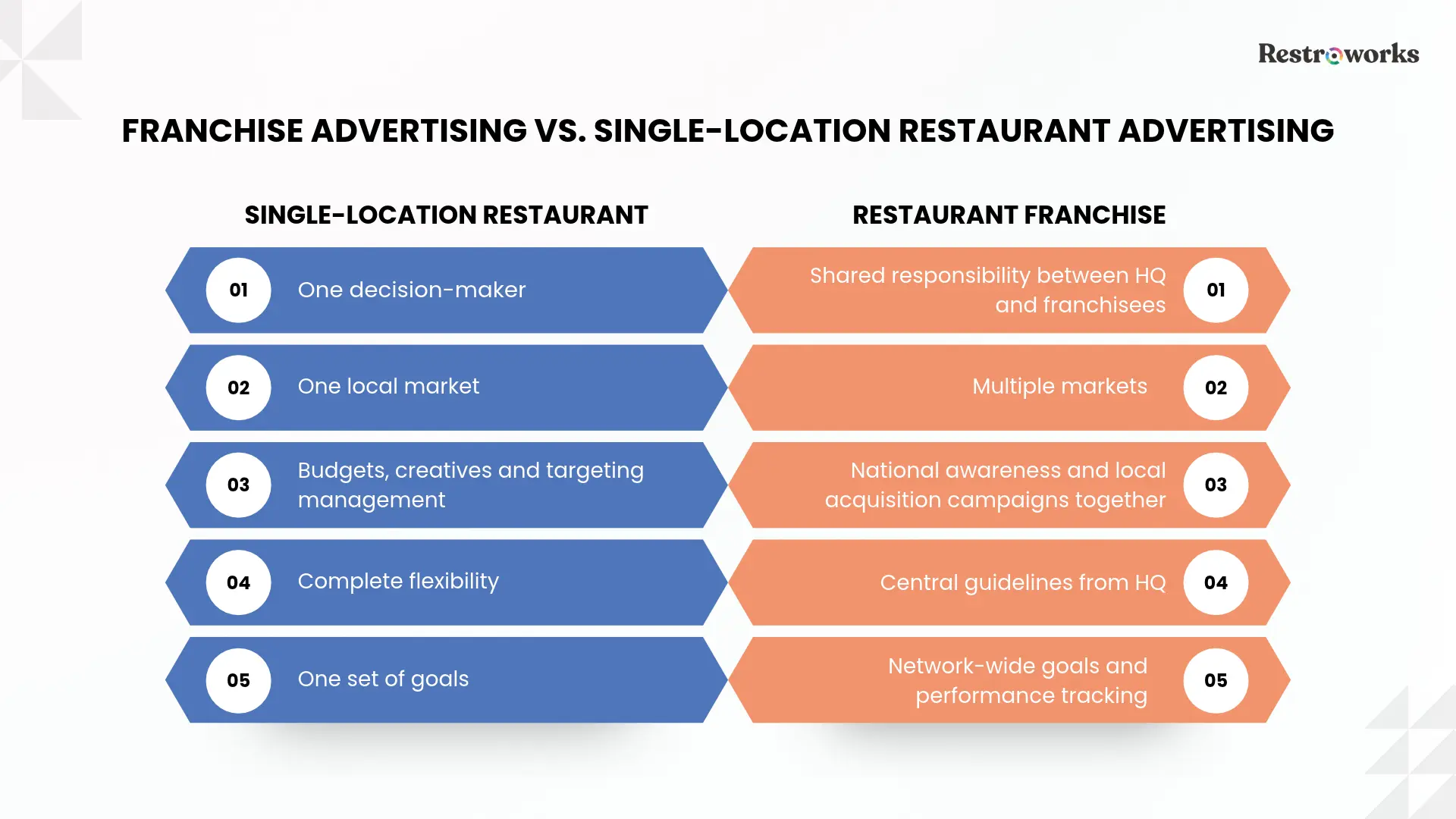
Paid ads for restaurant franchises differ fundamentally from generic restaurant marketing. A single-unit operator controls every touchpoint; franchisors must enforce brand standards across dozens or hundreds of markets while franchisees handle local store marketing with varying skill and resources.
Effective advertising for restaurant franchises involves capturing high-intent searches at the local level while reinforcing the restaurant brand nationally.
Franchisors manage national brand advertising (awareness campaigns, seasonal offers, menu launches). Local store marketing (LSM) is handled by franchisees, covering proximity targeting and local social campaigns.
A 50-location chicken franchise might run national YouTube campaigns for brand awareness while each store runs geo-targeted Google Search ads for “wings open now” within a 3-mile radius, both campaigns pulling in the same direction with different budgets.
TRADE-OFF: Franchisor Control vs. Franchisee Flexibility: Centralizing all paid advertising through HQ protects brand standards but removes local agility. The best franchise systems use pre-approved creative templates franchisees can customize within guardrails, avoiding a binary choice between control and freedom.
Campaign Structure for Multi-Location Restaurant Ads
Google Search ads are the highest-intent paid channel for any restaurant franchise. When someone types “best tacos near me,” they are actively searching for food and ready to decide; Google Ads can reach those diners at the exact moment they search.
In LocaliQ and WordStream’s 2026 search advertising benchmarks, Restaurants & Food search ads averaged a $2.05 cost per click, a 6.83% click-through rate, an 8.05% conversion rate, and a $30.57 cost per lead. Competitive terms in dense metros run higher.
1. Local Keyword Targeting and Bid Adjustments
Build one master template per concept with shared keywords and best practices, then create location-level ad groups with local keywords like “sushi restaurant in Stratford.” Apply bid adjustments by device, time of day, and audience segment.
Use hyper-local targeting within 2–5 miles in urban areas or 5–10 miles in suburban areas. Bid up mobile during lunch (11:00–14:00) and dinner (17:00–21:00), then keep or drop those bid-ups based on each location’s own conversion data by hour.
- Google AI Max for Search: Google’s AI Max for Search is a campaign-level setting that adds keywordless matching, dynamically generated ad headlines, and Final URL expansion to standard Search campaigns. For restaurant franchises, it widens reach to high-intent queries your keyword list doesn’t explicitly cover (such as “open late near the arena” or “kids-friendly tacos downtown”) without requiring separate campaign builds. Test it as a layer on existing Search campaigns rather than replacing manual keyword structure entirely, and monitor Search Term reports closely to catch irrelevant expansions.
- Google Demand Gen: Demand Gen campaigns (replacing Discovery ads) place visual and video inventory across YouTube feeds, Gmail, and Discover. For restaurant franchises, Demand Gen works well for new location launches and seasonal LTO awareness before Search intent builds, making it a cheaper alternative to full YouTube campaigns.
- Yelp and Apple Business Connect: Yelp Ads remain a significant channel for restaurant discovery in the US, particularly for users actively comparing options. Yelp’s cost-per-click model and restaurant-intent audience make it a practical addition for franchises in competitive urban markets. Apple Business Connect allows restaurant franchises to control how their locations appear across Apple Maps, Siri, and Wallet, including photos, menus, and ordering links.
Why Identical Ads Across All Locations Underperform
A diner in Nashville searching “best wings near me” responds to “Nashville’s favorite wings since 2009,” not a generic brand ad. Location-specific ad customizers or separate ad groups per store let each ad match what the searcher typed, which is what drives click-through rate. Test localized ads against your generic brand ad in a few markets and roll out the winner.
Recommended watch
Google Ads Tutorials: Setting up a Performance Max campaign for store goals: Google’s official walkthrough of Performance Max store-goals setup, directly applicable to restaurant franchise location targeting.
2. Owning Local Intent with Google Maps Ads
Google Maps has become the default “where should we eat tonight?” engine for restaurant franchises. Google Maps ads increase visibility for local searches and display restaurant reviews and photos directly in the listing, converting search intent into store visits.
Every franchise location needs a fully optimized Google Business Profile: correct NAP matching the website, accurate hours with holiday adjustments, minimum 10 photos (interior + exterior + food), menu URLs, and ordering links. Promoted pins and top-of-list placement appear for “near me” searches via Performance Max and location assets in Google Ads.
GBP Quality Directly Affects Maps Performance: Performance Max with store goals uses each location’s Google Business Profile to build its Maps placements, so missing hours, photos, menus, or ordering links weaken the ads themselves. Complete every location’s profile before you scale Maps spend.
For bid strategy, use Maximize Conversions with a target cost-per-store-visit once you have 30+ monthly conversions per location; below that threshold, use Maximize Clicks to build data.
Enable store visit conversions in Google Ads under Tools, Conversions, Store Visits: this requires linking your Google Business Profile to your Ads account and meeting minimum visit volume thresholds. Asset requirements: at least one call asset, one location asset, 3–5 ad headlines including a local qualifier (“Near [Neighborhood]”), and a minimum of 5 active photos per GBP location.
Review your FDD Item 11 disclosures before allocating co-op funds to Maps campaigns, as some franchise agreements restrict which platforms franchisees may activate independently.
3. Google Display and YouTube for Franchise Brand Building
Google Display and YouTube ads build brand awareness before guests think to search; they generate demand that Google Search ads then capture. Display is bought largely on impressions and costs far less per impression than a search click, which makes it a cost-efficient brand-building complement to search. YouTube bumper ads (6 seconds, non-skippable) are a reach and frequency tool best evaluated by unique reach, brand lift, and downstream search volume, not click-through rates.
For Display: target foodies, parents, and office workers; deploy remarketing to menu visitors who did not order; place banners on recipe blogs within each DMA. For YouTube: run 6-second bumper ads for seasonal LTOs; use 15–30-second in-stream ads for food or founder stories. To see whether a Display and YouTube flight worked, compare branded search volume in each market during and after the flight against the weeks before it.
4. Facebook and Instagram Ads for Local Guest Acquisition
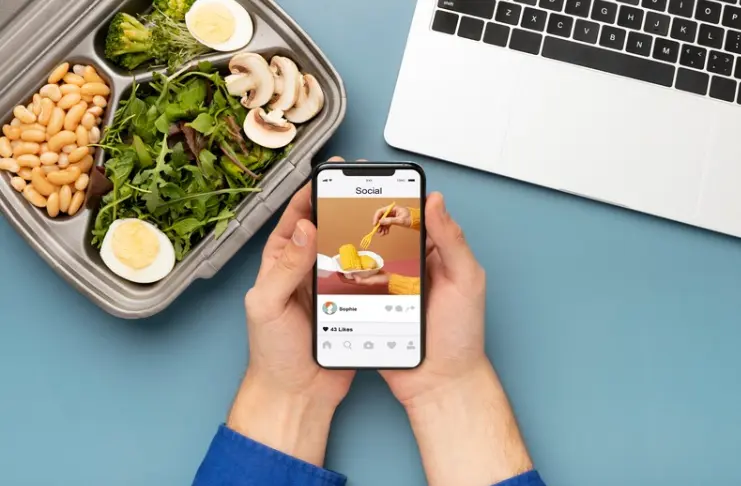
Facebook and Instagram reach diners before they start actively searching, ideal for new openings, lunch specials, and loyalty programs. Meta’s platforms are particularly effective for visual food content: the combination of interest targeting, lookalike audiences, and location-based delivery makes them a strong complement to Google’s intent-based channels.
To leverage Facebook and Instagram ads:
- Structure Meta campaigns in Ads Manager with a central brand account for creative control, then apply location-based targeting within 3–5 miles of each restaurant.
- Use interest-based targeting (food, cuisine types, family dining), lookalike audiences from loyalty members, and retargeting lists for repeat visits.
- Meta Advantage+ campaigns use AI to automatically optimize audience targeting, creative combinations, and placements.
This way, franchise systems with strong creative libraries see faster scale with Advantage+ Shopping campaigns for delivery and online ordering objectives.
Campaign Types and Creative Formats
Campaign types to launch: new store “now open in [city],” mid-week traffic offers, loyalty sign-up driving app downloads, and LTO campaigns that start building awareness before the offer goes live.
For Gen Z and younger Millennials, visually led creative matters most. A/B test user-generated content against polished brand imagery in your own accounts and let cost per order decide which wins. Formats that convert: carousel ads showing menu items, story ads with a link sticker or CTA button to a local ordering page, and reel-style ads for LTOs.
TikTok for restaurant franchises: TikTok has become a meaningful discovery channel for food brands. In a 2025 MGH survey, 58% said they had visited a restaurant after seeing a TikTok video about it. For franchises, TikTok works best as a content amplification layer: short food-focused videos (15–30 seconds) showing preparation, atmosphere, and limited-time items.
TikTok’s geo-targeting allows location-level ad delivery, which makes it most viable for franchises with several locations in one market. Launch with Spark Ads (boosting organic creator content) before building a dedicated TikTok campaign budget. Authentic “TikTok-style” creative also performs well cross-posted to Facebook and Instagram Reels.
5. Advanced Targeting and First-Party Data: Loyalty, Email, and Retargeting

The most profitable restaurant franchises treat paid advertising as part of a data ecosystem. First-party data from loyalty programs and online ordering histories fuels smarter targeting and higher returns.
Upload hashed customer email lists to create “VIP guest” custom audiences, then build lookalike audiences to find similar high-value diners in new markets. Use purchase-event data to segment high-frequency guests (loyalty retargeting) versus lapsed guests (reactivation campaigns). Geo-fencing allows franchises to serve ads to potential customers near competitor locations.
Sports and event targeting: For game nights, layer sports interests, proximity to venues, and time of day in Google Ads, using Performance Max audience signals and a tight radius around each location. Compare results against your always-on baseline in a few markets before scaling the approach across the system.
Attribution Breakdown Across Locations: Without store visit conversion tracking, unified UTM parameters per location, and matched franchise-level reporting in Google Ads and Meta, ROAS numbers in dashboards are incomplete. Structure attribution from the start, not as an afterthought.
6. Seasonal Promotions, Dayparting, and Event-Based Paid Ads
Seasonal and event-based paid advertising is one of the highest-leverage levers for restaurant franchises. Keep the lunch and dinner mobile bid-ups from your Search campaigns in place during promotions.
For LTO campaigns: begin awareness a few days before launch (YouTube bumpers, Display, Instagram Stories), activate conversion campaigns on launch day (Google Search, Maps, Facebook feeds), and run a closing push targeting retargeting lists with urgency messaging.
7. Event-Based Campaigns and Seasonal Budget Shifts
Local events create predictable demand spikes. Load event-proximity campaigns 48–72 hours in advance so they are live before demand peaks. Budget emphasis shifts seasonally: Q1 retention (remarketing, loyalty reactivation), Q3 acquisition (summer peaks), Q4 brand (holiday LTOs).
Structuring Budgets and KPIs for Franchise Ad Campaigns
Franchises must separate national fund, co-op, and local budgets to maintain control and optimize performance. One planning approach splits spend roughly evenly across new customer acquisition, retention, and brand building, with about 10% held back for testing.
This is a planning heuristic, not an industry standard; the right split depends on your brand’s lifecycle stage, competitive pressure, and whether you are in launch mode or sustaining mature markets.
Brand advertising fund contributions typically range from 1% to 6% of gross sales, according to Franzy’s guide to franchise advertising funds; Burger King charges 4% and Dunkin’ charges 5%. Local store marketing requirements are set separately in each franchise agreement.
A CMOx analysis of 718 franchise FDDs (2026) found that quick-service and fast-casual restaurant ad funds spend an average of 46% on media placement, 18% on production and creative, and 18% on administration.
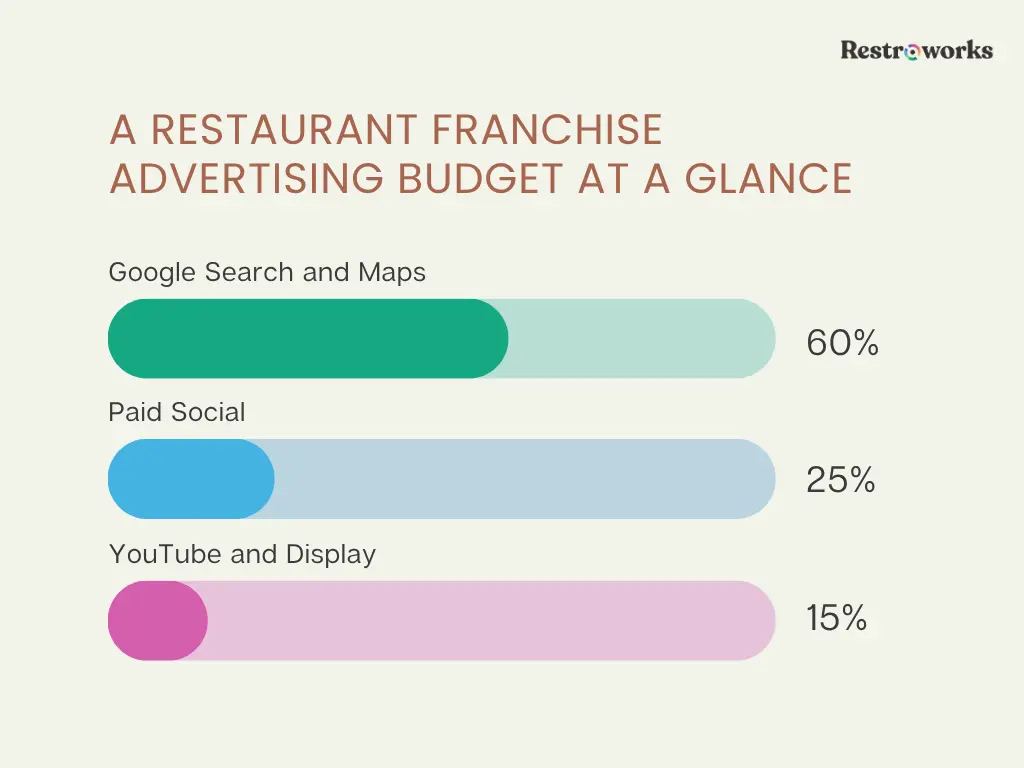
One reasonable starting channel split is 60% to Google Search and Maps, 25% to paid social, and 15% to YouTube and Display. Treat this as a baseline that shifts with your brand’s stage and competitive market, not a fixed rule. Judge each channel against the break-even ROAS for that location’s margin, not against a system-wide average.
Set ROAS targets from your own margins rather than from industry averages. Break-even ROAS is 1 divided by contribution margin, so a location that keeps 25% of each order as contribution margin breaks even at 400% ROAS. Expect new locations to run below target for their first 90 days while campaigns build conversion history.
KPIs to Measure
Why a Local Marketing Requirement Matters: National funds optimize for system-wide metrics. A brand with strong average ROAS across hundreds of locations may still have a cluster of stores in weak local markets where national campaigns underperform. A local marketing requirement ensures those markets receive targeted spend for their specific problem (competitor encroachment, new store awareness, or seasonal gaps) that no system-wide campaign can address.
When Increased Spend Doesn’t Improve Results: Raising Google Ads spend without updating localized landing pages tends to raise cost per lead along with it, with more spend chasing the same poor-converting traffic. Audit conversion paths before scaling spend.
Third-Party Delivery Platform Advertising: DoorDash, Uber Eats, and Grubhub Ads
Third-party delivery platforms represent a significant paid channel for restaurant franchises with fundamentally different economics than Google or Meta.
Delivery platforms sell advertising inside their own apps, and that ad spend sits on top of the commission each order already carries. DoorDash’s Marketplace plans charge 15%, 25%, or 30% commission on delivery orders depending on the plan, so advertising costs require careful margin modeling. Platform ads make sense for new location launches, LTO promotions, and competitive defense. They underperform on high-commission items with narrow margins.
A good example is Tropical Smoothie Cafe on DoorDash Ads. The 1,600-plus location brand used DoorDash’s Franchise Opt-In Campaigns for Sponsored Listings to make joining a system-wide promotion easier for franchisees. Participation rose from 2% to 44% of eligible stores (more than 689 locations).
Over an eight-week campaign from November 28, 2025, to January 8, 2026, participating stores saw a 31% weekly sales lift, an average of $575 in incremental revenue per store per week, and 6.5× ROAS. DoorDash counts only attributed marketplace sales in that ROAS, and the lift figure comes from a modeled comparison of 526 stores.
Delivery Platform Ads vs. Direct Digital Ordering: Every delivery order captured through DoorDash carries a 15% to 30% commission, while a card payment on your own ordering channel costs only a processing fee; Stripe’s standard US rate is 2.9% + 30¢ per transaction.
Run delivery platform ads defensively to maintain visibility while actively directing loyalty members and remarketing audiences toward direct ordering.
Protecting Franchise Territory in Paid Advertising
Franchisees in adjacent territories regularly bid on the same keywords, driving up CPCs for the entire system. Without geo-fencing exclusions, a searcher at the border between two territories triggers both locations’ ads, raising auction prices and potentially routing the customer to whichever location wins the bid rather than the closest one.
For example, when two locations bid against each other on “fast lunch near downtown,” both pay more per click for traffic that one location would have won alone with proper geo-fencing in place.
Implementing Territory Controls
Apply negative location targeting to prevent territory overlap; use radius-based campaigns centered on each store address rather than DMA-wide campaigns; for Performance Max, use the “target people in or regularly in” setting with store-radius targeting.
Franchise agreements should address territory protection explicitly; franchisors who centralize Google Ads campaign management can enforce geo-fencing rules that individual franchisees cannot maintain independently.
TRADE-OFF: Centralized vs. Decentralized Campaign Management: Centralized management ensures territory protection, brand compliance, and consistent ROAS benchmarking, but removes franchisee autonomy. A tiered model: central for Google Search (where keyword bidding wars cause the most damage), local for Facebook and Instagram (where creative localization is highest value).
Ad Compliance and Brand Standards Across Your Franchise Network

Franchise advertising compliance is a legal and brand requirement enforced through the franchise agreement and FTC guidelines. These include-
- Ad copy must use approved brand names and claims
- Promotional offers must be pre-approved
- Imagery must come from the approved asset library
- Landing pages linked from paid ads should meet ADA/WCAG 2.1 AA accessibility standards.
Creative Library and FDD Compliance
Franchisors should maintain a central creative library with ready-to-use assets for Google Search, Maps, display, YouTube, and Meta formats, all locale-customizable but brand-consistent. FDD Item 11 requires transparency about ad fund spend; reporting dashboards showing per-location ROAS from co-op spend build franchisee buy-in and reduce compliance disputes.
Creative That Converts: Design and Messaging for Franchise Paid Ads
Design equals performance at scale. Creative best practices: consistent logo placement and brand colors; hero food images optimized for mobile (test at 320px before publishing); minimal copy with a single call to action.
In addition, message types that consistently increase sales for franchises are-
- Time-bound offers (“Free kids meal every Tuesday in October 2026”)
- Seasonal features connected to real menu availability
- Review-led messages (“4.7 stars on Google Maps, 2,000+ reviews”)
Run A/B tests comparing hero dishes, price-led versus value-led headlines, and photo versus video. Rotate creatives quarterly and feed results to the central library so every location benefits from network-wide learnings.
The best-performing franchise locations pair digital paid ads with real-world visibility through local store marketing (LSM), especially in suburban markets.
For example, a fast-casual location can pair school sports league sponsorships with geo-targeted Facebook ads to local parents within a few miles of the store, then compare foot traffic against a digital-only market at the same budget.
Franchisors should prepare templated event ad kits with approved images, copy, targeting presets, and budget guidelines so franchisees can launch compliant campaigns quickly without central approval delays.
Why Mobile-First Creative Is Non-Negotiable: Diners looking for somewhere to eat nearby are usually searching on their phones. Ads designed for desktop produce blurry images, truncated headlines, and tap targets too small to use. Design all franchise ad creative mobile-first: square or vertical format (1:1 or 9:16), and text readable at phone screen size.
Measuring Success and Optimizing Paid Ads Across the Franchise Network
Franchises that treat paid advertising as an ongoing optimization process sustain a durable competitive advantage. Track these metrics monthly at brand and location level:
Optimization Cadence and MCC Setup
Optimization cadence: weekly anomaly detection in spend and ROAS; monthly cycles pausing underperformers and scaling winners; quarterly reviews to rebalance channel mix, refresh creative, and review territory settings. Restructuring search campaigns; separating brand from non-brand keywords, using location-specific landing pages, and tightening geo-fencing; is consistently among the highest-leverage structural improvements available to multi-location operators.
2026 measurement standard: The current baseline for franchise paid advertising measurement goes beyond UTMs and store visit counts. Google Ads offline conversion import allows franchises to feed actual POS order data back into campaign optimization, so Google’s bidding algorithms optimize against real revenue rather than just clicks or website visits.
Enhanced conversions in Google Ads and Meta’s Conversions API (CAPI), fed with hashed POS customer data, improve attribution accuracy in a cookieless environment and give Meta’s algorithm a richer signal to find high-value guests.
Multi-Location Attribution Without MCC: Running separate Google Ads accounts per location without a unified Manager Account (MCC) means the franchisor cannot compare ROAS across locations or identify which creative works system-wide. Set up a Google Ads MCC before launching your first multi-location campaign.
Reputation Management and Paid Ads: Reviews, Ratings, and Local Trust
Reputation is a paid advertising multiplier. Because most consumers will only use a business rated four stars or higher (see the BrightLocal survey cited above), a location sitting below four stars is filtered out by many searchers before a paid ad has the chance to convert. Review quality and volume affect both CTR on Google Maps ads and conversion rates on paid social.
Franchises that prompt guests for reviews (SMS, loyalty app, QR code) build review volume that improves both organic and paid performance. When reviews flag an operational issue at a specific daypart, pause bid-up campaigns at that location until resolved. A branded search campaign with a strong reputation message controls what appears above organic listings when competitor activity creates negative queries.
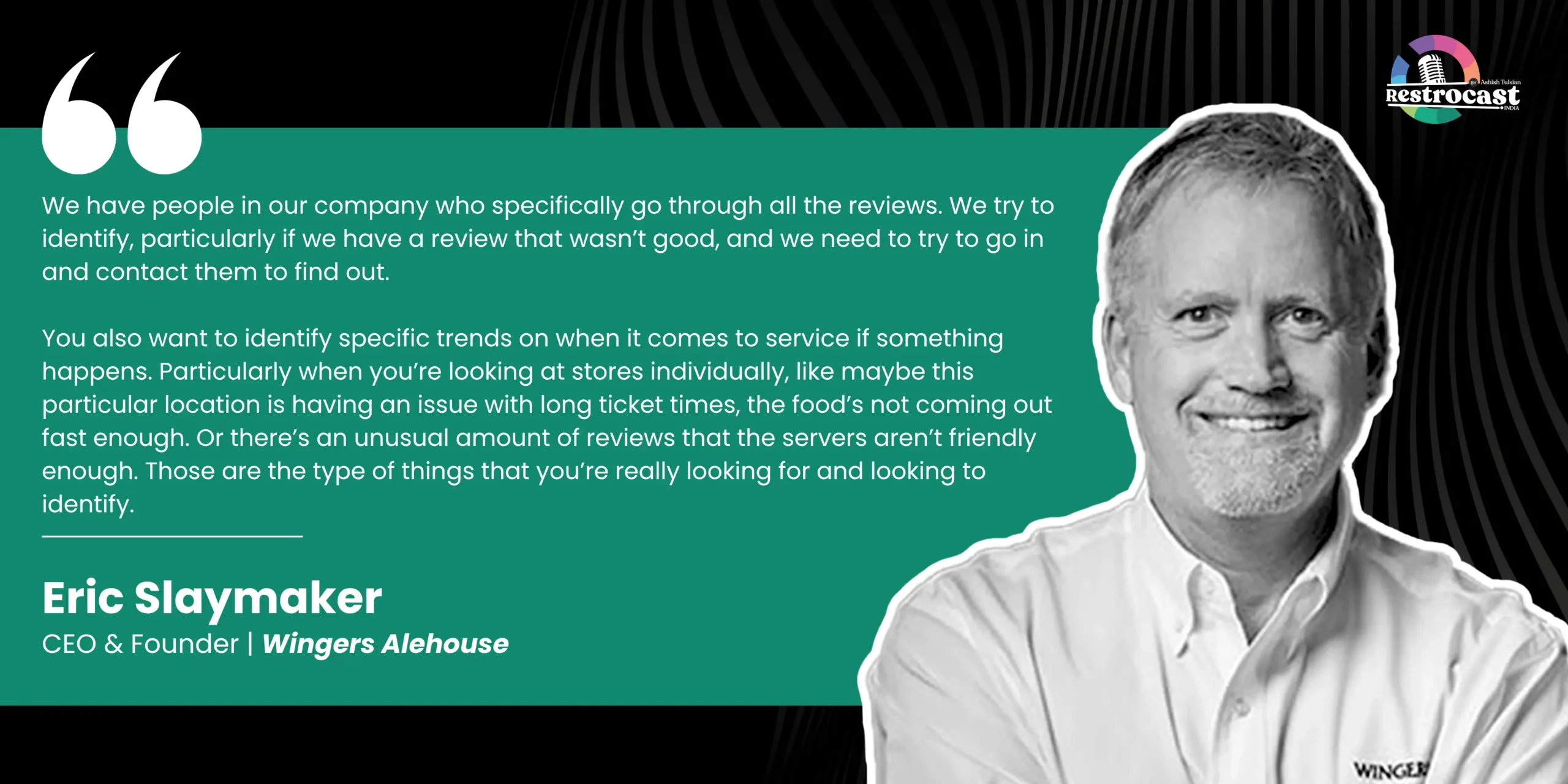
As Eric Slaymaker, CEO & founder of Wingers Alehouse, mentions on Restrocast–
Why Review Gating Backfires: Google’s review policy prohibits businesses from discouraging negative reviews or selectively soliciting positive reviews. The FTC’s updated Endorsement Guides treat review gating as potentially deceptive when it makes posted reviews substantially more positive than they would otherwise be, and the FTC’s 2024 rule on consumer reviews separately bans suppressing reviews through threats or intimidation.
Paid campaigns that prompt reviews should send every guest to the review platform, regardless of their internal satisfaction score.
Bringing It Together: Building a Scalable Paid Advertising Playbook for Your Franchise
The full strategy integrates Google Search, Google Maps, Facebook and Instagram, YouTube and Display, and delivery platform advertising into one connected system where each channel covers a specific stage of the customer’s decision journey.
A scalable playbook includes: campaign templates with locked brand elements and editable local fields; standard budgets and KPIs by store type; launch checklists for new locations; territory governance rules; and a quarterly creative refresh calendar fed by network-wide A/B test results.
Pilot in 3–5 markets for 90 days (always-on Google Search and Maps for active intent, paid social for discovery, retargeting and loyalty for repeat visits), then roll out network-wide with the playbook proven.
Paid ads for restaurant franchises work best as a system; the compounding effect is the unlock. The franchises that sustain strong ROAS and measurable foot traffic growth run a connected system where every channel feeds the next: Google Maps data informs Search bid adjustments; loyalty retargeting on Meta closes guests Search found; seasonal promotions run in coordinated waves rather than silos.
The operators who struggle are almost always running campaigns like single-location restaurants: one Google Ads account, one Meta campaign, no territory controls, no unified MCC view. The fix is architecture, not budget.
Start this quarter with the two highest-leverage actions: audit every Google Business Profile for completeness (NAP, hours, photos, menu URLs, ordering links), then restructure location-level Google Search campaigns with proper geo-fencing and location-specific ad groups. Those two actions correct the most common ROAS leaks before you add any new spend.
KEY TAKEAWAYS