


Best Restaurant Franchise Automation Practices You Should Consider in 2026
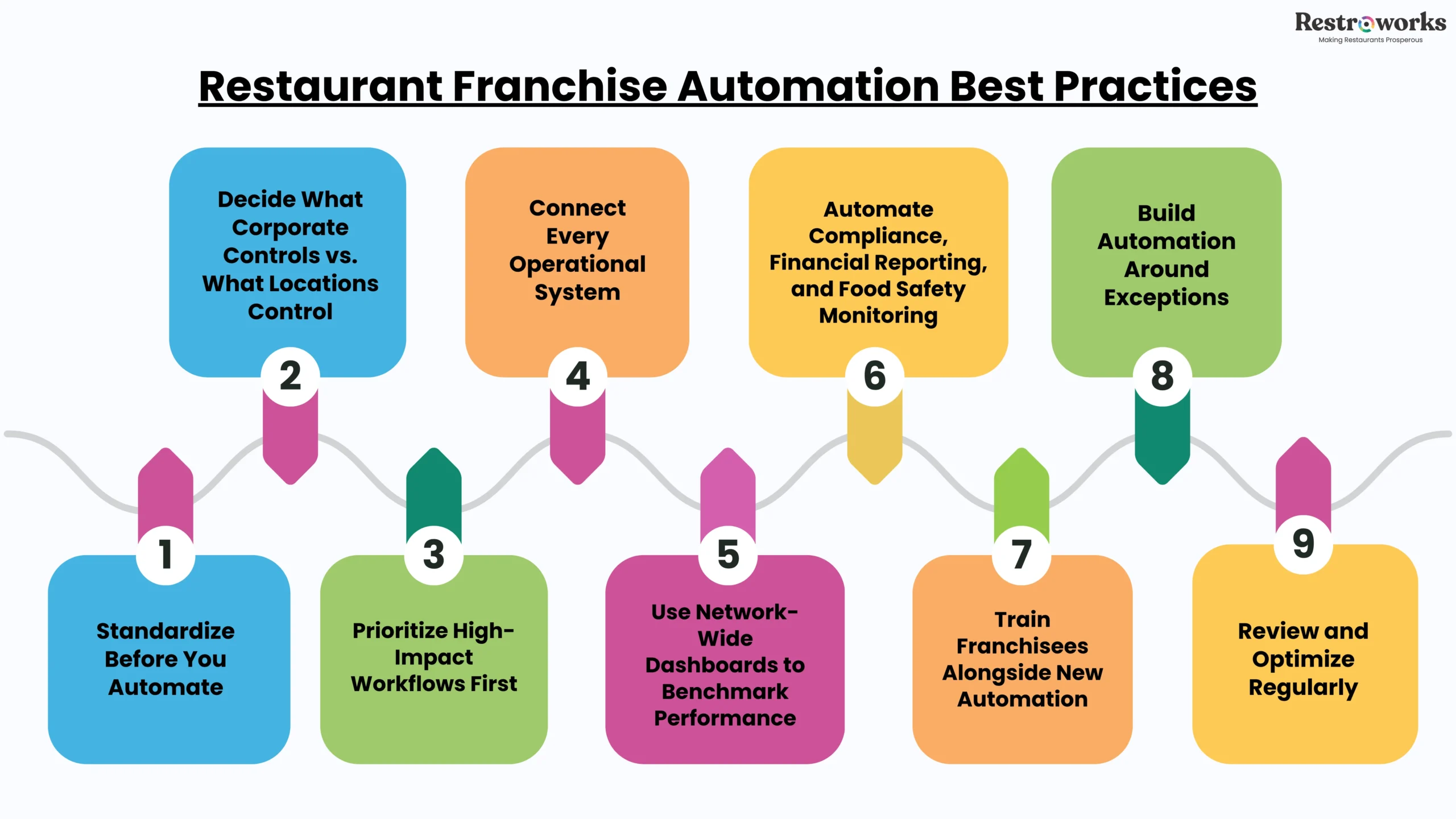
The best franchise automation practices include-
1. Standardize Before You Automate
You know what happens when you try to scale or automate an already inconsistent process? Inconsistencies happen at scale and much faster.
Customers notice those inconsistencies. In Tillster’s 2024 Phygital Index, a survey of more than 1,000 U.S. quick-service and fast-casual diners, 89% said inconsistent experiences across locations of the same chain bother them, and 57% said those experiences make them less likely to return.
That’s why franchises need full-on automation that standardizes brand standards, be it in terms of recipe compliance, service timing, quality control, and not automation that’s merely layered on top of ad hoc local habits.
Hattan Bakor puts it well. When he was scaling a franchise, his biggest concern was making sure that the product reached every customer with the same quality and taste, and so he doubled down on building SOPs and manuals, “because you know it’s like a foundation, and if you build something on a fragile foundation, it will collapse.”
2. Decide What Corporate Controls vs. What Locations Control
Before rolling out any technology, decide which systems corporate will mandate for every location and which ones franchisees can choose for themselves.
Both centralized and decentralized systems have their own merits and demerits. For one, centralized systems protect compliance, but franchisees often resist the implementation.
Decentralized systems, on the other hand, increase local buy-in but fragment the brand across incompatible platforms. So, which one should you go for? That’s completely your take. Maybe sit with your team members and other franchisees to make a decision.
3. Prioritize High-Impact Workflows First
Start by automating the workflows that deliver the fastest ROI: inventory, scheduling, reporting, purchasing, and customer feedback. These touch every location every day, so improvements add up quickly across the system.
For back-of-house automation, consider investing in Kitchen Display Systems (KDS), automated inventory tracking, and precision cooking technology. Kitchen Display Systems (KDS) are especially useful because they streamline order production, reduce errors, and improve food consistency.
Next comes automated inventory forecasting, which, using AI, helps reduce food waste and ensure stock availability.
As for the front-of-house automation, consider self-service kiosks, QR code menus, and automated reservation systems. According to data from Appetize, self-service kiosks in quick-service restaurants reduce total order time by nearly 40%. Kiosk provider Tillster reports that kiosks typically lift average checks by 15–30% through upselling.
There’s also another tech tool that helps with voice AI ordering. It can handle high call volumes and take orders directly into the POS system, which is particularly useful when you are scurrying through peak periods, competing with bars and late-night eat options for the same city foot traffic.
4. Connect Every Operational System
You need to get this very straight – Your POS, inventory, payroll, scheduling, accounting, and CRM need to share data, not just store it.
Disconnected systems are one of the most common problems in restaurant technology. In a survey of 1,254 restaurant leaders by Oracle Restaurants and Informa TechTarget, 48% said their systems aren’t fully integrated, and 66% said they run at least four separate technology systems.
Multi-unit brands feel this most: in Qu’s 2025 State of Digital Report, which surveyed 170 quick-service and fast-casual brands representing 85,000 locations, 64% named technology and systems consolidation as a priority.
5. Use Network-Wide Dashboards to Benchmark Performance
Automated benchmarking dashboards that compare drive-thru times, waste percentages, and labor cost ratios across a network let owners identify what top-quartile locations are doing differently and then systematically roll those strategies out across the network.
6. Automate Compliance, Financial Reporting, and Food Safety Monitoring
Compliance, financial reporting, and food safety are three areas where automation protects your brand both financially and legally. Automated royalty calculation and sales verification reduce the risk of revenue lost to unintentional and, occasionally, intentional underreporting.
You also need to know that automated compliance monitoring has a legal boundary because franchisees are independent operators, so automation that’s too prescriptive (or comes off as such) about scheduling, pricing, or procedures can create joint-employer liability and jeopardize the franchise structure itself.
7. Train Franchisees Alongside New Automation
Roll out training at the same time as new technology, because tools that franchisees and staff don’t know how to use won’t deliver results.
Every quarter you delay in automating onboarding and training will mean that a new location’s ramp-to-profitability will be delayed by 6-8 weeks on average. If a franchise, let’s say, is opening 20 new locations a year, that sums to around $400,000–$600,000 in delayed royalty revenue.
Moreover, training has an uneven adoption curve. Tech-forward franchisees move fast but often want customization, while more traditional operators may resist new technology outright, which slows the rollout across the network
8. Build Automation Around Exceptions
Set up automation to alert managers only when something goes wrong, instead of reporting on everything that’s working.
Most things in a restaurant run just fine every day, and managers don’t need notifications that say “Store A is all set,” “Store B is all set,” and so on. But they do need to know the moment something isn’t right, such as when a refrigerator at Location X is getting abnormally warm, or when Location Z has failed a food quality inspection.
Take the case of Tropical Smoothie Cafe’s compliance system, for example. Its system takes random photos of food during preparation and checks whether it meets the brand’s standards. If a store scores 85% or higher, nothing happens. But if the score falls below 85%, the system automatically assigns retraining to that location. Because managers only step in when there’s an actual problem, the company reduced compliance-related work by 60%.
9. Review and Optimize Regularly
Review your automated workflows on a regular schedule to see what’s working, what isn’t, and what needs adjusting.
Who Pays For the Automation (Who Should, Actually)? Governance in the Restaurant Industry
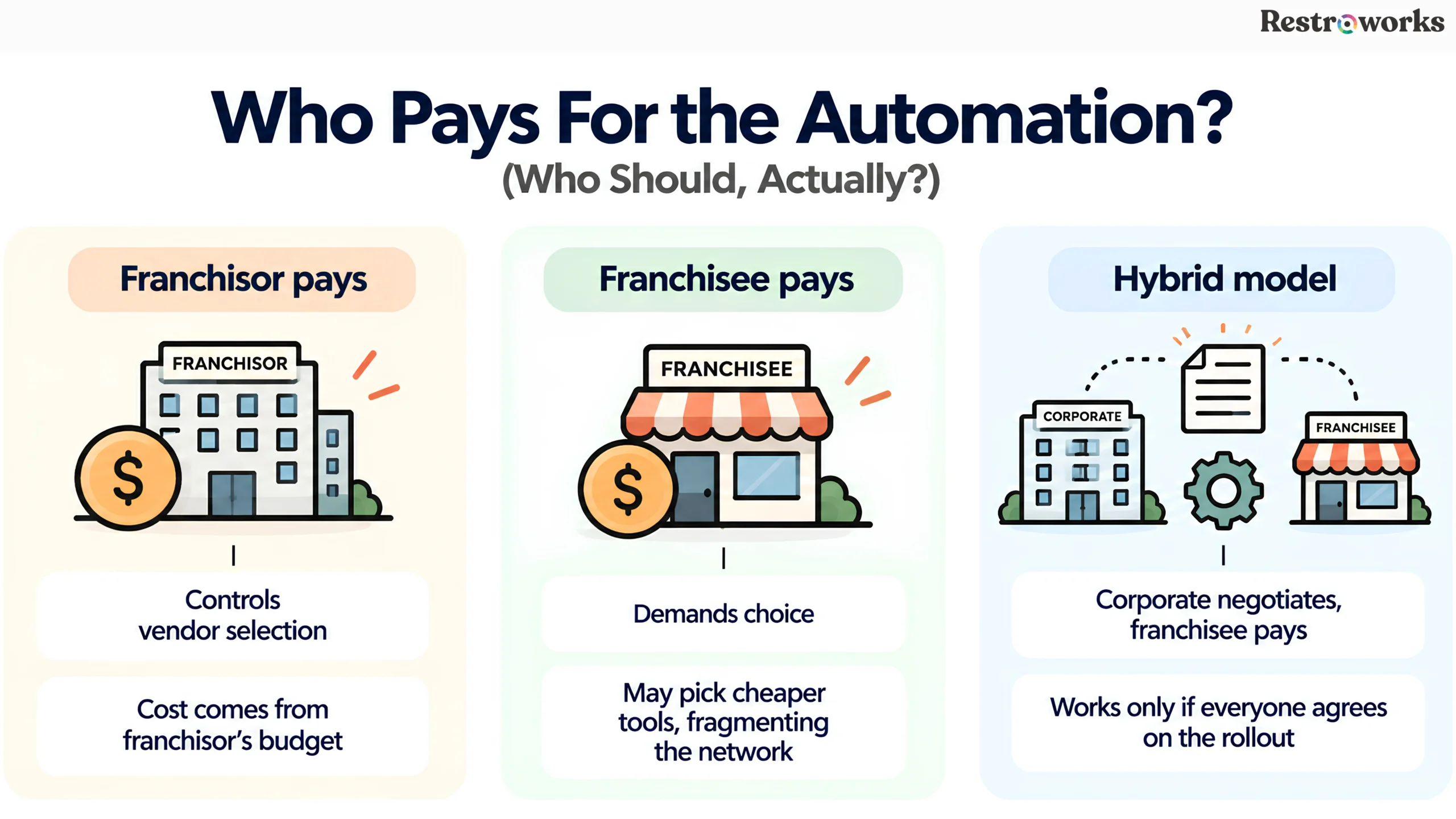
Clearly, there are only two options: either the franchisor pays, or the franchisee pays.
If the franchisor pays, it controls vendor selection, but the cost has to come out of the franchisor’s own budget.
If the franchisee pays, they’ll demand choice and may pick cheaper tools that fragment the network.
You may even consider a more hybrid model in which the corporate entity negotiates and the franchisee pays, but only if everyone agrees on the rollout and understands why the technology is being introduced in the first place. There should be a proper change management strategy in place.
In either case, this is not a security service-related or IT question; it’s purely a governance matter that needs to be settled before you can implement the steps discussed in the previous section.
What KPIs Should You Track to Measure Restaurant Franchise Automation Success?
The core metrics that you should be tracking are:
- Labor cost as a percentage of revenue (the industry average for full-service restaurants currently sits at 32.4%, per National Restaurant Association benchmarks)
- Food waste
- Inventory variance
- Compliance scores
- Order accuracy
- Guest satisfaction, and
- Task completion rates
Automation in restaurants can broadly reduce labor costs by up to 30% and, more specifically, cut them by up to 40% while reducing order wait times by 20-30%, so it’s definitely worth keeping tabs on.
What Common Mistakes Should You Avoid When Rolling Out Automation Across a Franchise?
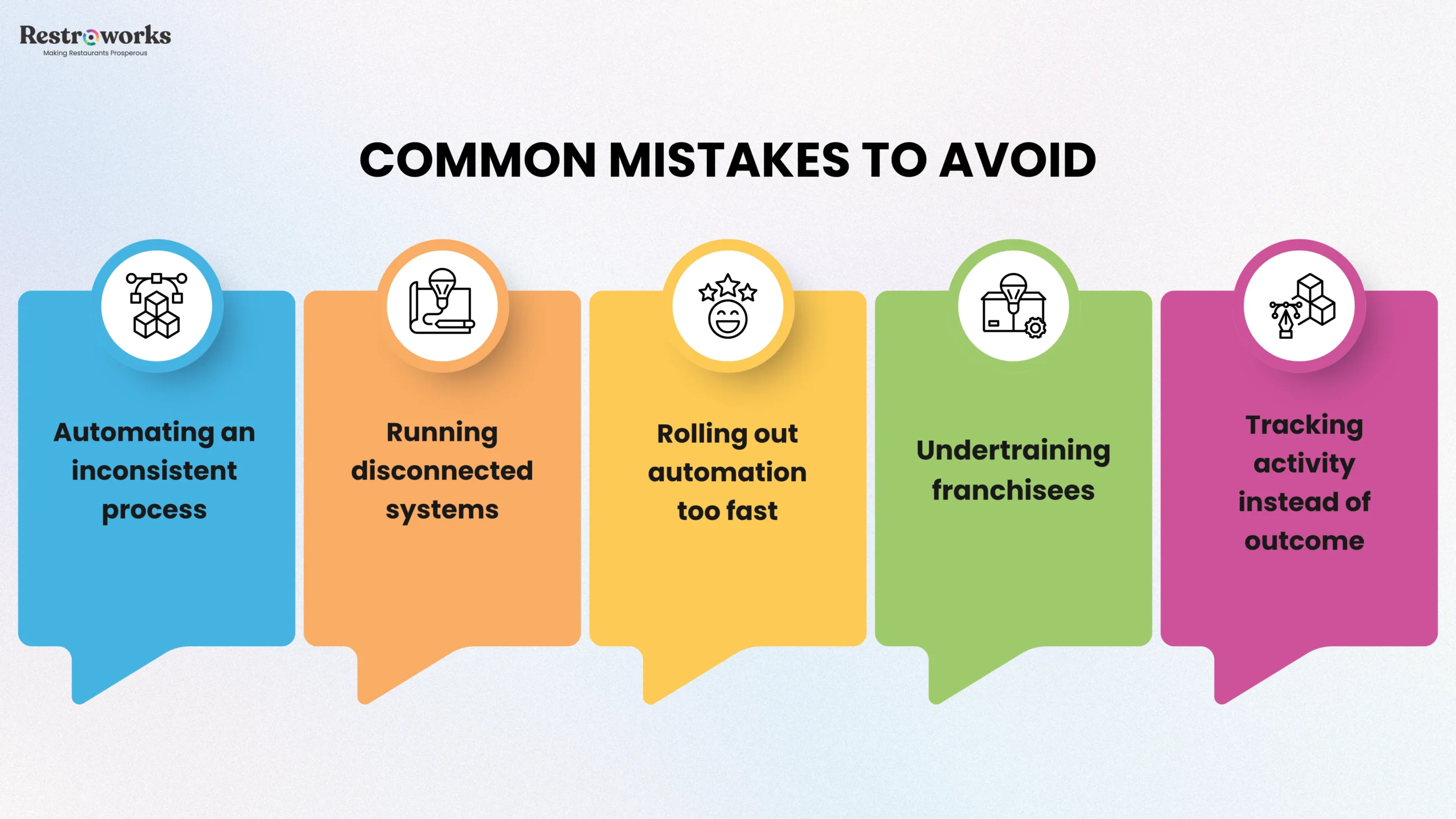
Number one would be automating an inconsistent process, because automation is in no way a magic wand that will “correct” your operations; it will only make a bad process happen faster.
Other mistakes include running disconnected systems, rolling out automation too fast without a phased plan, undertraining franchisees, and tracking activity, like how many times people use it instead of whether it actually improves the business.
Rolling out too fast is especially risky with newer technology like AI. The 2025 Intouch Insight drive-thru study found that AI-assisted drive-thru orders were faster, but customers had to repeat themselves 34% of the time, compared to 22% across all orders. Even McDonald’s ended a major drive-thru AI test with IBM. Piloting first lets you catch problems like these before they reach every location.
The Counterargument
Not every successful franchise to date has automated aggressively. Some of the most well-established brands that have focused on strategic operator selection and intensive human oversight have achieved real consistency with comparatively little automation.
That suggests that culture and hiring (good people and good processes) are just as important as the technology itself.
Chick-fil-A is a clear example. The brand is famously selective about who runs its restaurants: about 100,000 people apply each year to become operators, and roughly 200 are selected. The results show up in customer experience. In the 2025 Intouch Insight study, Chick-fil-A had the slowest drive-thru of the 13 brands studied, at over seven minutes, yet it led in customer satisfaction with a score of 98%.
You need to understand this one thing: plenty of “franchise-ready” platforms that are available in the market are, in fact, single-location tools with multi-unit reporting bolted on, meaning franchisors sometimes spend 12-18 months implementing a system that ultimately needs expensive customization or replacement.
Getting technology right takes real integration work across the business. As Rusty Bills of Galardi Group explains, technology, marketing, and operations “used to be these silos” and now function as one united front, but getting there takes real integration work.
KEY TAKEAWAYS