


Many restaurant brands use a hybrid model: corporate restaurants test menus and set execution standards, while franchised territories bring in local operator knowledge. Refranchising (converting corporate locations to franchisee ownership) is a common capital-light move for mature chains.
Franchise Readiness: Before You Sell the First License
Many franchise systems struggle because the franchisor expanded before the model was ready to replicate. The practical readiness threshold is at least two to three profitable, consistently run locations over two or more years.
Before franchising, have in place:
- Proven unit-level profitability across multiple locations, not just a flagship
- A registered federal trademark. FDD Item 13 must disclose when the principal mark is not federally registered, and Connecticut, North Carolina, South Carolina, and Maine add registration requirements in that case, per The Internicola Law Firm’s FDD registration guide
- Documented operations manual at task level
- Training program that can onboard someone with no prior brand experience
- Field support infrastructure to service the first wave of units
- Financial reserves to sustain the franchisor entity until royalty income covers costs
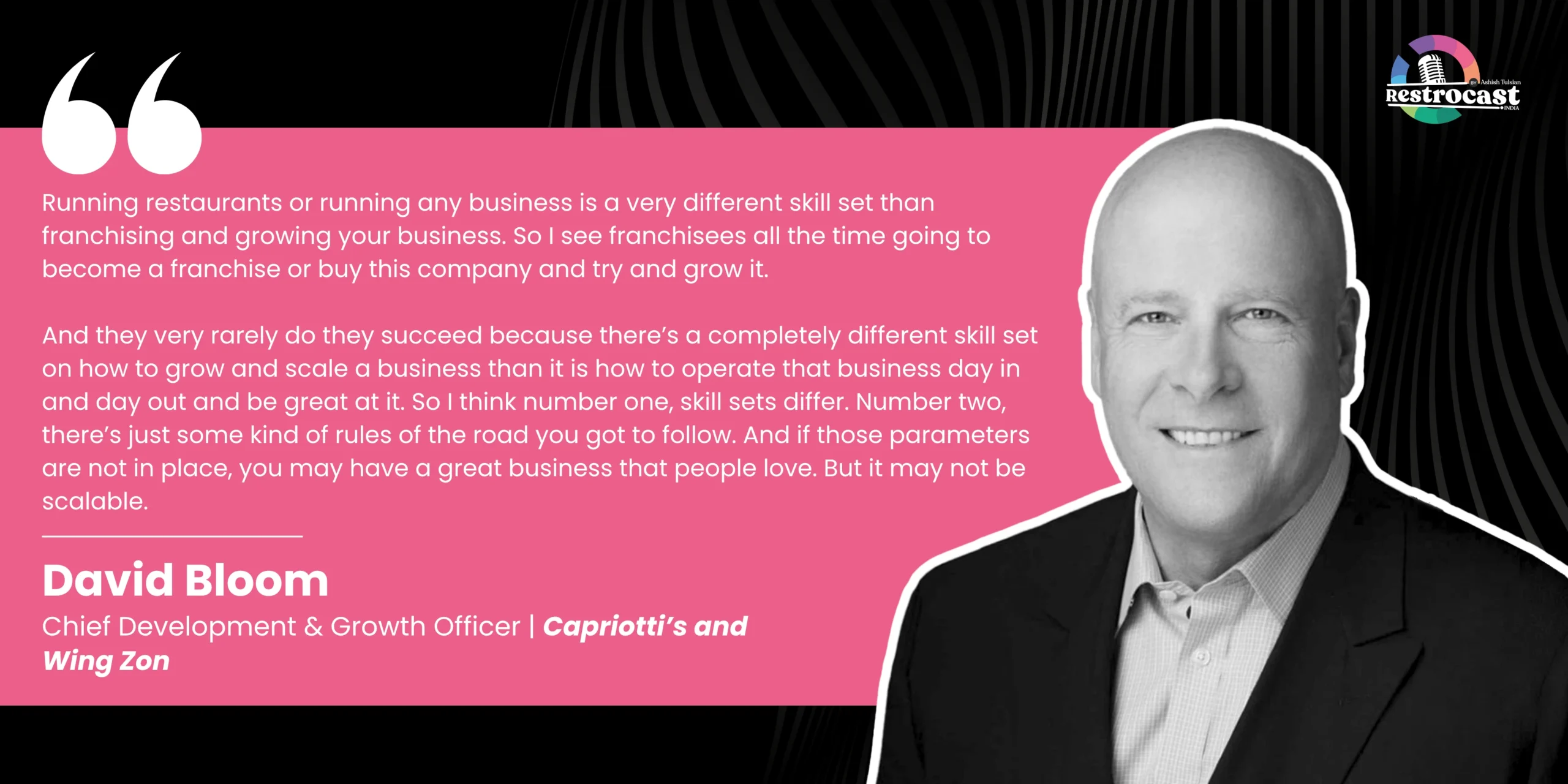
Hear it from David Bloom, Chief Development & Growth Officer at Capriotti’s and Wing Zone, who talks about being ready to franchise on Restrocast–
Build a Scalable Foundation
Premature expansion is one of the most common ways restaurant franchising initiatives stall. Inconsistent execution damages the brand that made the first location worth replicating.
Franchise infrastructure (minimum readiness standard):
Franchisee Recruitment and Selection
The quality of the franchisee network determines whether a system compounds or degrades. A signed agreement with an undercapitalized or operationally weak franchisee costs more to manage than it generates in royalties.
Screen franchisee candidates for:
- Liquid capital above the minimum (working capital shortfalls are a common cause of early franchisee failure)
- Operational background or a committed operating partner (absentee ownership at launch is a documented failure pattern)
- Local market knowledge for the territory being acquired
- References from prior business operations
FDD Item 20 (outlets opened, closed, and terminated) is where candidates see the output of your selection decisions. A high termination rate signals a broken recruitment filter: franchisors who treat recruitment as a sales process end up with a system full of agreements and short on operators who can execute.
Why Restaurant Franchise Expansions Fail

The most common reasons restaurant franchise expansions stall:
- Premature franchising: Expanding before the model is proven at multiple locations, so franchisees debug the system rather than run it
- Undercapitalized franchisees: Candidates who pass the minimum on paper but carry no working reserve once build-out costs run over
- Territory oversaturation: Opening units faster than the market absorbs. Subway peaked at about 27,000 US locations in 2015 and was down to 19,502 after closing 631 in 2024, as reported by CNN. This is a case of development outpacing demand.
- Weak field support: Franchisees who cannot reach support during their first months become non-compliant, then become terminations
- Technology fragmentation: Operators running different POS systems across units lose the cross-unit visibility that makes multi-unit management viable
Site Selection That Drives Revenue
Consider the following site selection criteria:
Territorial rights: Franchisees should read the actual contract before signing: exclusivity radius, non-traditional venue carveouts (airports and ghost kitchens are frequently excluded), and cannibalization recourse clauses. A sustained AUV decline at an existing unit after a nearby opening signals trade area oversaturation.
Expanding Your Restaurant Business: Franchise Development Blueprint
1. FDD Preparation and Legal Compliance
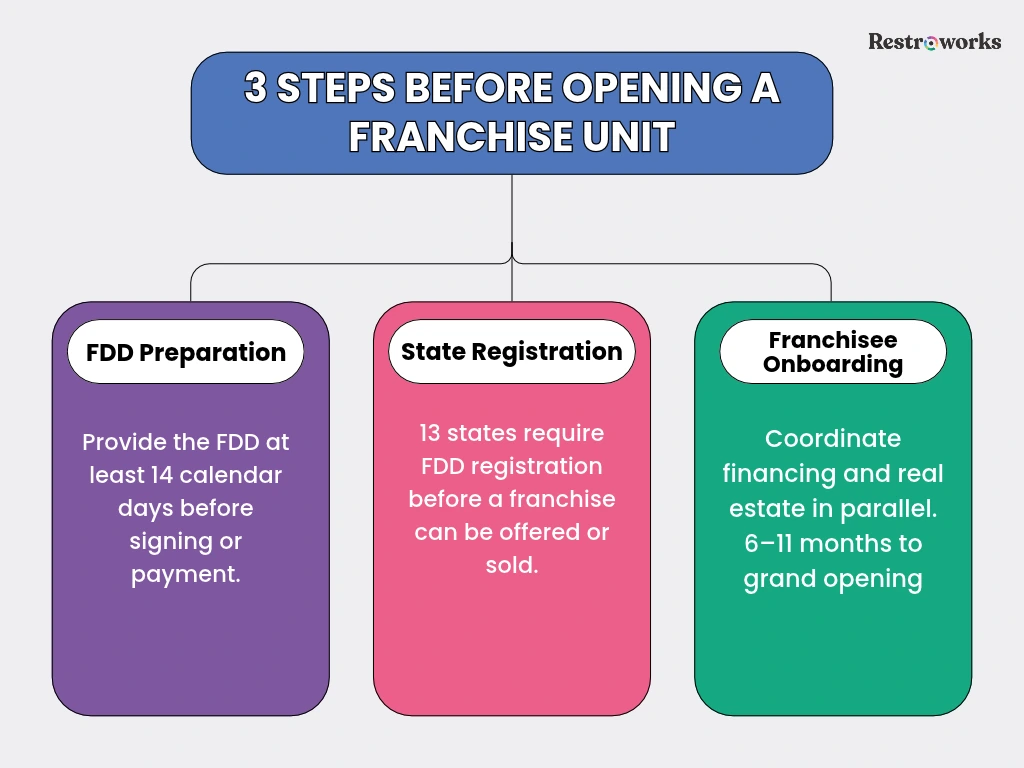
The FTC Franchise Rule (16 CFR Part 436) requires franchisors to provide the FDD at least 14 calendar days before a prospective franchisee signs a binding agreement or makes any payment.
- Item 19 (Financial Performance Representations) is where a franchisor may disclose unit performance such as average sales or costs. It is optional, but it gives candidates the numbers they need to underwrite a unit.
- Item 20 (Outlets and Franchise Information) covers restaurants opened, closed, or terminated over the last three fiscal years. Experienced candidates treat Item 20 as a filter: high closure rates end serious conversations before the first site visit.
2. State Registration
Thirteen states require FDD registration before a franchise can be offered or sold there, including California, Illinois, Maryland, New York, and Washington. State review takes anywhere from 20 days to three months, and material changes trigger amendment filings between renewals, per The Internicola Law Firm’s FDD registration guide.
3. Franchisee Onboarding
Elapsed time from franchise agreement signing to grand opening: typically 6–11 months, driven by permitting, equipment lead times, and SBA financing, which commonly takes 60–90 days from application to funding and must run in parallel with real estate, not after.
Staff Training and Development
Consistent staff training helps franchise locations maintain service standards, execute daily operations, and deliver a reliable guest experience. Recommended training timelines vary by role, depending on the responsibilities involved and the level of operational oversight required:
Labor (salaries, wages, and benefits) ran a median 36.5% of sales at full-service restaurants and 31.7% at limited-service restaurants in 2024, per the National Restaurant Association. Operators who build internal training processes achieve better retention and execution consistency across locations.
Technology Stack for Multi-Unit Franchise Management
Technology infrastructure is not optional beyond a handful of units. Operators managing multiple locations need integrated platforms that surface inventory, labor, sales, and compliance data across units in a single view. Without that cross-unit visibility, unit-level problems become system-level problems before anyone catches them.
Core requirements for multi-unit franchise management:
- POS system: Multi-location reporting, centralized menu management, and royalty data export. Cross-unit dashboards make food cost variances visible in real time; food is one of the two largest cost lines alongside labor, so a small variance repeated across 20 units is material margin loss.
- Inventory management: Integrated with POS to track usage against theoretical, flagging waste at the unit level before it compounds.
- Labor scheduling: Supports compliance as operators expand across state lines with different overtime and break requirements.
- Franchise management platform: Centralizes franchisee communication, compliance tracking, audit results, and field support tickets. Evaluate options against your unit count, growth rate, and reporting requirements
Supply Chain and Vendor Management

Volume purchasing delivers meaningful cost reductions at scale; the specific savings depend on contract terms, category, and distributor. Requirements:
- Approved supplier agreements with national or regional distributors for all locations
- Backup supplier qualification for supply disruption resilience
- Distribution reach assessment before entering new markets
- Supplier qualification for a new market, built into the opening schedule rather than left to the final weeks
Multi-Unit Area Development Agreements
Area development agreements (ADAs) accelerate restaurant franchise expansion by granting an operator both the right and the obligation to open a defined number of units within a territory on a committed schedule.
How ADAs work:
- Upfront area development fee (a portion of total licensing fees for committed locations)
- A development schedule specifies unit count and deadline per milestone
- Missing the schedule triggers loss of exclusivity for unbuilt units, not termination of existing restaurants
- Area developers typically receive a reduced per-unit franchise fee for volume commitment
Master agreements go further: master operators sub-license within their geography, responsible for developing and supporting restaurants in their assigned region. Subway and Domino’s built significant expansion through master agreement structures.
Brand Consistency Across Locations
Effective standards enforcement programs share three traits:
- Defined, auditable criteria: measurable standards for food quality, cleanliness, service speed, and hospitality
- Regular field visits: mystery shopping plus operational audits at least quarterly
- Corrective action protocols: a defined escalation path from first notice through the cure period set in the franchise agreement, which is usually much shorter for health and safety defaults than for operational ones
Consistent standards protect same-store sales across the system, making enforcement a revenue lever, not just a brand one.
Financing Your Franchise Expansion
A common reason multi-unit operators stall is running out of working capital between openings, before the next site generates revenue.
Some financing options include-
- SBA 7(a) loans: The most common route, up to $5 million per loan per the SBA 7(a) loan page. Startups and changes of ownership need at least a 10% equity injection under SOP 50 10 8, effective June 1, 2025, as Whiteford’s summary of the SOP explains. Maturities run up to 25 years for real estate and generally 10 years or less for equipment, per the SBA’s 7(a) terms, and holders of at least 20% ownership generally must guarantee the loan under 13 CFR 120.160.
- SBA 504 loans: Better for real estate-heavy expansions; fixed rate, long-term, paired with a Certified Development Company, with the borrower contributing at least 10% of total project cost.
- Brand financing programs: Some franchise systems offer preferred lender relationships or in-house financing for qualified operators.
- Private equity: For larger multi-unit groups, PE investors exchange growth capital for equity; terms vary by fund and concept tier
Before committing to area development, operators need sufficient liquidity to carry multiple openings simultaneously. A franchise attorney or SBA lender with restaurant experience can model this against your situation.
The IFA 2026 Franchising Economic Outlook projects US franchise output to rise 1.6% to $921.4 billion in 2026, with franchise establishments growing to 845,000 units and employment reaching nearly 8.9 million jobs.
90-Day New Unit Opening Roadmap
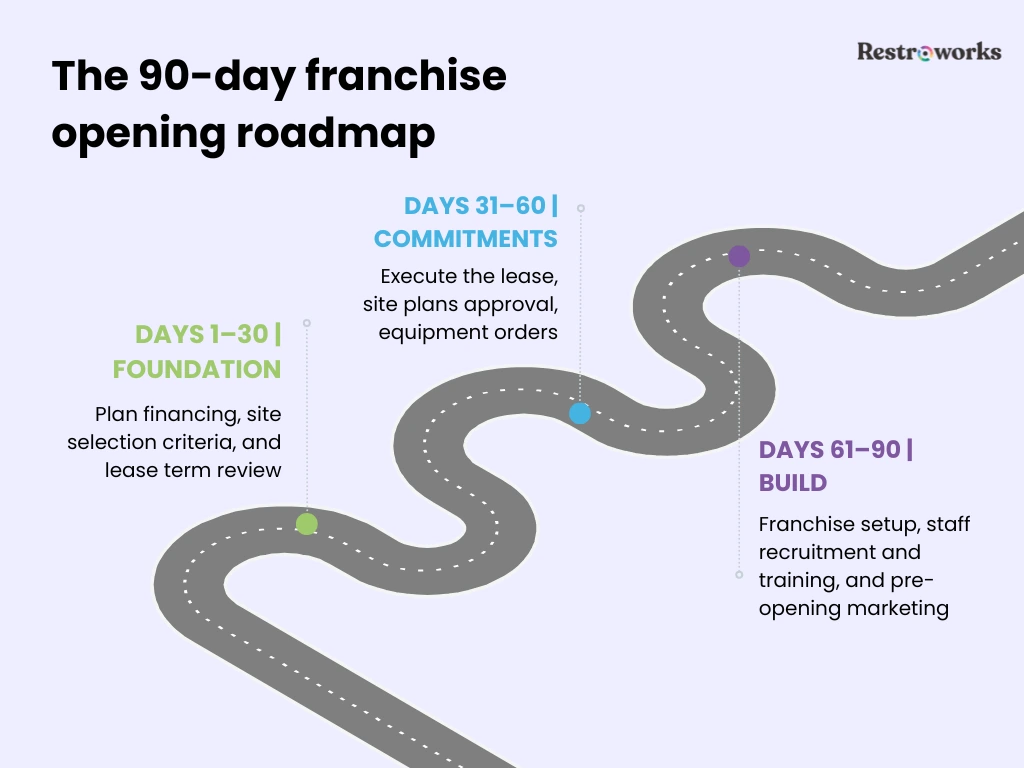
This roadmap is for franchise operators opening an additional location under an existing brand agreement. The critical constraint: SBA 7(a) loans commonly take 60–90 days from application to funding, so financing must start in Days 1–30, before site signing.
Days 1–30: Foundation
- Initiate SBA 7(a) or conventional lender conversations (a 60–90 day path to funding means Day 1 is the deadline, not a suggestion)
- Confirm site selection criteria against brand standards
- Engage a franchise attorney to review any new lease terms against your franchise agreement
- Notify brand of intended territory and begin site approval process
Days 31–60: Commitments
- Execute lease and submit site plan for brand approval
- Secure lender approval so funding can close by the end of the window
- Place equipment orders at lease execution, not build-out completion, because custom equipment can take weeks to months to arrive
- Begin vendor qualification for the new market if outside existing distributor coverage
Days 61–90: Build
- Build-out commencement (permitting in major metro markets often extends the total timeline)
- Staff recruitment and training schedule confirmed
- Supplier agreements in place for the new location
- Pre-opening marketing plan finalized with brand team
Total elapsed time from signed agreement to open door: typically 6–12 months. The 90-day roadmap above covers the operator’s active decision window; build-out and permitting extend beyond it.