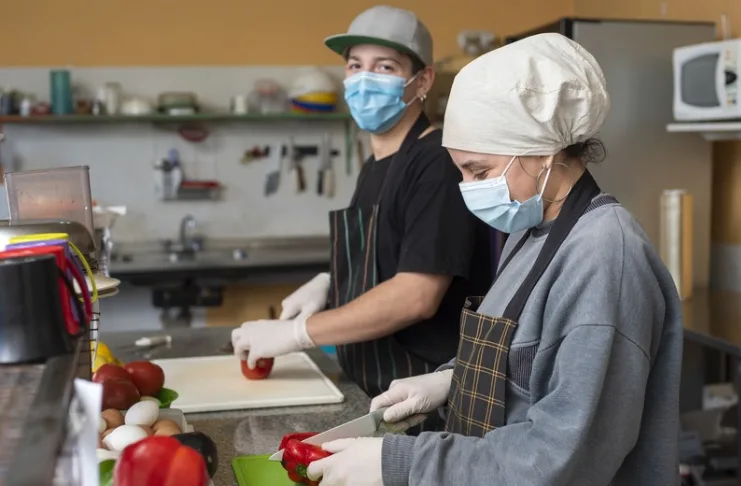

A single supplier failure can turn into a franchise-wide crisis. In July 2026, CDC and FDA linked a Cyclospora outbreak to shredded iceberg lettuce served at Taco Bell restaurants. By the time the outbreak was declared over, it had reached 12,883 laboratory-confirmed illnesses across 21 states, with 570 hospitalizations and 2 deaths, all traced back to one supplier, Taylor Farms de Mexico.
That is the defining feature of restaurant franchise food safety: a failure at one point in the system becomes everyone’s problem, and a strong food safety culture is the only structure that absorbs that risk.
According to Johns Hopkins Bloomberg School of Public Health, a single outbreak at a fast food restaurant can cost from about $4,000 when 5 people get sick to $1.9 million when 250 people get sick, considering the lost revenue, lawsuits, legal fees, and fines. On the flip side, a ServSafe Manager online course and exam costs $152.95 plus proctoring fees in a simulation study, and the certification is valid for 5 years.
This blog covers the key food safety standards, practices, and compliance requirements franchise brands need to protect guests and maintain consistency across locations.
What You Will Learn
- The food safety standards and compliance requirements every franchise location must follow.
- How franchisors and franchisees share responsibility
- Monitoring food safety, preventing contamination and maintaining consistent standards across locations.
Why Food Safety is Non-Negotiable for Restaurant Franchises?
Unsafe food makes an estimated 866 million people ill worldwide each year and kills 1.52 million. In the United States, CDC estimates that seven major pathogens cause about 9.9 million domestically acquired foodborne illnesses, 53,300 hospitalizations and 931 deaths a year. In 2024, CDC’s FoodNet surveillance sites alone reported 24,624 infections, 6,746 hospitalizations and 178 deaths.
Restaurants sit at the center of that risk. CDC notes that more than half of all foodborne outbreaks in the United States are associated with restaurants, banquet facilities, schools and other institutions.
The financial exposure compounds the public health toll. Jack in the Box’s 1993 E. coli outbreak sickened over 700 people in four states and killed four children. In the quarter that followed, same-outlet sales fell 22.2%, and parent company Foodmaker reported a $29.3 million loss.
Consumers do not forgive easily. 68% say they would stop visiting a restaurant permanently after a food safety issue, and 57% say inconsistent experiences across locations would stop them from returning to a brand. For a franchise system, that second number matters as much as the first.
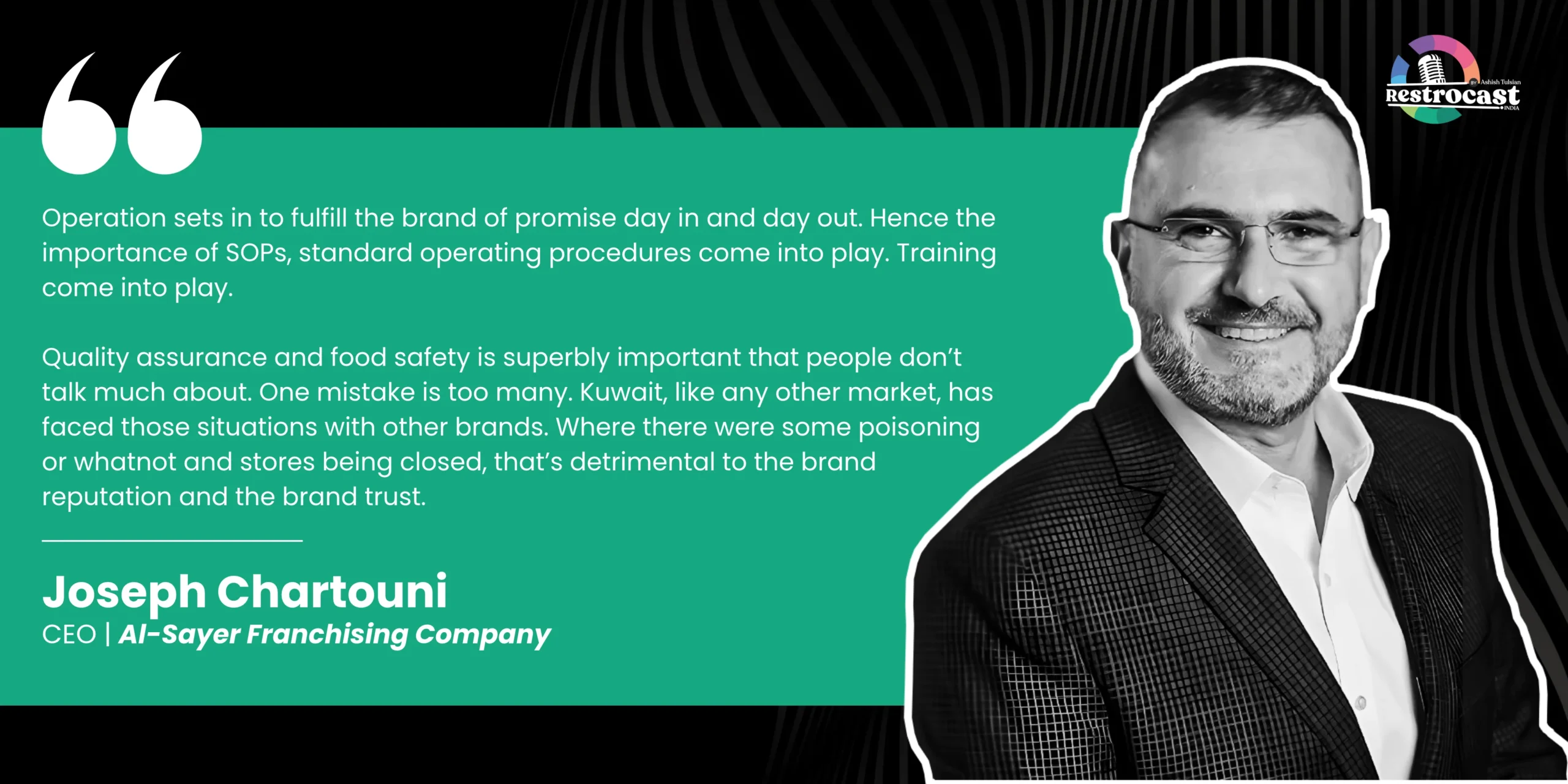
Joseph Chartouni, CEO of Al Sayer Franchising Company, highlights why food safety needs to be treated as a core part of brand management. On Restrocast, he mentions-
What Makes Food Safety Different in a Franchise System?
Independent restaurants control every process directly. Franchise operators face a structural tension: the franchisor sets the standards, but the franchisee owns execution, liability and the consequences of failure.
Most food safety risk sits with people: handwashing compliance, temperature logging discipline, illness reporting. Those behaviors live at the unit level, inside the franchisee’s hiring and training systems. A 2026 CDC Environmental Health Specialists Network (EHS-Net) study of 321 restaurants found that food safety policies, monitoring of those policies, and worker training were all positively associated with a stronger food safety culture.
Who owns the franchise also affects outcomes. A January 2025 study of nearly 1,500 quick-service franchise restaurants in the US Southeast, led by Mississippi State University researchers, found that franchises owned by a parent company received the fewest health code violations, single-owner franchises came second, and family-owned franchises received violations most often.
Who Is Responsible for What: Franchisor vs. Franchisee
Responsibilities in a franchise food safety system are divided by contract, and the split matters when something goes wrong.
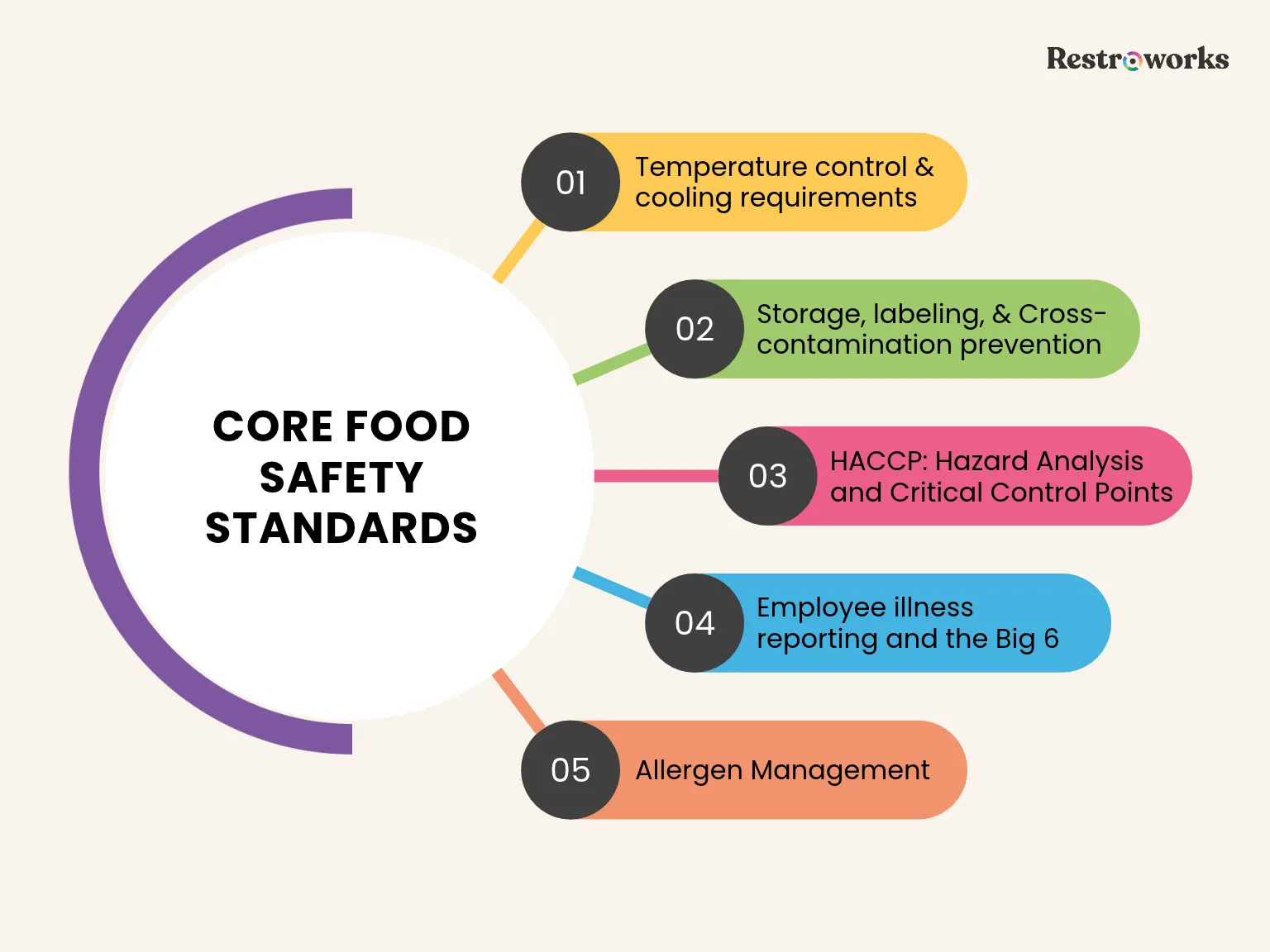
Core Food Safety Standards Every Franchise Location Must Follow
Food safety in US restaurants is governed by the FDA Food Code (2022 edition), a model code that states adopt in full or with modifications. Inspection frequency is set by state and local health departments, usually based on each establishment’s risk category.
The most commonly cited critical violations cluster around temperature control, storage and cross-contamination, the three areas franchise training programs address first.
1. Temperature Control and Cooling Requirements
Core thresholds set by the FDA Food Code:
The Food Code requires accurate, calibrated thermometers but does not set a calibration schedule. Daily calibration is a common franchise operating standard, not a code requirement.
Cooling is where restaurants slip most often. CDC’s EHS-Net research found that 1 in 7 restaurants stored food in refrigerators running above 41°F, 4 in 10 placed hot food in deep containers that cool too slowly, and chain-owned restaurants and those with certified kitchen managers were more likely to use quick-cooling methods.
2. Storage, Labeling, and Cross-Contamination Prevention
Food Code storage rules include-
- Food to be kept at least 6 inches off the floor.
- Raw proteins stored below ready-to-eat foods.
- Date marking applies to ready-to-eat TCS (time/temperature control for safety) foods held longer than 24 hours, which may be kept at 41°F or below for a maximum of 7 days, counting the prep day as day 1.
- Cross-contamination prevention relies on dedicated equipment for raw proteins, color-coded tools (a common franchise standard), and handwashing for at least 20 seconds.
- Cleaning schedules enforced through digital checklists, rather than paper logs, create timestamped, auditable records of every sanitation cycle.
3. HACCP: The Hazard Control Framework
HACCP (Hazard Analysis and Critical Control Points) is the systematic framework for identifying and controlling biological, chemical, and physical hazards in food production. Franchise food safety programs are built on HACCP principles, whether or not the term appears in unit-level training.
The seven HACCP principles are-
- Conduct a hazard analysis
- Identify critical control points (CCPs)
- Set critical limits
- Set monitoring procedures
- Set corrective actions
- Set verification procedure
- Keep records
In restaurant franchises, CCPs typically include cooking temperatures, cooling, and hot and cold holding, the same areas that draw the most inspection violations.
4. Employee Illness Reporting and the Big 6
The FDA Food Code requires food employees to report certain symptoms and diagnoses to the person in charge. Six pathogens, known as the “Big 6,” trigger exclusion or restriction from food handling-
- Norovirus
- Hepatitis A virus
- Shigella
- Shiga toxin-producing E. coli (STEC)
- Salmonella Typhi
- Nontyphoidal Salmonella
Every franchise location needs a written employee health policy that documents-
- Conditions requiring exclusion from work
- Conditions requiring restriction to non-food-handling tasks
- How employees report illness to managers.
5. Allergen Management
Allergen management is a critical part of restaurant food safety. It involves identifying ingredients that can trigger allergic reactions, communicating their presence to guests and preventing cross-contact during food preparation.
Sesame became the ninth major food allergen on January 1, 2023, under the FASTER Act, joining milk, eggs, fish, crustacean shellfish, tree nuts, peanuts, wheat and soybeans. Franchise staff must be trained to-
- Identify all 9 allergens in every menu item
- Prevent cross-contact during preparation
- Answer guest questions accurately.
Allergen incidents carry compounding risk in franchise systems, because a reaction at one location makes headlines under the brand’s name. Multi-unit operators should confirm that their system’s allergen matrix is current and that unit training includes sesame.
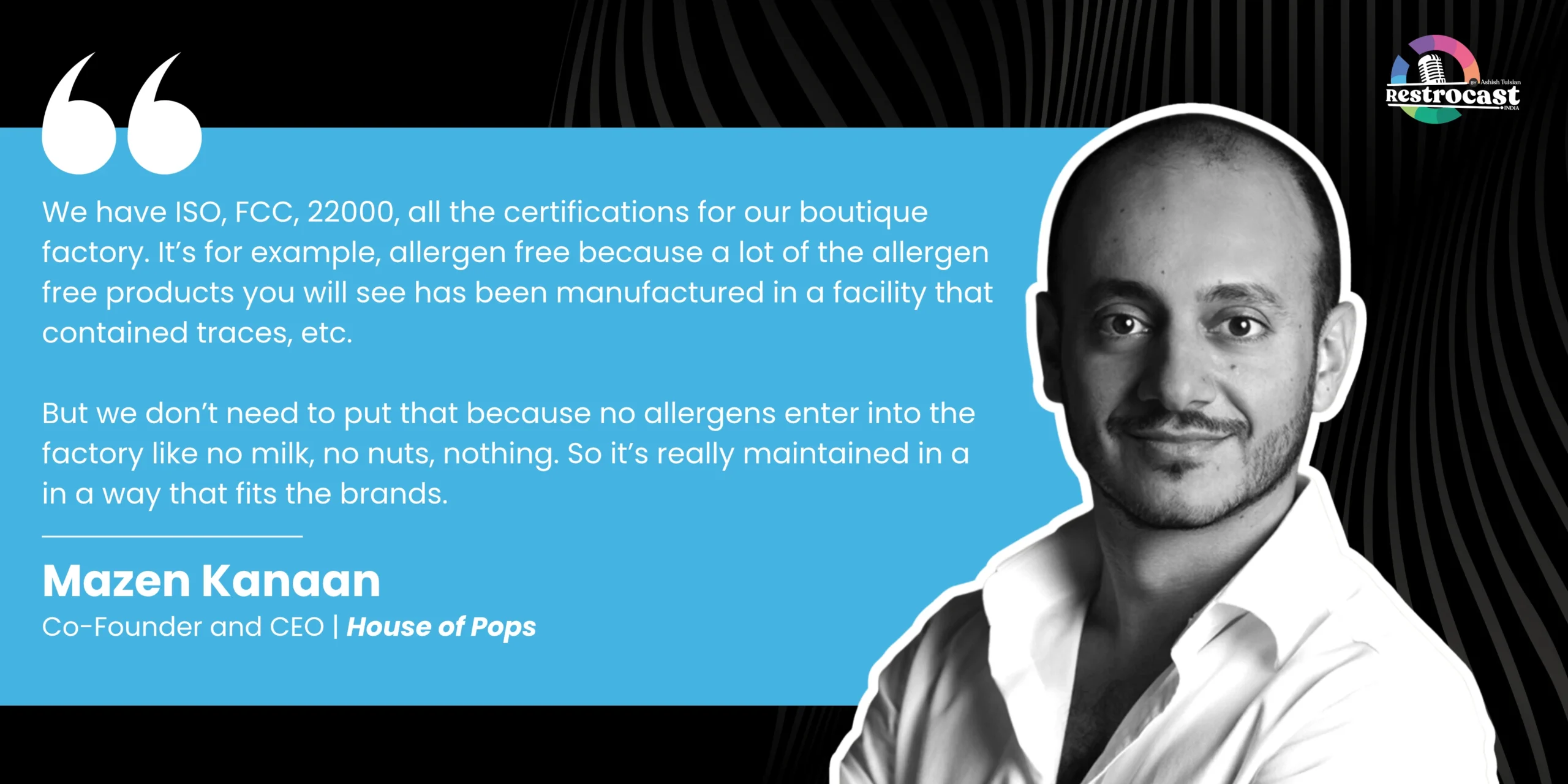
In a Restrocast episode, Mazen Kanaan, Co-Founder & CEO of House of Pops, talks about preventing allergens in a 7000 sq ft. production facility.
Supply Chain Controls: From Approved Vendors to Franchise Kitchen
Franchise systems maintain approved vendor lists (AVL) to centralize sourcing, and most major systems require approved suppliers to hold certification under a GFSI-benchmarked scheme such as SQF, BRCGS or FSSC 22000.
Franchisees who substitute suppliers without written franchisor approval breach the franchise agreement, even when local alternatives meet local health codes.
Centralization also creates single-point-of-failure risk. The 2026 Taco Bell outbreak showed it clearly: one approved lettuce supplier, Taylor Farms de Mexico, exposed franchised restaurants across multiple states at once, and Taco Bell stopped using that supplier’s lettuce on July 17, 2026, the same day the supplier announced a voluntary removal.
The FSMA Section 204 Food Traceability Rule requires businesses that handle foods on FDA’s Food Traceability List, such as fresh-cut produce, shell eggs and soft cheeses, to keep enhanced traceability records and provide them to FDA within 24 hours of a request.
Some smaller restaurants are exempt, so operators should check their status with FDA’s exemption tool.
Leading systems go further, with on-site supplier audits, microbiological sampling requirements and traceability systems that can isolate a contamination source within hours.
Training, Certification, and the Food Safety 5 Framework

Since the 2017 edition, the FDA Food Code has required the person in charge to be a Certified Food Protection Manager (CFPM) under Section 2-102.12. State adoption varies, and many franchise systems go further by requiring CFPM certification for every manager.
Food handler cards are a separate, frontline requirement. Only a small number of states require them statewide, including California, Illinois, Oregon, Texas, Utah and Washington, while elsewhere counties or cities may set their own rules. Multi-state operators should map the requirements for every jurisdiction they operate in.
Chick-fil-A’s Food Safety 5 shows what a fully developed franchise food safety system looks like. Presented at the 2022 Food Safety Summit, when the chain had about 2,800 restaurants handling more than 700 million pounds of raw chicken a year, it was built around two primary biological hazards, Salmonella and Campylobacter.
According to Chick-fil-A’s system, the five pillars of safety are:
- Health & Hygiene: Designates specific people and designated equipment for raw product, color-coded yellow, to reduce the raw footprint
- Cleaning & Sanitation: Establishes consistent cleaning and sanitizing practices to maintain hygienic food preparation areas, equipment, and surfaces.
- Time & Temperature: Uses IoT monitoring of the temperature danger zone, with bar-coded pans and screens that show time remaining and batches due for temperature checks
- Culture: Builds a “Culture of CARE” built on commitment, consistency, and incremental improvement to make food safety a shared responsibility.
- Cross-Contamination: Restaurant design and food flow that reduce the raw footprint.
Middle managers are the critical lever for sustained compliance. They set daily norms, enforce temperature logging, and decide whether food safety is “the way we work” or “the thing corporate cares about.”
Monitoring, Audits, and Third-Party Verification
Internal audits against the franchise’s food safety checklist are the first verification layer. Findings require documented corrective actions, closed within set timeframes.
Third-party audits by accredited firms such as EcoSure, NSF and Steritech are the second layer in most major franchise systems, and many systems schedule them unannounced.
Hooters of America, which operates or franchises more than 400 restaurants, had NSF as its food safety audit partner in May 2022. NSF’s annual review includes anonymously benchmarking Hooters’ performance against other brands it works with.
Franchise agreements typically set their own audit score thresholds, often stricter than health department minimums. An operator who passes every government inspection can still lose franchise rights if third-party audit scores stay below the contractual threshold. The franchise agreement’s audit standard governs, not the government minimum.
Legal Responsibility: Who Bears Liability When Things Go Wrong
Franchise agreements generally treat franchisees as independent operators and place food safety liability on the unit, even when the franchisor mandated the procedures, the suppliers and the audit program. That arrangement is not absolute.
Courts look at how much control the franchisor actually exercises. Then again, the standard varies by state and by type of claim, so “independent contractor” language does not settle the question on its own. Multi-unit operators should have counsel review their specific agreement.
Common termination triggers include repeated failed audits, a confirmed outbreak, and failure to fix critical violations within the agreement’s cure period. Terminated franchisees often remain bound by their lease, equipment financing and non-compete obligations.
Scaling Compliance Across Multiple Franchise Locations

Multi-unit operators cannot manage food safety the way a single-unit owner does. Past a handful of locations, the compliance program has to work without the operator present, and it has to work consistently: an outbreak at one unit can bring health department scrutiny and franchisor crisis audits to the whole portfolio.
- Cross-location compliance dashboards are the operational foundation. A central platform should show, in real time, current audit scores by location, open corrective actions and days to close, manager certification status with CFPM renewal dates, and temperature monitoring alerts. Without that visibility, operators discover gaps through audits or incidents, both of which cost more than catching the gap early.
- Exception-based alerting changes the response pattern. Instead of reviewing every location’s data by hand, exception alerts push critical deviations to the operator before they become violations. For instance, a walk-in drifting above 41°F overnight, a location nearing an audit threshold, a manager certification about to expire. At scale, manual review is not viable; exception logic is.
- Corrective action workflows close the loop. When an audit flags a finding, the fix must be documented, timestamped and tied back to the original finding before the record is closed.
- Centralized records protect against legal exposure. Operators who keep timestamped digital records of every inspection, corrective action and manager certification are in a much stronger position when a health department or plaintiff’s counsel asks for documentation.
Technology and Digital Food Safety Management
Paper records stop working once an operator runs more than a few units. Digital food safety management systems (FSMS) provide automated temperature logging, digital HACCP documentation, timestamped sanitation checklists and cross-location compliance dashboards.
Some franchise systems mandate specific technology. Before committing to new units, operators should check what the FDD discloses: Item 11 describes required computer systems and software, and Item 7 estimates the initial investment. Required sensors, logging hardware and subscriptions belong in that review.
Brand-Wide Crisis Response When Incidents Occur
A confirmed incident becomes a brand crisis within hours, and the damage does not respect individual unit performance. After Chipotle’s 2015 E. coli outbreaks, which the CDC linked to 55 illnesses in 11 states without ever identifying a specific ingredient, the chain’s comparable restaurant sales fell 14.6% in the fourth quarter of 2015 and 29.7% in the first quarter of 2016.
Chipotle’s restaurants were company-operated, so corporate absorbed the hit directly. In a franchise system, the same drop would land on every independently owned unit. Chipotle later paid a $25 million criminal fine under a 2020 deferred prosecution agreement.
A centralized incident response plan is the operational requirement. A 72-hour protocol, in execution order:
- Notify franchisor legal and operations contacts immediately
- Report to the local public health authority as the jurisdiction requires
- Preserve all records: temperature logs, cleaning logs, employee health logs, delivery receipts
- Commission independent environmental swabbing and product sampling
- Activate supplier traceability and pull AVL sourcing records for the implicated items
- Close the affected location and begin an emergency deep clean
- Route all external inquiries to the brand communications team
State-by-State Compliance for Multi-State Franchisees
Health codes are administered by states and localities. The FDA Food Code is a model, and states adopt different editions with their own amendments, which creates real compliance gaps for multi-state operators. Food handler card rules are one example: required statewide in some states, set locally in others, and absent in many.
Multi-state operators must map the stricter of the state code and the franchise standard for every jurisdiction. Franchise agreements rarely allow stepping down to the state minimum; the operations manual usually governs.
Food Safety Compliance: Daily, Weekly, and Monthly Checklist
A structured checklist turns policy into daily habit. Use this as a reference framework; franchise agreements will specify their own documentation formats.