


How Can You Build & Implement Group-Wide Restaurant Sustainability Practices?
Before anything, try to figure out these:
- What must be mandated across every unit?
- What should be recommended?
- What needs to stay local for more relevance?
Getting this wrong early means either under-delivering (everything is optional, so nothing changes) or over-reaching, with requirements that franchisees and corporate can’t meet.
What you should do instead is:
#1: Develop Corporate ESG Standards to Reduce Waste
Most assume the first step is choosing initiatives, when it’s actually auditing utility bills, resource data, and purchasing records across all locations.
Factor this in – According to data, after proper auditing, energy consultancies consistently report at least 20-40% cost reductions in their first rollouts.
From there, a tiered structure works better than a uniform mandate.
Why? Some sustainability metrics belong in the non-negotiable category, like resource reporting, supplier minimum standards, recycling programs, and compliance with local regulations. Others make more sense as targets with flexibility in how locations reach them.
For example, the Mayfair Private Members Club in London built 57 specific measurable eco-conscious objectives across 8 themes, ranging from net-zero operations, promotion of social value and low-carbon transport, supporting biodiversity and climate resilience, efforts to minimize waste, and fostering a circular economy. That level of detail only holds together because measurement was built into the design, and not added afterward.
This is a clear case of how restaurants can implement standardized circular economy practices to divert scraps from landfills and improve environmental performance across locations.
#2: Create Different Strategies for Franchise vs Corporate-Owned Location
Franchisees mostly and ONLY respond to incentives and contract requirements.
The best holistic view here can be to embed green initiatives (sourcing criteria, resource tracking requirements, and energy-efficient equipment specifications) directly into franchise agreements at renewal.
However, don’t forget to pair it with something concrete in return, like preferred supplier pricing, co-funded equipment upgrades, or access to group-level rebate programs.
Corporate-owned locations, on the other hand, can move faster and should. Use them to pilot interventions, validate unit-level economics, and remove ambiguity before scaling.
Did you know? A global analysis of 114 restaurant sites across 12 countries found that on average, restaurants generated $7 in savings for every $1 invested into food waste reduction efforts over three years, with 76% recovering their costs within the first year (rising to 89% by year two). Even at the unit level, sites saved over two cents on every dollar of COGS. And importantly, these returns held steady regardless of geography or restaurant type. What all high performers were doing in common was to track losses rigorously, engage staff, control overproduction, tighten purchasing, and find ways to repurpose extra materials. |
How Can Eco-Friendly Restaurant Supply Chains Be Built at Scale?
Let’s put it straight – Supply chain is where restaurants (a group, to be precise) have real leverage (really REAL, tbh). But the question is whether that leverage is used intentionally.
A restaurant group’s supply chain can be its largest source of emissions, highlighting the need for sustainable sourcing practices.
Centralized vs Regional Sourcing Models
At scale, procurement becomes policy.
A 300-location group negotiating compostable packaging or certified protein has purchasing power that makes supplier ESG requirements enforceable in practice.
OECD data shows 54% of food supply chain firms have set no greenhouse gas emissions at all, including, almost certainly, some of your current vendors. Centralized procurement creates the scale to actually require it and mean it.
Regional sourcing adds a different kind of value here. Sourcing ingredients from local suppliers can significantly reduce the carbon footprint associated with transportation, as local ingredients require less travel time and distance to reach restaurants. And 38% of consumers say they’re more likely to choose restaurants that do it.
The trade-off, however, is complexity. Most groups prefer centralized procurement for commodity items and packaging, regional programs for produce and protein, with group-level standards applied to both.
Restaurants can enhance their sustainability efforts by offering more vegetarian and vegan menu options, which typically have a lower environmental impact compared to meat-based dishes.
Take how Chipotle focuses on sourcing local produce and aims to purchase more than 37.5 million pounds locally in 2023 to reduce emissions. Restaurants that source locally support the local economy, foster growth in the community, and create jobs. By adopting a farm-to-table approach and sourcing local ingredients, restaurants can reduce their environmental impact and use this practice as a unique selling point.
Purchasing seafood from certified sustainable sources, such as those recognized by the Marine Stewardship Council, helps maintain fish populations and supports responsible fishing practices.
As Paul Bruce-Brand puts it: “We don’t dictate what fish should appear on the menu: nature and our fishers do.”
For restaurant owners, that’s the (& must be the) principle. Set the standard. Let the system adapt around it.
Supplier ESG Requirements
Scope 3 emissions (those embedded in your vendor and procurement operations) are increasingly part of ESG reporting expectations for larger restaurant groups. Getting food suppliers to track and disclose their emissions often starts with asking. Groups that have built supplier scorecards with environmental criteria find that suppliers respond when it affects the contract.
Toks Restaurant Group in Mexico went further and implemented blockchain-based tracking for organic coffee, working directly with cooperatives to eliminate intermediaries. Farmer income, thus, increased 700%, and the authenticity of organic claims became verifiable — and trust us that last piece matters more than it used to. Greenwashing exposure through the FTC Green Guides is a real legal risk for groups making public environmental claims.
That clear, now let’s list a few green practices restaurants can start employing right away:
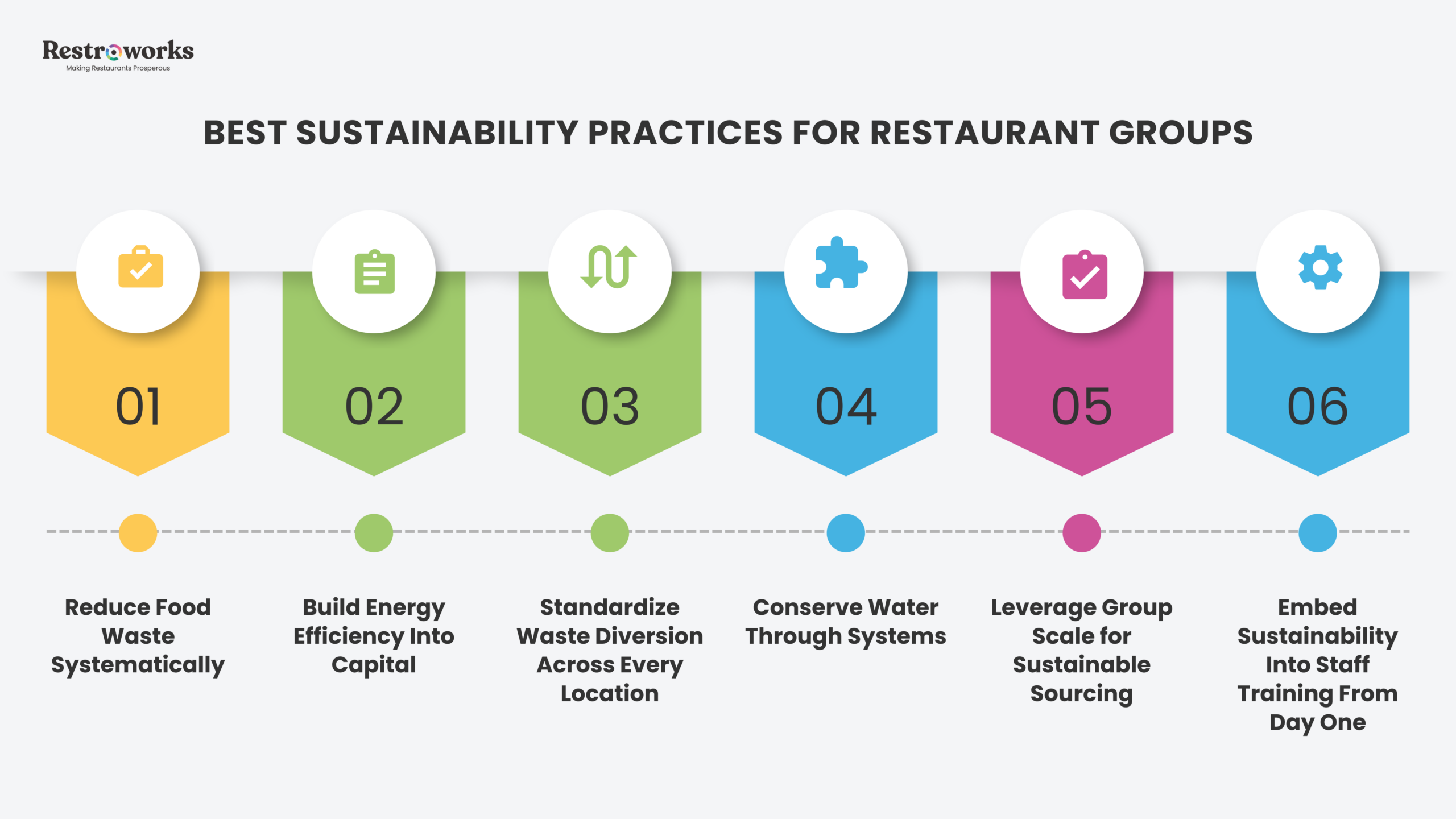
Practice 1: Reduce Food Waste Systematically for Greater Community Engagement
Reducing waste is one of the single highest-ROI restaurant sustainability practices that’s equally a win-win for both the business and the environment. U.S. restaurants discard over 7.6 billion pounds of food annually. In 2023 alone, restaurants and foodservice operators generated 12.9 million tons of surplus groceries. Only 13% of the 12.9 million tons of surplus food created by restaurants each year is composted, highlighting the need for better residue management practices. The rest goes to landfill, where it decomposes and produces methane.
For groups, the intervention points stack. Demand forecasting across all locations using POS and reservation data is more accurate than anything an individual manager can produce, because the dataset is larger and patterns become visible at scale. Menu engineering and standardizing portion sizes across the group means one recipe adjustment propagates across every location simultaneously.
Thus, conducting a food waste and energy audit helps identify areas where waste occurs, such as prep scraps and spoilage. Restaurants can significantly reduce waste by implementing tracking systems that monitor inventory and automatically adjust orders based on demand forecasts, which helps minimize over-ordering and excess food preparation. Comprehensive food waste tracking can reduce spoilage in restaurant operations. Effective inventory management, such as using the FIFO (first in, first out) method, helps restaurants reduce spoilage by ensuring older stock is used before newer stock.
Plus, donating excess edible material to local organizations, such as soup kitchens and shelters, is an effective way for restaurants to reduce spoilage while also supporting the community. Partnering with local food banks for excess ingredient donations can also reduce spoilage in restaurants. Establishing partnerships with organizations working toward food waste reduction can enhance a restaurant’s sustainability initiatives. It’s also one kind of eco-friendly restaurant effort that builds genuine community relationships.
Joining a recycling program can help restaurants manage scraps more effectively, allowing them to recycle food scraps, paper towels, packaging materials, and other materials.
“Aiming to reduce spoilage doesn’t have to be difficult or expensive. Businesses [in the restaurant industry] that divert material from the landfills and donate their unused ingredients make a positive impact — financially, socially, and environmentally.” – Laura Abshire, Director of Sustainability Policy and Government Affairs, National Restaurant Association. |
Practice 2: Invest in Energy Efficiency & Reduce Energy Consumption Across Locations
Behavior-based efficiency programs fail at scale because of turnover. With 120%+ annual staff churn in parts of the hospitality industry, a program that depends on someone remembering to turn off the fryer hood is structurally unreliable.
The durable fix is capital: utility management systems, smart sensors, automated controls that operate regardless of who’s working that shift.
LED lighting and programmable thermostats can minimize electricity usage in restaurant operations. Restaurants can lower utility costs and reduce carbon footprints by optimizing resource consumption. Restaurants can significantly reduce their energy consumption by installing energy-efficient appliances, which can lead to lower utility costs and a reduced carbon footprint.
ENERGY STAR-certified refrigeration equipment, dishwashers, ovens, etc., save approximately $4,000–$5,300 per location per year.
Shari’s restaurant chain, for example, has earned over $300,000 in utility rebates since 2010 through systematic equipment upgrades.
Maybe that’s why shifting to more eco-friendly options, such as LED lighting and ENERGY STAR equipment, is recommended for environmentally conscious restaurants. Using smart thermostats can help restaurants automatically reduce heating and air conditioning during closed hours, contributing to energy savings. Regular maintenance checks on HVAC systems can ensure they operate efficiently, which is crucial for reducing energy consumption in restaurants.
LED bulbs use 90% less energy than traditional lighting, and switching to them is encouraged for sustainability. Consider how Starbucks has started using 100% renewable energy sources in its U.S. stores since 2015.
This kind of infrastructure investment helps restaurants reduce costs, save energy, save money, increase efficiency, and lower their restaurant’s carbon emissions over time.
Practice 3: Cut Down on Single-Use Plastics to Reduce Your Brand’s Environmental Footprint
Recycling programs and composting work differently when you’re operating at a group scale. How? The infrastructure investment amortizes better, supplier partnerships become available that individual locations can’t access, and data from multiple locations actually tells you what’s working versus what’s just being reported.
Implementing recycling programs can help restaurants manage waste production more effectively, as many cities offer free or low-cost recycling services for businesses. Recycling bins with clear visual signage at every kitchen and front-of-house station reduce contamination rates.
Using biodegradable or compostable disposables instead of plastic can significantly reduce waste and environmental footprint, as millions of tons of plastic are disposed of each year in the US alone. Using reusable serviceware can significantly reduce disposables in restaurants.
Restaurant Brands International aims for 100% of guest packaging to come from renewable or recycled sources by 2025. Starbucks introduced new cold cups using up to 20% less plastic to prevent over 13.5 million pounds of plastic utensils from entering landfills.
Restaurants can implement in-house composting programs to divert organic waste from landfills. Establishing industrial composting programs can support a restaurant’s waste management strategy. Using diversion strategies such as composting food waste and recycling can significantly reduce the amount of waste sent to landfills by restaurants.
In fact, more than 60% of customers now look for businesses that use sustainable packaging, making eco-friendly options a smart choice for restaurants.
Replacing single-use plastics with biodegradable or compostable materials significantly reduces packaging waste, making your business more appealing to environmentally conscious consumers.
According to Oracle’s Restaurant Scene 2022 global survey, 49% of respondents stated that having biodegradable or recyclable packaging influences their purchasing decisions. Many restaurants are now replacing plastic straws and disposable cutlery with biodegradable containers and more environmentally friendly products as part of their eco-friendly practices.
Practice 4: Conserve Water, Upgrade Cleaning Products and Systems, and Reduce Energy Use
Water conservation follows the same logic as utility management.
Upgrading dishwashing pre-rinse water sprayers to a flow rate of 1.15 gallons per minute or less can cut water use in half, saving on water and sewer charges as well as energy used to heat the water. Low-flow fixtures reduce water consumption meaningfully without any behavioral dependency.
Installing low-flow faucets, dishwashers, toilets, and other cleaning products can reduce water use by up to 20%, leading to lower utility bills and conservation of a vital resource. At the group scale, you can start standardizing these specifications for all brand-new installations and renovations.
Regularly checking water-cooled equipment and cleaning products for efficiency can help reduce unnecessary water usage, which is crucial for lowering operational costs. Fixing leaks in faucets and hoses can prevent significant water wastage, as a single drip per second can waste over 3,000 gallons of water per year. According to the National Restaurant Association’s Conserve Program, fixing small leaks in the kitchen can save restaurants up to $400 annually and help preserve essential natural resources.
Restaurants can enhance sustainability by growing their own produce, which not only reduces transportation emissions but also provides fresh ingredients for their menu.
Plus, replacing bottled water with filtration systems removes both cost and plastic waste from the equation in one move. These upgrades help conserve water, optimize water usage, and create a more sustainable restaurant model over time.
Practice 5: Switch to Seasonal Ingredients to Cut Carbon Footprint and Support Local Economies
Seasonal ingredients reduce transportation emissions and typically cost less because they’re not being shipped from distant climates out of season.
Restaurants can reduce their environmental impact by sourcing ingredients locally, which minimizes transportation emissions and supports local economies. An example: Chipotle showed a strong commitment to purchasing more than 37.5 million pounds of produce locally to reduce transportation emissions.
For smaller groups, what you can do is identify which high-volume ingredients have viable local farmers within the region and pilot the switch before committing group-wide.
Supporting local economies also means you’re supporting jobs and local economic growth in the communities where your restaurants operate, which matters for the social component of any ESG framework.
Moreover, sourcing locally and seasonally helps reduce a restaurant’s carbon footprint by cutting down on emissions from long-distance transportation, which contribute to global greenhouse gas emissions. This also gives many restaurants a chance to encourage staff members and customers to engage with fresher menus, regional ingredients, and more sustainable options.
Practice 6: Embed Eco-Friendly Practices Into Staff Training From Day One
The training program that runs once during onboarding and never gets revisited is, practically speaking, the program that doesn’t exist.
That’s why training for more responsible operations needs to be part of the standard onboarding flow. The same training, every time, across every location, regardless of who’s doing the hiring that week.
Using digital onboarding modules for training can help establish scrap sorting and energy-saving habits among restaurant staff. Training employees on green practices is essential for effective implementation across restaurant chains. Training employees on the restaurant’s sustainability goals can improve sustainability efforts and awareness. Video-based modules work better here because they’re consistent and repeatable. Try it.
Educating employees about sustainability best practices at least annually can improve awareness and engagement, helping to foster a culture of sustainability within the restaurant. Management support for a green team can significantly enhance sustainability efforts in restaurants, as having a dedicated group of employees focused on these initiatives can lead to more effective implementation and engagement. Encouraging employee feedback and suggestions related to sustainability actions can lead to innovative ideas and continual improvement, as staff often have unique insights into operational efficiencies.
Needless to mention, restaurants that adopt Environmental, Social, and Governance (ESG) protocols are increasingly seen as responsible businesses, as these protocols focus on environmental sustainability and ethical operations.
How Does Implementing the Above-Listed Practices Help Restaurants Increase Sales & Social Impact?
ESG reporting is no longer voluntary for restaurants above a certain size. Every investor of yours will expect it.
Now the question is what exactly you should measure and how consistently it should be applied across locations.
Here are the KPIs worth tracking:
- Power consumption per cover
- Water usage per cover
- Resource recovery rate (% of total discarded materials)
- Resource wastage (% of material purchased)
Carbon emissions tracking across Scope 1 (direct emissions), Scope 2 (purchased energy), and Scope 3 (vendor emissions) will give you a full picture. Most groups start with 1 or 2 and build toward 3 over time.
On public claims: FTC Green Guides govern what can legally be said about sustainability efforts.
Terms like “sustainable,” “eco-friendly,” and “carbon neutral” all carry legal implications currently under active regulatory revision. Groups making public “We’re green” claims should therefore run their marketing lingo through legal review.
Also, remember these statistics very clearly –
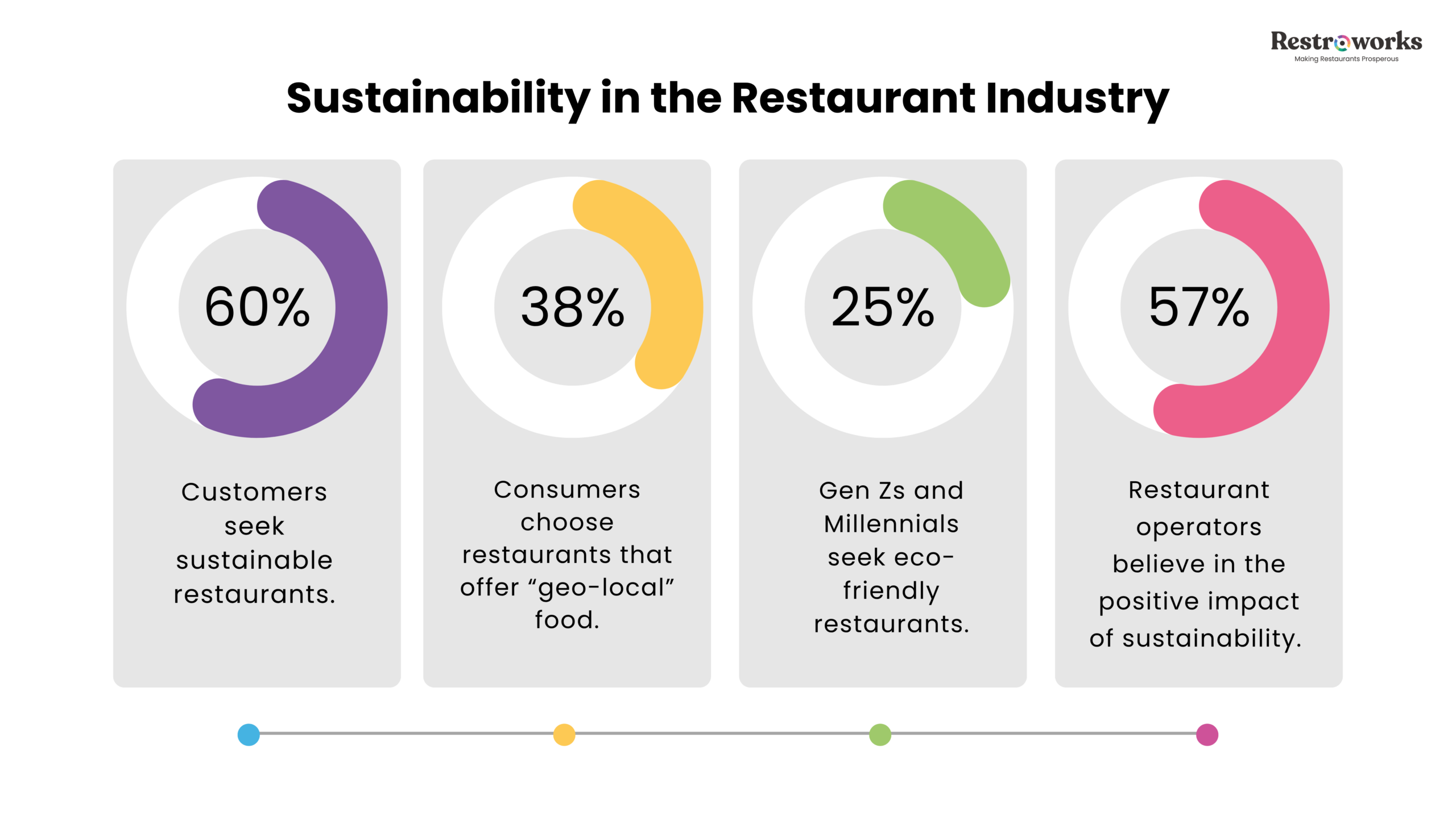
- 60% of customers are actively seeking out sustainable restaurants and are willing to pay more for sustainable establishments.
- 38% of consumers are more likely to choose restaurants that offer locally-sourced ingredients, highlighting the importance of transparency in sustainability efforts.
- 77% of diners check a restaurant’s website before visiting, making it crucial for restaurants to feature their sustainability practices online to build trust and attract eco-conscious customers.
Also, according to Dataessentials research, 25% of Gen Z and Millennials would go out of their way to find other restaurants that prioritize eco-friendly practices, highlighting the growing demand for sustainability improvements in dining.
Hence, implementing sustainable practices can significantly reduce a restaurant’s ecological footprint and contribute to a greener future, as 57% of restaurant owners believe the sustainable food service industry can impact the environment positively.
Case to Look Up To Omar Shihab has been integrating eco-friendly practices into BOCA Dubai for over ten years. The restaurant has earned the Gulf Sustainability Gold Award, Gault&Millau UAE Sustainable Kitchen of the Year, Gault&Millau UAE Sustainability Hero of the Year, and a Michelin Green Star. He says, “We don’t claim that we are farm-to-table. We don’t claim that we’re 100% local, but that’s not what drives us.” What drives BOCA, he’s said, is integrity, transparency, and long-term operational resilience as guiding principles. On why ‘green environment initiatives’ add value beyond operations, Shihab says: “If you can have all of that [great dishes, service, space] and then also stand for something bigger and larger, people love that.” |