
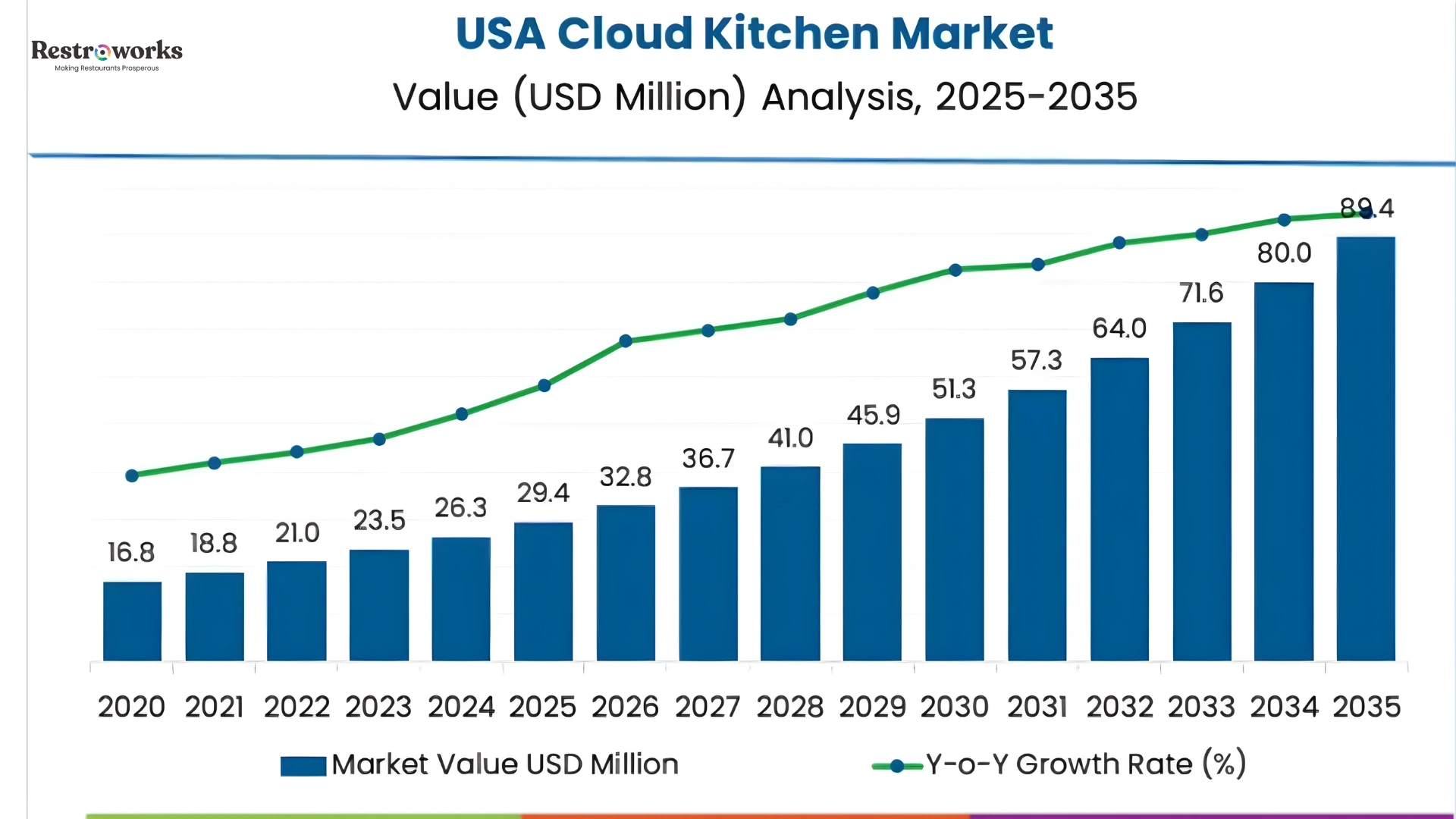
Okay, so you’re finally serious about starting a cloud kitchen. Fair. The model does present quite a few benefits – low overhead, no front-of-house payroll, no expensive corner-location rent, and a U.S. food delivery market that’s projected to hit USD 89.4 million by 2035, growing at a CAGR of 11.8%. It sounds clean.
Almost too clean, to be honest, because you’ve yet to account for a $363,500 upfront investment, a labor bill sitting at $327,000 in year one, and how heavily the cloud kitchen model relies on delivery platform commission rates (which, in fact, you don’t have much control over!).
Yes, the cloud kitchen concept is genuinely compelling, but it’s also genuinely complicated. Hence, this article. It breaks down the exact cloud kitchen profit and what it actually takes to get there.
What You Will Learn
- The real profit margins and earnings for cloud kitchens.
- The seven levers that determine whether your cloud kitchen makes money.
- Actionable strategies to protect your cloud kitchen’s bottom line.
What Does a Cloud Kitchen Business Actually Earn?
First things first, a cloud kitchen — also known as a dark kitchen, ghost kitchen, or virtual kitchen — is a commercial space that prepares food solely for delivery and takeout. Now, guess how much this type of foodservice format can even earn?
You’d be surprised – a high-performing cloud kitchen operation can generate an EBITDA (earnings before interest, taxes, depreciation, and amortization) of $663,000 in year one, on approximately $149 million in revenue.
You heard it – That’s the ceiling (and it’s absolutely real). But, again, it only belongs to operations that have cracked the code to “right” menu, pricing, delivery, demand, and costs.
In practice, the average range for cloud kitchen owner income, after combining salary and profit distributions, is somewhere between $150,000 and $400,000 annually.
For those just starting out, the realistic figure is closer to $50,000-$150,000, depending on their location, order volume, and cost structure.
Net profit margins in this food business are typically between 5% and 15%, while gross profit margin is between 20% and 30%.
That said, a well-run operation can break even in as little as three months, with full payback on initial investment in under a year.
Compare that to traditional restaurants that take two to three years to recover their initial investment, assuming they survive that long. (After all, 14-30% restaurants shut down within their first year!)
What are the Exact Cloud Kitchen Profit Margins?
So, there are basically two margin numbers you must keep tabs on –
Gross profit margin tells you how much is left after paying the direct cost of producing the food, which includes your food costs, packaging, and platform fees. Net profit margin tells you what’s left after accounting for labor, kitchen space rent, utility costs, marketing, insurance, etc.
In a well-run cloud kitchen, gross profit margins sit between 20% and 30%. That’s broadly in line with the restaurant industry at large.
But the actual difference comes from what you’re not paying for, like dining room, staff, street-facing lease premium, etc. These lil things are where the model earns its edge.
The contribution margin — the figure that really drives cloud kitchen profitability — can reach as high as 81% under optimal conditions (i.e., by controlling variable costs).
Mind that the 81% holds only as long as third-party delivery services stay out of your margin. Standard delivery platforms (Uber Eats, DoorDash, Grubhub) charge between 15% and 40% per order. If those commissions normalize across your order volume, the contribution margin goes off a cliff. A shift from 3% to 25% in platform fees drops the margin from 81% to roughly 59%, instantly.
Maybe this is why profitable cloud kitchen operations mostly own their ordering channels (direct apps, branded websites, loyalty programs) rather than depending entirely on third-party delivery platforms.
INDUSTRY INSIGHT
Not all cloud kitchens are the same, and those differences directly impact their profit margins. As for the data, multi-brand cloud kitchens account for 45% of global market share, independent cloud kitchens 32%, and hybrid models 23%.
In fact, the multi-brand model secured the largest revenue share of 36.78% in 2023. This may be because when multiple concepts run under the same roof, their overhead is split among them.
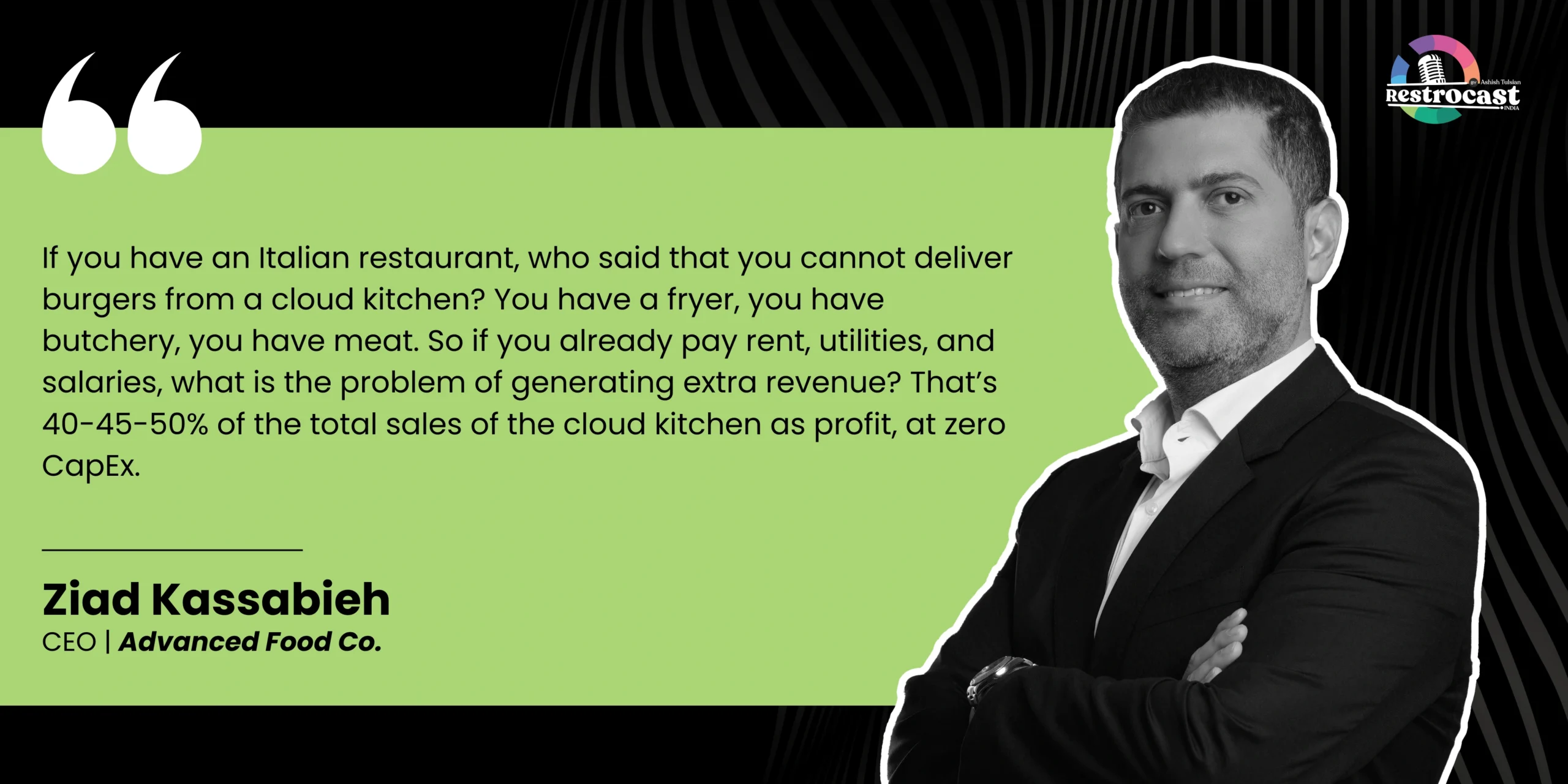
As Ziad Kassabieh, CEO of Advanced Food company, who operates 15 cloud kitchens alongside his dine-in brands in Saudi Arabia, puts it:
You may also want to explore a franchise setup, as it enables entrepreneurs to leverage established brand names and operational frameworks. But remember, it comes at a cost of royalty fees and reduced menu flexibility.
1. Food Costs and Food Waste
Food costs are your most manipulable variable.
While the target food cost percentage for a profitable cloud kitchen is around 14% of revenue, the industry norm runs at 30–35%. Mind that a lower food cost percentage directly translates to higher profit margins, and therefore, it becomes your responsibility to close this gap and track the numbers daily.
Closing the gap means actively tracking your food waste, inventory, menu, storage, and more. Regularly reviewing food cost percentages and inventory reports helps with effective cost management.
A growing number of operators now run their kitchens on dedicated cloud kitchen management software, tracking ingredient usage against historical sales data, predicting demand, and automating purchasing to hold food cost percentages much tighter.
Next comes menu engineering. When you build your menu around shared ingredients (proteins, sauces, and base components across multiple dishes), your raw materials spend less time sitting in cold storage and more time generating revenue. Streamlining the menu can also lead to operational efficiency and reduced prep time. That’s how you optimize inventory management without adding headcount.
2. Labor Costs
At $327,000 in year one, labor is the largest line item in a cloud kitchen’s cost structure. You may think that for a delivery-only model, a 60-person team is excessive. But, it isn’t. The model demands it — food preparation volumes supporting 97 to 180 daily orders require teams covering multiple shifts and prep windows.
Here, the operational efficiency question isn’t whether to hire fewer people. It’s whether you’re scheduling the right number for actual order volume on a given day.
What helps is treating labor as a variable. High-performing kitchens stagger shifts to match hourly order patterns, cross-train teams to move between stations, and use data analytics on order flow by hour. Implementing automation technology to optimize order management and food production can further lower labor costs by around 10%. Integrated kitchen management systems and kitchen display systems (KDS) can also streamline communication among staff and improve overall throughput.
3. Utility Costs, Kitchen Space, and the Hidden Stuff
The $13,800 monthly fixed overhead covers commercial kitchen space rent, utility costs, and base marketing.
A cloud kitchen runs hotter and longer than a traditional setup. Prep windows stretch across the day, equipment rarely sits idle, and without a dine-in area, there’s no broader footprint to absorb these fixed costs.
But the real pressure comes from what doesn’t show up cleanly on a P&L.
Waste management, equipment depreciation, food spoilage, and poor inventory control can shave off another 10–15% of profits. Not through one-off shocks, though, but through accumulation – a refrigeration unit running inefficiently, a supplier whose costs crept up unnoticed, an ingredient that’s technically on the menu but barely selling.
How Cloud Kitchens Generate Revenue & Scale It?
There is essentially one primary revenue engine in a standard cloud kitchen: online food delivery. Everything else — catering, meal kits, subscriptions — is a secondary revenue stream. Important, yes, but secondary.
The primary growth path depends on two variables: daily order volume and average order value.
At 97 orders per day with an AOV of $38–$42, a cloud kitchen covers its fixed costs and begins generating meaningful net profit.
At 140 daily orders (which is basically the Year 5 projection for most high-performing operations), those same fixed costs are spread thin enough that every incremental order delivers substantially more to the bottom line.
Mind that online food delivery and online ordering are not the same channel. Orders coming through owned platforms (your app, your website, your direct ordering link) carry zero third-party commission. Orders placed through standard delivery apps carry a 15–40% fee.
That’s why directing even 30% of volume to owned channels has a measurable impact on monthly revenue retained.
The Average Order Value Problem
AOV sensitivity is underappreciated. If average order value slips from $40 to $30, the daily order volume required just to cover fixed costs jumps from roughly 97 to 185. That’s not a minor adjustment; it’s nearly doubling your operational load without changing your kitchen footprint.
The only real defense is menu engineering. Design the menu so that naturally upsells, bundles, and complementary items make the $40 order the path of least resistance.
Here’s the math worth noting: At 81% contribution margin and a $38 average order value, you need approximately 447 orders per month just to cover the $13,800 non-labor fixed overhead before a single dollar goes to wages or net profit.
Diversifying Beyond Delivery
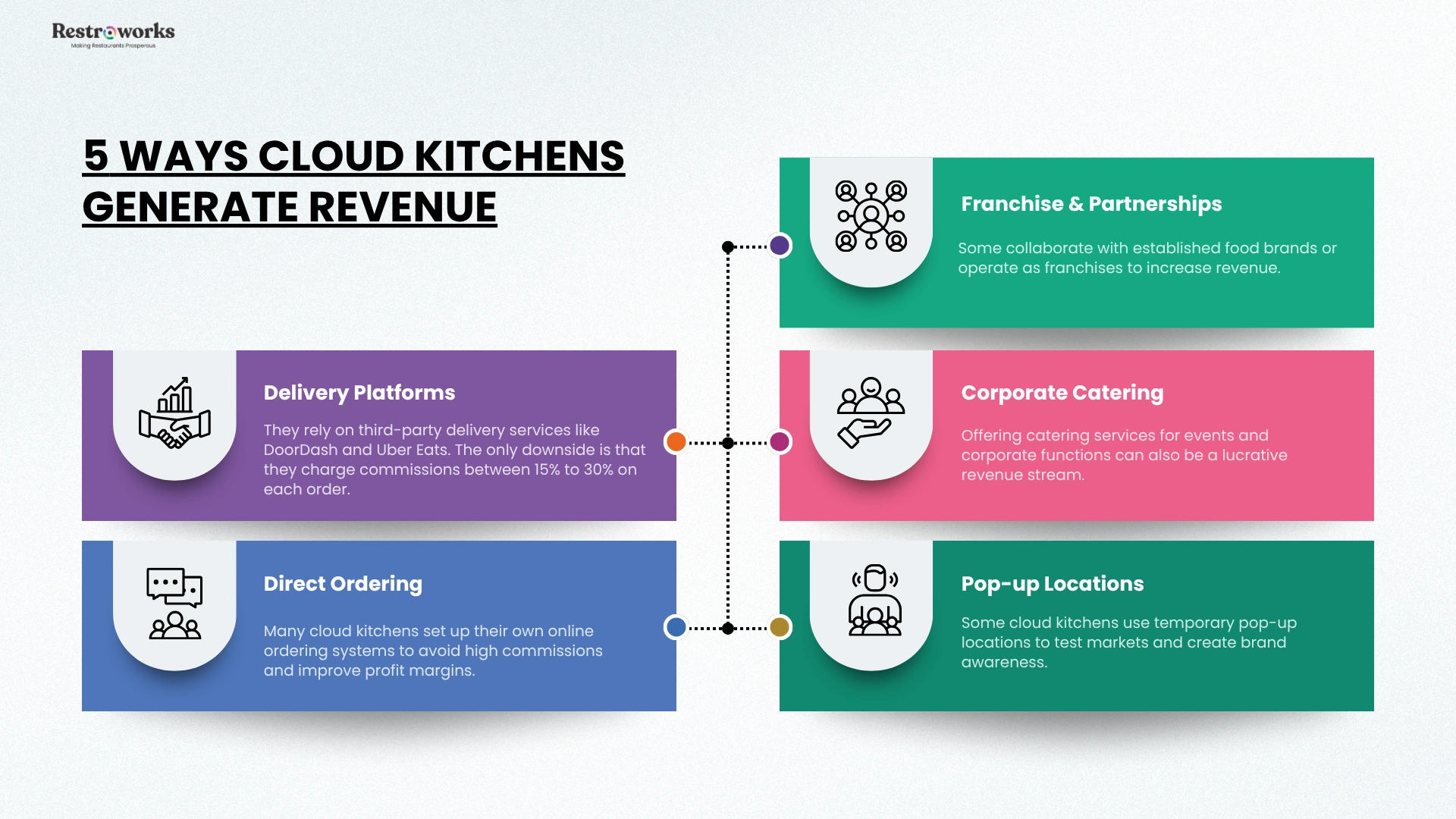
The most resilient cloud kitchen businesses eventually diversify. Catering services, subscription meal plans, and co-branded menu offerings with local businesses can add 5–15% to total sales revenue. These streams also generate a customer relationship that isn’t mediated by a delivery app’s algorithm.
Repeat customers (earned through consistent food quality and a reliable delivery process) are, in fact, worth substantially more than acquisition-driven one-time orders.
In a food business where marketing efforts cost $2,500 per month just to stay visible on platforms, a loyal customer base that orders weekly through your owned channel is the closest thing to free revenue that exists.
How Does Operational Efficiency and Food Quality Add to Your Profit Margins?
Here’s a kicker: in the cloud kitchen industry, you never see your customer. There’s no table to return to, no chance to catch a disappointed face before they leave. The only feedback loop you have is the rating they leave on the delivery app. And by now, you must know how ratings drive the algorithm, which further drives visibility, which drives order volume. Everything connects.
Consistent food quality, in this context, becomes a financial lever. An operation that delivers consistent food quality across every order retains customers, earns repeat orders, and builds a strong brand identity that generates organic growth without proportional marketing spend. Maintaining food quality during transit is equally paramount — investing in high-quality packaging solutions that preserve the taste, texture, and temperature of your menu items is a direct input into your ratings and repeat-order rate.
Food safety, here, is the floor. Cloud kitchen operations are subject to the same health codes and food safety regulations as any commercial kitchen.
Waste management, temperature control, and food safety training are operating expenses that protect every other line item in the P&L.
How Does Data Help?
The structural advantage cloud kitchens hold over traditional restaurants is data access. Every order is digital. Every delivery is logged. Food delivery platforms return granular information on order times, popular menu offerings, peak windows, and customer preferences.
Cloud kitchen businesses that use data analytics to adjust prep schedules, refine menus, and target marketing efforts by zip code and time of day outperform those that ignore it by 10–15% in productivity.
Plus, Inventory management software that connects historical sales data to purchasing decisions is the most direct tool to reduce food waste, control food costs, and avoid over-ordering.
Emerging food trends — flagged by food bloggers, delivery app trending data, and social media signals — also feed into data-driven decision making.
The ability to test a new item, measure its performance within two weeks, and either scale it or cut it (without having to reprint, retrain staff, or change a physical menu board) is a structural advantage the restaurant industry simply doesn’t have.
How Can You Make Your Cloud Kitchen More Profitable?
Knowing the margin structure is one thing. Building toward it is another. These five strategies, when applied strategically to your cloud kitchen business, can increase overall profitability by 55–105%.
- Optimize menu pricing and food costs. Menu engineering that highlights 70%+ contribution margin items, combined with dynamic pricing during peak hours and negotiated supplier contracts, can reduce food costs by 20–30% and cut food waste by around 10%. This is the most direct path to a better food cost percentage.
- Improve operational efficiency through automation. Redesigning kitchen workflows to reduce food preparation time by 15–20%, integrating automation tools to lower labor costs by ~10%, and optimizing the delivery process can materially improve your net profit margin. The goal here is to gain more orders per labor hour & not more labor hours per order.
- Expand revenue streams beyond food delivery orders. Catering, meal kits, and subscription-based models are the most common diversification plays. Every dollar that bypasses a 25% commission is worth more than it looks on a P&L.
- Reduce overhead through smart contracts and efficiency. Long-term lease negotiations, energy-efficient equipment (5–10% reduction in utility costs), and technology-driven administrative tools are the overhead reductions that compound over time.
- Invest in marketing and customer retention. Build loyalty programs that increase repeat-customer rates by 20%, targeted social media campaigns that boost engagement by 30%, and email marketing that drives order conversion by 15%. Invest in high-quality food photography (because in the online ordering environment, visuals are your storefront). Build a strong brand identity, as it is essential for long-term success in the cloud kitchen industry. Plus, make sure to monitor and optimize your marketing performance for continuous improvement and growth. Basically, make customer satisfaction the input, and you’ll get repeat orders and organic word-of-mouth, including food bloggers and social sharing, as the output.