

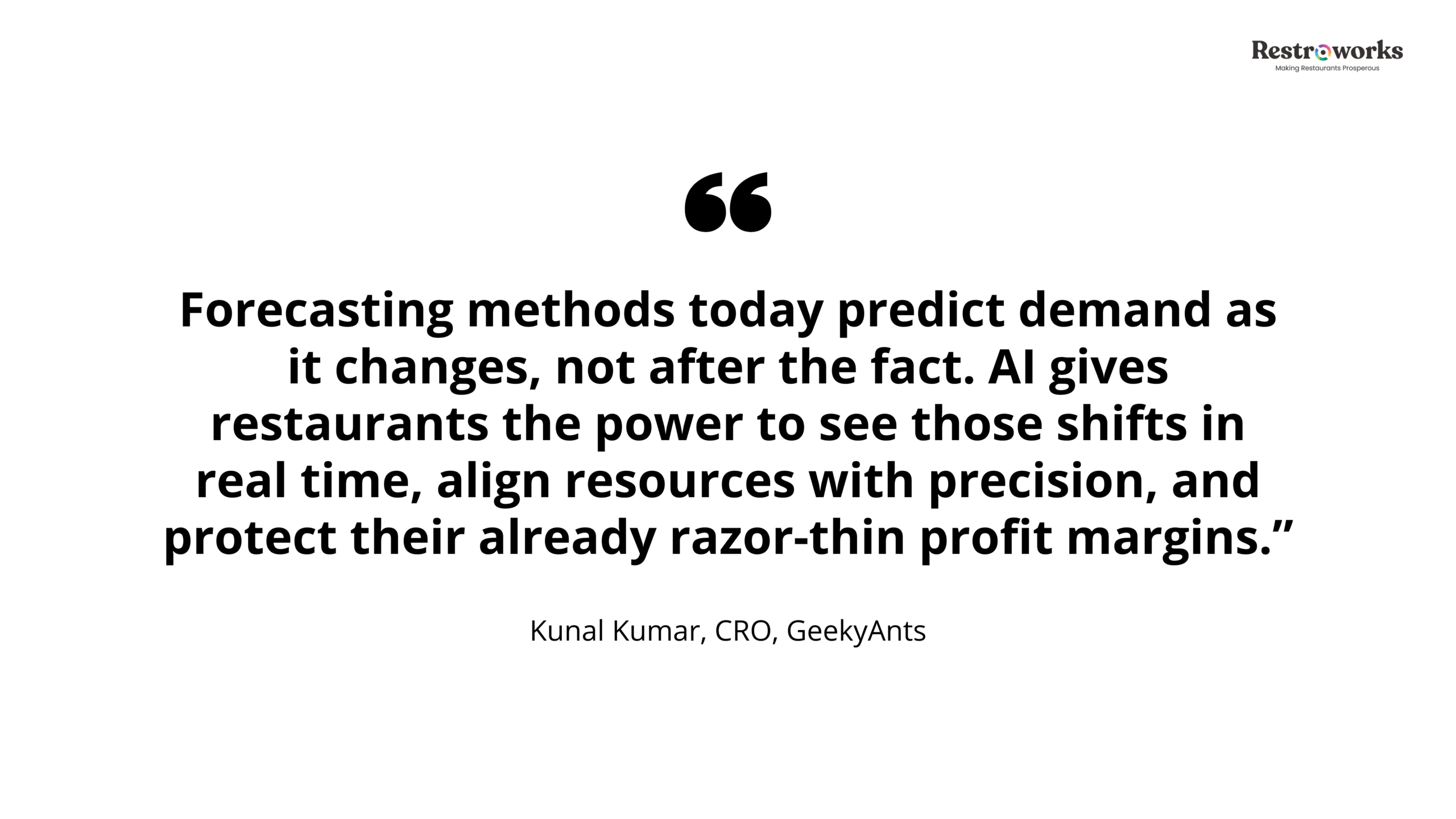
Data has it that U.S. restaurants waste approximately $162 billion in food waste-related costs every year, primarily due to flawed forecasting methods. At the system level, for example, 29% of all food produced in the U.S. goes unsold or uneaten, amounting to over $384 billion in surplus.
You know what the core issue is? Demand, no matter how much you’d like it to be, is never stable, be it due to hyperlocal weather, market trends, local events, promotions, or even a micro-level change in your menu.
That’s where AI-powered demand forecasting for restaurant chains helps.
Modern systems, these days, are capable of reconciling multiple real-time data streams (like those from POS, inventory, customer feedback, etc.) simultaneously, so you can predict volume, which is more “current.” These systems learn patterns, detect anomalies, and dynamically adjust forecasts at the SKU, store, and daypart level.
The impact? AI demand forecasting can reduce food waste by 30-40% by accurately predicting customer orders and aligning resources accordingly. In fact, AI-driven forecasting can predict customer orders with 85–95% accuracy by analyzing real-time signals such as weather, local events, and promotions. Whichever restaurants plan to implement AI forecasting can achieve a 30-40% reduction in food waste within the first year by continuously refining their models based on new data. At the unit level, too, machine learning models help align production with actual consumption.
More importantly, AI reframes forecasting from merely what happened to what will happen next and what you should do about it.
Across the restaurant industry, many operators are already heavily using predictive analytics and AI-powered forecasting to generate precise forecasts and predict future sales before they impact restaurant operations. The ability to forecast demand more accurately gives brands a competitive advantage in the equally competitive market. How can you do the same? Let’s see!
What You’ll Learn
- Why predictive forecasting becomes exponentially harder at the chain level, and why most deployments fail even before rollout.
- How AI-powered forecasting operates at the SKU, store, and daypart level.
- The rollout sequence and the limitations of predictive forecasting.
Why Does AI Forecasting Become Exponentially Harder for Restaurant Chains?
When you’re running a brand from a single location, forecasting calls for you to connect the POS, ingest 12-18 months of historical data, and tune the model. For chains, though, the steps become more technical, organizational, legal, and somehow, political even.
For example, they have to deal with:
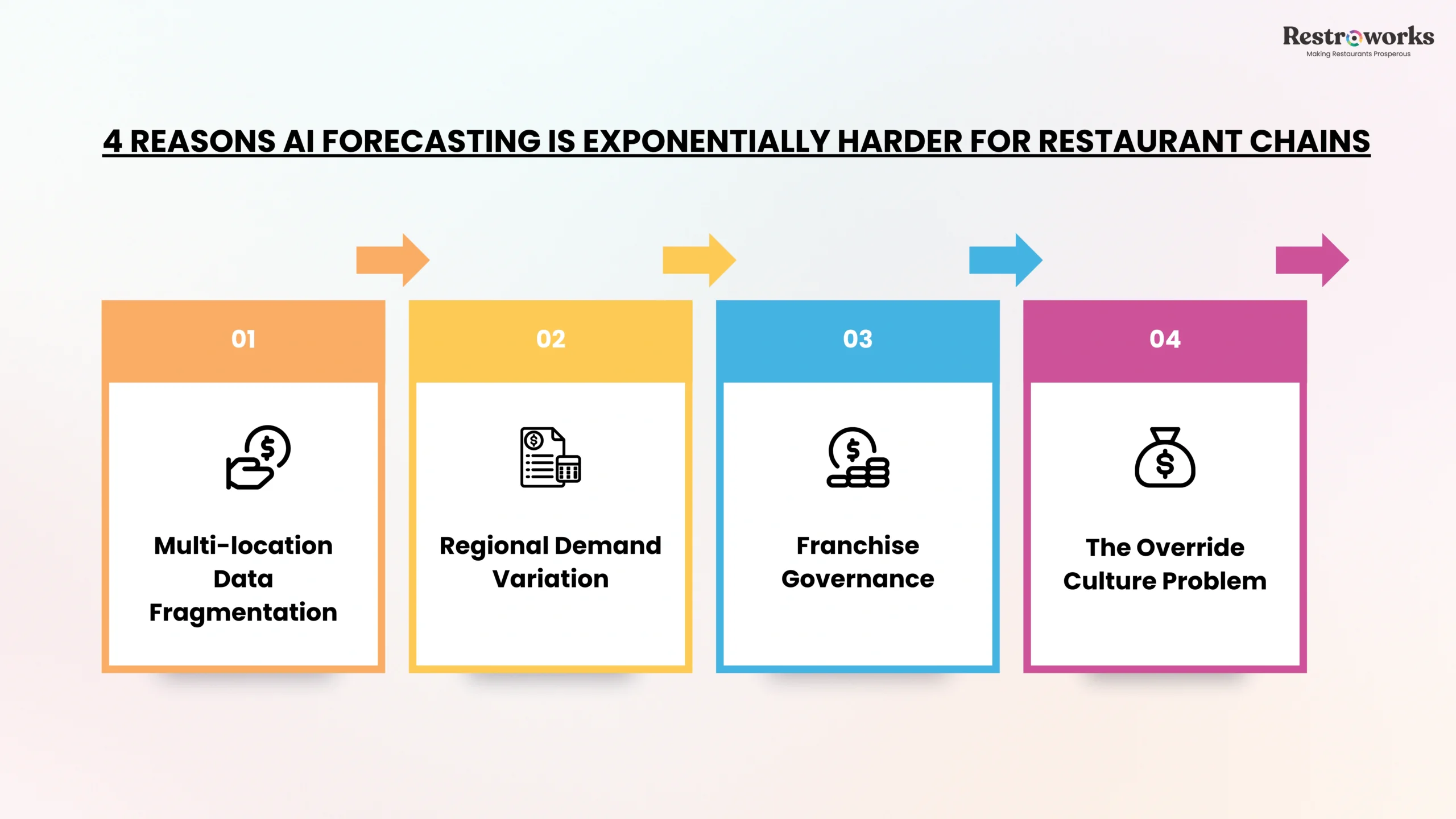
1. Multi-location Data Fragmentation
Like, if you run 80 locations across five states, there is a chance that each outlet uses a different management software – each with individual item-code schemas, timestamp granularity, and inventory and tracking behaviors. Which means before you employ any AI model, all of the data needs to be standardized, and that process alone takes 2-4 months at least.
Without standardized data structures, AI systems often struggle to deliver accurate predictions. Many restaurant operators underestimate how much manual data entry and disconnected ERP systems can affect forecast quality and system integration efforts.
2. Regional Demand Variation
Believe me or not – A brand-wide forecast is worse than no forecast at all.
Why do I say it? AI creates unique forecasts for every location rather than applying a blanket, brand-wide projection. This is because a location [let’s say one that’s in downtown Chicago] behaves completely differently from another [again, let’s say, one in a suburban area] location with the same menu, same promotions, and same brand guidelines.
The AI has to know the difference, and it does this by learning location-level patterns independently while sharing learnings across the network (called cross-location model learning).
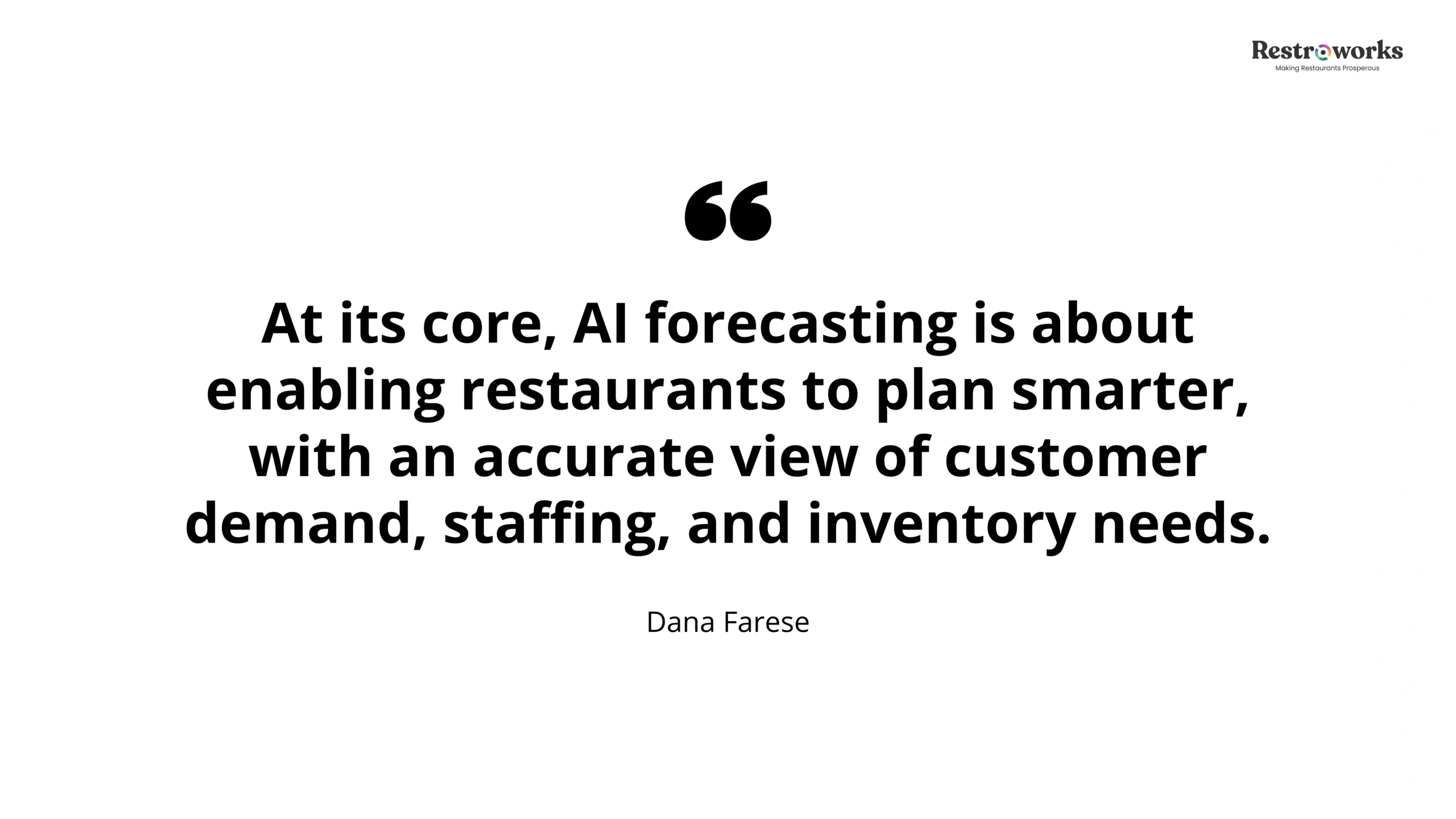
This is precisely why AI forecasting tools provide location-specific intelligence, allowing multi-unit operators to tailor their inventory and staffing strategies based on unique patterns at each site. Needless to mention, AI-powered forecasting enables multi-location restaurant operators to transition from reactive management to proactive operational excellence, significantly improving decision-making processes across all outlets.
3. Franchise Governance
Corporate-owned chains can mandate technology adoption. Franchise chains cannot, or at least can’t easily.
So, what happens is franchisees have to bear the cost, and if they feel the platform is being imposed without clear ROI, they will naturally resist.
That resistance, in turn, breaks the data pipeline that the chain-wide model depends on, degrading forecast accuracy for everyone.
4. The Override Culture Problem
When experienced managers routinely override AI scheduling recommendations based on intuition, two things happen: the operational benefits of AI disappear, and the training data gets corrupted.
The model sees that its predictions were “wrong” (because humans deviated from them), and adjusts accordingly in the wrong direction.
How AI Forecasting Works at the Chain Level?
INDUSTRY INSIGHT
Okay, so traditional forecasting methods rely on what amounts to a sophisticated average. Like, it looks at historical averages for the day/week/season, applies a growth factor, and adjusts for known local events. In a way, traditional forecasting is backward-looking and static.
AI demand forecasting, on the other hand, is forward-looking and adaptive.
Here’s the complete process of how it works:
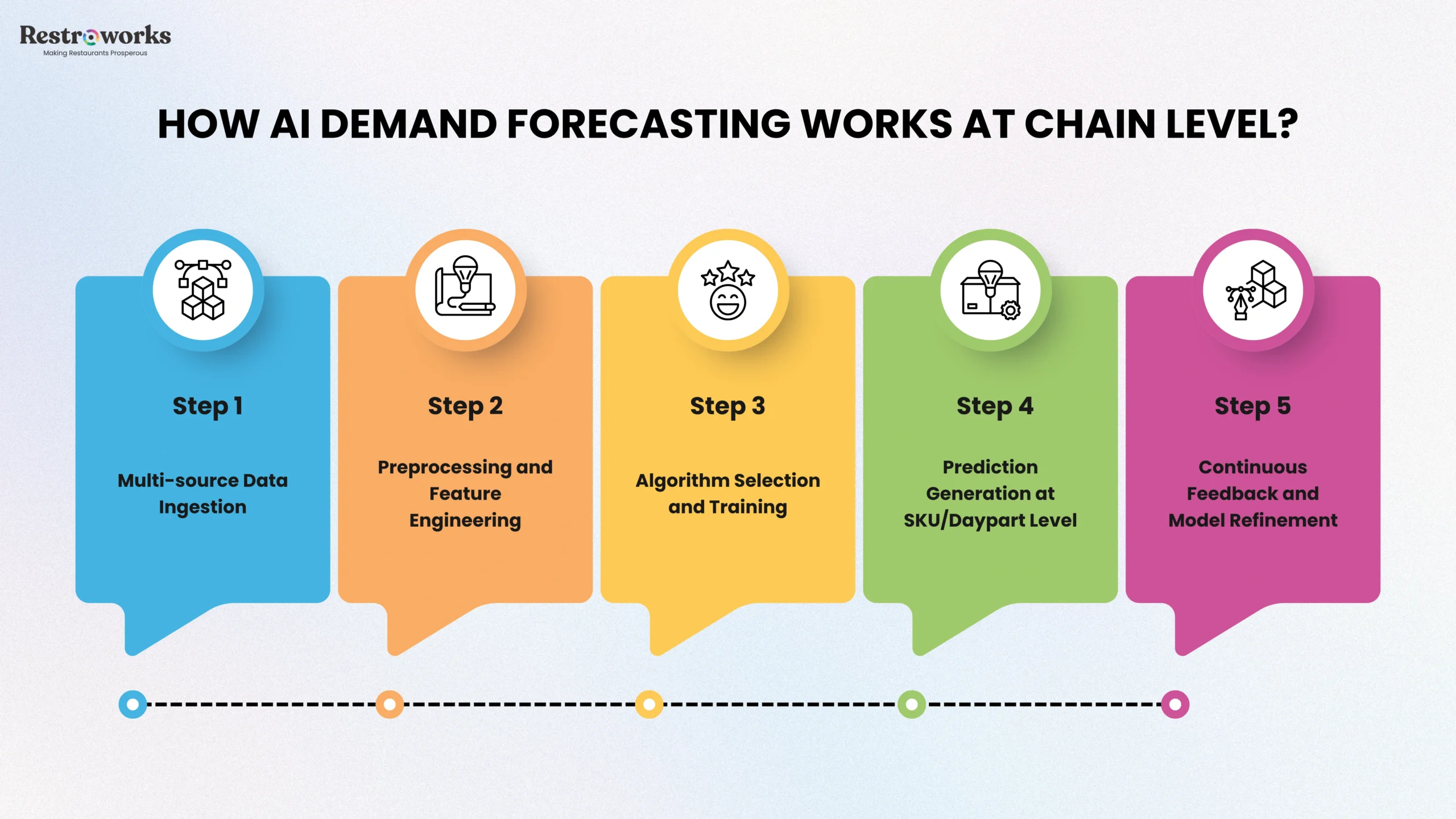
Step 1: Multi-source Data Ingestion
First and foremost, the model is fed tons of data simultaneously. This data comes from POS transactions at the item level, inventory management and food waste logs, labor scheduling records, weather forecasts and historical averages, local event calendars (concerts, sporting events, conventions, school calendars), supply chain status, and promotional calendars.
The richness of this input (especially item-level POS data vs. just daily totals) directly determines how granular the predictive output will eventually be.
Modern AI-driven demand forecasting platforms also incorporate customer behavior, customer preferences, and broader consumer demand signals to improve the accuracy of future demand, sales trends, and inventory strategies. This allows brands to react faster as unpredictable demand knocks in.
Step 2: Preprocessing and Feature Engineering
Next, all of the raw data is cleaned, standardized across location schemas, and transformed into “features” that the model can actually learn from. This includes anomaly detection (flagging a data spike from a one-time event so it doesn’t corrupt the baseline), temporal trend analysis (to identify day-of-week effects, seasonal trends, and predict demand shifts), and integrating weather patterns into a structured process.
Step 3: Algorithm Selection and Training
Most enterprise platforms use ensembles, i.e., combinations of time series models (that are inherently good at seasonal events), regression models (good at capturing relationships between variables like temperature and menu mix), and neural networks (good at identifying complex, non-linear correlations that simpler models miss).
Machine learning algorithms learn from historical data and, thus, get sharper with every new data cycle.
Most AI tools use a multi-stage process to generate predictions with 2–5% accuracy, while AI models learn from mistakes and adjust in real-time for improved accuracy.
Step 4: Prediction Generation at SKU/Daypart Level
The output of all the forecasting your model did will be somewhat like “you’ll need 47 portions of the spicy chicken sandwich between 12:00–1:30 PM, 22 between 1:30–3:00 PM, and 63 during dinner service.”
That kind of granularity is exactly what will help you with accurately managing inventory and demand-based staff scheduling.
AI demand forecasting helps restaurants optimize staff scheduling by accurately predicting the number of staff needed for each shift based on expected customer patterns.
Plus, by ensuring ingredients are always in stock, customers can count on ordering their favorite items, reducing dissatisfaction from shortages.
Many AI-driven enterprise platforms also support real-time inventory tracking, enabling managers to make adjustments before excess inventory accumulates. Maintaining optimal inventory levels becomes significantly easier when purchasing decisions are aligned with AI-powered predictive analytics.
Step 5: Continuous Feedback and Model Refinement
Now that the model predicted that you’ll need 22 portions of chicken sandwich between 1:30 and 3 PM, did the real demand sync with that?
At this step, the system compares predictions to meet demand, measures error, and adjusts its parameters.
This self-correcting loop is why accuracy improves over time and why the first 60–90 days of a deployment typically see lower accuracy than month six. After all, AI relies on feedback volume; the more data, the sharper the forecasts.
Why Do Most AI-Driven Forecasting Deployments Fail Even Before Rollouts?
The single biggest reason we believe machine forecasting deployments kind of underperform in the first year is that restaurants begin with “talking to” different vendors before auditing their data.
What happens is they sign a contract, get through implementation, and then spend three months debugging why their forecasts are 20% off, only to discover that half their locations have inconsistent item codes, two locations didn’t log inventory waste, and one POS migration somehow erased 8 months of transaction history.
Most platforms require at least 12–18 months of item-level POS transaction history before their models can produce reliable results. That’s why chains that have recently migrated their POS systems may need a 2–3 month data remediation phase before the forecast can go live at all.
Do This Before You Invest in any AI-powered Demand Forecasting Software Run a data readiness audit across all locations.
Remember – Bad data in means bad forecasts out. Basically, “garbage in, garbage out.” So, fix your data first. |
The next most important thing you should focus on is whether your POS is compatible with your forecasting platform.
Because, if not, selecting a platform that requires custom API integration with your systems (wrong selection, in a way) can add $10,000–$50,000 in integration consulting costs and 2–3 months to your timeline. I bet you won’t want that.
In fact, most restaurants in the U.S. spend between $25,000 to $50,000 in the first year for setup, integration, and staff onboarding of forecasting systems.
How does Poor Forecasting Create Labor Compliance Risks?
One thing almost no restaurant tech vendor includes in its ROI discussion is the cost of Fair Workweek compliance fines.
That said, if your chain operates in New York City, Chicago, San Francisco, Philadelphia, Berkeley, Emeryville, or Oregon, you’re subject to regulations requiring advance schedule notice (typically 7-14 days) with significant penalties for violations.
In fact, as per the record, NYC Fair Workweek violations can reach $500 per employee per violation. Berkeley and Emeryville penalties, on the other hand, go up to $1,000 per employee plus $500 per provision violated.
For a chain with 40 employees per location across five NYC locations, a single scheduling incident can cost tens of thousands of dollars.
For example, look at this case:
What are the Benefits of AI in Customer Experience & Gaining Competitive Edge in the Restaurant Industry?
The best thing is that AI can analyze customer behavior to offer menu recommendations and targeted promotions, helping brands personalize engagement at scale.
AI forecasting enables restaurants to respond quickly to market trends and changes, enhancing customer experience by ensuring that customer needs are met in a timely manner. By accurately predicting customer traffic, an AI forecasting system works to help restaurants maintain optimal inventory levels, ensuring that popular menu items are always available, which directly improves customer satisfaction.
Plus, AI forecasting tools can analyze historical sales data and external factors to provide insights that help restaurants optimize their operations, leading to a more efficient service and a better overall customer experience.
What Can AI Forecasting Not Fix & Why Does AI Technology Need Continuous Improvement?
Overselling AI forecasting is one sure-shot way to set up an implementation to fail internally and then spend 18 months explaining why you spent the budget on something that “didn’t work.”
Consider this – AI technology relies on clean, well-structured historical data. No algorithm will ever compensate for inconsistent item-level POS records or incomplete waste logs.
AI forecasting also demands sustained organizational discipline. When managers routinely override the system’s scheduling recommendations, they corrupt the feedback loop. When franchisees don’t consistently report data, they basically compromise chain-wide model accuracy.
Implementation timelines are underestimated as well. Data standardization across hundreds of locations with different POS systems, varying internet reliability, and inconsistent reporting protocols can take 6–18 months before AI models can produce reliable results. Chains’ post-POS migration may even face an additional 2–3 month data remediation phase. You should be factoring all this into your timeline anyhow.
And finally, ROI claims from AI forecasting vendors are typically based on 1–2 flagship implementations at chains with exceptional data infrastructure.
Independent analysis of average chain performance shows typical 15-20% improvements rather than the 30–40% often cited in vendor materials. The 30–40% figures are indeed achievable, but they align more with mature implementations that have at least 18+ months of model training and high organizational adoption.
Remember this thing very well –
Yes, AI-driven predictive analytics offer a number of tangible benefits, including (but, of course, not limited to):
- Accurate sales forecasts
- Cost savings and cash flow
- Improved inventory
- Higher customer satisfaction and repeat business
- Real-time insights into customer behavior
- A stronger positioning in the restaurant industry
- Smoother restaurant operations, and
- The ability to make better data-driven decisions
…all while keeping implementation costs under control.
But, again, AI-powered forecasting for restaurants is not a plug-and-play technology purchase. It’s an organizational capability that requires clean data, POS compatibility, executive sponsorship, franchise governance alignment, and a realistic 12–18 month timeline to reach full accuracy.
For chains that sequence it correctly [data audit first, pilot second, enterprise rollout third], the documented results are truly amazing.