


Food safety and quality management in chain restaurants through software solutions is not just a matter of technological adoption. It is risk management, and the risks associated with a mistake are categorically different from those faced by independent restaurants.
According to the Centers for Disease Control and Prevention, foodborne illnesses cost the US economy $15.6 billion per year. More than nine out of ten restaurant owners identify food, labor, and insurance expenses as significant sources of stress influencing their profitability in 2026, the National Restaurant Association finds. Against such odds, food safety regulations cannot be divorced from profitability concerns. They are intrinsically linked. One avoidable error can result in FDA investigations throughout the chain, legal expenses amounting to over $2.6 million, and prolonged revenue recovery efforts.
What You Will Learn:
- How to manage food safety
- Quality across restaurant chains using restaurant chain management software.
Food Safety Practices: Why Chain Scale Changes Everything
For one place, you can manage food safety compliance with pen-and-paper documentation, manual inspections, and a competent crew the owner trusts personally. There is definitely something wrong with such an approach, but the feedback loop is small enough to work. For twenty, fifty, or two hundred places, it just stops working. You will not know if the temperature logs for each place were filled out properly at six AM. You will not be able to make sure that the refrigeration system did not overheat at two AM in some other state. That is the problem that food safety management software addresses.
Mitchell Lowe, founder of IXI Capital and a longtime restaurant operator and advisor, described the anxiety this creates without digital oversight: “The number one issue that kept me up at night was a foodborne illness outbreak at one of our restaurants, despite our relentless focus on safety and sanitation protocols.” The Global Food Safety Management Software market is growing at a CAGR of 9.80% through 2030, driven by exactly this need.
Food Safety and Compliance: The Regulatory Framework Chains Must Navigate
Before assessing any software system, restaurant chains should first identify what their compliance obligations entail. This is because compliance requirements differ based on location, concept, and ingredients, which is something that individual restaurant guidance does not always cover.
It is mandatory for restaurants operating in virtually all US states to have a HACCP-based plan for quality control. Compliance with the HACCP requirement entails hazard analysis, critical control point identification, critical limits, monitoring measures, and record-keeping in cases where corrective action needs to be taken.
The Food Safety Modernization Act, by the FDA, calls for documented preventive controls, supplier verification, and lot-level traceability data. The FSMA 204 Food Traceability Rule, which applies to leafy greens, tomatoes, and fresh herbs frequently included on most restaurants’ menus, will require compliance by July 20, 2028, following a 30-month extension granted by the FDA in March 2025. Restaurants covered under the rule will need to provide traceability records within 24 hours of an FDA request, which cannot be achieved with paper systems across different locations.
There are differences in regulatory requirements across jurisdictions. Software that provides location-based compliance modules within a uniform framework meets this requirement; imposing the same configuration across all locations does not allow compliance in places where regulatory requirements differ.
Food Safety Management System: Core Software Capabilities
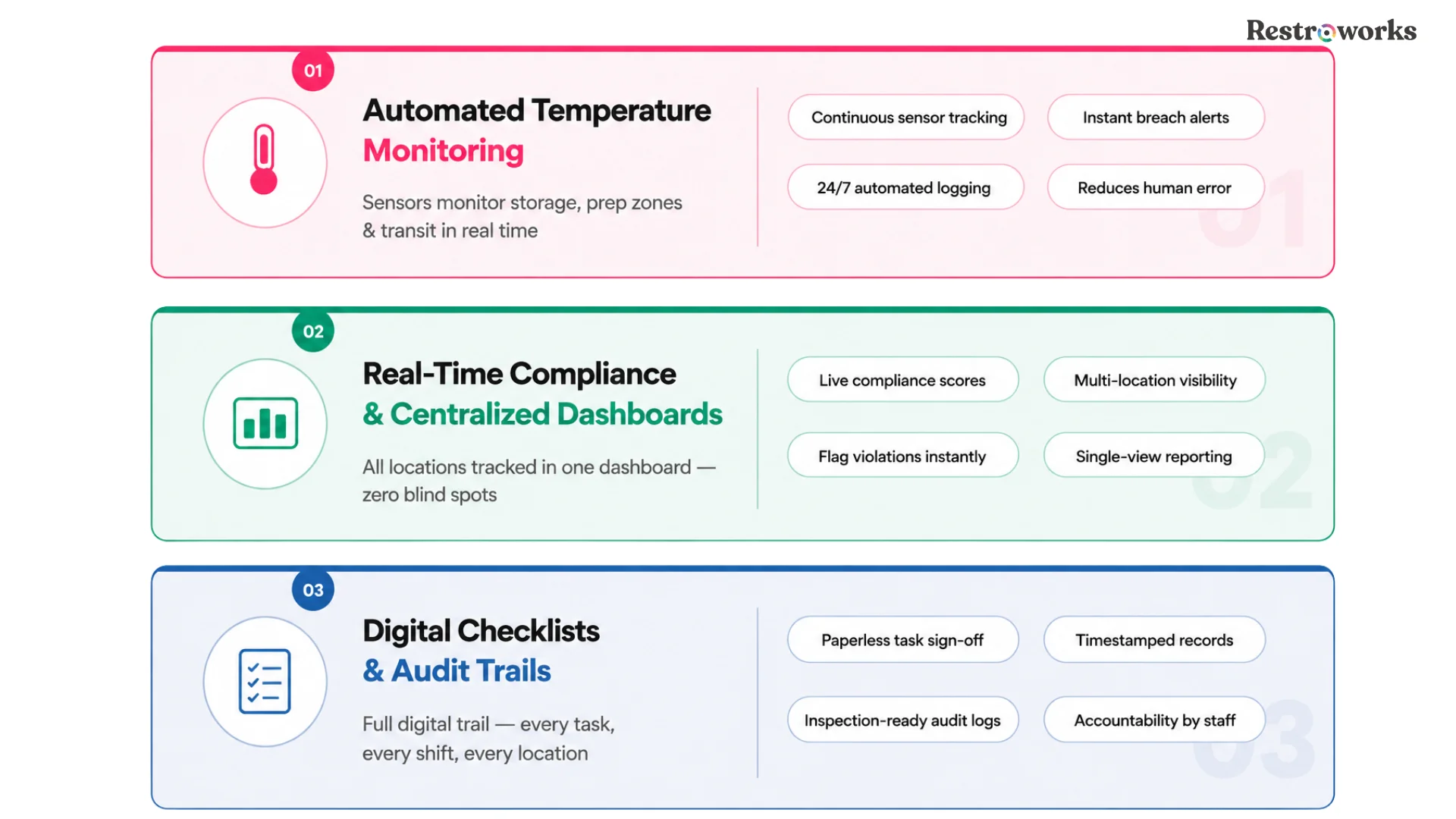
Most operators thinking about food safety software default to thinking about digital checklists and temperature logs. Those are table-stakes features. The real value of a food safety management system at the chain scale lies in capabilities that paper and basic apps cannot replicate.
Automated Temperature Monitoring
Manual temperature checks happen every two to four hours. During that interval, a refrigeration unit that drifts above the safe range can spoil products, which must be discarded.
INDUSTRY INSIGHT
Automated temperature monitoring using IoT-based wireless sensors eliminates those monitoring gaps entirely. Systems like SmartSense continuously track refrigerator and freezer temperatures, sending real-time alerts to mobile devices if food enters the danger zone. Bluetooth-enabled thermometers sync with software to record temperatures instantly, eliminating the compliance risks of inaccuracies and omissions associated with manual logging.
For multi-location operators, the ROI is documented. Automated temperature monitoring delivers three-to-one to eight-to-one annual return on investment, with 85 to 95% reduction in violation costs within the first year and a payback period of five to sixteen weeks across two-to-ten-location groups.
Before selecting a platform, check whether temperature monitoring uses open sensor hardware or proprietary equipment. Some platforms lock operators into their own sensor hardware, which can add $200 to $500 per location in hardware costs and creates dependency on a single vendor’s hardware roadmap.
Real-Time Compliance Monitoring and Centralized Dashboards
A centralized platform that monitors and streamlines compliance status across all restaurant locations from a single dashboard is what makes chain-scale management operationally feasible. Corporate or regional managers can see which locations are current on health inspections, which have outstanding corrective actions, and which have compliance gaps requiring attention, without contacting individual location managers or waiting for weekly reports.
Real-time compliance monitoring enables immediate response to deviations at any location. If a critical control point log is not completed by the scheduled time, the system automatically escalates the alert. When a corrective action is logged in response to a temperature deviation, the record is timestamped and audit-ready without any additional data entry.
Digital food safety records, retrievable in under 30 seconds, replace paper systems that can require hours of manual searching during health inspections. That document retrieval speed matters during unannounced inspections and, significantly, during FDA investigations where the 24-hour records food production requirement under FSMA 204 applies.
Digital Checklists and Audit Trails
Digital checklists replace paper logs with tablet-based or mobile-accessible forms for cleaning schedules, sanitization procedures, equipment maintenance, food prep area checks, and food handling protocols. When staff completes these checklists digitally, every entry is timestamped, linked to a specific location and user, and automatically stored in the audit trail.
The audit trail function is not optional from a legal protection standpoint. Without documented corrective actions, FDA inspectors and plaintiff attorneys treat the absence of records as evidence of negligence. A complete, timestamped digital record of every food safety procedure completed, every deviation logged, and every corrective action taken creates the documented compliance history that protects the chain in the event of an investigation or litigation.
Photo verification for critical control points adds a further layer of documentation that paper cannot provide. Staff photograph the food prep area, the temperature reading, or the sanitation completed, and the image is automatically attached to the compliance record.
Friendly’s implemented this model across its 266 Mid-Atlantic and Northeastern US locations, replacing a third-party auditing system that relied on Excel spreadsheets with RizePoint’s digital platform. The result was the ability to gather meaningful data faster and distribute it to the right people immediately, enabling a shift from reactive problem-solving to proactive prevention.
IHOP franchisee Landmark Restaurant Group cut audit processing time by 60 to 70%. Regional managers who previously spent two to three hours conducting audits plus one to two hours on manual data entry found that the digital system captured data automatically as the audit was completed. Their observation: “All the audit forms are included in RizePoint, and the operator can complete the audit paper-free. Once the audit is complete, the data is already captured, meaning no manual data entry! Our managers were thrilled.”
Restaurant Food Safety & Food Quality Management: Supplier Management and Supply Chain Traceability
Chipotle’s 2015 outbreak illustrated, in the most expensive possible way, what happens when supply chain visibility fails at a chain-wide scale. Investigators determined that the outbreak was caused not by a single failure but by systemic weaknesses, including reliance on a large, geographically diverse supplier network with inadequate traceability for raw ingredients like lettuce, tomatoes, and cilantro served without a kill step.
Modern food safety software addresses this through integrated supplier management and supply chain traceability capabilities. A centralized supplier document management system tracks certifications, audit results, expiration dates, and compliance status across the entire supplier network. When a supplier certification expires or a supplier fails an audit, the system flags the issue automatically rather than waiting for a manual review cycle.
Automated supplier management systems track performance, flag risks early, and ensure all supplier documents are up to date, reducing the administrative burden on food safety teams that would otherwise manage this manually across complex supplier networks. Integration with the entire supply chain, from raw materials intake through food preparation and service, creates the lot-level traceability that FSMA 204 requires and that effective recall management depends on.
Compliance Management: Franchise vs. Corporate Locations
Restaurant chains with franchise operations face compliance management challenges that fully corporate chains do not. Franchise locations legally operate as independent businesses, which means corporate headquarters cannot mandate software purchases or access franchisee data without specific contractual provisions. Franchise agreements that do not explicitly address loyalty to a food safety management system, data-sharing requirements, and software procurement authority create gaps in chain-wide visibility into compliance.
The practical consequence is that many chains discover after a food safety incident that their franchise locations were using different compliance procedures, different documentation formats, or no digital system at all, because the franchise agreement did not require uniformity. By that point, the liability exposure is already established.
Food safety software designed for franchise operations allows configurable autonomy boundaries where the corporate sets required protocols and minimum industry standards, while individual locations retain operational flexibility. Location-specific compliance modules handle regulatory differences between markets without requiring franchisees to use identical configurations.
Management Software: Choosing the Right Platform for Your Chain Size
The food safety software market comprises three distinct platform categories, and choosing the wrong one is a common and costly mistake.
Operations execution platforms such as Zenput, CrunchTime, Operandio, and Restroworks focus on standardizing daily operations and managing compliance tasks across locations. They are strongest for checklist management, task verification, and real-time compliance monitoring, and they are the right fit for chains whose primary need is consistent procedure execution.
Food safety compliance platforms such as FoodDocs, FoodReady, and SmartFoodSafe focus specifically on HACCP compliance, digital food safety documentation, and audit readiness. Morgan Baker, Food Safety and Quality Manager at Tippin’s Gourmet Pies, chose SmartFoodSafe over competing systems because “the platform is built with an auditor mindset and incorporates functions that would usually require additional programs and/or systems.” These platforms are the right fit when the primary need is regulatory compliance documentation and audit preparation.
Supply chain traceability platforms such as FoodLogiQ and TraceGains focus on supplier compliance, lot-level traceability, and the documentation requirements of FSMA 204. These are the platforms that address the supply chain visibility gap exposed by Chipotle’s outbreak.
Enterprise-level chains typically need capabilities from all three categories. Josh Svenhard, CEO of Eurobake, described the integrated approach: “You cannot build a holistic food safety program without capturing every piece of data that’s important to every aspect of business, from accounting to logistics, to warehousing.”
Real-Time Alerts and Daily Restaurant Operations
The aspect that always alters the day-to-day operations in restaurants with multiple locations is real-time alerts. An automatic alert is sent to the right person if there is a temperature deviation in the early morning hours, if there is an incomplete checklist, or if a supplier’s document expires. This aspect helps reduce food waste, improve compliance, and minimize labor inefficiencies.
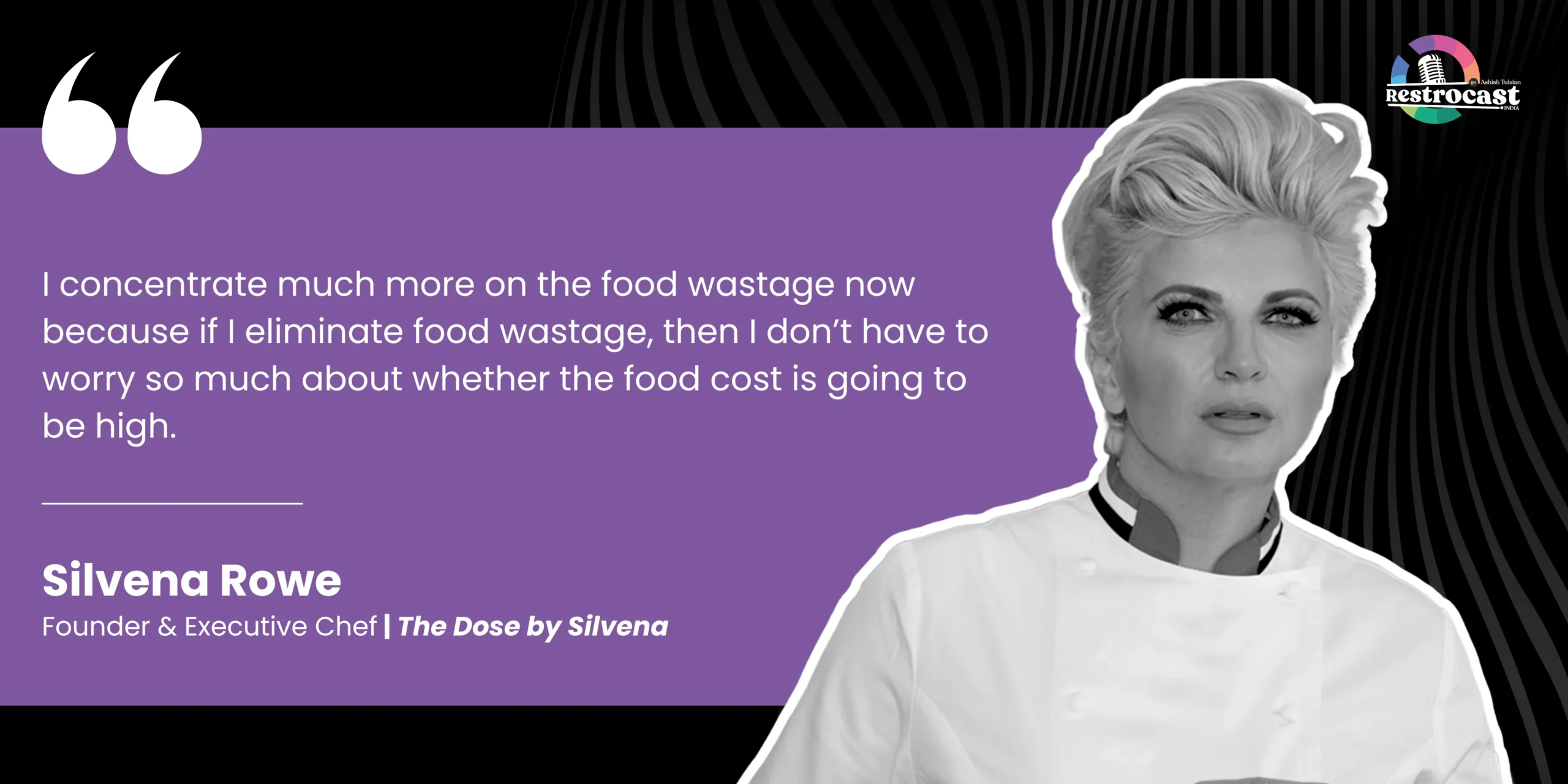
Silvena Rowe, Founder & Executive Chef at The Dose by Silvena, appeared on the Restrocast podcast and discussed how managing food waste benefits her and her brand.
An employee receiving automated alerts in the food safety app installed on their phone will help in resolving issues on the spot without having to wait for the next scheduled review.
Quality Management: Health Inspections and Audit Readiness
Unexpected health inspections are part of each day’s operations at chain restaurants. The distinction between a site that always passes and one that always gets violations may depend on preparation for an audit, whether the paperwork is done, up to date, and available when the inspector arrives.
With digital food safety records, all documents can be retrieved in less than 30 seconds. Fully completed checklists, corrective action plans, temperature charts, and vendor compliance documentation can be accessed using keywords such as dates, locations, and categories. During a health inspection, the food safety manager will be able to produce any document instantly, without going through piles of papers in binders.
Food Manufacturers and Digital Transformation ROI
The financial case for food safety software is clearest when measured across the full cost picture.
Food and beverage companies implementing digital transformation achieved a 5.6% increase in both revenue and profit within 12 months. Ajinomoto achieved a 36% increase in productivity after digitizing its food safety standards and quality standards assurance processes.
For restaurant chains, the manual temperature monitoring cost alone makes the ROI case. Multi-unit operators with two to ten locations spend $45,000 to $120,000 annually on food safety compliance, with 60 to 70% attributable to manual temperature monitoring. Automated monitoring reduces that cost by 85 to 95% in the first year, with a five- to sixteen-week payback period. AI is increasingly central to this, projected to grow the food and beverage AI market to more than $56 billion by 2029 at nearly 43% annually.
Supply Chain: Implementation Roadmap for Multi-Location Chains
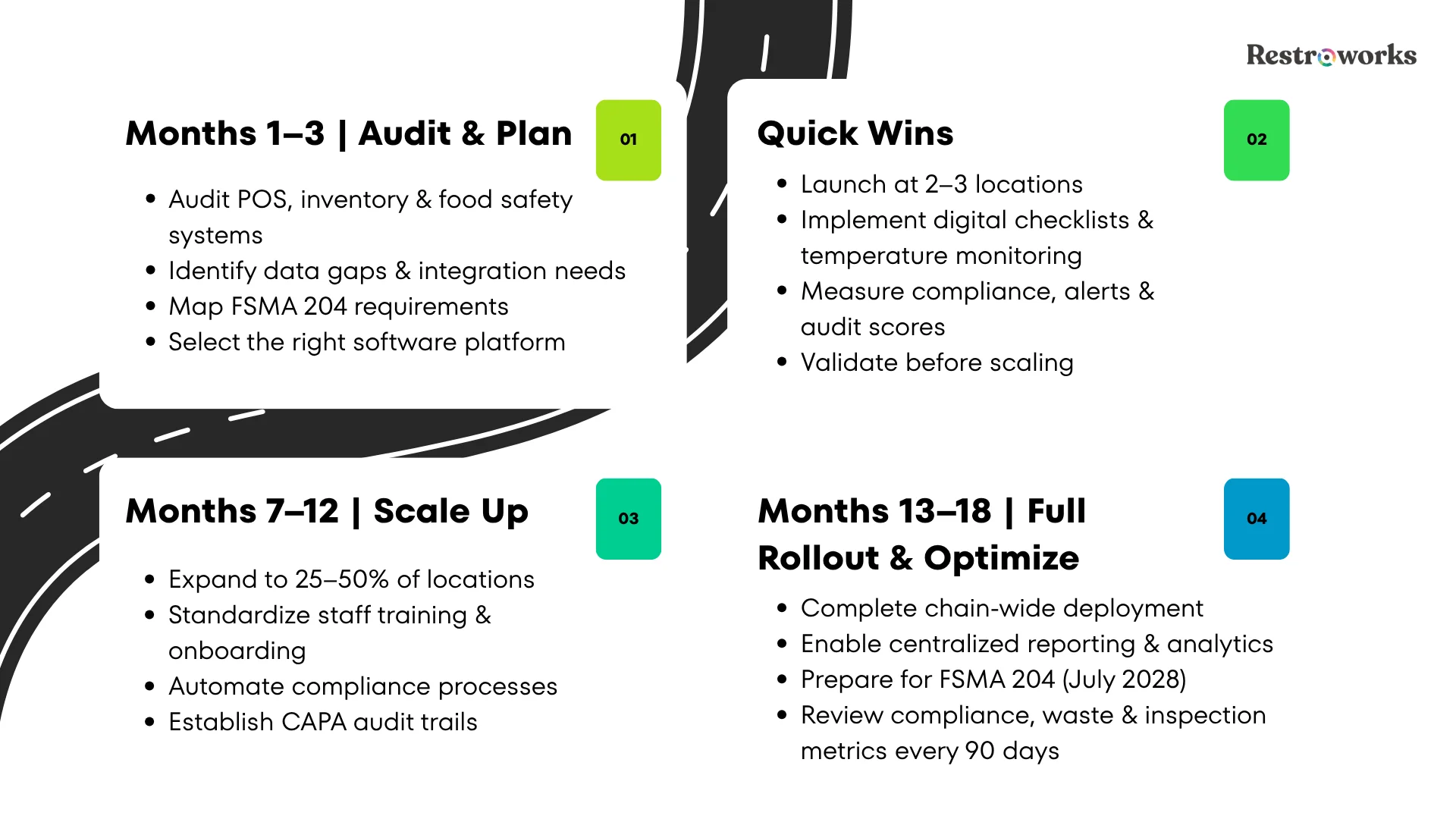
Getting food safety software deployed consistently across multiple locations requires a sequenced approach. Here is a straightforward 18-month framework.
- Months 1 to 3: Audit and foundation. Audit your current POS, inventory management, and any existing food safety systems to identify integration capabilities and data gaps. Map your FSMA 204 obligations by reviewing your ingredient list against the FDA’s Food Traceability List. Review franchise agreements or corporate policies to confirm data access rights and software procurement authority at each location type. Select your platform category based on your primary compliance gap.
- Months 4 to 6: Pilot Deploy in two to three locations only, ideally those with engaged managers who will provide honest operational feedback. Implement automated temperature monitoring, digital checklists, and centralized reporting for pilot sites. Track compliance completion rates, alert response times, and audit score changes. Do not proceed to chain-wide rollout until pilot data validates the operational model.
- Months 7 to 12: Phased expansion, roll out to 25 to 50% of locations using the training and onboarding process refined during the pilot. Build food safety compliance training into core staff onboarding to maintain compliance and quality standards rather than treating it as a separate module. Staff turnover in restaurant operations averages 75% annually, which means training infrastructure must be automated and repeatable to remain effective. Establish CAPA (Corrective and Preventive Action) audit trail requirements as a non-negotiable standard from day one of each location’s deployment.
- Months 13 to 18: Full deployment and optimization. Complete chain-wide deployment. Activate cross-location reporting and analytics to identify compliance patterns, underperforming locations, and systemic gaps. Begin preparing FSMA 204 documentation infrastructure for the July 2028 deadline. Set 90-day review cycles to assess compliance score trends, food waste metrics, and inspection outcomes across all locations.
The most efficient restaurant chains with regard to food safety view compliance as a process to be optimized rather than minimized, since it is a regulatory burden. The combination of an integrated food safety management process with automated temperature monitoring, a compliance checklist, real-time notifications, supplier compliance, and CAPA documentation not only helps pass inspections but also avoids the systemic problems that have caused $25 million in losses for Chipotle.