

Customer Satisfaction: The Connection Between Menu Analysis and Guest Experience
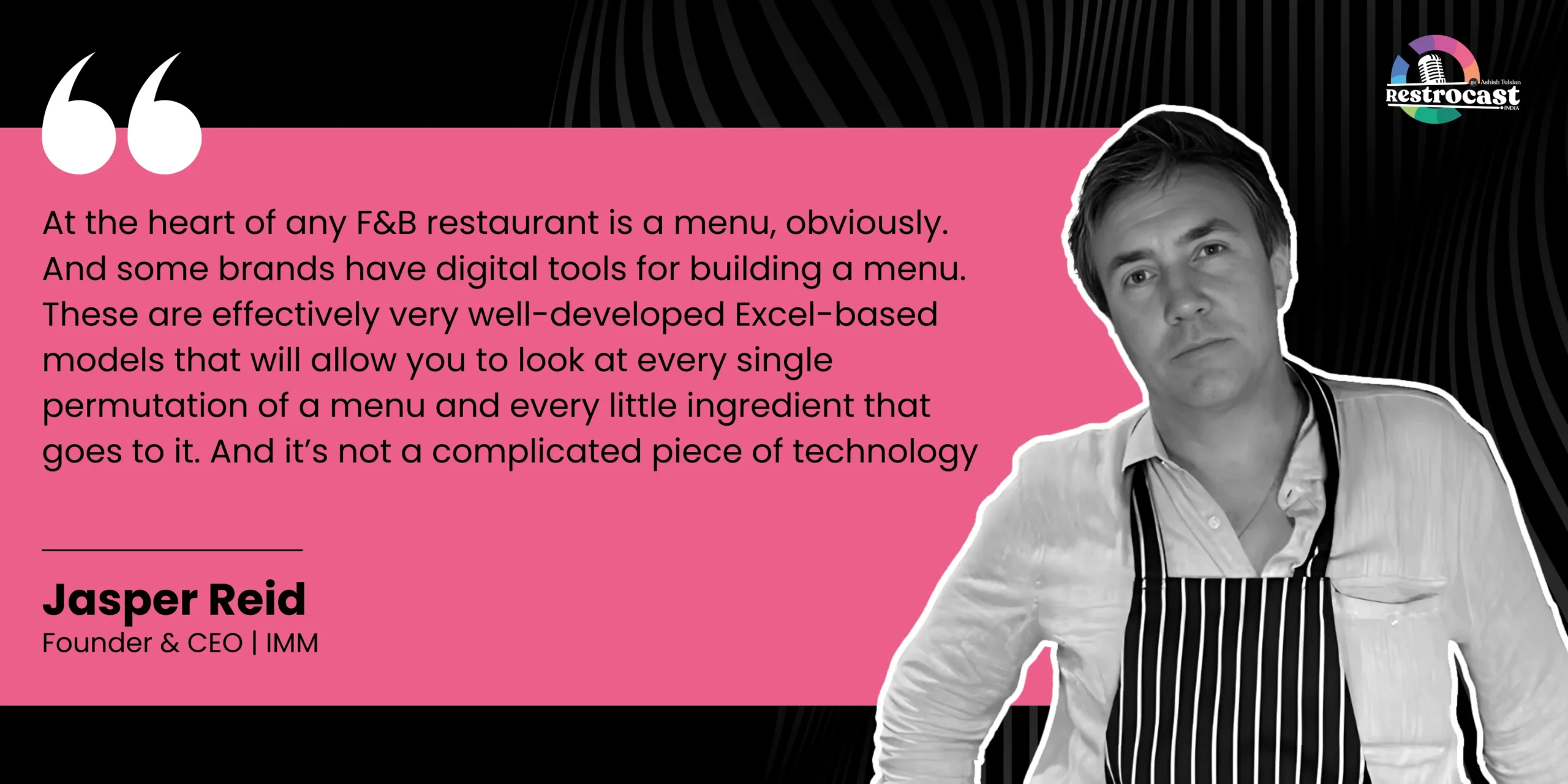
Jasper Reid on Restrocast discussed the importance of the menu and how new restaurant technologies help refine it. If more brands used such systems, they would see so much success.
A lengthy menu causes decision fatigue and complicates operations in the kitchen. Cutting off unpopular items in the menu cuts down costs in preparing food, lessens the number of ingredients that need to be managed, and ensures a consistent recipe, since every item retained in the menu becomes an additional variable that needs to be performed properly in each location. With menu engineering software, choices become more objective using sales data and not just culinary preference.
Ninety-four percent of restaurants see benefits from digital menu technologies, while 52% of restaurant owners value menu item data for 2026 technological planning.
Food Waste: What Underperforming Items Actually Cost
Menu items with both poor sales and low profit margins do much more harm than most people in operations comprehend. They consume ingredients that might never be used to capacity, making them susceptible to spoilage. Every item adds operational complexities for the kitchen staff. And every item must undergo training for the employees, even though they might not be served often. With several locations, restaurant concepts with ten such poorly performing menu items are handling inventory that offers no benefit to their bottom line.
Menu engineering software highlights these items and allows direct correlation between the two factors, allowing restaurant operators to save money by reducing waste from the offending menu items. Integrated inventory tools can link menu performance with stock levels, helping to reduce food waste for low-performing items by analyzing menu performance in a timely manner.
Categorize Menu Items: The Four-Category Framework
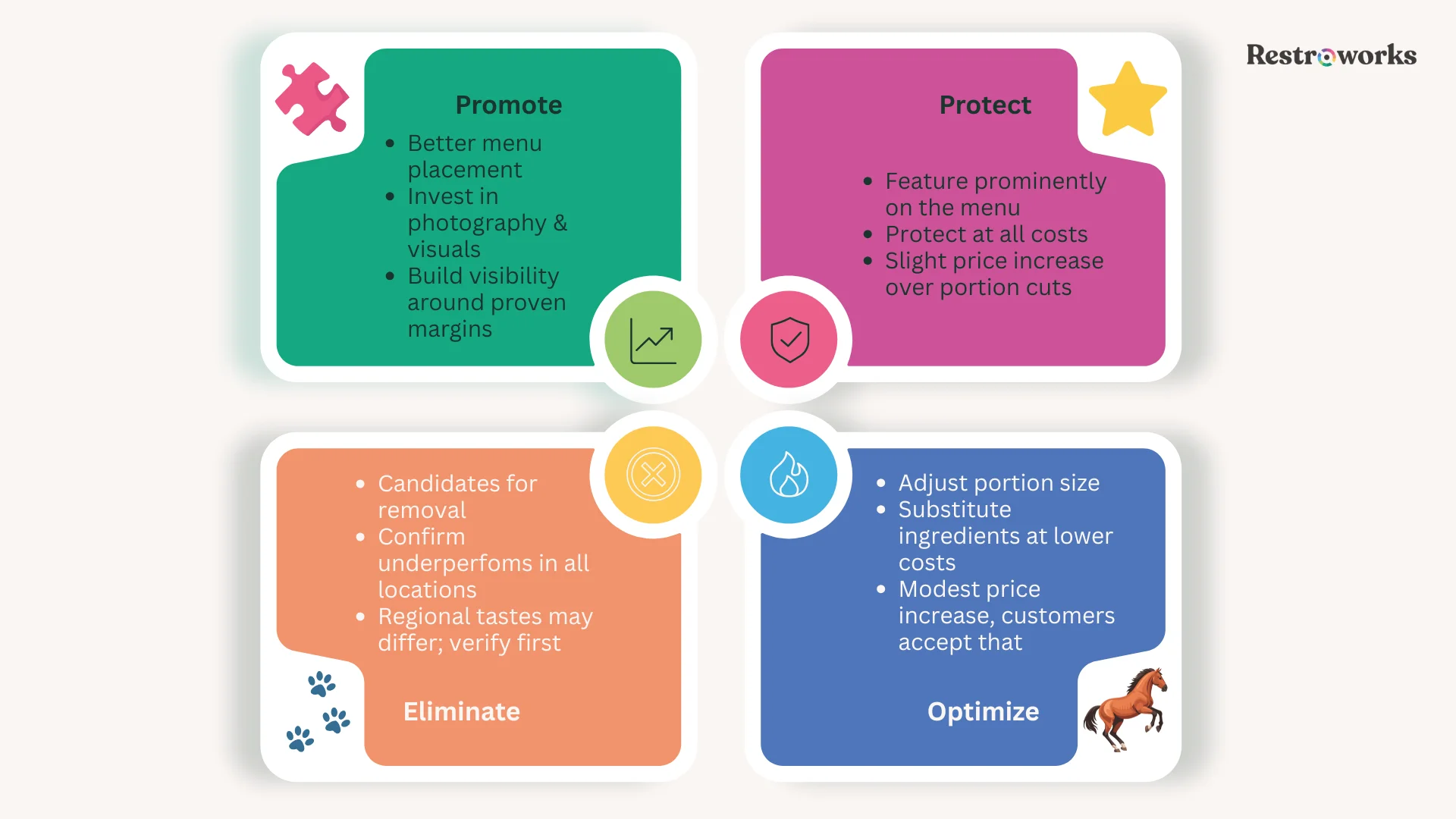
The menu engineering matrix classifies items into four quadrants based on popularity and contribution margin: Stars (high popularity, high contribution margin), Puzzles (high contribution margin, low popularity), Plowhorses (high popularity, low contribution margin), and Dogs (low popularity, low contribution margin). The foundation of the menu engineering process is this four-category matrix, which classifies every item based on two dimensions: profitability and popularity.
Stars: High Popularity, High Profitability
Stars are menu items that have high popularity and high contribution margin, making them ideal candidates for promotion and protection on the menu.
Stars are the menu items every restaurant wants more of. They sell frequently, generate strong contribution margins, and often become the dishes customers associate with the brand. These items are already doing the hard work of attracting repeat business while contributing significantly to profitability, which means the primary objective is not to change them, but to protect and maximize their performance.
For multi-unit operators, Stars should receive the highest level of operational consistency. Every location should prepare them using standardized recipes, portion sizes, and presentation guidelines so customers receive the same experience regardless of where they order. These items should also be featured prominently in both physical and digital menus, positioned in high-visibility areas, highlighted with appealing photography, and included in promotional campaigns.
When food costs increase, operators often make the mistake of reducing portion sizes on their best-selling items. Customers usually notice these changes immediately, damaging trust and repeat purchase behavior. A more effective strategy is to implement a modest price increase while maintaining product quality and consistency. Loyal customers are generally more willing to accept a small price adjustment than a decline in value.
For example, if a restaurant’s signature truffle burger consistently ranks among the top-selling and high-margin items across all locations, it should receive premium placement on delivery platforms, appear in combo meals, and be promoted through loyalty programs rather than being discounted heavily.
Plowhorses: High Popularity, Low Profitability
Plowhorses are popular items that generate low contribution margins; strategies to improve their profitability include adjusting portion sizes or prices.
Plowhorses are dependable sellers that attract a large number of customers but generate relatively little profit. These dishes often become customer favorites because they offer strong perceived value, but rising ingredient costs or inefficient recipes gradually reduce their contribution margins.
Unlike Dogs, Plowhorses should rarely be removed from the menu because they frequently drive traffic and customer satisfaction. Instead, operators should focus on improving profitability without negatively affecting the guest experience.
Several menu engineering strategies can achieve this. Portion sizes can be adjusted gradually if they exceed customer expectations. Expensive ingredients may be replaced with equally effective alternatives that preserve taste and quality and also lower food costs. Recipes can be standardized across locations to reduce waste, and suppliers can be renegotiated to improve purchasing costs. In many cases, a modest price increase is also feasible because these items already enjoy strong demand and customer loyalty.
Consider a popular chicken Alfredo pasta that sells hundreds of portions every week but generates only a small margin because of rising dairy prices. Rather than removing the dish, the operator might slightly reduce sauce volume, source a more cost-effective cheese blend, negotiate better supplier pricing, or increase the menu price by $1.50 while maintaining overall customer satisfaction.
The goal is to preserve popularity while gradually improving profitability.
Puzzles: Low Popularity, High Profitability
Puzzles are items that have high contribution margins but low popularity; they represent opportunities for improvement through repositioning or enhanced marketing.
Puzzles are among the most interesting items on a menu because they generate excellent profits whenever customers order them, yet very few customers actually do. The challenge is rarely the economics of the dish; instead, it is usually a visibility, positioning, or perception problem.
Restaurants should first determine why customers are overlooking these items. Poor menu placement, uninspiring descriptions, lack of photography, confusing naming conventions, or limited staff recommendations can all reduce sales despite strong profitability.
Improving visibility is often enough to transform a Puzzle into a Star. Restaurants can reposition these dishes near top-selling menu sections, use high-quality food photography for online ordering platforms, highlight chef recommendations, bundle them into meal deals, or train servers to actively recommend them during service. Digital ordering platforms also allow restaurants to feature these items as “Chef’s Picks,” “Most Recommended,” or “Limited-Time Favorites,” increasing customer attention.
For example, a premium grilled salmon bowl may deliver one of the highest contribution margins on the menu but account for very few orders because it appears near the bottom of a long online menu without an image. Simply moving it closer to the top, adding professional photography, and including it in personalized recommendations may substantially increase sales without changing the recipe.
Because these items are already highly profitable, even modest increases in sales volume can significantly improve overall restaurant profitability.
Dogs: Low Popularity, Low Profitability
Dogs are items that have low popularity and low contribution margins, and they are typically candidates for removal from the menu to streamline menu offerings.
Dogs are menu items that neither sell frequently nor generate meaningful profit. They occupy valuable menu space, increase kitchen complexity, require additional inventory, and often contribute to food waste because ingredients move slowly.
In many cases, these items are strong candidates for removal. Eliminating Dogs allows operators to simplify operations, reduce inventory carrying costs, improve kitchen efficiency, and focus staff attention on higher-performing menu items. A smaller, more focused menu often leads to faster service, better execution, and improved customer satisfaction.
However, removal decisions should always be supported by data rather than assumptions. Multi-unit restaurant operators, in particular, should analyze performance across every location before discontinuing an item. Customer preferences often vary significantly between markets. A slow-selling seafood dish in a Midwest location may perform exceptionally well in a coastal restaurant. Similarly, an item that appears to be a Dog chain-wide may actually serve as an important complementary purchase within a specific customer segment.
For example, a gourmet quinoa salad may record low sales and weak margins across most urban locations but consistently perform well in health-conscious suburban markets. Rather than eliminating it entirely, operators could retain it only where demand justifies its presence.
Menu engineering should therefore balance operational efficiency with regional customer preferences, ensuring that decisions strengthen both profitability and customer satisfaction across the entire restaurant portfolio.
Inventory Management Software: Connecting Menu Decisions to High or Low Popularity Purchases
Menu engineering does not exist in isolation from inventory management. When you decide to promote a Star item, the kitchen needs more of the ingredients that make it. When you eliminate a Dog, the purchasing team needs to stop ordering the ingredients that are only required by that item. When you adjust pricing on a Plowhorse, the POS needs to reflect the change across all channels simultaneously.
Software that connects menu analysis to inventory management creates this feedback loop automatically. Matchbox LLC, a 12-location casual dining restaurant group operating across Washington D.C., Maryland, Virginia, and Florida, reduced food costs by 2% and saved managers 8 to 10 hours per week after implementing Restaurant365, which automated vendor invoice processing and centralized financial reporting across all locations. Their assessment: “Managing multiple entities would be next to impossible without it [their POS system].”
Core Menu: Building the Foundation for Multi-Location Restaurant Consistency
Menu engineering, a key aspect of data-driven decision-making, uses metrics like contribution margin and food cost percentage to evaluate the profitability of menu items. Effective data-driven decision-making requires continuous monitoring of menu performance, allowing restaurants to adapt to changing customer preferences and market conditions. Menu items can be categorized into four main categories based on their popularity and profitability: Stars, Puzzles, Plowhorses, and Dogs, as mentioned before.
For operators managing multiple restaurant concepts, the question of where to standardize and where to allow local adaptation is one of the most consequential decisions in the menu engineering process. A core menu that aligns with each brand’s identity, supported by a centralized system that enforces recipe consistency and accurate cost management, gives corporate the visibility it needs while allowing concepts to maintain their distinct character.
The practical challenge is data standardization. Before menu engineering software produces a valid cross-concept analysis, every POS item must be mapped to a cost recipe with consistent ingredient naming across all concepts. At 150 to 300 items per concept, this represents eight to twenty hours of culinary director time per concept, a hidden implementation cost most vendors do not mention.
Applebee’s manages real-time menu updates across nearly 2,000 franchise locations with up to 800 different menu versions using IRIS GearBox, running six to seven national rollouts per year from a centralized system.
Data Driven: Building the Right Analysis Infrastructure for Smooth Restaurant Operations
However, before the software can provide meaningful results, its inputs must first be accurate. Cost per recipe should match the costs reported by the supplier, and POS mapping should assign each sale accurately to its corresponding recipe. In case of multi-location concepts utilizing different POS systems within concepts, consolidation into an analysis layer will require middleware or platform migration. Otherwise, it becomes impossible to analyze across concepts irrespective of the software utilized.
In cases where the delivery channel contributes 25% or higher of concept revenues, PMIX data from DoorDash and Uber Eats will exist outside the in-house POS. Decisions based on data, not including delivery channels, are a marginal risk that should be sorted out before implementing effective menu engineering.
Adjust Pricing: Making Changes That Stick Across Multi-Location Restaurants
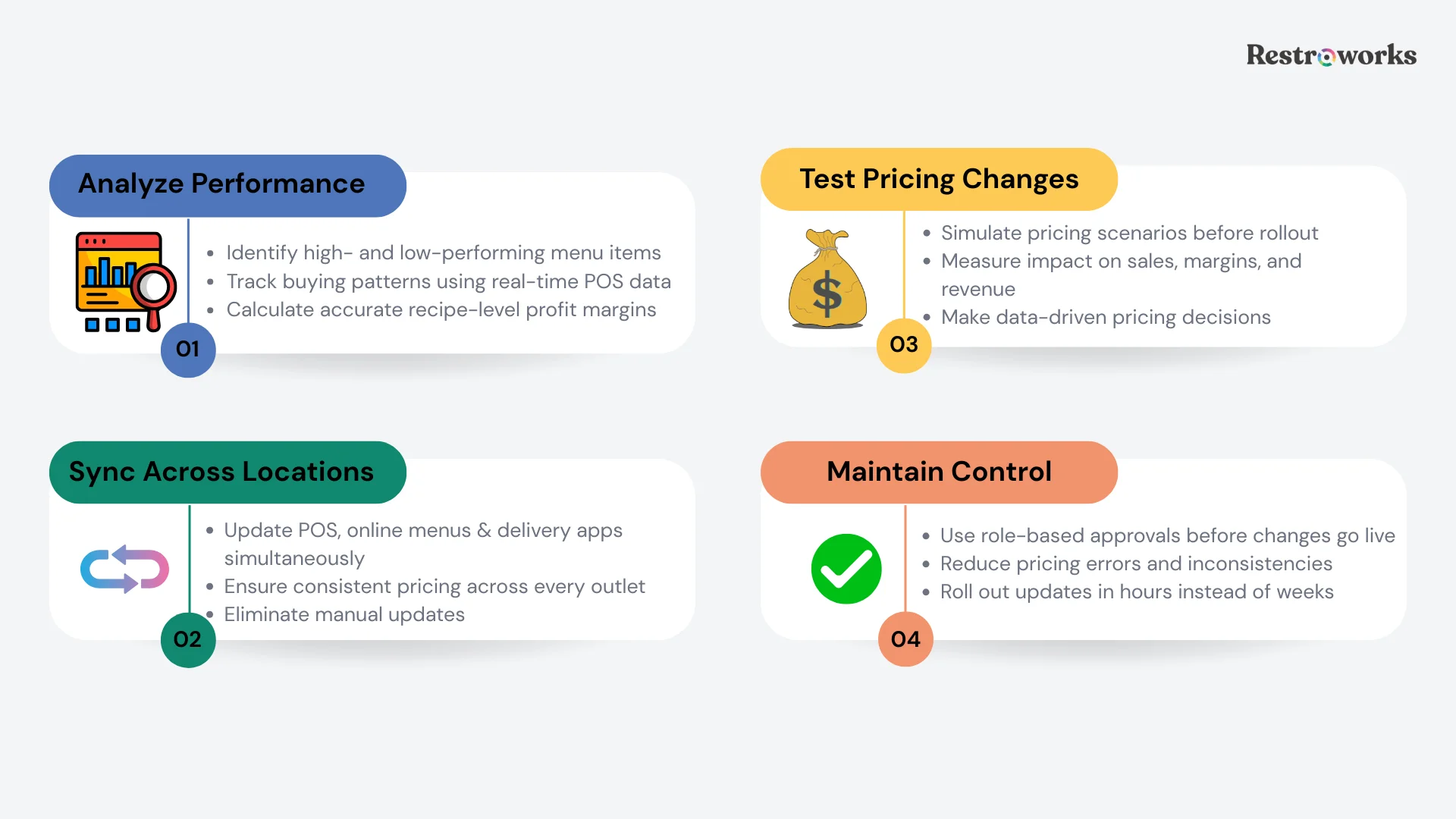
The most operationally complex part of the menu engineering process for multi-concept operators is not the analysis; it is the change management that follows. Without centralized software, adjusting pricing requires contacting each location individually and accepting that inconsistencies will persist through the transition window.
Price sensitivity analysis can use software to test scenarios impacting overall concept revenue. Seamless syncing with POS systems provides real-time sales data, which is essential for identifying buying patterns across different concepts and locations. Implementing software that links recipe-level costing directly to real-time ingredient prices ensures accurate contribution margins across concepts. Automated profitability analysis systems import sales data from POS to automatically calculate contribution margins and popularity, eliminating manual spreadsheet analysis.
With the right tools, a pricing update propagates across all POS systems, online menus, delivery apps, and printed menu order queues simultaneously, with role-based approvals ensuring finance signs off before anything goes live. Platforms like Trabon MenuNet and Deliverect enable this synchronization. The gap between identifying a Plowhorse and implementing a slight price increase across all locations drops from weeks to hours.
Item’s Cost: The Hidden Driver of Financial Performance
Ingredient prices change constantly, but recipes in manual systems are typically re-costed infrequently. An item correctly classified as a Star six months ago may have shifted to a Plowhorse as ingredient costs increased. Without real-time costing, the menu matrix does not reflect this, and the item continues receiving premium placement.
Automated menu engineering software pulls live ingredient prices from supplier invoices and continuously updates recipe costs, allowing accurate cost management. A $0.40 increase in the cost of a protein used in 12 dishes across five concepts is a material margin event that quarterly manual analysis will not catch in time to protect financial performance across multiple units.
Menu Design: Applying Analysis to the Guest Experience
Designing the menu is when menu engineering analysis becomes customer-oriented. Highlighting profitable dishes on the menu through the use of descriptive copy that adds value to high-margin items, and minimizing the presentation of low-profit margin items are examples of applications derived from the analysis process.
In the case of multi-concept restaurants, designing the menu should consider the unique identity of each brand and not follow a generic template prescribed by the corporation. Menu Engineering Pro will provide the technical support. The decisions for application will be made by those who know their brand inside out.
Implementing menu management in different restaurant concepts through the use of software is more an issue of infrastructure than technology. The data should be clean, recipe costs accurate, POS systems correctly mapped, and processes established. Then, and only then, will the software analyze continuously based on concepts in order to make good business decisions.
What gives the group a competitive edge is that while other operators are still analyzing their spreadsheets quarterly, a group that has the infrastructure in place wins time-wise when it comes to the process between finding out which items are underperformers and taking action.