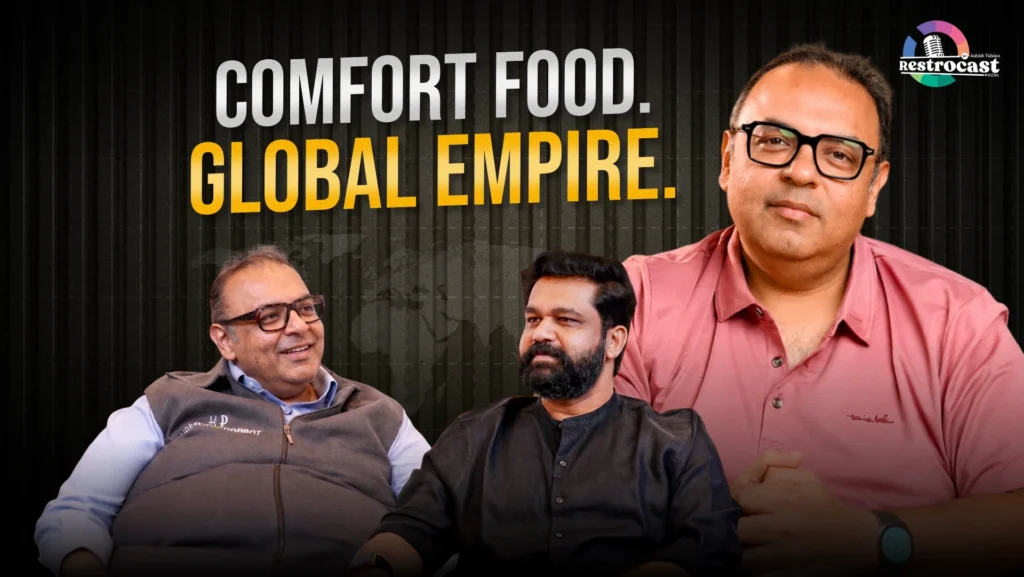

There is a stall near the Kailash Parbat office in Mumbai. The owner has been doing business there for 40 years. Owners of one of the oldest and internationally known restaurant brands in India eat from his stall regularly. And it is not the number of restaurants, not the 14 countries, not even the numbers that could have any restaurateur weeping in envy – all of that combined reveals just how Amit Mulchandani thinks about food. The story of Kailash Parbat starts in Karachi in 1940, when a 16-year-old was dreaming of cooking for people. It went through Partition, survived by moving to Colaba in 1952, and has not closed its first store ever since. Today it operates in the United States, Canada, Singapore, Hong Kong, Germany, and the Netherlands, and is soon going to open its first outlet in China. It is all company-run, with premixes made in Mumbai and shipped to the world, and done without any VC funding. This episode of the Restocast brings together Ashish Tulsian and Amit for a chat about what it takes to survive 74 years.
Kailash Parbat started in Karachi. How did it get to Colaba?
Amit Mulchandani: My grandfather began his career as a chef when he was not even 16 years old, in 1940, in Karachi, British India. We belong to the Sindhi community. The family migrated completely in 1947, and their humble beginnings were at Azad Maidan. My grandfather has always believed in the fact that if you feed your customers well, you have done the best thing possible. This belief drove him forward. Our first restaurant opened in 1952 in Colaba. That place still exists.
His father -my great-grandfather -was in the business of fruits. He wanted my grandfather to take up that profession. My grandfather refused. He wanted to become a chef and serve the customers by cooking for them. He did that, built the business, and brought all the family members together when they moved here. The family has been running it from the beginning of this venture.
The name has its origin in my grandfather’s devotion to Shiva. He was a very devout man. Kailash Parbat -the abode of Shiva- was the inspiration behind the name. The name was thought of at that very first Colaba restaurant and has stuck ever since then.
You were running a restaurant at age 11. What was that like?
Amit Mulchandani: I must have been only 11 at the time when I got to know that we were running a business. We had opened a restaurant in Mahalakshmi, and my uncle, along with my father, had gone to Japan on a catering assignment around 1992-93, thanks to the Sindhi community there. So, it was left to me to handle the restaurant. I had been there all alone for one and a half to two months. That was my first experience.
Thereafter, I used to follow my grandfather. He used to go back to our original store frequently until the end of his life to check on the quality of the food being made there. It’s a part of your genes now. You watch it happening and make it an instinct.
When I passed out of my 10th standard, my grandfather called me up and said that if I wanted to study, I should study, but I had to be in the business. I was forced into it. That became my passion. I joined the business full-time by the time I was 16.
74 years is extraordinary in an industry where most restaurants don’t survive three. What explains it?
Amit Mulchandani: Passion. You cannot treat a restaurant as a commodity trade. It is not like that. You have to be genuinely passionate about what you are doing. Most businesses that fail do so because the numbers are wrong, the location is wrong, the economics are wrong, or the understanding of the product is wrong. People think it is a glamorous business. It is not. A restaurant is like a baby. That is my definition. It never grows up. You have to be on your toes, 24 hours a day, always. The moment you take your eyes off it, something suffers.
The other thing is that our food is comfort food. Every Indian, regardless of age, has a relationship with chaat. The elderly have nostalgia. The young are discovering it. We do not have to convince anyone to eat what we make; we just have to make it well, consistently, every single day.
85 stores across 14 countries, no outside funding, mostly company-operated. How does that actually work?
Amit Mulchandani: This is definitely where we have done the most streamlining. We prepare premixes in India and send them out wherever we operate. This helps us maintain consistent product taste at 80 to 90 percent, regardless of where the store is located. Those ingredients that cannot be procured locally are supplied from here, while for the rest, we work with local partners – usually people from the Indian community who know the food and its culture. Our own team goes there to set up and manage the kitchen. Getting visas may be difficult, but it’s only one-time difficult.
We work on a joint venture and company-operated model. Yes, we do have some franchised outlets – only ten – but we don’t do that anymore. The franchises tend to change things. One of ours had switched off delivery commissions once, and we were making money we did not even realize. To ensure quality, consistency, and a consistent experience in every store, we need to maintain control.
You mentioned exiting the UK. What happened?
Amit Mulchandani: We came into the UK in 2013. Smaller shop in Wembley, around 50 covers. We had amazing numbers. Then we opened a bigger place right next to the first one – 150 covers. Also doing great. Then the British government, for some reason, canceled many sponsorship licenses in 2013-14, including ours. Unable to get visas for our staff for two years. Unable to bring in people from India. Tried opening up with local staff, but local laws in the UK are very hard to deal with. Local staff – once they have sorted out their passport – work on their terms. Salary comes first, and then the job. Had to leave. Same situation with Switzerland. Applied for visas for almost a year and couldn’t do it. Had to pull out. Germany has been alright. France is coming up soon.
Your unit economics are extraordinary. Walk us through them.
Amit Mulchandani: Our stores in India are typically 3,000 to 6,000 square feet and average between 50 lakhs and 80 lakhs per store per month. We have a store doing 1.2 crores a month on a rental of 2.5 lakhs. That is under 2%. Another is doing 91 lakhs on a rent of 1.75 lakhs. In Mumbai, we own six locations outright, so rent does not enter the equation there. Across the portfolio, we average around 5% on rent.
Food cost is 22-24%. Manpower is around 20% higher than average because we make everything from scratch at every store. There is no central kitchen. Everything is made in-house. Labor is higher, but rent compensates. We charge a royalty of around 6% on sales. Put everything together, and our higher-performing stores take home 30-35%. Industry standard calls 15 to 20% a good outcome.
Delivery accounts for about 15-18% of our business on average. Some stores go to 25%, but most of our customers prefer to come in. Our format is built for dine-in, and that is where the experience lives.
Why has no Indian food brand built a McDonald ‘s-scale chain?
Amit Mulchandani: McDonald’s and Chipotle were designed for what they are. The food was conceived for frozen supply chains, for standardization at scale, for the kind of eating culture that exists in the US. Indians want fresh. Garam chapati straight from the tawa. Bhatura hot from the kadai. The more you freeze or process Indian food, the more you lose what makes it Indian. People who have tried QSR Indian formats in the US—they exist—but as an Indian, you will not prefer going there. You know immediately it is not the same.
That said, I do believe there is a path. I have been looking at robotic kitchen technology, AI that can measure spice levels, monitor texture, and replicate the cooking process consistently. If that works for Indian food, then 10,000 stores become possible. We are close to testing something. The constraint has always been trained manpower. If technology can solve that, the dream becomes real.
What is your relationship with food outside of Kailash Parbat?
Amit Mulchandani: Authenticity in its essence. This is what I look for in everything around me. There is something in Haridwar that is called Bhagwati – one store. Then there is Prem Chole Bhature in Rajouri Garden, Delhi. I adore such small-scale places that are located at just one place. Vada Pav stall outside our office – the same person has been running it for 40 years now. Everyone eats from there. I am visiting Banaras specially for some stores there.
The last meal that impressed me so much was in Chikmagalur. We stayed at the coffee estate there, approximately 2,000 acres of it. They used whatever was grown there for the meals served to us. This is what I am looking for. I have become a vegan now, but I sample everything, every sauce, every dish, everything we cook. One cannot create the menu without trying it first. Goan vegetarian food is one of the most underrated cuisines in India. GSB – Gaur Saraswat Brahmin cuisine has some outstanding dishes that people outside the community do not know about.
You collect watches— micro-brands, character over value, story over status. Is that a coincidence?
Amit Mulchandani: Probably not. I have about 150 to 160 watches. I am not interested in the obvious brands. I like Shinola from Detroit, made from stone found on the Detroit shoreline. I have a Vario from Singapore, designed by an elderly man in a small garage. Two Japanese limited-run pieces. The value is always secondary. It has to have a story, a character, something unique inside. The same is true for food. The stall in Haridwar with one item done perfectly is more interesting to me than a large brand doing thirty items adequately. That philosophy runs through everything.
Conclusion
Amit Mulchandani did not opt for this business. He was roped in at 11, thrown in at 16, and went on to spend the next 30 years transforming a family business into a global empire, without diluting equity, without franchising on a large scale, and always sticking to the founding ideology of his grandfather’s, which he brought back from Karachi: If you take care of your people by feeding them well, it’s enough. Kailash Parbat is a 74-year-old enterprise operating in 14 countries, with sub-5% rental income across all its stores, preparing everything fresh at each outlet, and eating at the same 40-year-old vada pav stall outside the office premises. The next story is about automated kitchens and machine learning of spices. The one thereafter, with Amit having his way, will be about the Goan vegetarian food brand that nobody has yet demanded but everyone loves. Some brands have complete clarity about themselves. It turns out to be the only strategy they have needed so far.