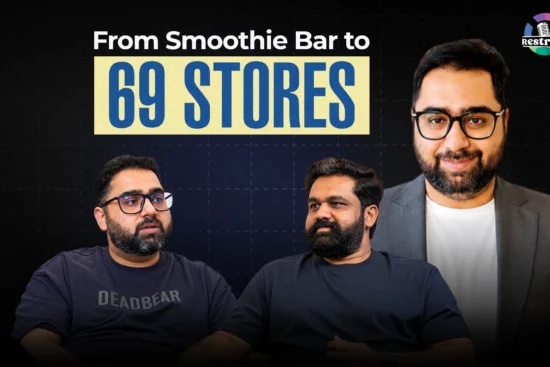
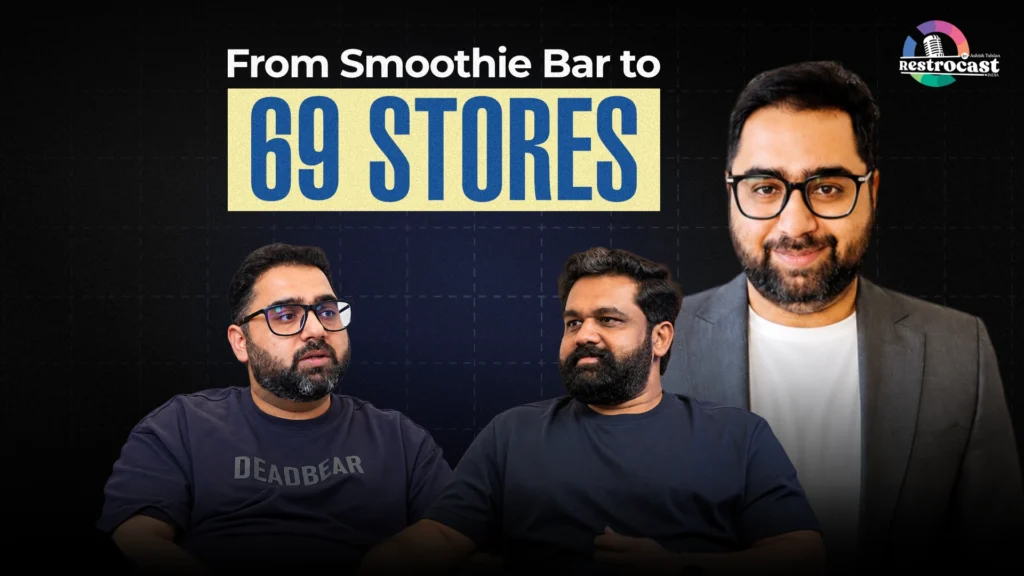

Burgers were not a part of Indian childhood. Only with the Golden Arches did this segment enter the country and remain alien for quite some time. Creating a domestic burger brand in this market- not a gourmet store, not a kitchen experiment, but an actual chain of restaurants that operates 69 locations in North India, Maharashtra, Andhra, and Telangana- takes a certain type of obstinacy. One that saw 11 franchise locations close within a week because of COVID and kept going. One that silently manages the spice mix and sends out nothing else. One that reads every negative customer feedback at all 69 locations right when waking up and does it for five years straight. In this episode of Restocast, Ashish Tulsian chats with Burgrill’s co-founder about the darker side of franchising, the economics of dependency on aggregators, and why India needs its own Chipotle moment.
You knew from eighth standard you wanted to be in F&B. Where did that come from?
Shreh Madan: She established her first bakery in Indore, which included a supermarket, bakery, and confectionery all in one beautiful establishment. The entire family joined her on that auspicious occasion. I was then in eighth standard, and all I could think about was how amazing this venture was, and that is what I wanted to do too. And I did stick to my word. Even by the time I reached college, my aim wasn’t limited to opening restaurants; it extended to franchising them. How did McDonald’s manage to do what it did? That was my ambition.
Coming out of hotel management, I did a course at Oxford Brookes and spent two years here, two years there. I got back into a recession in 2009. Could not get a job, so I saw an ad for a smoothie place called Aloha opening at Select City Walk. I joined, helped take it from one shop to four, and helped franchise the idea. That’s when my mother called and told me: “Why do you want to do all this for others? Come to Indore; we have our foothold here.” I left in about one and a half years, moved to Indore, opened my own café, learned my lessons there, opened more stores, and franchised them. Then I joined my father’s business for some time: solar panels, nutraceuticals, pharmaceuticals, bulletproof cars, and jackets. Wide variety. But every time I was in Chandigarh, I looked around for restaurants and thought, “Why am I not doing this?” Called my father, told him, “I will join back in F&B.” He agreed. This is how Burgrill started, in August 2016.
You went from zero to 34 stores in four years, then COVID hit. What happened?
Shreh Madan: By the end of the first week during which COVID occurred, 11 stores were closed. That’s when I realized I didn’t have any control over my business. It involved thirty-four stores, thirty-two of which were franchised, while only two were company-owned. When franchisees closed their stores, I couldn’t stop them.
Our direction was COCO, company-owned and operated. Right now, we have 69 stores: 19 are COCO, and 50 are franchised. We are actively seeking funds to buy up franchises and convert them to COCO.
You still franchise. What are the real problems with it that people don’t talk about?
Shreh Madan: One is that when there is something wrong with the outlet, franchisees do not behave in the manner that is expected of them. One franchisee of mine opened four outlets without my permission. He was a wealthy man. One of his partners decided to back out midway. He didn’t have any cash to splurge on these outlets for six months, and all four outlets failed. Ask anyone in Jaipur about Burgrill, and he will tell you this is the reputation that you have built.
Another aspect that is never discussed is the political pressure applied. I got a call at 9:30 in the evening from a guy with some political connections, saying he would come down and meet me in thirty minutes, or he would send notices to all your outlets for non-compliance. Your intention was nothing but good. The franchisee had some problems in his business.
Thirdly, there is the issue of people changing, using your brand knowledge, your kitchen layout, your suppliers, and opening up under a new brand name. This has been done to us three times. They have always failed because there is something they cannot copy: our unique seasoning. We outsource all ingredients for our outlet except the seasoning, which we make ourselves and never let leave our possession. That is our moat.
How do you actually enforce quality across 69 stores when you can’t be everywhere?
Shreh Madan: Each morning, I go through the reviews from all 69 stores. This has been happening for the past five years. All of them come under one dashboard, which is bifurcated into two depending on the type: quality problems, missing products, and service problems. In particular, we check the quality problems and ensure they are sorted out by the evening.
The bigger thing is that we have access to CCTV cameras in each of the franchises: three cameras for each store, cold assembly, packaging, and grilling. When a complaint comes in, we pull the order ID and timestamp, then watch the video before contacting the store manager.
One trainer visits five stores once a week. Our testing process happens once a month and is done on Vauer, which includes videos and seven or eight questions on products and services. We give employees ₹1,000 for each test completed. The trainer’s bonus is calculated based on the performance of the stores he is assigned to on the test.
There are some financial incentives. If the fine is imposed and not paid, we do not supply any material. The store closes. It is a last resort, but it is available. Our strategy is never to profit from the fine; if the store passes the next audit, we return the fine.
What is Burgrill as a brand? What’s the positioning?
Shreh Madan: Your friendly local burger shop. For your daily fix. Somewhere where there is no need to get dressed up before coming in, and there is no need to think twice about whether to go.
The differentiator that we have created, and I am not ashamed to say this, is the fact that we are a healthier choice when it comes to fast food. Grilled burgers have been the core of our menu since we started. We have the largest selection of healthy bowls in this category: rice bowls and salads. Our burger buns are always brown by default, and white is just an option. Our spinach wraps, multigrain bread, and three of our seven drinks have fewer than four calories. We like to call it guilt-free indulgence.
We tried shifting from brown buns once. We changed it to white buns. Reviews started asking where the brown bun was. They told us they had come especially for it. The shift happened within weeks. It proved our positioning was real, not just a marketing line.
We also adopted trends quickly. We were among the pioneers in bringing out the vegan burger in India. We launched the Butter Chicken burger. We launched a chili oil burger in 2021, when very few people were thinking about chili oil. We started early with smashed burgers. Korean burgers too; we were ahead of the curve there.
What do the unit economics actually look like?
Shreh Madan: COGS–everything except for input tax credits–is 40%. Rent costs us 8-10%. Direct and indirect costs, including salaries, account for approximately 15%. Aggregator fees take 25% of business turnover.
For aggregators specifically, let’s say we made one lakh in business; then we get 50,000 as a settlement. This means a 25% commission fee and an additional 8.5 to 10% for advertising on the platform. In other words, 33 to 35% of the aggregator’s revenue comes back to them even before we consider anything else. We couldn’t achieve the current volumes without them. This is the honest answer. However, volumes cost margins.
That’s precisely why we struggle to maintain 40% of our business in dine-in and take-out. You save a buck in commission when someone comes in to place an order. Delivery-only will always keep your margins structurally squeezed. Together, that brings us to about 20% per unit. And in tier two cities, this is what happens: in Amritsar, for instance, we employ four or five guys who place orders to cars waiting outside. No need for a delivery app, no commission. This unit earns ₹30,000 per day just through car services. They come along with their girlfriends without entering the restaurant.
What’s your repeat rate and who is your core customer?
Shreh Madan: Our current repeat rate is 45%. It used to be 85% in 2017-18, which sounds quite impressive, but unfortunately it wasn’t; we didn’t acquire enough new customers then. It fell as competition grew. Though 45% isn’t a low repeat rate, we are still working on it.
Our target TG comprises individuals aged 21 to 25, university students, and fresh employees. The average order value is about ₹400. That is an affordable amount, so customers can visit us without second thoughts. We have seen people from Pashchim Vihar who work out visiting our restaurant every day for the protein bowl, a large salad for ₹400 that makes you feel full. Customers have made advance deposits to pay for our services because of their regular visits.
What excites you most about the business after 10 years?
Shreh Madan: Product development. Always. We came up with a menu two and a half months ago. I would say we’re 80-85% done with what I wanted. I will get the other 15% – again, not on marketing but on execution: every store gets the materials in time, all training is completed, all products are launched at once. We’re not quite there.
What gave me the most confidence this cycle was the hot truffle sauce that I made. We piloted it in four different locations, and that was our best-selling item. And there’s nothing better than piloting something, seeing it work, and knowing it will now go out to 69 locations.
Ankur, my brother, handles growth and business development. We have three partners, so the third handles finance and supply chain. So I take care of product, operations, and marketing. And although operations and creativity don’t quite go hand in hand, for me, marketing means being the reality check when the creative team goes off the rails.
What do you tell someone in their mid-twenties who wants to start a restaurant brand today?
Shreh Madan: Learn from the international chains that have been around the longest before even thinking about constructing anything. Learn from McDonald’s. Learn from Chipotle. Not because you should be imitating them, but learn what kind of structural choices they made to grow that big.
And here’s the real truth about what India needs now: somebody needs to build an Indian Chipotle. Build-your-own concept with Indian ingredients: idli, buckwheat, different types of rice, Indian protein, Chettinad gravies, kachumbar, papad. Seven elements, all Indian, all customizable, all yours. And whoever nails that concept will go ballistic in this country. Customization is here in India. People would feel awkward answering questions asked by Subway. Now people argue with their colleagues on which Chipotle meal is better. Bring customization to Indian food and boom! You have something.
Do something that, if successful, you’d be remembered for. This should be your only criterion.
Conclusion
A decade down the line, Burgrill has come a long way from what its founder expected to see in eighth standard; it’s far from being an ideal brand. It has 69 stores and the only seasoning recipe in the business. It overcame a week when 11 of its stores shut down in a single day, but emerged with a better appreciation of what control really means. Its founder wakes up at 7 AM to read customer reviews, watches CCTV footage before reaching out to his store managers, and takes three hours to make a sandwich for himself on Sundays because that’s his idea of relaxation. The upcoming decade won’t be as much about how many stores Burgrill opens, but who runs them. And the answer, more often than not, will be: us.