


“We aren’t in the food business. We’re in the people business,” said Joe Rogers Sr., Co-Founder of Waffle House, and can we argue against that?
It was back in 1955, in Avondale Estates, GA, that two Georgia neighbors, Joe Rogers Sr. and Tom Forkner, decided to open a 24-hour, sit-down restaurant with a very unique proposition. They wanted to focus on people on both sides of the counter. That was the first door to the Waffle House, which, btw, today operates over 1,900 locations across 25 states, mostly in the Southern United States.
Since then, every single Waffle House outlet has been running 24 hours a day, seven days a week – even during hurricanes. You won’t believe it, but FEMA literally uses the Waffle House Index to measure how bad a natural disaster is, i.e., if by chance your local Waffle House is closed, you know things are genuinely bad or out of control.
As for the money side of things, Waffle House locations pull an average unit volume (AUV) of approximately $655,000 annually, with estimated average operating profits of around $100,000 per location.
The brand expands purely through corporate investment. It’s privately held and company-owned, which leads us to some of the big questions everyone keeps googling…
What You’ll Learn
- If you could, and if the Waffle House allowed, how much would it cost you to own its franchise?
- Are you even eligible to be a Waffle House franchise owner in the first place?
- How quickly (if possible) can you recover your overall Waffle House franchise cost and investments?
How Much Does a Waffle House Franchise Cost?
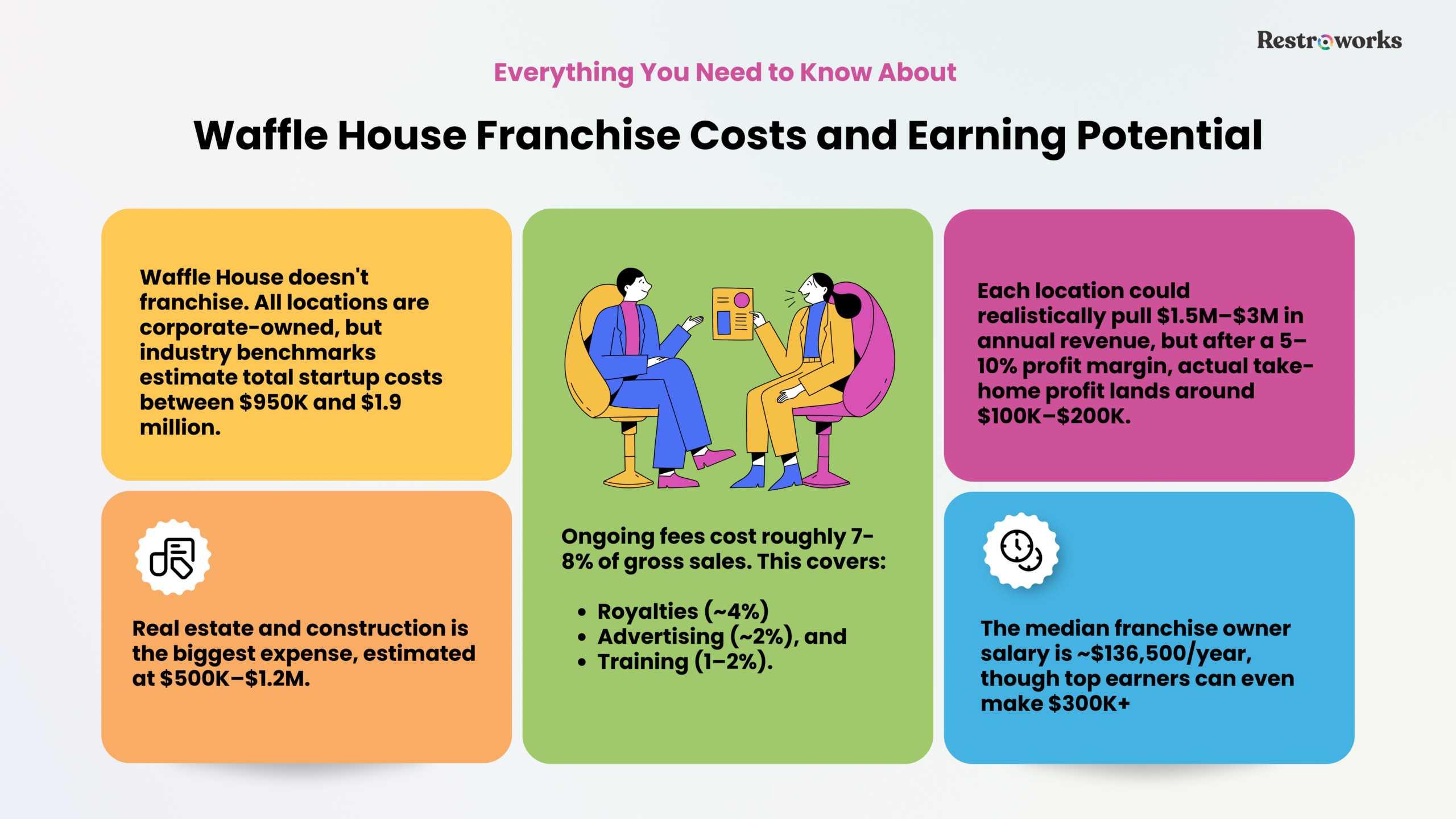
The thing is, Waffle House does not currently offer franchise opportunities to the general public. All locations are corporate-owned. Since Waffle House doesn’t franchise, there are technically no franchise fees associated with opening a Waffle House location.
BUT — and this is a big but — there’s historical data, industry benchmarks, and some very specific numbers that give us a realistic picture of what it would cost if they did, and it’s somewhat like this:
As per industry benchmarks, to open a Waffle House-style franchise, you’d need somewhere between $950,000 and $1.9 million in total startup costs.
Other than these fixed costs, you might need to cover some ongoing fees too:
- Royalty fee: ~4% of gross sales
- Advertising fee: ~2% of gross sales
- Training & support: ~1–2% of gross sales
For context, Forbes journalist Grace Chung noted that restaurant franchise owners “must shell out an initial $400,000 to $900,000 for a fully fitted store in order to cover lease agreements, construction, furniture, inventory, training, and royalty fees.” And that’s for smaller concepts. Waffle House would be on the much higher end for sure.
How Much Can Waffle House Franchise Owners Make?
Based on data from Comparably and industry analysis, Waffle House franchise owners can expect to earn a median salary of around $136,517/year.
The top 10% of earners can even make more than $300,000 per year, while the bottom 10% generate something under $50,000/year.
Individual Waffle House restaurants could realistically generate $1.5 to $3 million in annual gross sales, with profit margins typically between 5–10% of gross sales. That means on $2 million in revenue, you get $100,000–$200,000 in actual profit.
Are You Even Eligible to Open a Waffle House Franchise?
Even if Waffle House opened up franchising tomorrow, the question is, would you even be eligible?
On paper, here’s what you’d ideally need:
- Net worth of $1,000,000 – $2,000,000 minimum
- $250,000 – $500,000 of liquid capital
- Previous management experience in the restaurant industry (no newbies, sorry)
- Willingness to commit to Waffle House’s culture, systems, and day-to-day operations
- A location approved by Waffle House corporate
On a very similar scale, applicants for any alternative diner franchise would also need a net worth of at least $1,000,000 to $2,000,000 and liquid assets between $200,000 and $600,000.
So, Should You or Should You Not Open a Waffle House Franchise?
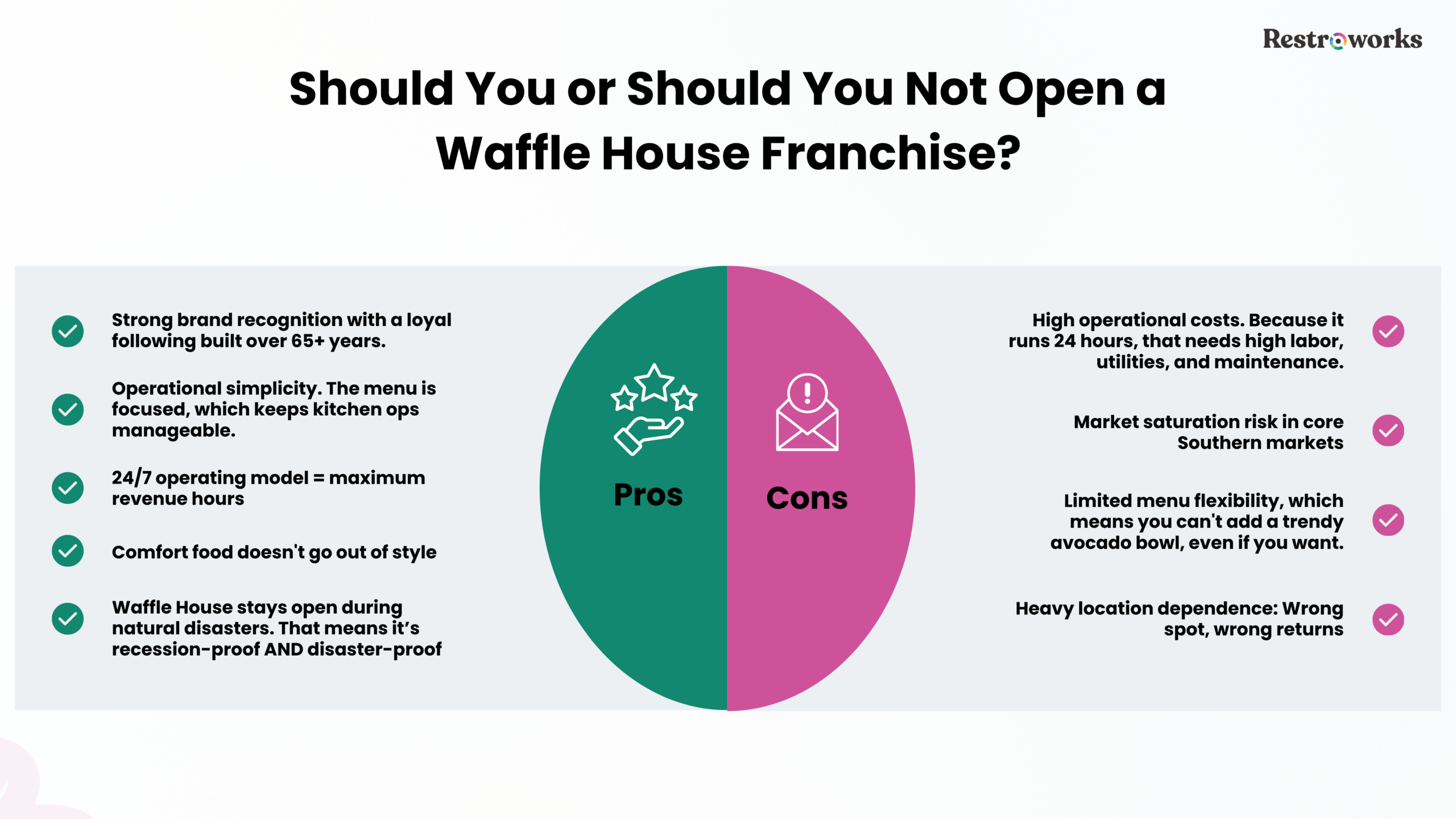
Because I love everything about how Waffle House operates, does, or serves, I would list 20 reasons you should open another of its franchises, but that wouldn’t be very fair to you as the operator. You should know both sides of the coin before you finally plan to take a dip.
For example, while a Waffle House franchise owner would likely benefit from strong brand recognition and operational simplicity, they would also have to navigate high operational costs, intense competition, and the growing market saturation risk.
So, here are some pros and cons of opening a Waffle House franchise:
How Can You Open a Waffle House Franchise?
Technically? You probably can’t, at least not as a newcomer. According to Waffle House’s own website, the brand does not offer franchise opportunities to the general public. Even surplus real estate from Waffle House cannot be reopened as a Waffle House restaurant by a third party.
The only real path is to get hired, for real, and work your way up. Waffle House promotes leaders from within, and long-term associates can sometimes gain partial ownership through company stock. It’s the ultimate “earn your seat at the table” model.
So, if you’re determined to own restaurant operations under the Waffle House brand, that’s essentially the only door open right now.
INDUSTRY INSIGHT
Would You Need External Funding?
Almost certainly yes, you would need external funding to open any restaurant franchise, for that matter, because the total investment range of $600,000–$1.9 million isn’t something most people have sitting around in their bank accounts. (You probably don’t have that, too!) So, your only options are:
- Get a personal loan from your friends and family (maybe multiple people at once) and somehow get by with it.
- Consider SBA 7(a) loans. If you are a qualified borrower, you can get up to $5 million through a bank partnership.
- Since equipment costs alone range from $250,000 to $400,000, you’d need to consider equipment financing as well.
- Reach out to private investors or partners if you find them and eventually convince them.
- There is something called ROBS, or Rollover for Business Startups. That means you can use your retirement funds without early withdrawal penalties.
Whatever funding you seek, always factor in unforeseen costs beforehand. Why? Because you never know when you might have to deal with sudden equipment breakdowns, slow months, or staffing issues. You’d always want a financial cushion beyond your minimum liquid capital requirements to survive these.
How Can You Increase Your Earning Potential from a Restaurant Franchise?
If you ever do get in (like if any opportunity comes your way by luck), or even if you’re planning to go with an alternative concept, here are a few tips to actually gain ground in the market:
- Laser your focus on location: Waffle House restaurants that are near highways, hospitals, colleges, and dense residential areas are making the most money.
- Manage your financial health aggressively: If you can do it yourself, well and good; if you can’t, hire someone to analyze your weekly/monthly food costs, labor costs, profits, etc., seriously. Ask them to forecast sales for the upcoming days as well.
- Nail customer service: This one is the most important. Waffle House website says that the brand was “founded on the principle of providing the friendliest service in town.” They focus on providing “their customers with unique experiences that keep them coming back for more.” Waffle House’s brand reputation is built on being warm, fast, and consistent, so naturally, you’d have to level up your game too.
- Market locally: Use social media, list your outlet on Google Business, market yourself through local events, etc. Just because the brand is known doesn’t mean your specific location is. You’ll need to put in the effort to bring in customers.
Now you may ask: if you’re buying a Waffle House franchise, which is already super famous and has a big, big loyal customer base, why would you need to invest in marketing? Fair, but just because the brand is known doesn’t automatically mean your specific outlet is too. You’ll need to put in at least some effort to bring in customers. The brand’s reputation would likely make them come again, but for that, they should at least know that a new outlet has opened nearby. That’s literally your job.
Look at what Hattan Bakor said during his conversation with Ashish Tulsian in one of the Restrocast episodes:

How Long Would It Take You to Recover Your Investment?
For Waffle House-style restaurant franchises, the break-even point is typically within 2–3 years, depending on the exact location of your outlet and its operational efficiency.
With $655,000 in average annual revenue and ~$100,000 in operating profit, a $700,000 investment could theoretically be recouped in 7 years.
Obviously, ongoing royalty fees and advertising fees are going to eat into that timeline, so model your numbers conservatively.
What’s the Status of Existing Waffle House Franchisees Today?
There is a very small number of Waffle House franchisees who exist from older agreements.
Waffle House restaurants operate almost entirely through company-owned stores as of 2025. The corporate ownership model gives the brand direct control over food quality, guest experience, and brand standards across all its 1,900+ locations.
In short, they have collectively agreed on the fact that consistency matters more than expansion speed, and honestly? It’s working.
|
“In hospitality, growth is visible. Discipline is not. But over time, disciplined growth creates far stronger and more enduring businesses than expansion driven purely by momentum.”
|
What Alternative Franchise Opportunities Can You Go For, If Not Waffle House?
If you want a diner-style breakfast franchise, I would recommend you check out these two options: